
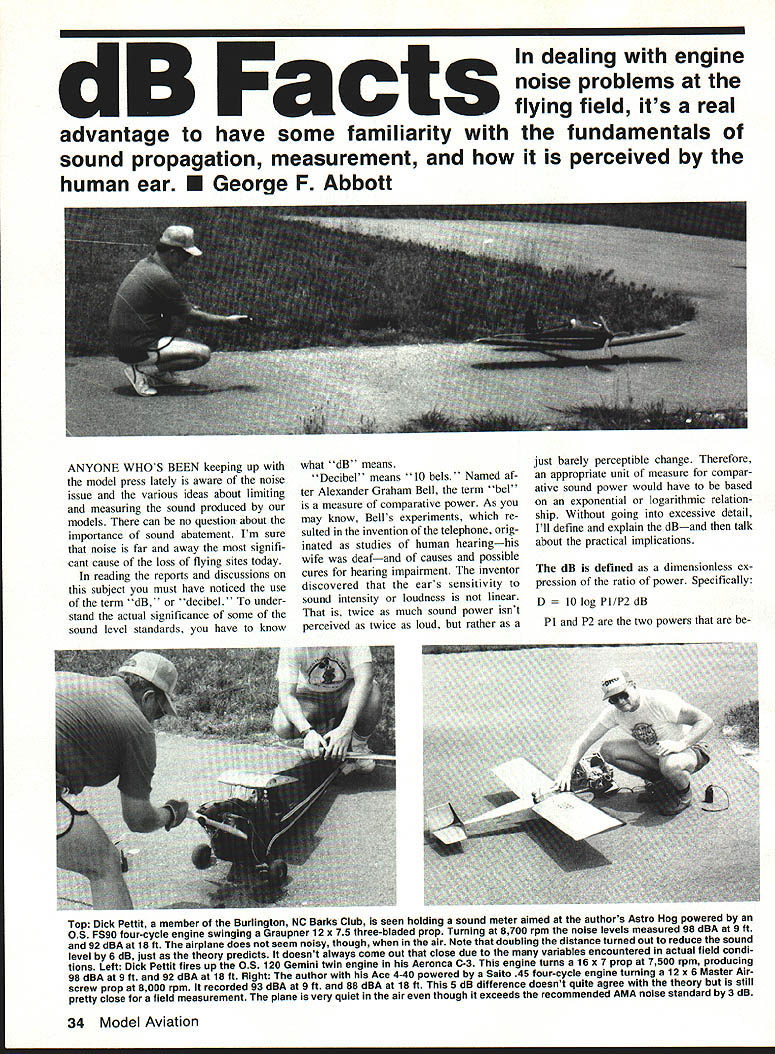
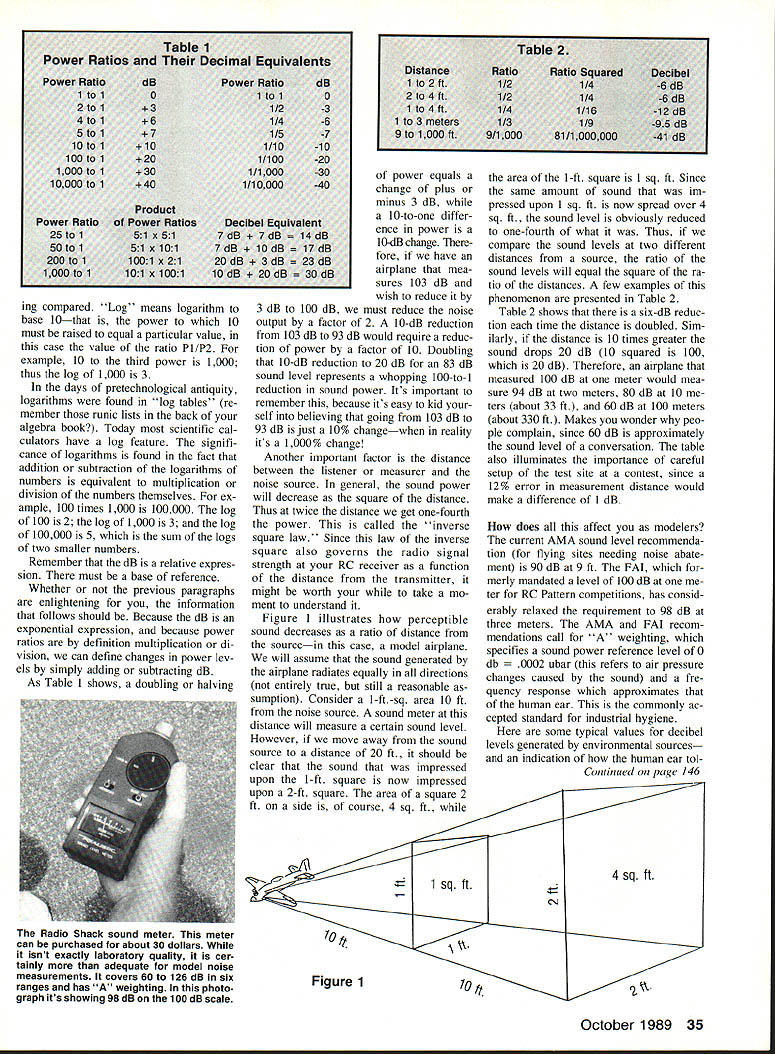
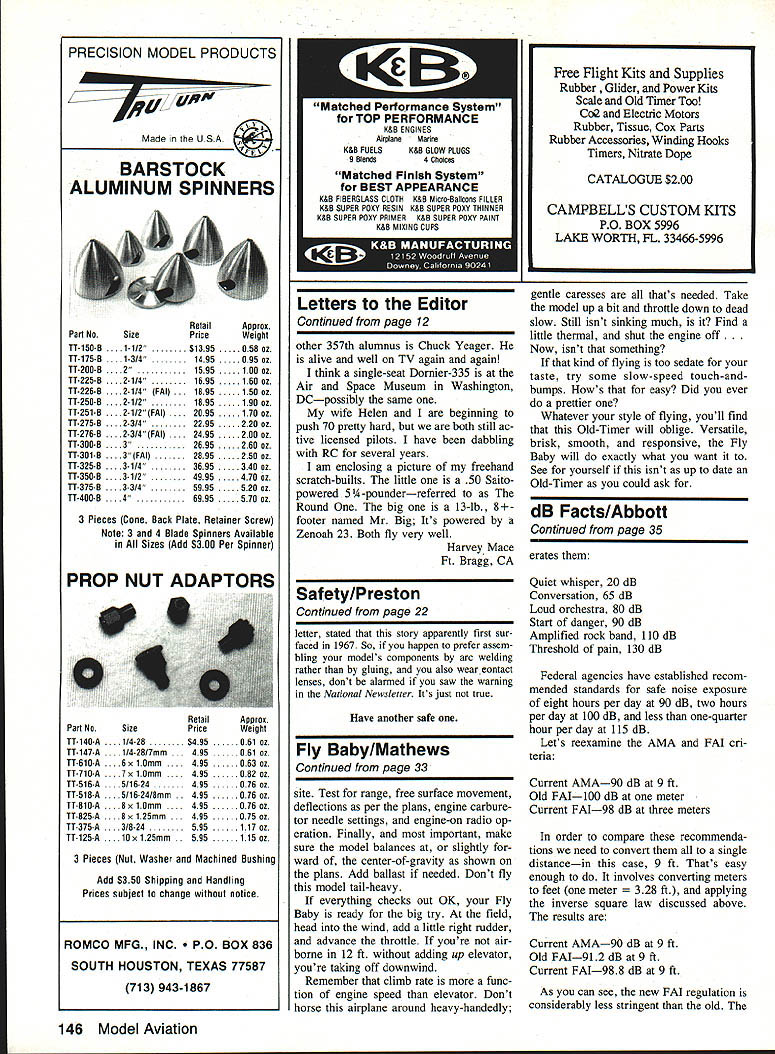
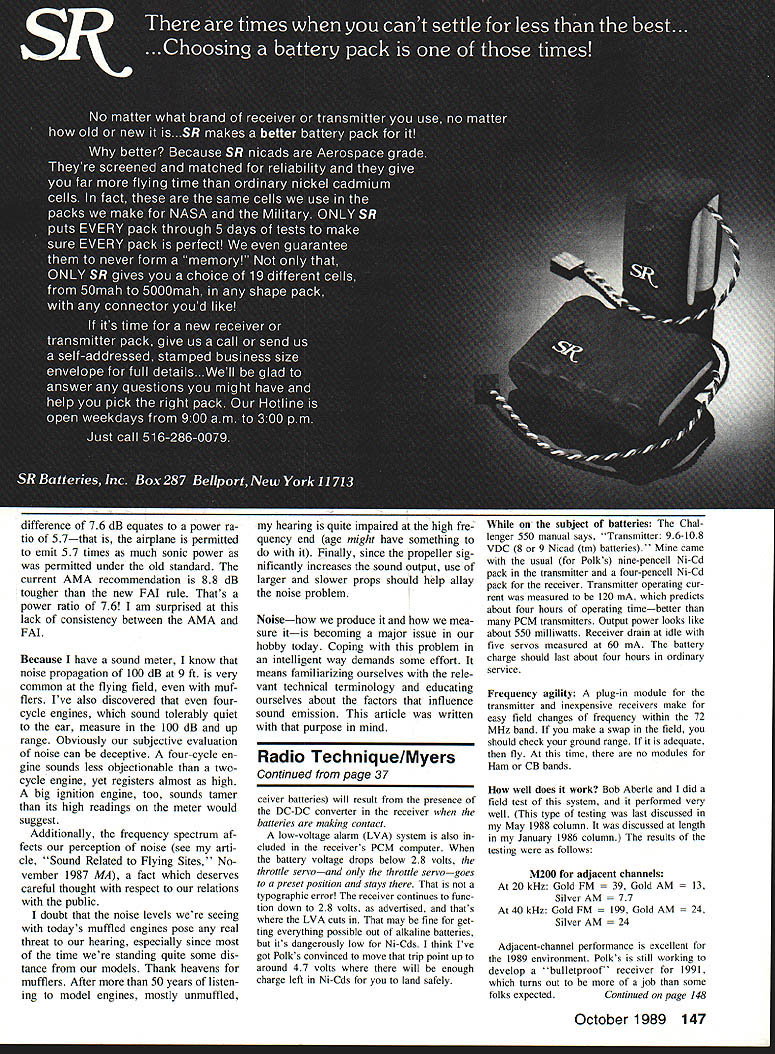
dB Facts
By George F. Abbott
In dealing with engine-noise problems at the flying field, it's a real advantage to have some familiarity with the fundamentals of sound propagation, measurement, and how it is perceived by the human ear.
Anyone who's been keeping up with the model press lately is aware of the noise issue and the various ideas about limiting and measuring the sound produced by our models. There can be no question about the importance of sound abatement. I'm sure that noise is far and away the most significant cause of the loss of flying sites today.
In reading the reports and discussions on this subject you must have noticed the use of the term "dB," or "decibel." To understand the actual significance of some of the sound level standards, you have to know what "dB" means.
"Decibel" means "10 bels." Named after Alexander Graham Bell, the term "bel" is a measure of comparative power. As you may know, Bell's experiments, which resulted in the invention of the telephone, originated as studies of human hearing—his wife was deaf—and of causes and possible cures for hearing impairment. The inventor discovered that the ear's sensitivity to sound intensity or loudness is not linear. That is, twice as much sound power isn't perceived as twice as loud, but rather as a just-barely perceptible change. Therefore, an appropriate unit of measure for comparative sound power would have to be based on an exponential or logarithmic relationship. Without going into excessive detail, I'll define and explain the dB—and then talk about the practical implications.
The dB is defined as a dimensionless expression of the ratio of power. Specifically:
D = 10 log10(P1 / P2) dB
P1 and P2 are the two powers that are being compared. "Log" means "logarithm" (base 10)—that power 10 must be raised to equal a particular value. In the case of the value of the ratio P1/P2, for example, 10 to the third power = 1000; thus log 1000 = 3. In days before calculators, logarithms were found in log tables—remember those runic lists back in the algebra book? Today scientific calculators have a log feature. The significance of logarithms is found in the fact that the addition or subtraction of logarithms of numbers is equivalent to the multiplication or division of the numbers themselves. For example, 100 times 1000 = 100,000; log 100 = 2; log 1000 = 3; log 100,000 = 5; the sum of the logs of the two smaller numbers gives the log of the product.
Remember, dB is a relative expression and must be based on a reference. Because dB is an exponential expression—because power ratios in its definition are multiplicative—changes in power levels can be defined simply by adding or subtracting dB. For example:
- Doubling the power equals a change of +3 dB.
- Halving the power equals −3 dB.
- A ten-to-one difference in power is a 10-dB change.
Example: if an airplane measures 103 dB and you wish to reduce the noise output by a factor of 2, a 3-dB reduction would give 100 dB. To reduce by a factor of 10 requires a 10-dB reduction; thus 103 dB reduced by 10 dB is 93 dB. A 20-dB reduction represents a 100-to-1 reduction in sound power; 83 dB would be the result. It's important to remember this because it's easy to kid yourself into believing that going from 103 dB to 93 dB is just a 10% change—when, in reality, it's a 1000% change.
Another important factor is the distance between the listener (or measurer) and the noise source. In general, sound power will decrease as the square of the distance. Thus twice the distance gives one-fourth the power—this is called the inverse square law. Since this inverse square law also governs radio-signal strength, RC receiver function will be affected by distance from the transmitter.
Consider a model airplane that radiates sound equally in all directions (not entirely true, but a reasonable assumption). A sound meter 10 ft. from the noise source will measure a certain sound level on a unit area; if we move away to 20 ft., the same sound is spread over four times the area, so the sound level is reduced to one-fourth. Thus, if we compare the sound levels at two distances from a source, the ratio of the sound levels will equal the square of the ratio of the distances.
- Each time distance is doubled, there is a 6-dB reduction.
- If the distance is 10 times greater, the sound drops 20 dB (because 10 squared = 100, which is 20 dB).
Examples: an airplane that measured 100 dB at one meter would measure approximately:
- 94 dB at two meters
- 80 dB at 10 meters (about 33 ft.)
- 60 dB at 100 meters (about 330 ft.)
This illustrates why people farther away perceive much less noise, and also the importance of careful setup of the test site at a contest—since a 12% error in measurement distance would make a difference of about 1 dB.
How does all this affect you as modelers? The current AMA sound level recommendation (for flying sites needing noise abatement) is 90 dB at 9 ft. The FAA, which formerly mandated a level of 100 dB at one meter for RC Pattern competitions, has considerably relaxed the requirement to 98 dB at three meters. The AMA and FAA recommendations call for "A" weighting, which specifies a sound pressure reference level of 0 dB = .00002 bar (this refers to air-pressure changes caused by the sound) and a frequency response which approximates that of the human ear. This is the commonly accepted standard for industrial hygiene.
Typical values for decibel levels generated by environmental sources, and how the human ear tolerates them:
- Quiet whisper: 20 dB
- Conversation: 65 dB
- Loud orchestra: 80 dB
- Start of danger: 90 dB
- Amplified rock band: 110 dB
- Threshold of pain: 130 dB
Federal agencies have established recommended standards for safe noise exposure:
- Eight hours per day at 90 dB
- Two hours per day at 100 dB
- Less than one-quarter hour per day at 115 dB
Let's reexamine the AMA and FAI criteria:
- Current AMA — 90 dB at 9 ft.
- Old FAI — 100 dB at one meter
- Current FAI — 98 dB at three meters
To compare these recommendations we can convert them all to a single distance (9 ft.). Converting meters to feet (1 meter = 3.28 ft.) and applying the inverse square law gives:
- Current AMA — 90 dB at 9 ft.
- Old FAI — 91 dB at 9 ft.
- Current FAI — 98.8 dB at 9 ft.
As you can see, the new FAI regulation is considerably less stringent than the old. The difference of 7.6 dB equates to a power ratio of 5.7—that is, the airplane is permitted to emit 5.7 times as much sonic power as was permitted under the old standard. The current AMA recommendation is 8.8 dB tougher than the new FAI rule. That's a power ratio of 7.6. I am surprised at this lack of consistency between the AMA and FAI.
Because I have a sound meter, I know that noise propagation of 100 dB at 9 ft. is very common at the flying field, even with mufflers. I've also discovered that even four-cycle engines, which sound tolerably quiet to the ear, measure in the 100 dB and up range. Obviously our subjective evaluation of noise can be deceptive. A four-cycle engine sounds less objectionable than a two-cycle engine, yet registers almost as high. A big ignition engine, too, sounds better than its high readings on the meter would suggest.
Additionally, the frequency spectrum affects our perception of noise (see my article "Sound Related to Flying Sites," November 1987 MA), a fact which deserves careful thought with respect to our relations with the public.
I doubt that the noise levels we're seeing with today's muffled engines pose any real threat to our hearing, especially since most of the time we're standing quite some distance from our models. Thank heavens for mufflers. After more than 50 years of listening to model engines, mostly unamuffled, my hearing is quite impaired at the high-frequency end (age might have something to do with it). Finally, since the propeller significantly increases the sound output, use of larger and slower props should help allay the noise problem.
Noise—how we produce it and how we measure it—is becoming a major issue in our hobby today. Coping with this problem in an intelligent way demands some effort. It means familiarizing ourselves with the relevant technical terminology and educating ourselves about the factors that influence sound emission. This article was written with that purpose in mind.
Transcribed from original scans by AI. Minor OCR errors may remain.

