
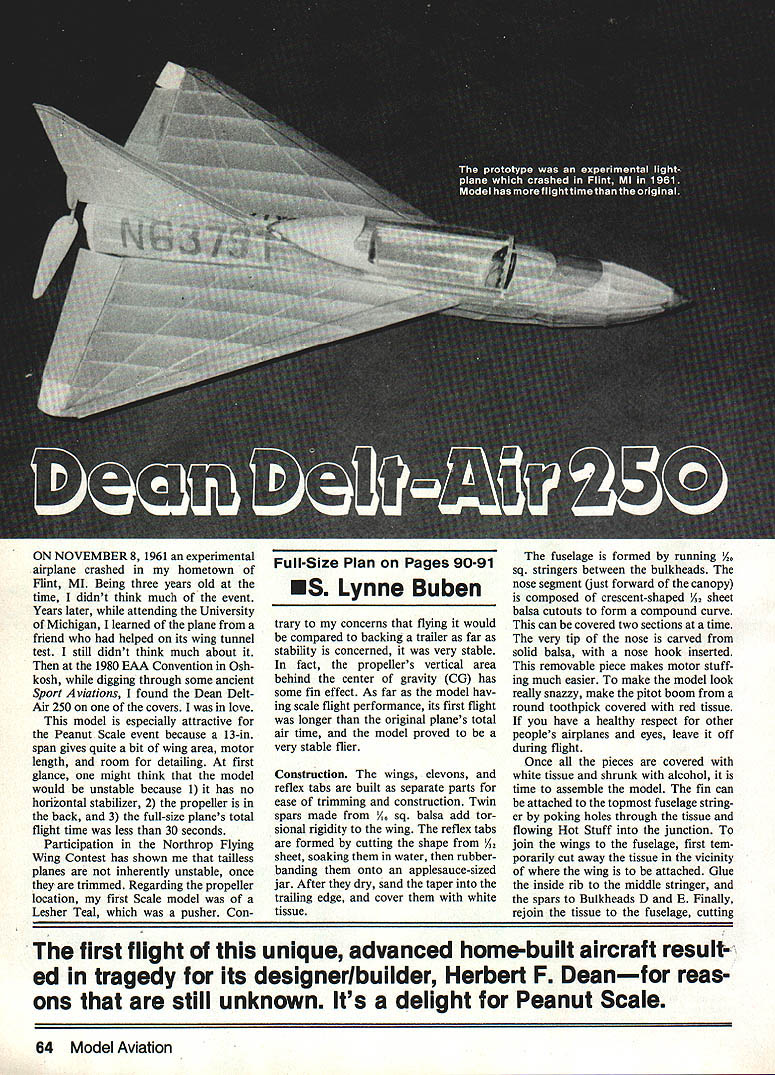
Dean Delt-Air 250
Full-Size Plan on Pages 90-91
S. Lynne Buben
Introduction
On November 8, 1961 an experimental airplane crashed in my hometown of Flint, MI. Being three years old at the time, I didn't think much of the event. Years later, while attending the University of Michigan, I learned of the plane from a friend who had helped on its wind-tunnel test. Still, I didn't think much about it until, at the 1980 EAA Convention in Oshkosh, I found the Dean Delt-Air 250 on the cover of an old Sport Aviation issue — and I was in love.
This model is especially attractive for the Peanut Scale event because a 13‑in. span gives quite a bit of wing area, motor length, and room for detailing. At first glance one might think the model would be unstable because it has no horizontal stabilizer, the propeller is a pusher, and the full‑size plane's total flight time was less than 30 seconds. Experience with tailless designs and flying‑wing contests shows that tailless planes are not inherently unstable once trimmed. In practice the model proved very stable — the propeller's vertical area aft of the CG provides some fin effect — and its flight times exceeded those of the original aircraft.
Construction
Overview
- Wings, elevons, and reflex tabs are built as separate parts for ease of trimming and construction.
- Twin spars from 1/16‑in. sq. balsa add torsional rigidity to the wing.
- The fuselage is formed with stringers between bulkheads and a carved solid‑balsa nose tip with a removable nose hook for easy motor stuffing.
Wings, elevons, and reflex tabs
- Build wings, elevons, and reflex tabs as separate pieces to simplify trimming.
- Make twin spars from 1/16‑in. square balsa for torsional stiffness.
- Reflex tabs: cut the shape from 1/32‑in. sheet, soak in water, rubber‑band onto an applesauce‑sized jar to form curve. After drying, sand the taper into the trailing edge and cover with white tissue.
Fuselage and nose
- Form the fuselage by running 1/8‑in. square stringers between bulkheads.
- The nose segment just forward of the canopy is formed from crescent‑shaped 1/32‑in. sheet balsa cutouts to create a compound curve; cover two sections at a time.
- Carve the very tip of the nose from solid balsa. Insert a removable nose hook — this makes motor stuffing much easier.
- Make a pitot boom from a round toothpick covered with red tissue for scale appearance; remove it during flight if you respect other people’s eyes.
Covering and assembly
- Cover all parts with white tissue and shrink with alcohol before assembly.
- Attach the fin to the topmost fuselage stringer by poking holes through the tissue and flowing Hot Stuff (cyanoacrylate) into the junction.
- To join the wings to the fuselage:
- Temporarily cut away the tissue where the wing will attach.
- Glue the inside rib to the middle stringer and glue the spars to bulkheads D and E (as per plan).
- Rejoin the tissue to the fuselage, trimming and gluing as required.
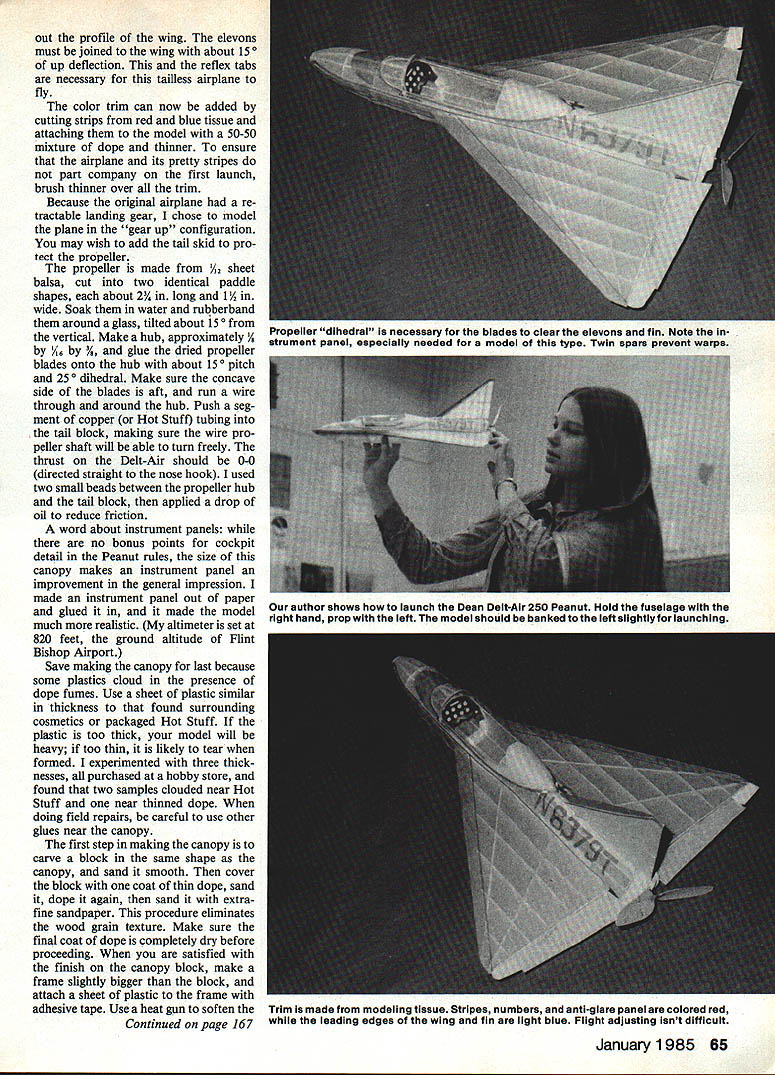
- The wing‑elevon hinge/installation: join the elevons to the wing at about 15° up. Reflex tabs are necessary for stable flight on a tailless airplane.
Propeller
- Make the propeller from 1/32‑in. sheet balsa:
- Cut two identical paddle shapes about 2-1/4 in. long by 1/2 in. wide.
- Soak them in water and rubber‑band them around a glass tube tilted about 15° vertical to form the blades.
- Make the hub approximately 5/64 in. diameter.
- Glue the dried propeller blades onto the hub at about 15° pitch with roughly 2‑1/2° dihedral. Ensure the concave sides of the blades face aft.
- Run wire through and around the hub; push the wire segment into a short length of copper tubing in the tail block, making sure the propeller shaft turns freely. Apply a drop of oil to reduce friction.
- Thrust line: set thrust to zero‑zero (no up or down thrust, no left or right).
Landing gear and tail skid
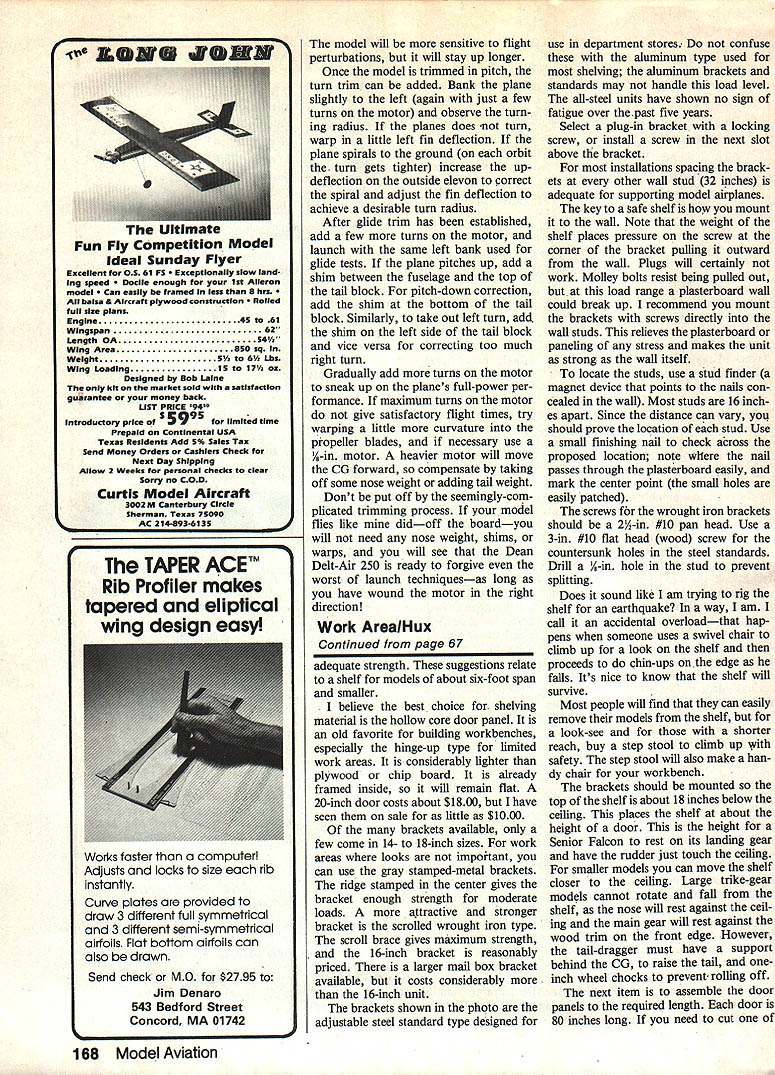
- The full‑size had retractable gear, so the model is usually built and flown gear‑up. You may add a small tail skid to protect the propeller.
Instrument panel and cockpit
- Peanut Scale rules give no bonus for cockpit detail, but a simple instrument panel of paper glued in place greatly improves appearance. On the original, the altimeter was set to 820 feet (Flint Bishop Airport ground altitude).
Canopy
- Save canopy work until last because some plastics cloud when exposed to dope fumes.
- Use sheet plastic similar in thickness to cosmetic packaging film. Avoid very thick plastic (adds weight) and very thin film (tears easily); test samples for clouding near Hot Stuff and thinned dope.
- Forming the canopy:
- Carve a block the same shape as the canopy and sand smooth.
- Apply one coat of thin dope, sand, dope again, then sand with extra‑fine paper to eliminate wood grain texture. Ensure the final coat is completely dry.
- Make a frame slightly larger than the block, attach a sheet of plastic to the frame with tape, use a heat gun to soften the film while pressing the frame around the canopy block.
- Remove the block, cut out the canopy (wear gloves when using a heat gun).
- To attach the canopy:
- Use a toothpick to apply Elmer's contact cement to the bottom of the canopy and to the fuselage. When the glue dries clear, press the canopy in place.
- Use thin white detailing tape around the junction and windshield breaks.
- Make the back of the canopy from paper and attach with white glue.
Flight trimming
Motor and initial glide trim
- Start with a single loop of 1/8‑in. rubber, about 1.5 times the fuselage length.
- Because tailless planes are sensitive to thrust line location, trim the model to glide first, then gradually add power.
- For glide tests:
- Set elevons deflected up at least 15° from the wing (to provide initial reflex).
- Ensure neither wing has wash‑in (wash‑in is a warp making outer panels more leading‑edge‑up than inboard).
- Add just enough wing wash‑in (backwards direction) to take up slack in the motor.
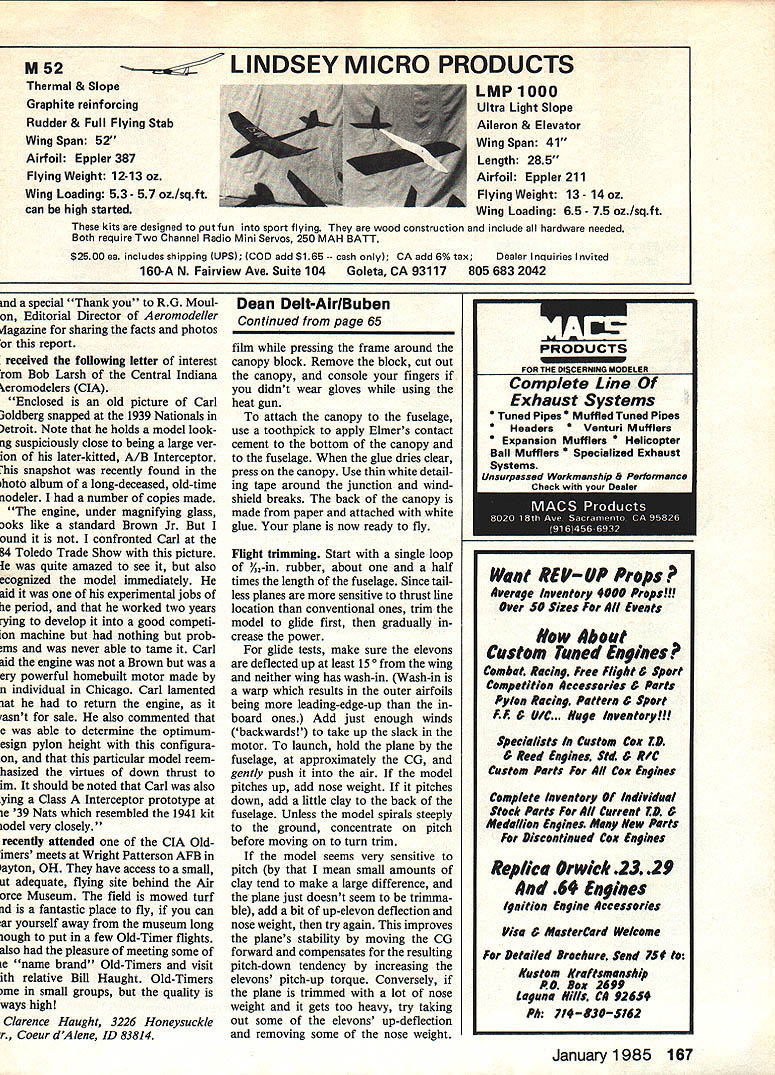
- Launch by holding the plane at the approximate CG and gently push it into the air.
- If the model pitches up, add nose weight.
- If it pitches down, add clay to the rear of the fuselage.
- Unless the model spirals steeply to the ground, make only small trim corrections.
Pitch sensitivity
- If the model is overly sensitive to pitch (small amounts of clay make large changes and it is hard to trim), add a bit more up‑elevon deflection and some nose weight:
- This moves the CG forward (more stable) and the added elevon up deflection compensates for the resulting pitch‑down tendency.
- Conversely, if the model requires a lot of nose weight, try reducing elevon up deflection and remove some nose weight.
Turn trim
- After pitch/glide trim is established, add turn trim:
- Bank the plane slightly to the left with only a few turns on the motor and observe the turning radius.
- If the plane does not turn: warp in a little left fin deflection.
- If it spirals tighter on each orbit: increase up‑deflection on the outside elevon to correct the spiral, then adjust fin deflection for a desirable turning radius.
Power trim and shims
- After glide trim, add a few more turns and launch with the same slight left bank used for glide tests.
- If the plane pitches up under power: add a shim between the fuselage and the top of the tail block (raises the tail, adds down angle to thrust line).
- If the plane pitches down under power: add the shim at the bottom of the tail block.
- To correct turning tendencies under power: add the shim on the left side of the tail block to reduce left turn, or on the right to reduce right turn.
- Gradually increase motor turns to approach full‑power performance. If full winds still don’t yield good trim:
- Try warping slightly more curvature into the propeller blades.
- If necessary, use a 1/8‑in. motor. A heavier motor moves the CG forward — compensate by removing nose weight or adding tail weight as needed.
Final tips
- Use a 50/50 mixture of dope and thinner to adhere tissue; brush a little thinner over trim stripes so they survive the first launch.
- Be cautious with glues and finishes during repairs — some plastics cloud or are damaged by certain glues and dope fumes.
- Don't be discouraged by the trimming process. If built and wound correctly, the Dean Delt‑Air 250 can fly straight off the board with minimal adjustments and is forgiving of launch technique.
Notes
- The first flight of the full‑size Delt‑Air resulted in the tragic loss of its designer/builder, Herbert F. Dean, under circumstances that remain unknown. The model, however, is a delight to fly for Peanut Scale enthusiasts.
Transcribed from original scans by AI. Minor OCR errors may remain.

