
Destiny at Kitty Hawk
JUST about everyone has at least one relative who is more than 75 years old—someone who was alive when the Wright brothers made that historic first flight of a fully controlled, heavier-than-air flying machine. The flight led directly to enormous changes in transportation, warfare and, for many of us, sport and recreation.
Three-quarters of a century seems like several lifetimes to a teenager. In terms of getting from one place to another, it is more like several lifetimes of progress. Yet it has all happened in just over the normal life span of the average person—because of two men who were very far from average.
It wasn't just that Wilbur and Orville Wright wanted to fly. A lot of men had been trying for years to invent the airplane. Most of them failed for reasons which today are painfully obvious: in most cases they didn't think the problems through. They sketched something that looked as if it ought to fly and then built it from whatever materials were handy. One after another, these early attempts fell flat. Most showed no sign of even trying to get off the ground. Those that lifted their wheels or skids into the air quickly crashed because their designers hadn't developed flight controls that stood any chance of working.
Many of these craft never achieved much speed or altitude. Their pilots (or "chauffeurs," as British historian Charles Gibbs-Smith prefers to call them) would have been unable to keep them going in a straight line once things began to go wrong. Some had limited flight controls, others depended on body-English, while a few had no known means of steering or correcting roll, pitch, or yaw.
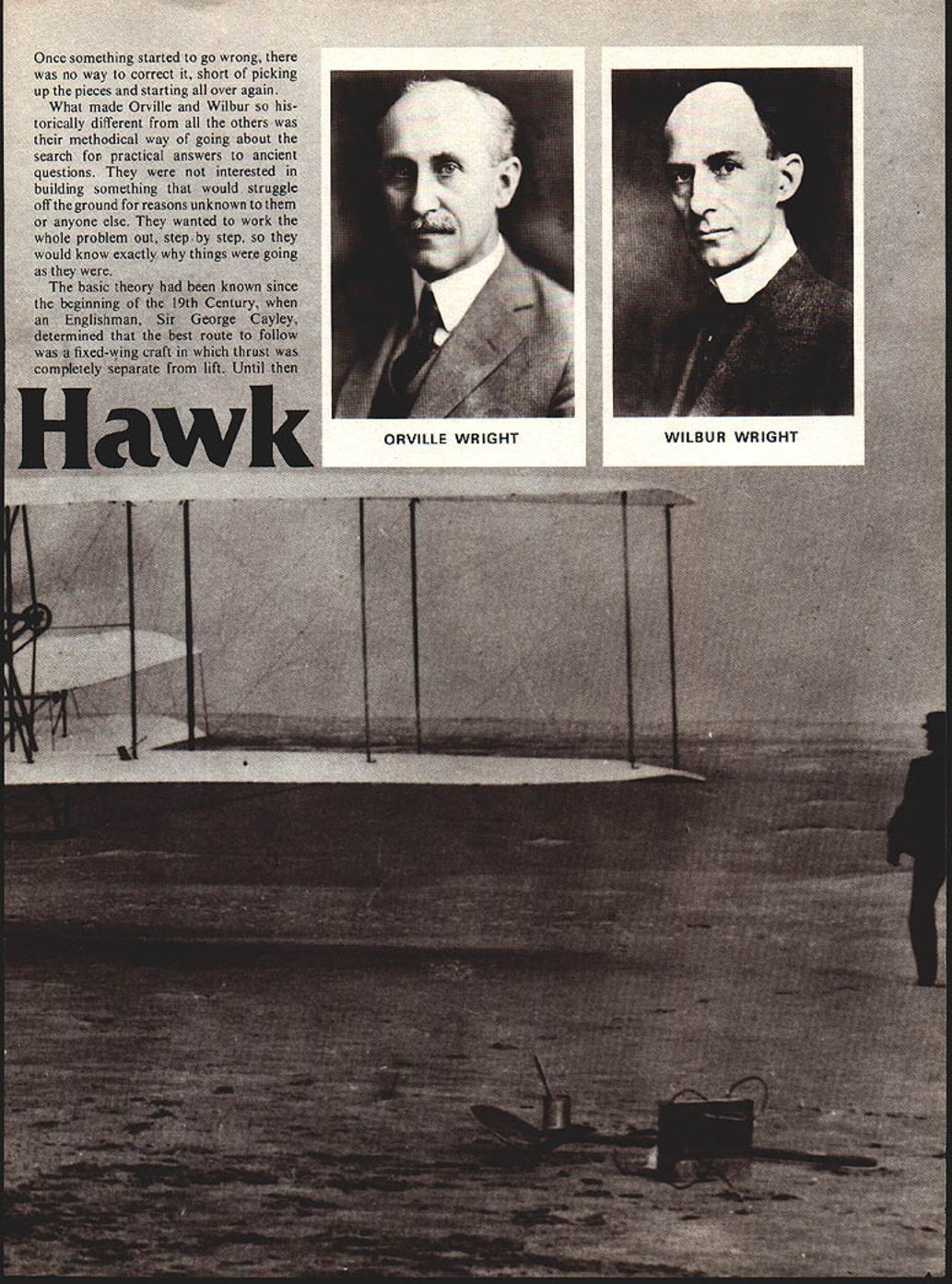
Once something started to go wrong with those machines, there was no way to correct it, short of picking up the pieces and starting all over again. What made Orville and Wilbur so historically different from all the others was their methodical way of searching for practical answers to ancient questions. They were not interested in building something that would struggle off the ground for reasons unknown to them or anyone else. They wanted to work the whole problem out, step by step, so they would know exactly why things were going as they were.
Early theory: Sir George Cayley
The basic theory had been known since the beginning of the 19th century, when an Englishman, Sir George Cayley, determined that the best route to follow was a fixed-wing craft in which thrust was completely separate from lift. Until then (and for some time afterwards), inventors seemed convinced that an airplane would have to resemble a bird if it was to stand any chance of flying—flapping wings were all the rage, at least until Cayley came along with the first truly scientific outlook.
In 1799, just after George Washington had stepped down as the first American president, Cayley produced his first airplane design. It had a fuselage of sorts, a monoplane wing, a rear-mounted tail with both elevator and rudder, two paddle-like propellers, and a cambered (curved) wing cross-section to produce what we now call lift. Cayley never built that full-size design, but in 1804 he constructed a small glider model which flew successfully. By 1809 he had done research on cambered wings using a whirling-arm test rig and had studied longitudinal stability, streamlining and the movement of the center of pressure.
Had there been a light, high-power engine available at the time, the first airplane might well have flown not in America but in England—and not in 1903, but by about 1815. Cayley's work was brilliant but largely forgotten, and inventor after inventor charged off along strange paths that could lead to nothing but failure.
Other early attempts
Some people did try. Two Englishmen, Henson and Stringfellow, worked through the first part of the 19th century on monoplane designs based on Cayley’s work. Felix du Temple in France probably made a ramp takeoff with a tractor monoplane in 1874, but it couldn't sustain flight. Ten years later, Russian Alexander Mozhaisky made a short lift in a steam-powered monoplane. In 1903 the German Karl Jatho built a tiny machine with a 9-hp gasoline engine and made at least two "running jumps," one possibly as far as 200 feet; neither is seen as a controlled flight in the full sense.
In at least one way it may have been fortunate that none of these machines could be shown to have attained fully controlled, sustained flight. Had partial successes been accepted, progress might have taken a different and less rigorous course. The Wrights, by refusing to accept partial success, were forced to develop a complete system—controls, structure, propulsion—and to carry through intensive research, experimentation and flight testing with a series of gliders. Simultaneously, they had to teach themselves to fly.
The Wright brothers' systematic approach
The Wright brothers realized they would have to learn to invent and perfect the airplane. For the very first time, man would be traveling in three dimensions, and this required new skills.
Their first step was to figure out what was needed and then try it with small gliders flown like kites. In August 1899 they flew a 5-foot-span biplane model and proved the value of wing-warping for lateral control; the model also had a form of elevator. Next came a 17-foot man-carrying glider flown at Kitty Hawk, North Carolina, in 1900—first tethered via a ground line, then freely by the pilot. It had a front elevator but neither a horizontal stabilizer nor any vertical tail surface; dihedral was tried but caused problems in gusty conditions. The machine made several tethered flights and 12 free flights with one of the Wrights lying on the lower wing.
With rapidly increasing knowledge, they moved on to larger gliders:
- Biplane Glider I (August 1899): 5-foot-span model—proved wing-warping and elevator concept.
- 17-foot man-carrying glider (1900): tethered and free flights at Kitty Hawk.
- Biplane Glider 2 (July–August 1901): 22 ft. span, 290 sq. ft. wing area; made about 60 flights, longest nearly 400 ft.; front elevator, hip-cradle controlled warping, no vertical rudder.
- Biplane Glider 3 (late summer 1902): 32 ft. span, 305 sq. ft. wing area, higher aspect ratio for reduced span-loading; initially had twin rear-mounted vertical fins for directional stability.
Biplane Glider 3 revealed a subtle control problem. When a gust dropped the right wing and the pilot warped the trailing edge down to increase lift, the warped wing’s extra drag caused it to lag behind. The result could be an undesired yaw and a tightening turn, sometimes into the beginning of a spin. The fixed vertical tails, intended as weathervanes, acted as levers during sideslips and worsened the problem.
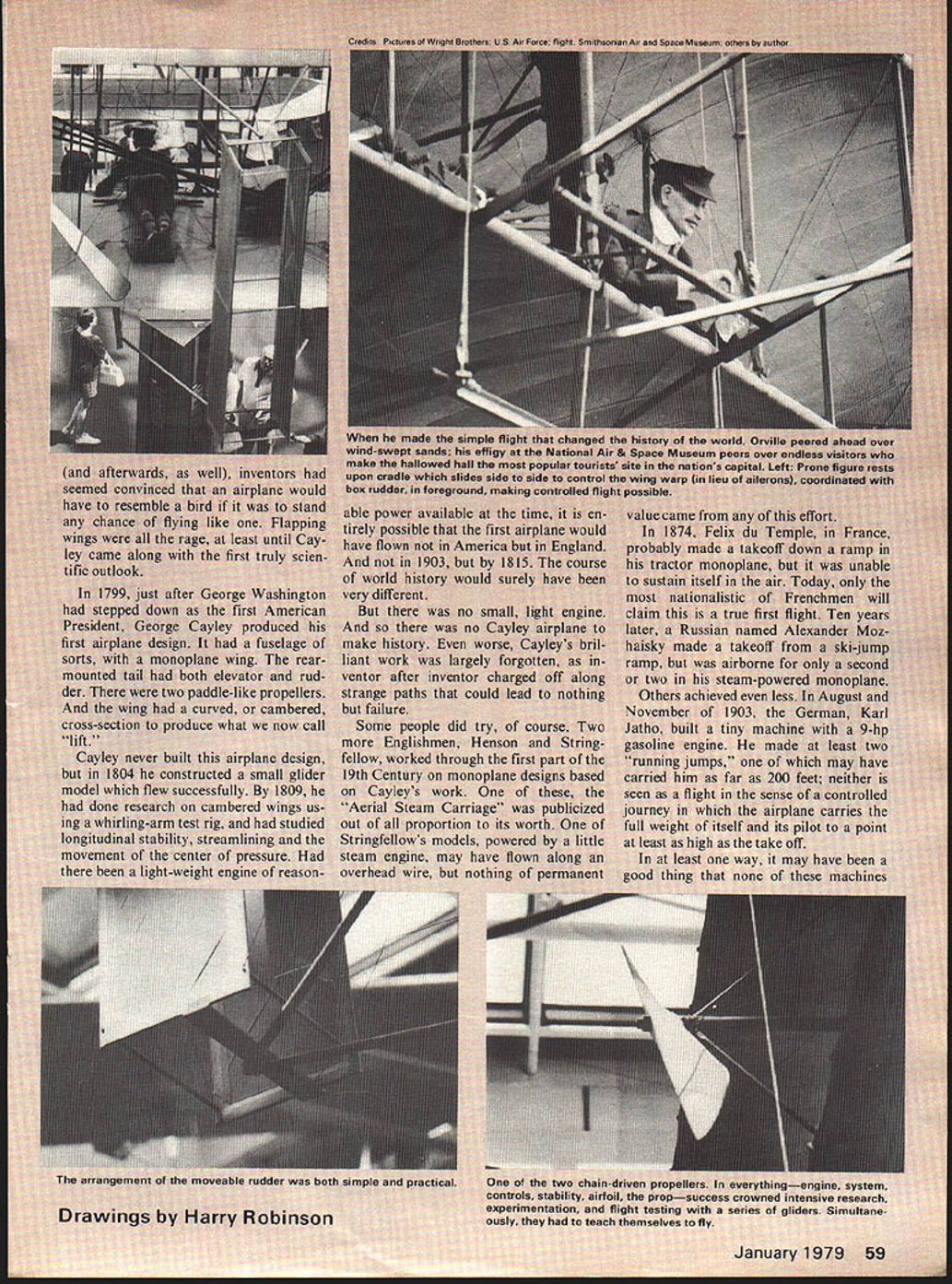
To correct this, the Wrights replaced the two fixed fins with one movable rudder, linked to the warping cradle so the rudder automatically turned in the direction of the warp. This produced the first coordinated turn and opened the door to controlled flight.
During September and October 1902 the Wrights flew their modified Biplane Glider 3 roughly 1,000 times—about four hours of flying time, more than everyone else in aviation history up to that point combined. More important than hours was the experience: they became the first humans to learn to fly. Little puffs of wind no longer ended flights; a dropped wing could be brought back quickly by the cradle-operated linked controls, and smoothly banked turns could be made as the glider skimmed down the sandy Kill Devil Hills. The Biplane Glider 3, as modified, had controls over roll, pitch and yaw, and the Wrights had control over it: history's first solid combination of man and airplane into a functioning unit.
From gliders to power
The next step was obvious: power. There were no off-the-shelf airplane engines, so the Wrights had to design and build an engine to fit an airplane being designed at the same time.
Meanwhile, Samuel Langley, secretary of the Smithsonian Institution, had been trying to beat them. Langley had built and flown several impressive tandem-wing models and attempted to scale one up into a man-carrying "Aerodrome." His mechanic, Charles Manly, produced an amazing 52-hp radial engine designed by Stephen Balzer, putting Langley far ahead of the Wrights in raw power. But Langley paid too little attention to structure and control. The Aerodrome had weak wing spars, a tiny elevator, a rudder close to the center of gravity and absolutely no roll control—traits that made success unlikely. Two attempts by Manly in October and December 1903 failed when the Aerodrome fouled its launching catapult and pitched Manly into the icy Potomac.
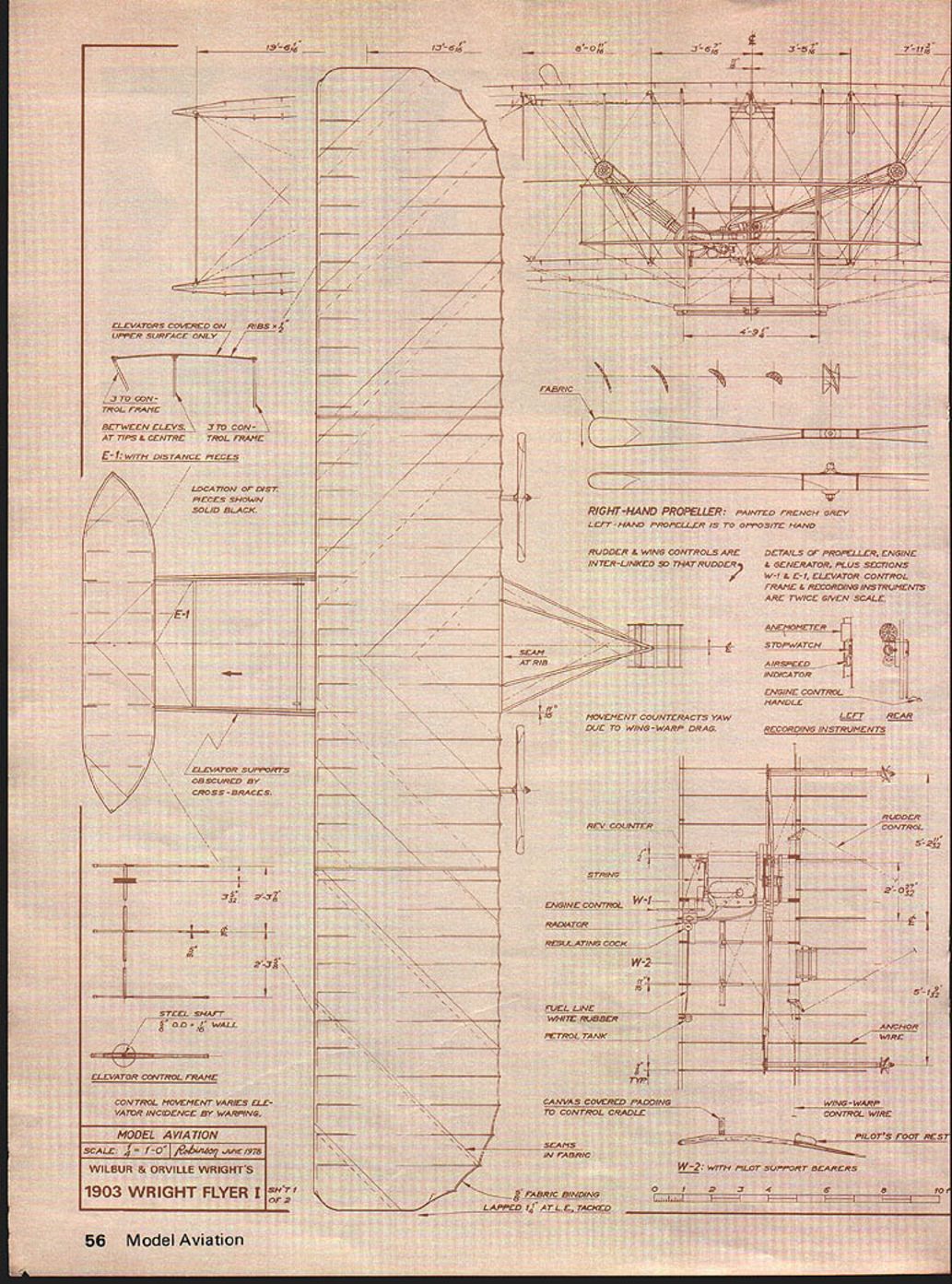
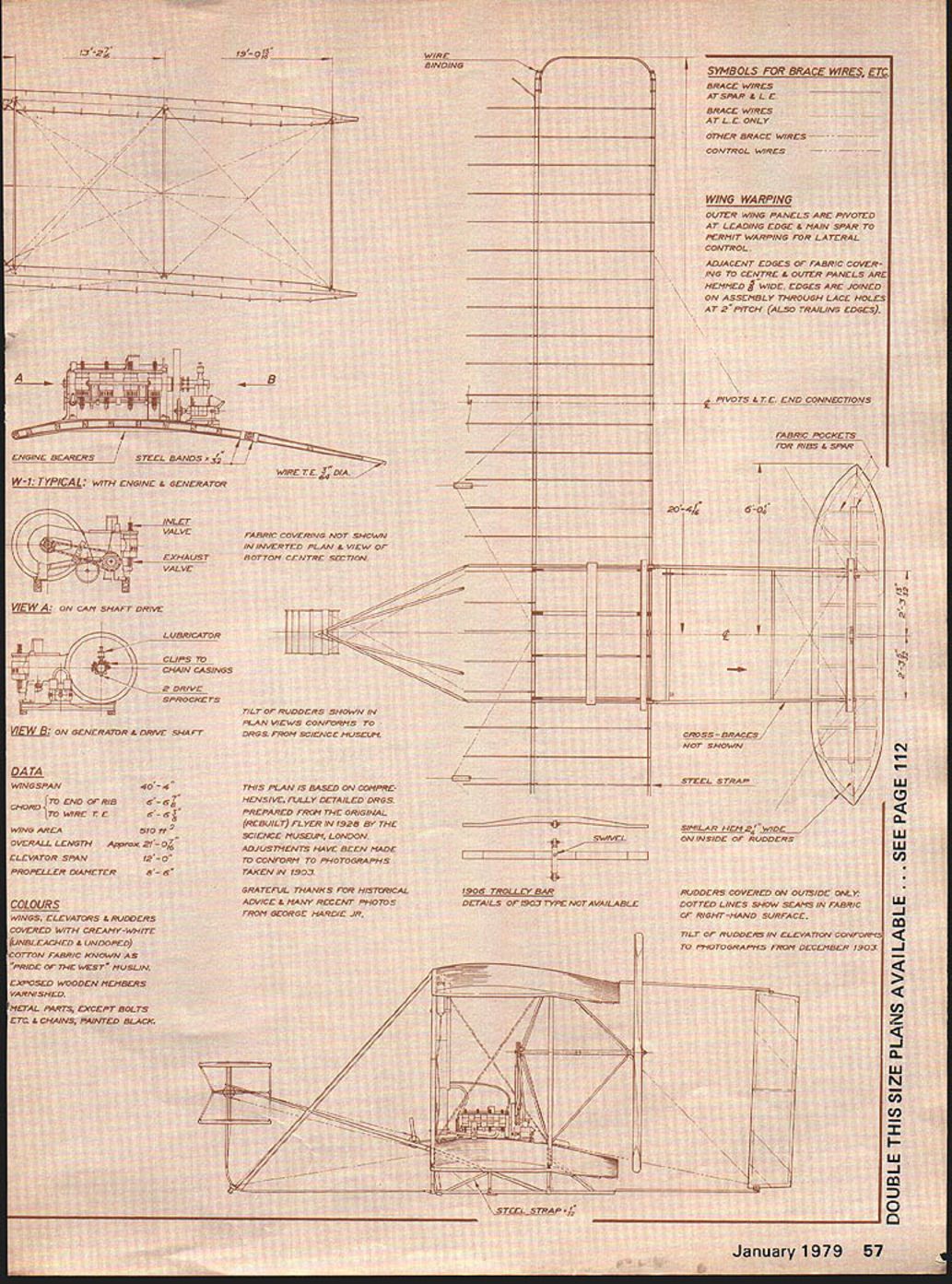
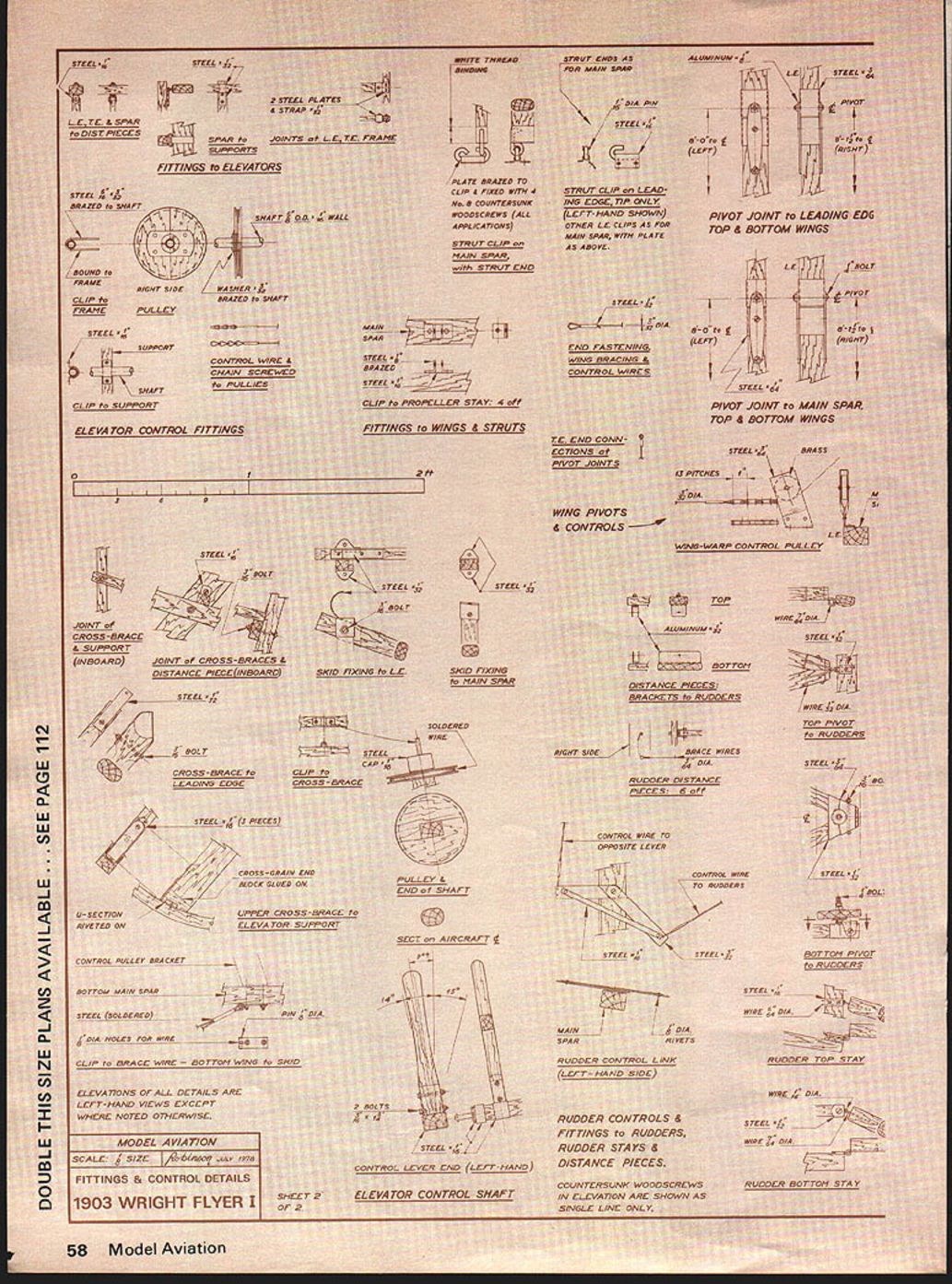
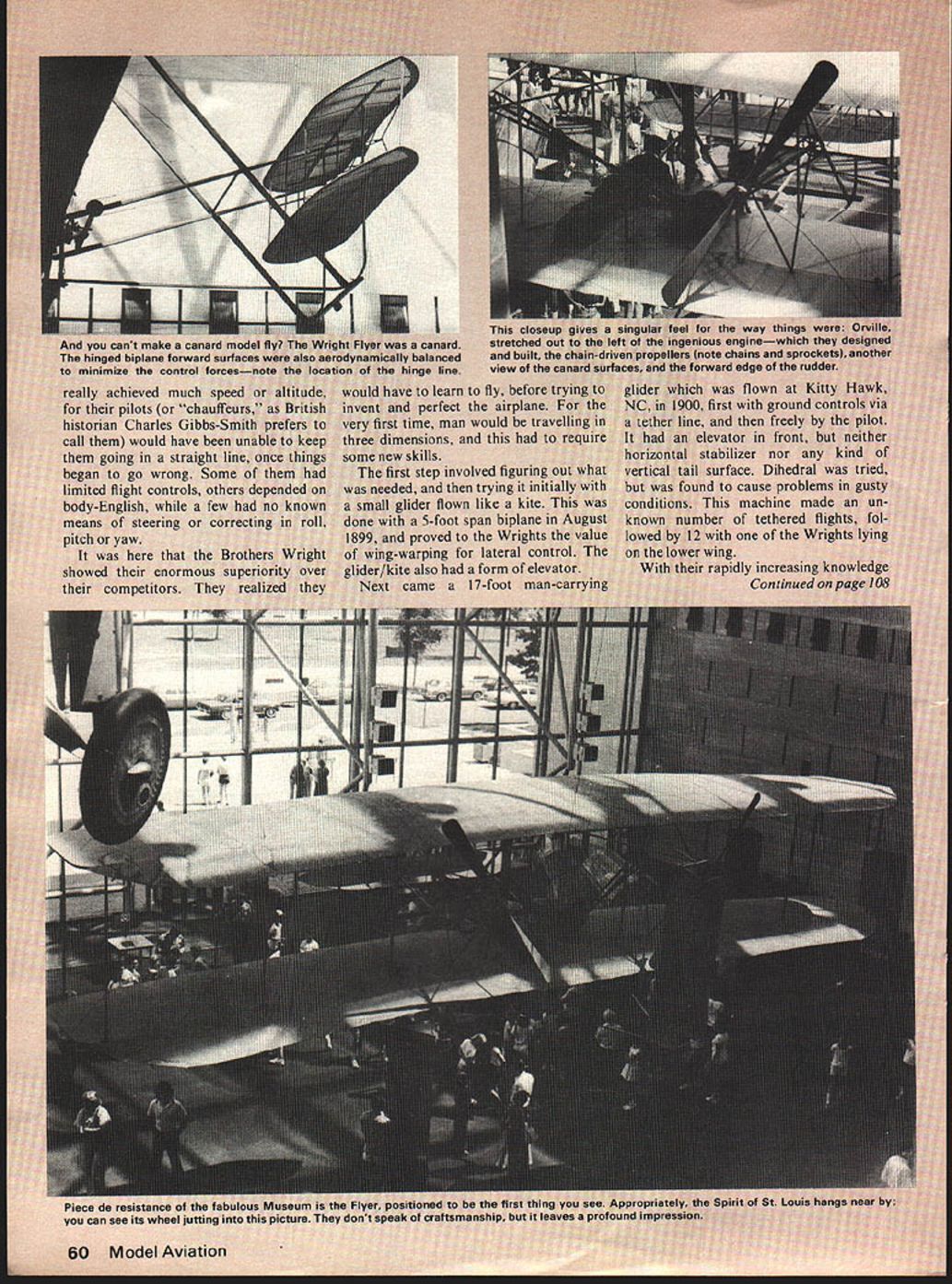
The Wrights, having polished their skills with many glider flights and having added a second rudder for even greater control, were ready. They built an entirely new craft, the Flyer I. It was the largest Wright aircraft yet: span 40' 4", wing area 510 sq. ft., and empty weight around 600 lbs. Like the Biplane Glider 3B it had twin rudders, but the low-aspect monoplane elevator was replaced by a slim biplane elevator a few feet in front of the nose where the pilot lay prone.
Their engine was another symbol of their genius: a four-cylinder inline producing about 13 hp at 1,750 rpm. Through chains it drove a pair of counter-rotating propellers that the Wrights had designed and built themselves.
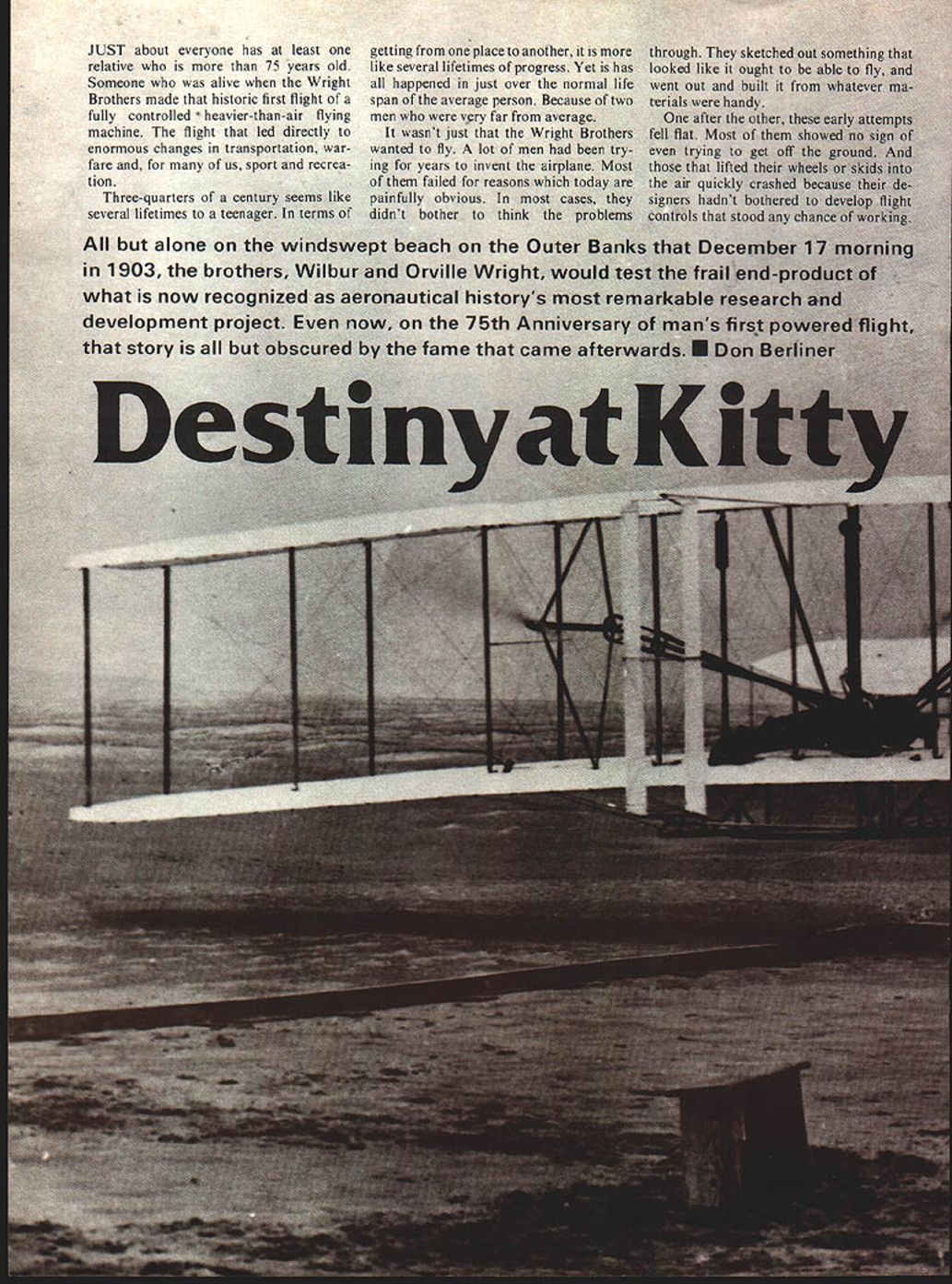
On Monday, Dec. 14, 1903 the machine was taken to the windswept North Carolina shore. Wilbur won the toss and prepared to become the world's first airplane pilot. The engine was run and the Flyer I started forward on its launching rails. Its nose came up quickly; Wilbur applied down-elevator, then up-elevator to prevent an immediate landing. After a few oscillations the nose dug into the sand after about 2½ seconds. The Wrights did not count this as a true flight—the airplane had not been truly under control.
Three days later, on Dec. 17, Orville piloted the Flyer as it rose from the rails, flew 120 feet in 12 seconds, and landed on the sand—the first sustained, controlled, powered flight in history. Three more flights were made that day; the longest, piloted by Wilbur, covered 852 feet in 59 seconds. The Flyer I never flew again; it was wrecked by wind shortly after its fourth landing that day.
The Flyer was eventually shipped to England for display in the Science Museum in London because the Smithsonian had insisted Langley was the inventor of the airplane. In 1948 it was finally placed on display in Washington after the museum acknowledged the Wrights' priority. Today the Flyer I hangs inside the entrance of the National Air & Space Museum, where millions have seen it.
Aftermath and legacy
The true superiority of the Wrights is still not fully appreciated by the world. It isn't merely that they were the first to fly a fully controlled heavier-than-air machine. Their accomplishments span the whole spectrum of aeronautics: aerodynamics, structures, control systems, engines, propellers and flight training.
The race to be the first to fly really wasn't much of a race. The 59-second flight of Dec. 17, 1903 wasn't bettered by anyone else for almost four years. By then, Wilbur had achieved flights of 38 minutes covering 24 miles—proof that the brothers were far ahead of their contemporaries.
If 75 years seems long, consider Steve Wittman, undisputed king of pylon air racing and record holder in the new Formula Vee Class. Wittman was born just three and a half months after the Wrights' first flight and remained as active as any pilot—his FAI sporting license is signed "O. Wright," a small testament to the brothers' enduring place in aviation history.
Transcribed from original scans by AI. Minor OCR errors may remain.

