
D.H. 88 Grosvenor House
By Don Berliner
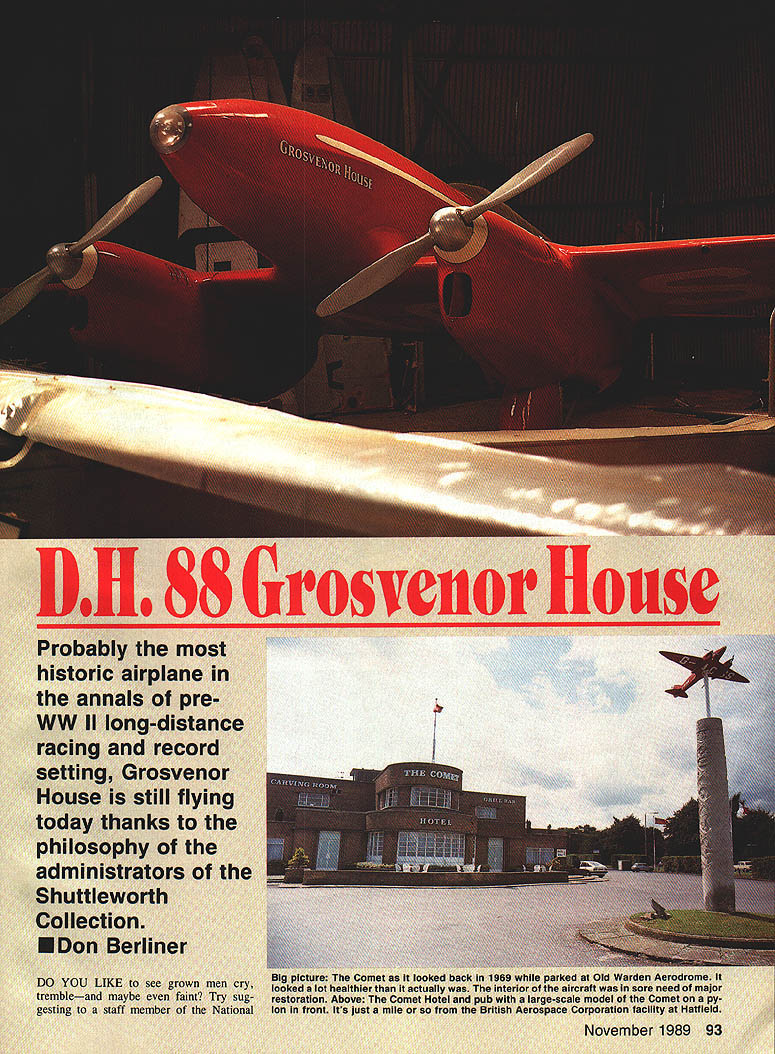
Probably the most historic airplane in the annals of pre–World War II long‑distance racing and record setting, Grosvenor House is still flying today thanks to the philosophy of the administrators of the Shuttleworth Collection.
Do you like to see grown men cry, tremble—and maybe even faint? Try suggesting to a staff member of the National Air and Space Museum in Washington, D.C., that some of its precious historic airplanes should be flown. The very thought of an antique flying machine actually taking flight is heresy to most museum professionals, who seem convinced the airplane would destroy itself at the first opportunity.
The nice folks who run the Shuttleworth Collection at Old Warden Aerodrome (England) are cut out of different cloth. The Shuttleworth curators have adopted the novel idea that airplanes are meant to fly. Practically all the aircraft in this fascinating collection, including planes as old as a 1912 Blackburn Monoplane and as historic as the 1934 de Havilland Comet, are actually flown. What's more, over the many years of the museum's history not a single aircraft has been wrecked.
The gulf between the Smithsonian and Shuttleworth policies represents a major difference in philosophy that no amount of discussion will apparently ever settle. The Smithsonian curators will continue to treat their airplanes like delicate objects of art, while the blokes at Old Warden will continue to restore their equally precious airplanes to be flown.
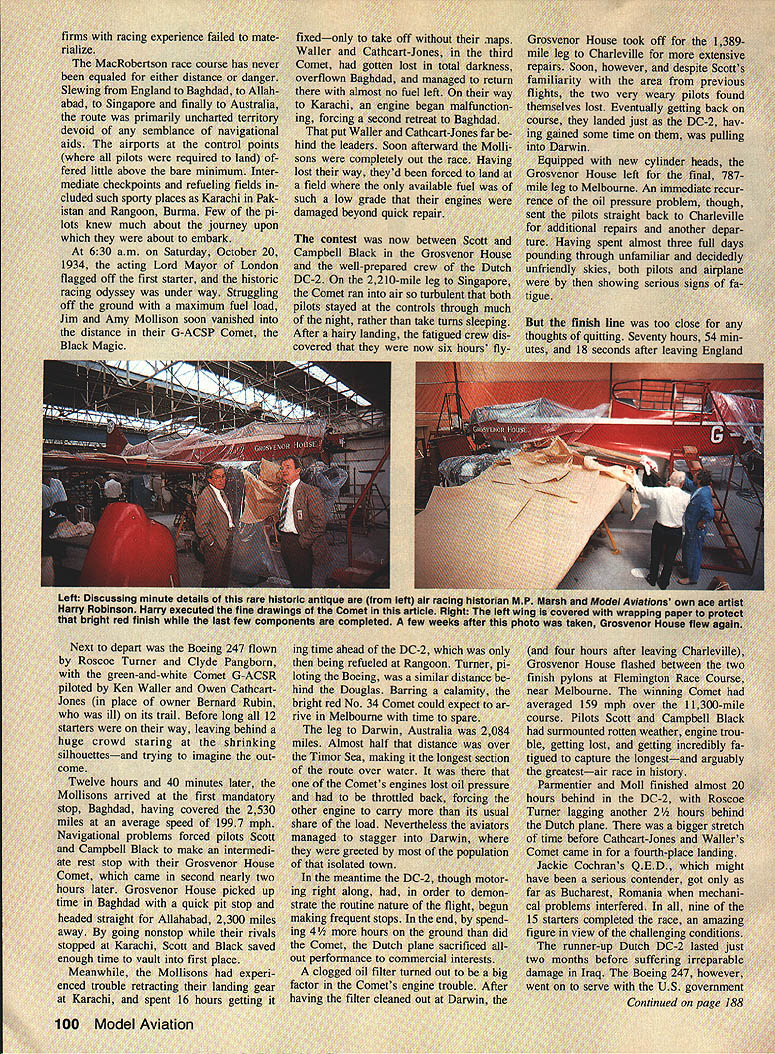
By good fortune, the Shuttleworth Trust owns a sizable number of truly historic airplanes. Among these is the de Havilland D.H. 88 Comet (G‑ACSS), Grosvenor House, winner of the MacRobertson Air Race, the famous 1934 jaunt of 11,300 miles from England to Australia known informally as "the world's greatest air race." The Comet was undoubtedly an inspiration behind the development of the de Havilland Mosquito, one of World War II's most versatile twin‑engined aircraft.
Design and development
When plans for the MacRobertson Race were announced in April 1933, there was no airplane in England capable of making a serious attempt for first place in the speed division. De Havilland was the only firm to commit to building a highly competitive racer. Design work on a totally original airplane suitable for the 1934 Speed Division began in January 1934. The racer would have to be completed, tested, and proven in time to sit at the starting line the following October—less than ten months away. De Havilland faced a ferocious challenge.
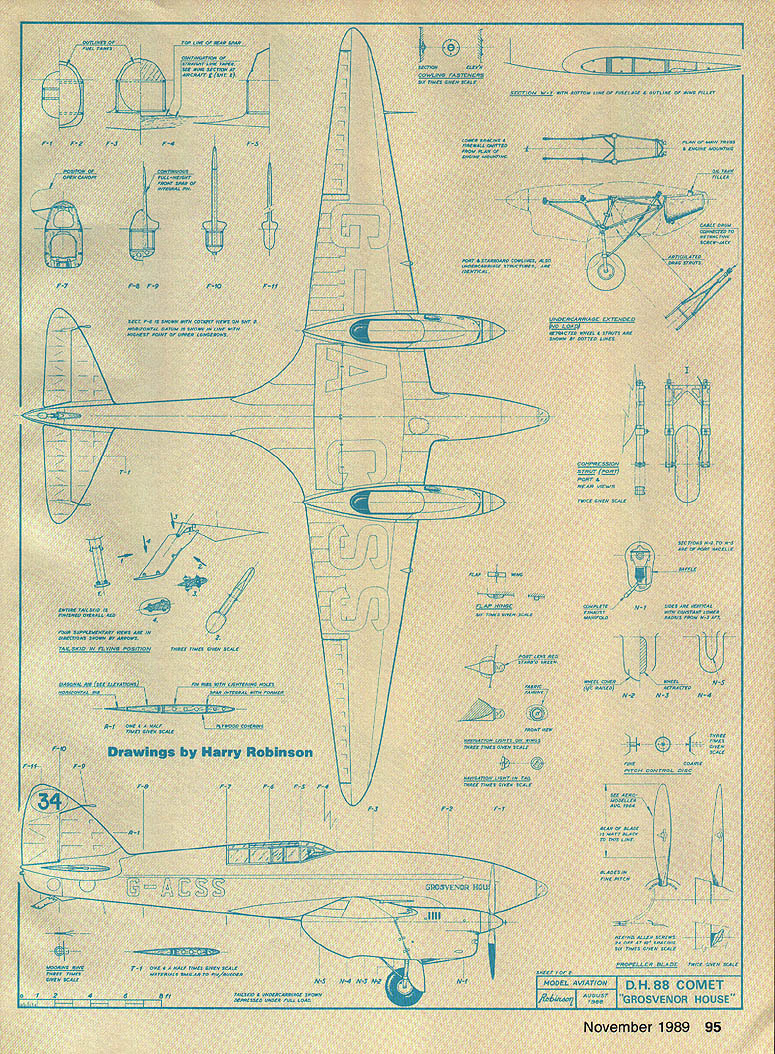
After considering modifications to earlier designs, the de Havilland team settled on a completely new airplane full of modern ideas. The racer was built at Stag Lane, northwest of London. In an era when strut‑and‑wire‑braced biplanes still ruled the skies, the D.H. 88 Comet incorporated advanced features that made it one of the sleekest machines of its time.
By late February 1934 three Comets had been ordered: one for Jim and Amy Mollison, a second by A. O. Edwards (director of the Grosvenor House Hotel) to be flown by C.W.A. Scott and Tom Campbell Black, and a third by Bernard Rubin, who planned to pilot it himself.
Eight months after the project began, the first Comet flew from de Havilland's aerodrome at Hatfield. On 8 September 1934 de Havilland's chief test pilot Hubert Broad flew Comet No. G‑ACSP for 25 minutes. That first brief flight proved the design a success. The Comet demonstrated a top speed of over 200 mph. One disadvantage, however, was that the pointed wingtips reduced low‑speed control.
Takeoffs and landings were awkward, but the Comets were built for long‑distance speed. The G‑ACSS Grosvenor House had a total flying time of only 1½ hours when it arrived at the starting line.
The MacRobertson Air Race (1934)
The race began at Mildenhall, England. Gathered for the start (which began on a Monday in October 1934) were 15 aircraft among over 60 originally entered. Along with the three Comets were a Douglas DC‑2 airliner from KLM and a Boeing 247 airliner sponsored by Heintz and flown by Col. Roscoe Turner. Other notable entries included:
- De Havilland Dragon Rapide twin‑engined biplane airliner
- Granville Gee Bee Q.E.D. (Jackie Cochran)
- Klemm lightplane
- Fairey Fox military biplane
- De Havilland Puss Moth lightplane
- Airspeed Courier and Airspeed Viceroy
- Desoutter and Pander from the Netherlands
- Miles Hawk Major sport plane
Next to depart was the Boeing 247 (Roscoe Turner and Clyde Pangborn), followed closely by the green‑and‑white Comet G‑ACSR (Ken Waller and Owen Cathcart‑Jones, flying in place of Bernard Rubin). Before long all twelve starters were en route.
At 6:30 a.m. on Saturday, 20 October 1934, the acting Lord Mayor of London flagged off the first starter and the historic odyssey was under way. Jim and Amy Mollison struggled off the ground in G‑ACSP (Black Magic) and soon vanished into the distance.
Twelve hours and 40 minutes later the Mollisons arrived at the first mandatory stop, Baghdad, having covered 2,530 miles at an average speed of 199.7 mph. Navigational problems forced Scott and Campbell Black (Grosvenor House) to make an intermediate stop; they arrived in Baghdad nearly two hours after the Mollisons. Grosvenor House made a quick pit stop and headed nonstop for Allahabad, 2,300 miles away. By going nonstop while rivals stopped at Karachi, Scott and Campbell Black saved enough time to vault into first place.
The Mollisons experienced trouble retracting their landing gear at Karachi and spent 16 hours getting it fixed—then took off without their maps. Waller and Cathcart‑Jones (G‑ACSR) became lost in darkness, overflew Baghdad, and returned there with almost no fuel; en route to Karachi an engine began malfunctioning, forcing a retreat to Baghdad. The Mollisons later were forced out of the race after landing where only very low‑grade fuel was available, damaging their engines beyond quick repair.
The contest came down to Scott and Campbell Black in Grosvenor House and the well‑prepared KLM DC‑2. On the 2,210‑mile leg to Singapore, the Comet encountered severe turbulence; both pilots stayed at the controls through much of the night and, after a difficult landing, found themselves six hours ahead of the DC‑2. Turner in the Boeing was a similar distance behind.
The leg to Darwin (2,084 miles, nearly half over the Timor Sea) brought an oil‑pressure problem in one engine that had to be throttled back, forcing the other engine to carry extra load. The crew limped into Darwin, where the clogged oil filter was cleaned. Grosvenor House then flew to Charleville for more extensive repairs; after becoming briefly lost, they landed just as the DC‑2 arrived and gained some time back.
Equipped with new cylinder heads, the Comet left for the final 787‑mile leg to Melbourne but suffered a recurrence of oil‑pressure trouble and returned to Charleville for further repairs. Fatigued after nearly three days of hard flying, the pilots pressed on.
Seventy hours, 54 minutes, and 18 seconds after leaving England, Grosvenor House flashed between the finishing pylons at Flemington Race Course near Melbourne, having averaged 159 mph over the 11,300‑mile course. Scott and Campbell Black had overcome rotten weather, engine trouble, navigation errors, and extreme fatigue to win arguably the greatest air race in history.
After the race
The brilliant red Comet became instantly famous and was displayed widely in England. The Comet flown by Cathcart‑Jones and Waller (G‑ACSR) continued setting records and was sold to the French government in 1935. The Mollisons' Comet was sold to the Portuguese government.
Grosvenor House (pronounced "GROVE‑ner") was transferred to the Royal Air Force in spring 1935 for test work, cutting off its racing career. The type proved somewhat temperamental for service pilots. A very hard landing in September 1936 caused major damage to gear, cowlings, props, engines, and fuselage; the aircraft was struck off military records a few months later and sold to a scrap dealer.
In 1937 Frederick Tasker bought Grosvenor House for $1,200 and had racing specialist Jack Cross restore it. Renamed "The Orphan," it appeared in blue and gray in time for the New York–to–Paris race scheduled for August 1937 (that race was later canceled and replaced with a European contest from Marseilles to Damascus and back to Paris). Flown by Arthur Clouston and George Nelson, the Comet averaged 196 mph over the 3,850‑mile race and finished fourth behind three Italian Savoia S.M.79 bombers.
In September 1937 Ken Waller piloted Grosvenor House in the King's Cup handicap, averaging 214 mph. In November, renamed "The Burberry," Clouston and Mrs. Kirby‑Green flew a 7,200‑mile course from England to South Africa and back in a record 45 hours. In March 1938 Clouston and Victor Ricketts flew an 11‑day, 26,500‑mile round trip to New Zealand.
The airplane was entered in the 1938 King's Cup at Hatfield but was damaged on takeoff; repairs were completed within five weeks and two test flights were made by Geoffrey de Havilland for a planned record flight to Australia that was later canceled. The G‑ACSS Comet never flew again after that.
During World War II Grosvenor House was stored outdoors at Gravesend Airport, later moved to Salisbury Hall (where the Mosquito was designed). The aircraft deteriorated from exposure but was reclaimed and cosmetically restored for the 1951 Festival of Britain exhibition; its interior was left incomplete. After the exhibition it was moved to the showroom of the de Havilland Engine Company.
In 1965 the Comet was presented to the Shuttleworth Collection at Old Warden Aerodrome. No longer airworthy, the famous raceplane languished in a hangar among the collection's flying aircraft.
Restoration to airworthiness
In 1972 David Ogilvy, manager of the Shuttleworth Collection, and Wally Berry, its shop mechanic, decided to restore Grosvenor House to flying condition. Fund‑raising occupied much of the early work. The Transport Trust and Hawker‑Siddeley Aviation (which had taken over de Havilland) became sponsors.
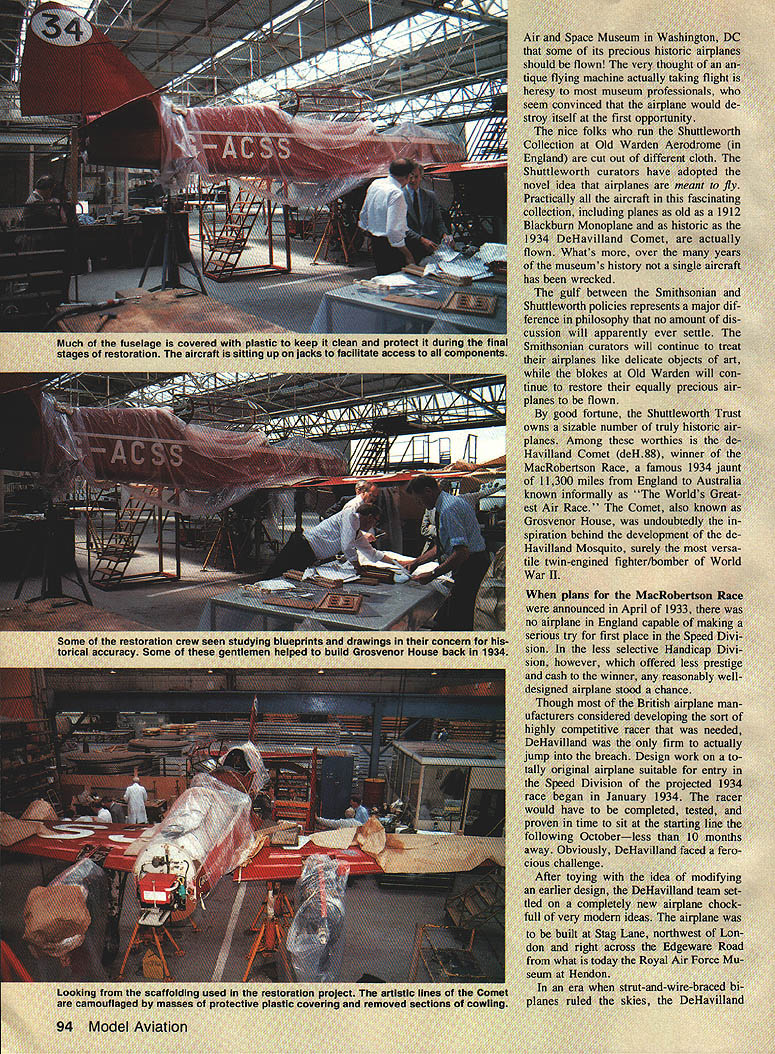
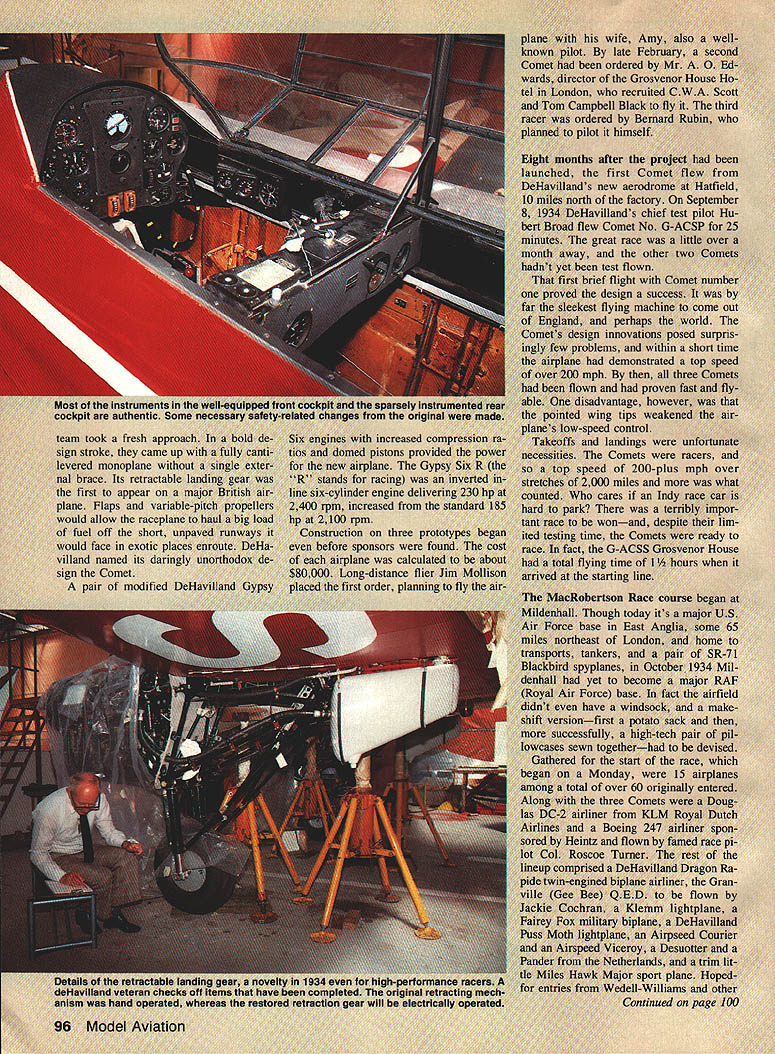
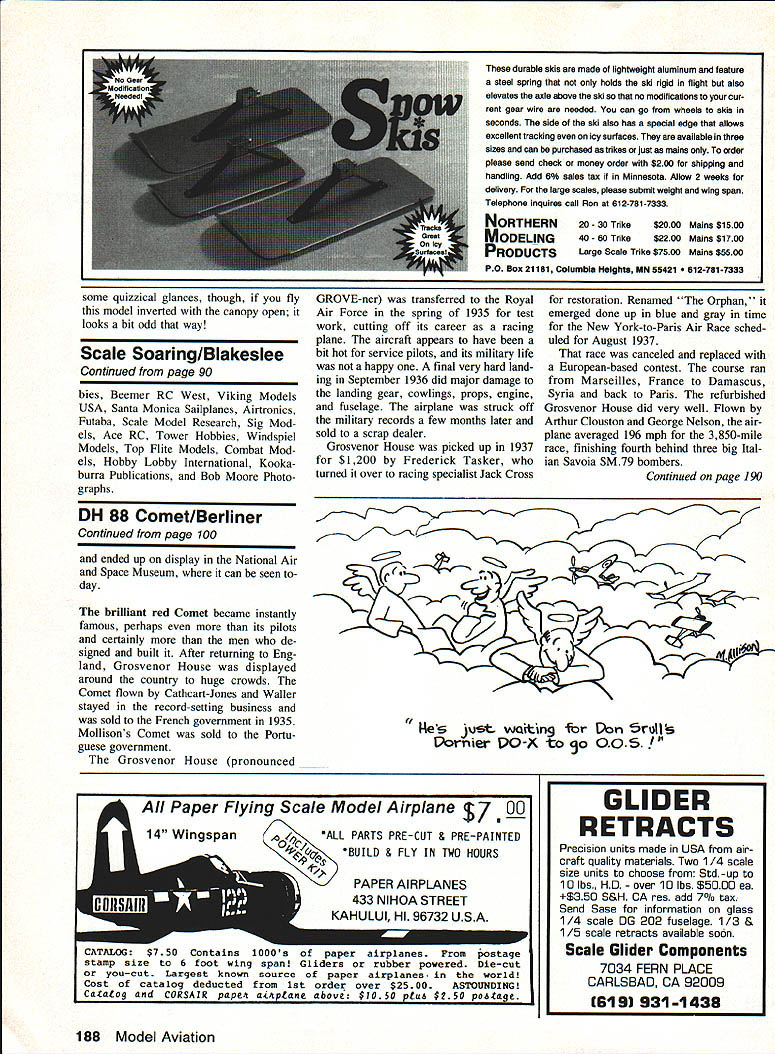
Work began after the 1974 flying season. The 30‑year‑old racer was dismantled, construction drawings gathered, and missing data recalculated. The landing gears were sent to Dowty‑Rotol for rebuilding. The one‑piece 44‑ft wing was opened up; much of the material required replacement. Metal fittings were checked and reassembled with new bolts.
Replacing the wing began in early 1977, followed by sanding, application of dope to Irish linen, and final finishing. The fuselage proved a greater challenge: many parts had been lost or taken as souvenirs, so restorers reverse‑engineered components. The canopy frame, instrument panel, and other items were re‑created from scratch where necessary.
Semiretired engineer/race pilot Ron Paine oversaw the restoration. Only minimal changes were made to balance authenticity with safety: a tailwheel replaced the original skid, a motor for winding the landing gear was fitted, and several modern instruments were added.
Delamination was found in the all‑wood wing in 1981; the cost of rebuilding delayed work and the project was temporarily suspended in late 1982. In May 1983 the airplane moved to the Royal Aircraft Establishment at Farnborough, where work resumed as apprentice training.
As the 50th anniversary of the England‑to‑Australia race approached, plans to fly the original course gave way to shipping the Comet to Australia for static display. Tens of thousands turned out to greet the historic airplane's 1984 arrival in Australia. The Comet was later shipped back to England and restoration was completed by spring 1987.
On 17 May 1987 the airplane lifted off from Hatfield for its first flight since 1938. The test program was successful and the Comet flew in an air show a week later at the USAF base at Mildenhall, the starting point for the 1934 race. In July 1987 the Comet ground‑looped, damaging a wingtip, landing gear, propeller, and cowling; repairs were carried out by British Aerospace. Repairs were finished in time for a new inaugural flight in mid‑August 1988, and Grosvenor House was included in the 1988 air display season at Old Warden.
Fate of the other Comets and legacy
Of the five Comets built, Grosvenor House is one of the few survivors.
- G‑ACSP "Black Magic" was recovered from a scrapyard in Portugal in 1980 in extremely deteriorated condition. Plans to rebuild it were abandoned when the owner was killed in a crash; rumors suggest another individual may yet revive that project.
- G‑ACSR was sold to France (as F‑ANPY), set several speed records, but was destroyed at Istres early in World War II.
- Two additional Comets built in 1935 had short lives: F‑ANPZ flew for the French government and was destroyed at Istres in 1940; G‑ADEF first flew in July 1935 and crashed in September 1935 over northern Sudan when the crew bailed out—Tom Campbell Black and Gordon MacArthur survived.
The Comets were designed for maximum‑performance long‑distance racing and were developed in minimal time. They were rare airplanes for the role they were intended to fill and collected an impressive list of records. These high‑powered, innovative aircraft were not really meant to last fifty years, and one survivor out of five is a respectable showing.
If you're traveling to England, include a stop at Old Warden airfield to see Grosvenor House. Unless the owners can be persuaded to bring it to the EAA Fly‑In at Oshkosh, that's the only opportunity to see this historic racer in flight. Modelers Bill Turner and Ed Marquardt are at work on a reproduction of Grosvenor House, with completion anticipated in the coming years.
Transcribed from original scans by AI. Minor OCR errors may remain.

