
Diesel Delights
— David Boddington
It's so addictive it ought to be illegal. After 40 years of sniffing diesel fuel and model diesel engine exhaust, I still haven't had enough. My senses are engaged by the pungent smells of kerosene, oil and ether (raw or burnt), the satisfying feel of starting a diesel and the way it sounds once it's running. Usually, even before the model takes the air, I'm feeling high.
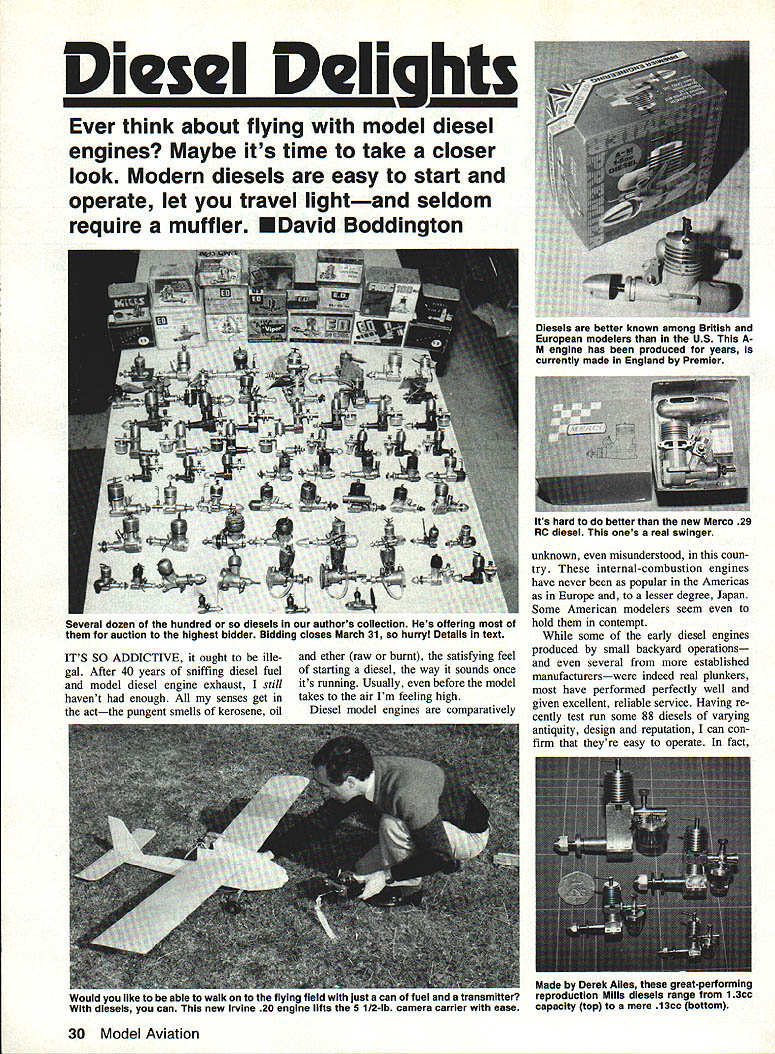
Diesel model engines are comparatively unknown and often misunderstood in this country. They have never been as popular in the Americas as in Europe and, to a lesser degree, Japan. Some American modelers even hold them in contempt. While some early diesel engines produced by small backyard operations — and even a few from established manufacturers — were indeed poor performers, most have worked perfectly well and provided excellent, reliable service. Having recently test-run some 88 diesels of varying antiquity, design and reputation, I can confirm they're easy to operate.
Basics and controls
Model diesel engines operate by igniting the fuel/air mixture through compression alone. Unlike glow engines, diesels generally use a tight-fitting contra-piston at the top of the cylinder; a variable rotating screw or lever (compression screw or lever) adjusts the contra-piston position to change compression.
The two basic variable controls are:
- the needle valve (fuel)
- the compression screw or lever
These controls may seem intimidating at first, but they're simple enough for anyone with a mechanical bent and are intrinsically interesting to work with — much like glow engine controls.
Starting (flick starting)
Forget the myth that diesels are difficult to start. Learn the slightly different "flick" technique and you’ll find diesels no harder to start than other model engines. To flick-start:
- spin the propeller a little faster than you would for a glow engine,
- advance the compression lever slightly for starting,
- after the engine warms (about 30 seconds) back off the compression.
With experience you'll learn the exact compression variation needed for reliable starts.
Throttling and modern designs
Earlier diesels sometimes had poor throttle response due to sub-piston induction designs. Modern diesels use R/C-type carburetors and silencers, so engines as small as 0.05 cu in to 0.08 cu in can be reliably throttled. Diesels generally have excellent low-speed torque (except the very smallest competition engines), allowing them to swing larger propellers at modest RPMs — a definite advantage for vintage, sport, Free Flight and RC designs.
Fuel and lubrication
If commercial diesel model fuel is unavailable, you can mix your own. A simple and effective recipe by volume is:
- 1 part kerosene
- 1 part oil
- 1 part ether
Details and tips:
- Use good-quality heating-grade or lamp-grade kerosene.
- Ether may be the solvent type used for cleaning, quick-start automotive fluid, or medical ether (the latter is more expensive and harder to obtain).
- Castor oil is a suitable lubricant if you don't mind heavy exhaust residues. Synthetic/castor blends produce less cling.
- Select a mineral oil of low viscosity; SAE 50 multigrades are unsuitable.
- Diesel fuels generally have a higher oil content than glow fuels — up to about one-third oil by volume in the basic recipe above. For well run-in or ball-raced diesels you can reduce oil content down to around 20%.
A number of additives can improve smoothness and starting, but the simple 1:1:1 mix will start and operate readily.
Advantages of model diesels
- Tractable: operate over a wide speed range and with various propellers.
- Excellent low-speed torque: can swing larger props at modest speeds.
- Often optional muffler: slow-revving diesels are quieter and often don't require mufflers — beneficial in scale models where space is tight.
- Smaller and more convenient mufflers when needed.
- Economical fuel consumption: allows smaller fuel tanks and less weight.
- Fuel and exhaust residues are less aggressive toward cellulose or standard enamel finishes.
- Minimal field equipment: you can go to the flying field with just the model, transmitter, a can of fuel and a rag — no heavy starters, batteries or field boxes needed.
Conversions
Conversion outfits (for example, the Davis Diesel conversion kits) can turn suitable glow engines into diesels. Diesel operation imposes extra loads, so choose a reasonably large glow engine for conversion — many prefer to stay around 0.29 cu in capacity. Diesels larger than about 0.29 cu in can become harsh or clunky, losing some of their charm and ease of operation. Experimental work on four-stroke diesels and conversions of large-capacity engines has been done, but smaller engines remain the author's preference.
Resources
- Dr. Diesel's Diary (All You Ever Wanted to Know About Diesels) by Eric Clutton. This excellent publication covers design, history and operation of model diesel engines, including fuels, propellers, exhaust systems, compression adjustments, starting and conversions. Eric Clutton also imports PAW engines and sells diesel fuel and castor oil.
- Contact: Eric Clutton, 913 Cedar Lane, Tullahoma, TN 37388. Tel: 1-615-455-2256.
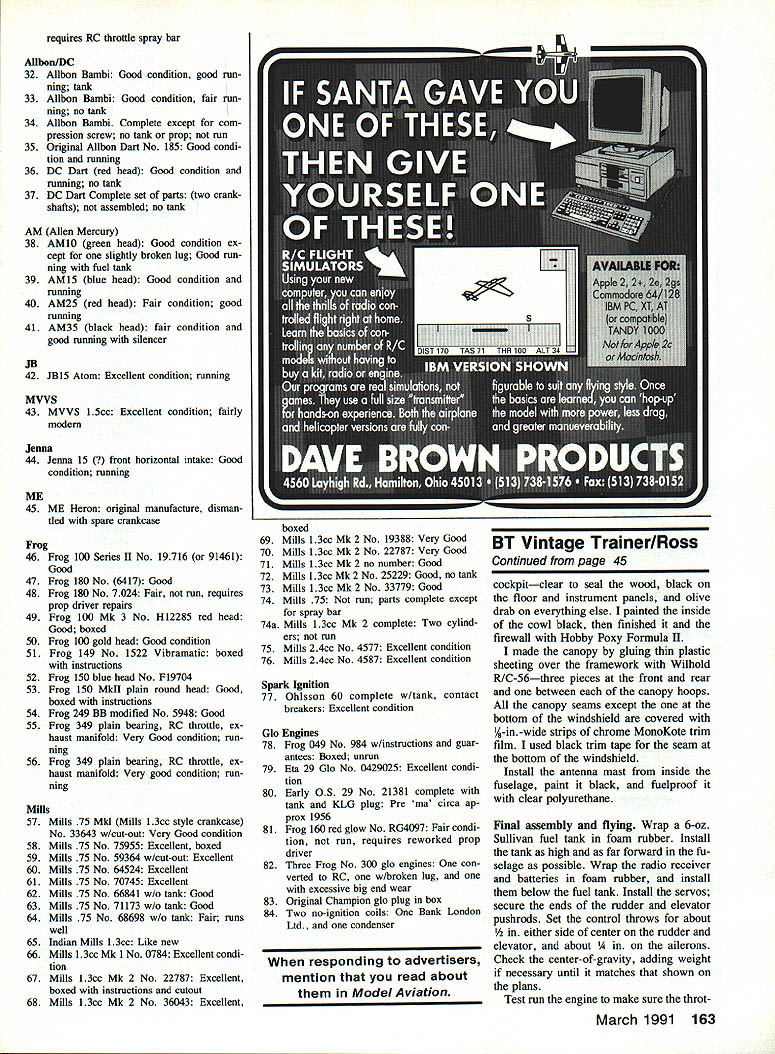
Engine Auction Sale
I have a large collection of diesel engines (and a few glow engines) that I am offering for sale by auction. While most are sound, practical engines suitable for scale or vintage use, some are rarer or more interesting. If you want a full list and details, send an addressed envelope and international postal coupons to:
David Boddington Ivy Crest, The Avenue Wellingborough, Northants NN8 4ET England
Bidding closes March 31, 1991.
- Mills 1.3cc Mark 1 — No. 11 995 (new, in original box)
- Mills 1.3cc Mark 2 — No. 23 937 (new, in original box)
- ED Mark 2 Competition Special — No. M198C (new, boxed)
- ED Mark 4 3.46 — No. E9/28 (new, boxed)
- Deanside Mills .75cc — No. 109 (new, boxed)
Marine Engines
- ED Sea Otter 3.46 — No. OM 40/C (barely run)
- Taplin Twin — No. W2218 (with heads for air-cooled conversion)
Unique Engine
- Mills 1.3 Mark 2 — No. 1 EXP (prototype)
ED Engines
- ED .46 Baby — No. BM39/5 55/11 (good condition, boxed)
- ED .46 Baby — No. BG 246582 (good)
- ED .46 Baby — No. 66A158 (fair)
- ED Mk 1 Bee — No. J84C (good, dirty box, air tank)
- ED Mk 1 Bee — No. 1 B6968 (good)
- ED Bee — No. V4189C (excellent; light exhaust stack; boxed with instructions)
- ED 1.46 Hornet — No. 217F58 (good, no fuel tank)
- ED 1.49 Super Fury — No. SA73B (good, early)
- ED 1.49 Super Fury — FK65K (excellent, later)
- ED 1.49 Super Fury RC w/exhaust — No. 7013 (boxed and test-run only)
- ED Mk 2 Competition Special — No. J84C (boxed)
- ED Mk II 2.49 — No. 3A1J (w/spare head and tank; excellent; requires sleeve for cutter)
- ED Mk II 2.49 — No. E3/1? (w/spare head and tank; excellent; requires sleeve for cutter)
- ED .246 Racer — No. 43386 (excellent w/exhaust studs)
Elfin
- Elfin 1.49 (good, boxed)
- Elfin 1.8 radial (good running)
- Elfin 1.8 radial (good running; requires prop driver)
- Elfin 2.49 beam-mounting (fair condition; runs well)
Amco
- Amco 3.5 — No. 821 (plain bearing; excellent)
- Amco 3.5 — No. 1661 (plain bearing; excellent)
Oliver
- Oliver Tiger — No. AT 3738 (excellent)
- Oliver Tiger — No. 31343R (excellent)
- Oliver Major — ATR413 (good condition)
Transcribed from original scans by AI. Minor OCR errors may remain.

