

Diesel Model Engines
Larry Renger
This article is aimed at the modeler who is comfortable starting, running, and flying with glowplug-ignited engines—the standard type used in the United States. My intent is to familiarize you with the uses, running, and care of model diesel engines.
Although the vast majority of modelers in the United States fly "glow" engines, there are some interesting alternatives. The most-advertised alternative engine technology is the four-stroke engine, followed by the diesel, and finally now, the turbine. The technology you choose depends on what you are planning to do.
Turbines speak for themselves. If you are into jets and have the money, expertise, and desire, is there an alternative? Four-stroke engines are well documented, are available everywhere, and are very "in." They are quiet, economical of fuel, and swing very large props.
Diesels will never replace the other types of engines. They have a place in modeling, and when used in the correct manner, cannot be matched by anything else available.
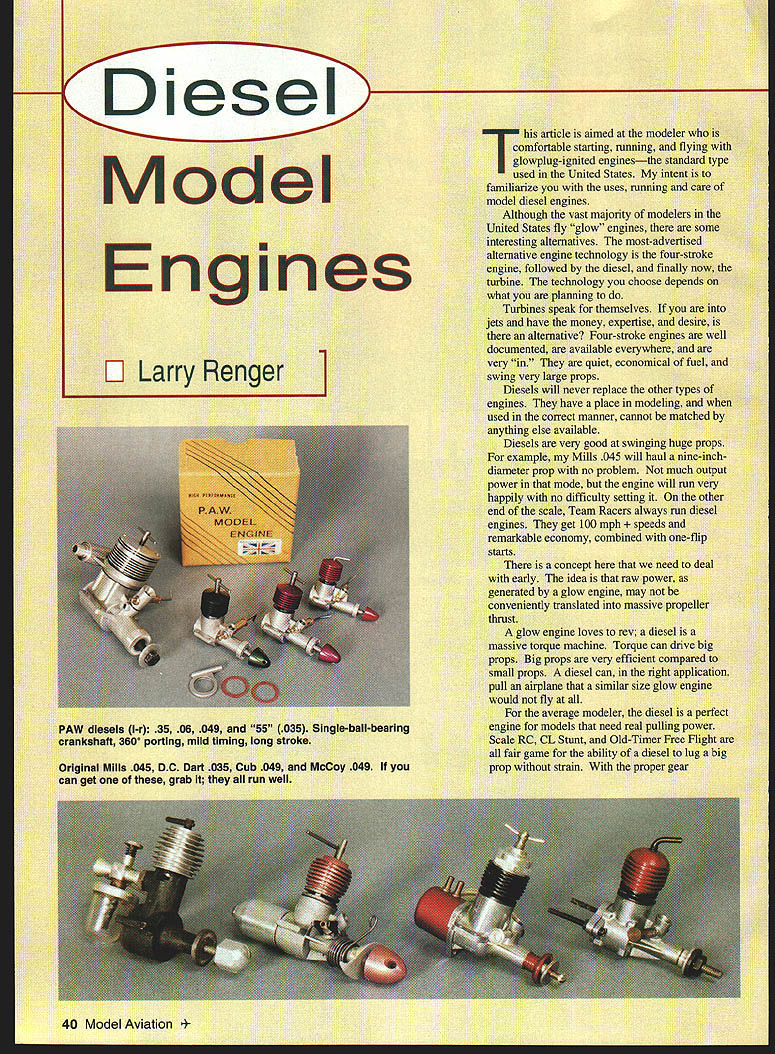
Diesels are very good at swinging huge props. For example, my Mills .045 will haul a nine-inch-diameter prop with no problem. Not much output power in that mode, but the engine will run very happily with no difficulty setting it. On the other end of the scale, Team Racers always run diesel engines. They get 100+ mph speeds and remarkable economy, combined with one-flip starts.
There is a concept here that we need to deal with early. The idea is that raw power, as generated by a glow engine, may not be conveniently translated into massive propeller thrust.
A glow engine loves to rev; a diesel is a massive torque machine. Torque can drive big props. Big props are very efficient compared to small props. A diesel can, in the right application, pull an airplane that a similar-size glow engine would not fly at all.
For the average modeler, the diesel is a perfect engine for models that need real pulling power. Scale, RC, CL, Stunt, and Old-Timer Free Flight are all fair game for the ability of a diesel to lug a big prop without strain. With the proper gear selection, helicopters and RC cars also benefit from the torque capability of diesel power.
The key is not that the diesel puts out raw power; it is that the huge torque capability lets you use big props (or high gear ratios) very efficiently. The net result can be greatly improved performance.
A Comparison
In applications that require swinging a large prop to maximize thrust, four-stroke engines and diesels have advantages over typical glow engines. Both types are much more economical of fuel usage, and are much quieter than a glow engine. There is also a certain amount of interest in both engine types, simply because they are technically possible and work well.
Now to select between the two types. I suspect that although the four-stroke engine gets more attention and advertising, more modelers have diesels than own four-strokes. Good, workable diesel engines have been in steady production throughout the world since before the invention of the glow plug. Until recently, diesels were more popular outside the US than glow engines, because the fuel components were easier to get than the nitro/alcohol mix we use here.
Workable production four-stroke engines are a relatively recent development in modeldom. Factors in favor of the four-stroke are the ease of starting, running, and adjustment of the latest designs. The low percentage of oil required in four-stroke fuel helps keep your models very clean compared to either glow or diesel. However, the power-to-weight ratio of a four-stroke is the lowest of the three types. Four-stroke engines are expensive, complex, and fragile compared to glow engines or diesels. The size of a four-stroke engine needs to be about double the capacity of a glow engine for a given model. By comparison, a diesel is typically specified one size smaller than the equivalent glow engine. For example, a .19 diesel will fly a .35 CL Stunt model.
Diesel model engines are built like tanks—very durable. A diesel will tune easily and run essentially any size prop. By minor modification it is possible to run a 16-inch prop on a .35 and produce usable power without damaging the engine. Power output may be less than ideal, but the ability to swing huge props at low rpm is what you want. Glow engines generally need to be designed around a particular rpm range and are not happy turning other-size propellers. Excess wear, unsteady settings, and overheating usually result.
There are several other advantages to diesels. The fuel economy of a well-designed diesel is about twice as good as a glow engine. A glow plug is not required, so it can't burn out; starting batteries are unnecessary; and a diesel can't flame out because a fuel drop hit the glow element. Battery booster systems for idle are completely unneeded too. Diesels can be incredibly small, because they don't need to accommodate a glow plug element in the head. The head design can be optimized for burning fuel without the extra cavity for the glow coil disturbing the flow.
On the negative side, diesels use funny-smelling, greasy fuel, and are hard to start because they require adjustment of two major tuning devices instead of one. Diesels are relatively hard to find, and experts are even more rare.
So what is the secret behind this little-known engine type? Diethyl ether. Ether bursts into flame when a column of air saturated with ether is rapidly compressed. Glow plug engines use a glowing coil of platinum alloy to ignite their nitro/alcohol fuel mix. Diesels time the ignition point of the diethyl-ether/kerosene fuel charge by controlling the engine's compression ratio.
As the piston rises to the top of the stroke, it compresses and heats the trapped air/fuel mixture. The ether detonates to start the burning of the main power component (kerosene). Compression ratios are much higher than those used in a glow engine, and this improves thermal efficiency. Kerosene has a higher energy content per pound than alcohol, so fuel economy improves as well. With diesels, oil for lubrication is contained in the fuel.
The combustion process of a model diesel differs from an automotive or industrial diesel. In those engines, the air is compressed to much higher levels than those in the model engine, and oil is sprayed into the combustion chamber in a fine mist at the moment that compression is at its peak. The hot, compressed air starts to burn the fuel without the need of a chemical or electric igniter, and the process is controlled by injector timing and the amount and pattern of spray.
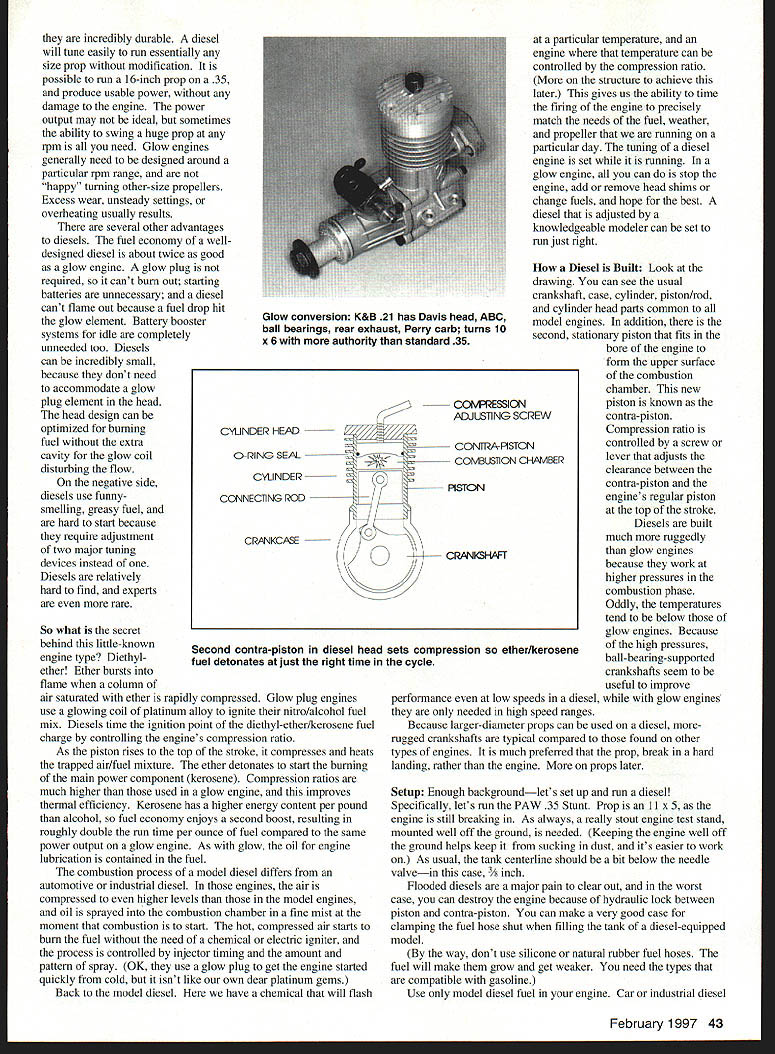
Back to the model diesel: here we have a chemical that will flash at a particular temperature, and an engine where that temperature can be controlled by the compression ratio. This gives us the ability to time the firing of the engine to precisely match the needs of the fuel, weather, and propeller that we are running on a particular day. The tuning of a diesel engine is set while it is running. In a glow engine, adjustments often require stopping the engine, adding or removing head shims or changing fuels. A diesel that is adjusted by a knowledgeable modeler can be set to run just right.
How a Diesel is Built
Look at the drawing. You can see the usual crankshaft, case, cylinder, piston/rod, and cylinder head parts common to all model engines. In addition, there is the second, stationary piston that fits in the bore of the engine to form the upper surface of the combustion chamber. This new piston is known as the contra-piston.
Compression ratio is controlled by a screw or lever that adjusts the clearance between the contra-piston and the engine's regular piston at the top of the stroke. Diesels are built much more ruggedly than glow engines because they work at higher pressures in the combustion phase. Oddly, the temperatures tend to be below those of glow engines. Because of the high pressures, ball-bearing-supported crankshafts seem to be useful to improve performance even at low speeds in a diesel, while with glow engines they are only needed in high speed ranges.
Because larger-diameter props can be used on a diesel, more-rugged crankshafts are typical compared to those found on other types of engines. It is much preferred that the prop break in a hard landing rather than the engine.
Setup
Enough background—let's set up and run a diesel! Specifically, let's run the PAW .35 Stunt. Prop is an 11 x 5, as the engine is still breaking in. As always, a really stout engine test stand, mounted well off the ground, is needed. (Keeping the engine well off the ground helps keep it from sucking in dust, and it's easier to work on.) As usual, the tank centerline should be a bit below the needle valve—in this case, 3/8 inch.
Flooded diesels are a major pain to clear out, and in the worst case, you can destroy the engine because of hydraulic lock between piston and contra-piston. You can make a very good case for clamping the fill hose shut when filling the tank of a diesel-equipped model.
(By the way, don't use silicone or natural rubber fuel hoses. The fuel will make them grow and get weaker. Use types that are compatible with gasoline.)
Use only model diesel fuel in your engine. Car or industrial diesel fuel won't run at all. There are several fuel manufacturers; I have provided addresses at the end of the article. Avoid electric starters if you want to keep your engine for any length of time.
Initial Starting
Most diesels are shipped with the compression level set correctly to start the engine, but let us assume that some dear friend started playing with the setting before you ever got a chance to run the engine.
The trick is to first find the compression setting, then work on the needle-valve setting. To do that, simply begin the process with an empty fuel tank. With a brand-new diesel, it is easiest to remove the muffler for those initial starts.
If the engine is set to the factory setting, use that. Otherwise, before getting fuel near the engine, screw the compression lever down until the piston just hits the contra-piston when you turn the engine over very slowly. Unscrew the lever 1/2 turn from there. This setting should be way "undercompressed," but it is the safe way to approach starting.
Flip the prop so the exhaust ports are closed, squirt some fuel in the exhaust port. Immediately turn the engine over twice while holding firmly onto the prop. A diesel is always capable of starting on the first try. Never casually flip the prop of a diesel.
Once you are prepared, start flipping the prop. The key is to flip the prop as fast as you can. Use of a chicken stick is highly recommended. Electric starters are not recommended, because they will destroy the engine instantly if it is hydro-locked because of excess prime.
Flip the prop, then close the compression lever a tiny bit at a time until the engine fires for a short burst. After every 20 or so flips, you'll want to reprime. Eventually, the engine will fire and run out the prime. Play with the prime and compression until you can get that run reliably. This is your cold-start compression setting.
Fill the tank and open the needle valve to its recommended starting setting. On this particular PAW, that is two turns open.
Now comes the fun part. A diesel—especially a brand-new diesel—doesn't like to continue running at the starting setting. Typically you need to tighten the compression down until the engine smooths out. For the first run on a new engine, tighten the compression until the engine smooths out, then back it off until you hear a slight intermittent miss or "burp." Let the engine run this way for about five minutes to do the basic wear-in of the mating parts. Pinch off the fuel hose to stop the engine, and let it cool off completely.
Break-In
After that first run and cool-down, you can begin to lean the engine out slowly and readjust the compression for more rpm. Do this slowly over several runs, and always be ready to reduce the compression if it sounds as though it is going into overheat mode.
My technique is to lean out the engine a tiny bit, then play with the compression until it is only just running without a "burp." More needle tweak, and compression again. At some point, the engine will suddenly stop running, and you know you have hit the absolute limit. Remember what that setting is; about 1/8 turn more open will be your running needle setting.
Speed of a diesel is controlled by compression; the needle is pretty much left alone. A caveat to this: I find that opening the needle 1/4 turn aids starting. Note your running settings for compression and needle, and you can just crank them back in as soon as the engine is running.
Break-in of a diesel is a long process, partly because the temperatures are lower than a glow engine, and because of the extra-tight piston fit required to maintain high compression. Many runs of about five minutes' length, with full cool-down between, are required to heat-cycle the engine parts so they stabilize. For the PAW, at least an hour of break-in will be needed.
All through break-in, friction will be higher than normal, and the runs will tend to be a bit unstable. Never leave a new diesel running on the bench without being ready to adjust the needle and compression. Keep listening to the sound of the engine and be ready to adjust the compression higher if it goes to a burping sound, or lower if it sounds smooth but "strained." You will learn to hear the character of a diesel's sound and detect preignition when the compression is too high.
There is no substitute for just running and running diesels to get the feel for how to run them. Play with the compression and needle, change props, and experiment. The goal is to run with the needle as lean as you can with the compression as low as possible. This takes a lot of back-and-forth tweaking of the two controls.
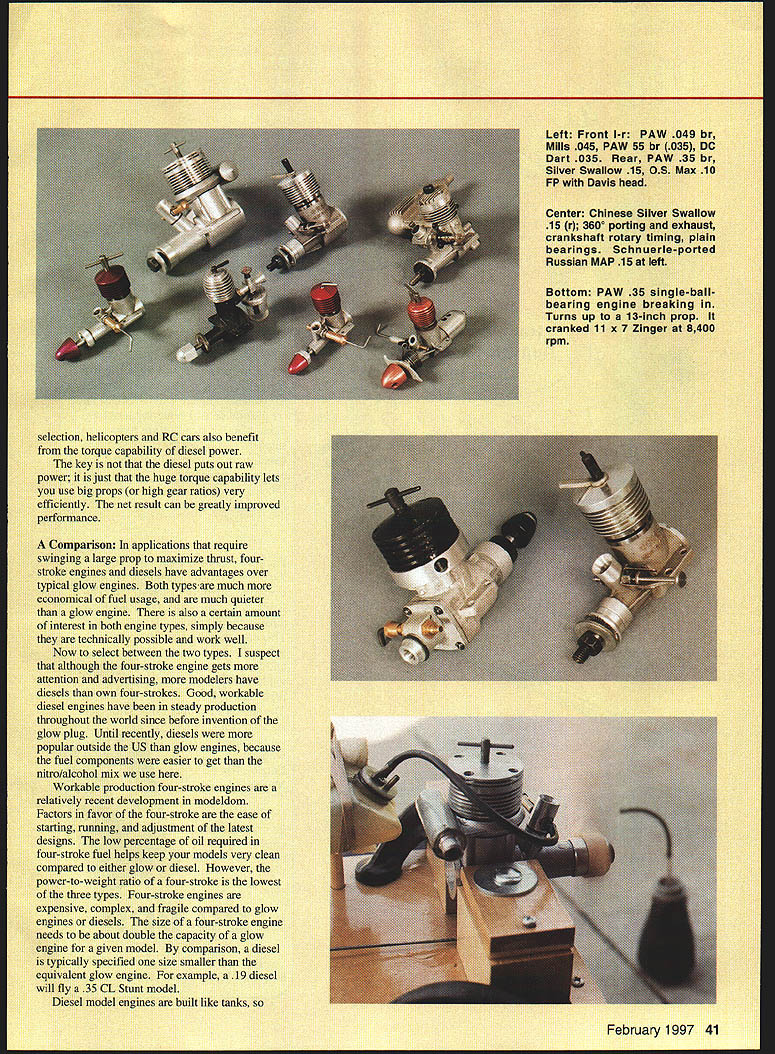
As break-in proceeds, and the engine runs reasonably steadily, switch to the propeller you expect to use when flying. The PAW will lug an 11 x 7 very nicely at 8,400 rpm. You may have to experiment to find the new starting settings, as timing will have changed depending on how different the size is from the initial prop. Typically, smaller props require more compression, and larger ones less. Another good thing to know: The starting setting of a cold engine is slightly higher compression than the running setting, and a hot engine slightly lower.
Shutdown and Storage: With a diesel, only shut the engine down by pinching the fuel hose—never flood it off. As with any engine, after running, clear out as much fuel as possible by running it dry. On the last run of the day, stop the engine by running it at full speed and removing the fuel hose. If the engine has stopped on its own, prime it and top it up with the fuel hose detached to completely clear out the crankcase and needle assembly.
After-run oil isn't usually necessary for a diesel unless you are going to store the engine for a very long time. The alcohol in glow engine fuel attracts moisture; none of the components in diesel fuel is hygroscopic.
One proviso, though, is that it is very important to store the engine with the exhaust ports open. That lets the last of the fuel residues evaporate, rather than leaving them to attack the metal surfaces (some acids are formed, it seems). Wrap the engine in a porous rag or tissue—never a plastic bag. Let the air at it unless, perhaps, you live in the tropics; then a closed container with silica gel desiccant is a good idea.
Available Engines
Now that you have had a chance to get familiar with the concept and techniques of diesels, let's take a look at what is available. Small diesels range down to .006 cubic inches (0.1 cc). Big diesels run up to about .60 cubic inches (10 cc), and you can get up to monster sizes by using large conversion heads.
As with glow engines, the little engines are a lot more touchy than the big ones, especially because of the difficulty of clearing out flooded conditions. I recommend at least a .09 (1.5 cc) size engine for your first diesel. Because of FAI competition, the largest assortment of diesel engines is available in the .15 (2.5 cc) range.
Diesel Engines vs. Converted Glow Engines
Regarding the relative merits of a designed-as-a-diesel engine vs. a glow engine converted to diesel, you have to consider several things. In my opinion, the ideal diesel engine is one that was conceived and designed for the purpose. However (and this is a very large however), the engine you want may not exist. Glow engines are available in much greater variety and supply, so converted glow engines can be a practical alternative when a purpose-built diesel is not available.
Have fun, and good luck.
Larry Renger 13182 Sutton St. Cerritos, CA 90703
Sources
- Aerodyne Models
1924 East Edinger Santa Ana, CA 92705 (714) 258-0805 Engines, fuel, many other kits & goodies
- Altech Marketing
(908) 225-6144 Engines
- Carlson Engine Imports
814 East Marconi Ave. Phoenix, AZ 85022 (602) 863-1684 Engines, fuel, accessories
- Eric Clutton
913 Cedar Ln. Tullahoma, TN 37388 (615) 455-2256 Engines, fuel, excellent book on diesels
- Davis Model Products
Box 141 Milford, CT 06460 (203) 877-1670 Diesel conversion heads, fuel
- FHS Supply, Inc.
Box 9 239 Bethel Church Road Clover, SC 29710 (800) 742-8484 Red Max files
- RJL Industries USA
Box 5 Sierra Madre, CA 91025 (818) 359-0016 Engines, diesel conversion heads
Transcribed from original scans by AI. Minor OCR errors may remain.

