
Dihedral
Blaine Beron-Rawdon
Three basic maneuvers involve the roll axis of the airplane:
- Straight and level flight
- Steady-state circling
- Steady-state rolling
This article discusses steady-state roll: a means to predict roll rate in detail and the effect of different dihedral arrangements on rolling properties. Part Three of the series will discuss steady-state circling and the relationship of dihedral to spiral stability. Part One introduced the basic mechanism of dihedral and a way to quantify it using the Equivalent Dihedral Angle (EDA).
Achieving steady-state roll
If we idealize the transition by ignoring certain lags, the process of achieving a steady-state roll can be simplified. First, the plane is yawed to a fixed yaw angle, which generates a roll moment due to the dihedral effect. As the plane accelerates in roll, an opposing roll-damping moment increases in proportion to the roll rate. When the roll moment and damping moment are equal, the roll rate stops increasing and a steady-state roll is achieved.
This process takes time. The principal way to reduce the time is to reduce the roll and yaw moments of inertia of the plane—keep the tip panels and tail group light.
Roll moment
The steady-state roll is achieved when the roll moment (from yaw) and the roll-damping moment are equal and opposite. The detailed calculation of roll moment due to yaw was described in Part One; the precise computation is not necessary here, but it is useful to review the variables that affect roll moment:
- Wing area: Roll moment is proportional to wing area because lift is proportional to area.
- Wingspan: Roll moment is proportional to wingspan because the lift lever arm increases with span.
- Roll rate: Roll moment due to yaw is not affected by roll rate. (There is a separate roll moment due to roll rate—roll damping.)
- Airspeed: Roll moment is proportional to the square of airspeed since lift varies with the square of airspeed.
- Yaw angle: Roll moment is approximately proportional to yaw angle.
- Dihedral (Equivalent Dihedral Angle, EDA): Roll moment is approximately proportional to EDA.
Summary: roll rate is proportional to airspeed, yaw angle, and EDA; inversely proportional to span. Example: to double roll rate you could double airspeed, double yaw angle, double EDA, or halve span.
Roll damping
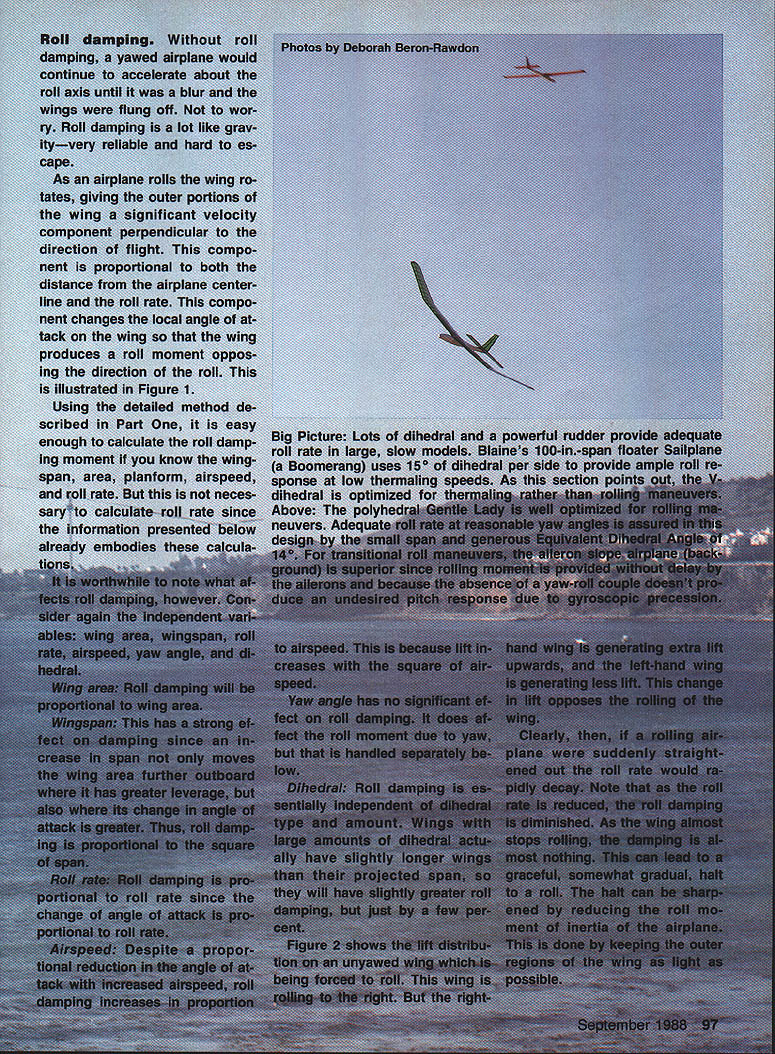
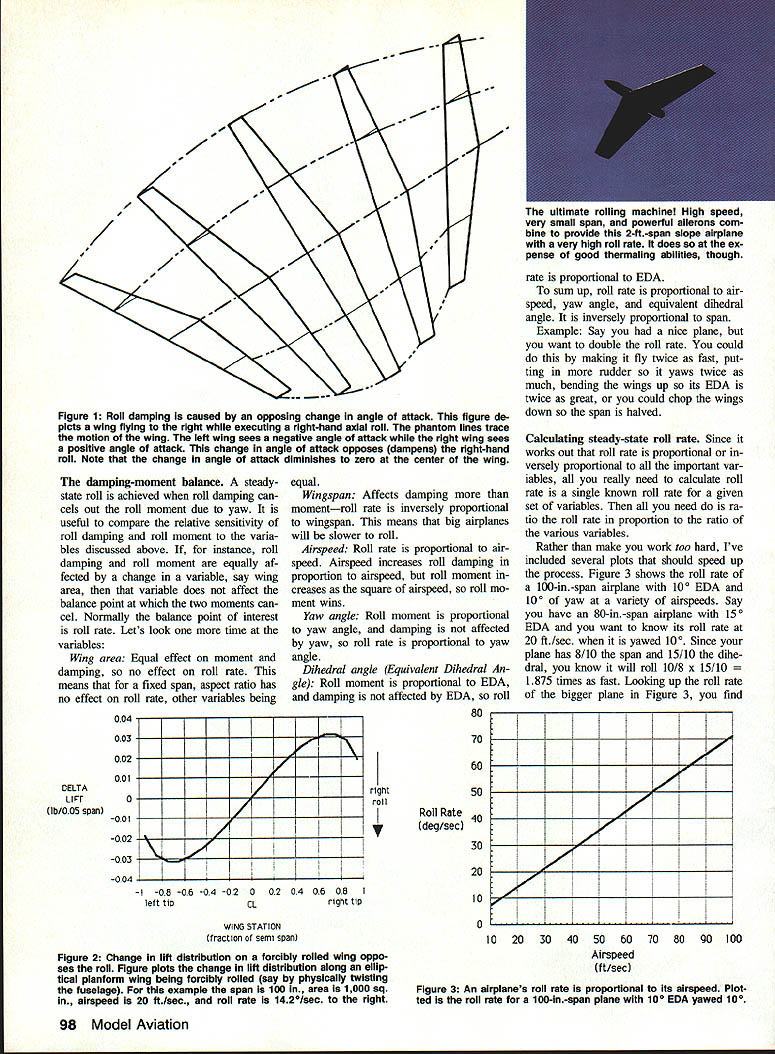
Without roll damping, a yawed airplane would accelerate about the roll axis without limit. Roll damping is produced because as the airplane rolls the wing rotates: outer portions of the wing acquire a velocity component perpendicular to flight that is proportional to distance from the centerline and to roll rate. That component changes local angle of attack and produces a roll moment opposing the roll.
Roll damping depends on wingspan, area, planform, airspeed, and roll rate, but you do not need to recompute it here because later graphs summarize the effect. Important dependencies:
- Wing area: Roll damping is proportional to wing area.
- Wingspan: Roll damping is proportional to the square of span (area is moved further outboard where its leverage and angle-of-attack change are greater).
- Roll rate: Roll damping is proportional to roll rate.
- Airspeed: Roll damping increases in proportion to airspeed (lift increases with the square of airspeed, and the angle-of-attack change reduces with speed but the net effect is proportional to airspeed).
- Yaw angle: Yaw has no significant effect on roll damping.
- Dihedral: Roll damping is essentially independent of dihedral amount; wings with high dihedral have slightly greater projected span and thus slightly more damping.
When rolling, as roll rate is reduced the damping lessens; damping is nearly zero as roll approaches zero, so the roll decay can be gradual unless inertia is reduced by light tips.
The damping-moment balance
Steady-state roll occurs when roll damping cancels the roll moment due to yaw. If roll damping and roll moment are equally affected by a change in a variable, that variable does not change the balance point (roll rate). Consider the variables:
Wing area
Equal effect on moment and damping, so no effect on roll rate. For a fixed span, aspect ratio has no effect on roll rate, other variables being equal.
Wingspan
Affects damping more than moment—roll rate is inversely proportional to wingspan. Large airplanes roll more slowly.
Airspeed
Roll rate is proportional to airspeed. Damping increases in proportion to airspeed, but roll moment increases with the square of airspeed, so moment grows faster.
Yaw angle
Roll moment is proportional to yaw angle; damping is not affected by yaw. Roll rate is proportional to yaw angle.
Dihedral (Equivalent Dihedral Angle, EDA)
Roll moment is proportional to EDA; damping is not affected by EDA. Roll rate is proportional to EDA.
Summary: roll rate ∝ airspeed × yaw angle × EDA, and ∝ 1 / wingspan.
Calculating steady-state roll rate
Because roll rate scales proportionally with some variables and inversely with others, you can compute the roll rate for one airplane from a known roll rate for another by taking ratios of the variables.
Examples (based on provided plots):
- Figure 3 gives roll rate for a 100‑in span airplane with 10° EDA and 10° yaw at various airspeeds. For an 80‑in span airplane with 15° EDA yawed 10° at 20 ft/sec: span ratio = 80/100 = 0.8, EDA ratio = 15/10 = 1.5, so roll rate scale = (10/8) × (15/10) = 1.875. If the 100‑in airplane rolls at about 14°/sec at 20 ft/sec, the 80‑in airplane will roll at 14 × 1.875 = 26.25°/sec.
- Figure 4 shows roll rate for 10° EDA and 10° yaw at 30 ft/sec across a variety of spans. If your plane has EDA = 15° (15/10), airspeed 20 ft/sec (20/30), and the same yaw, scale = (15/10) × (20/30) = 1.0, so the roll rate is the same as the plotted value. For an 80‑in span this gives about 26°/sec—consistent with the previous calculation.
- Figure 5 shows roll rate versus yaw angle for several EDAs.
Use the graphs (Figures 3–5) to estimate roll rates quickly.
Prototypical dihedral arrangements
Different dihedral schemes with the same EDA will roll at the same steady-state rate, but the local airflows and angle-of-attack distributions vary. These differences affect behavior near stall or when using minimal rudder. I describe two prototypical arrangements and one intermediate arrangement.
Parabolic (smooth curved) dihedral
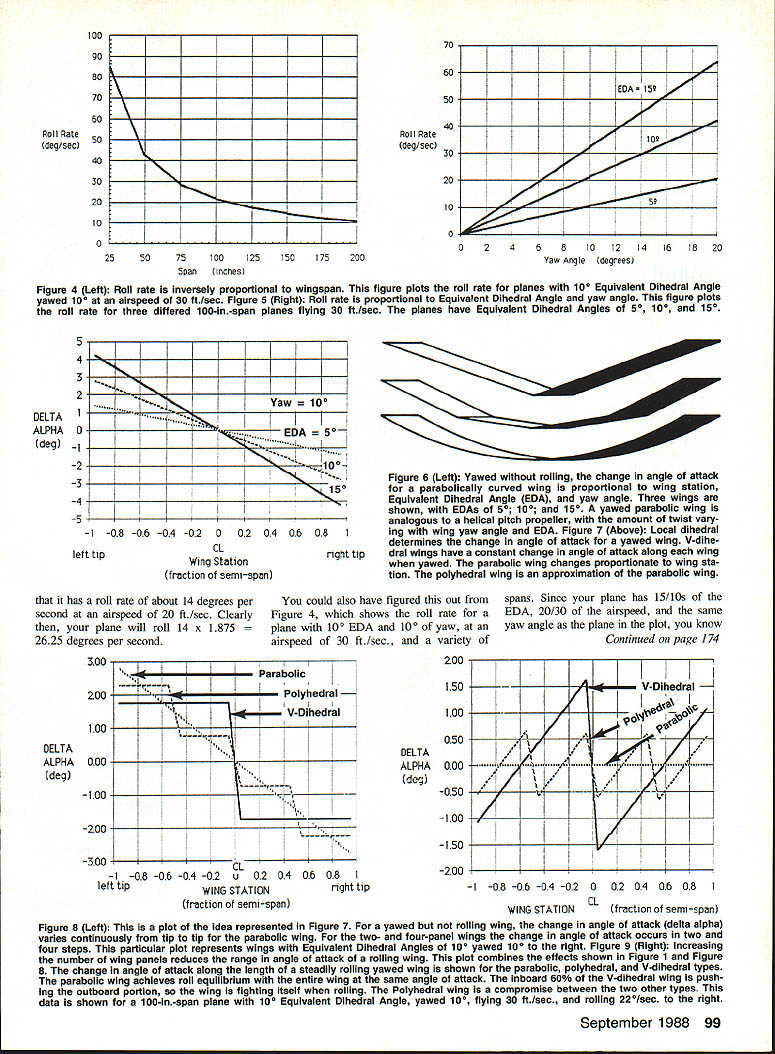
A smoothly curving (parabolic) dihedral has slope proportional to distance from the centerline. For moderate dihedral angles (< ~30°) the local dihedral angle increases roughly proportionally with distance from the centerline. When yawed, the change in angle of attack (Δα) increases linearly toward the tip. An approximate formula for the curvature is: Z = EDA × (0.0296 / b^2) × X^2 where Z is vertical height as a function of semispan X and total span b.
When forced to roll, the Δα induced by roll also varies proportionally with distance from the centerline; for a parabolic-dihedral wing these two effects match. At steady-state roll the Δα is zero all along the wing, so the entire wing works in unison—no part works against another. This minimizes angle-of-attack variation across the wing during steady rolls.
V-dihedral
A V-dihedral wing has the same dihedral angle everywhere along each half-wing, so a yawed V-wing produces a constant Δα along each half-wing. During roll, the roll-induced Δα varies with distance from the centerline, so the superposition can produce an inboard region trying to increase roll and an outboard region resisting it. Typically the inboard ~60% of the wing contributes to rolling faster while the outboard ~40% resists. The result is a larger range of Δα across the span (illustrated as a sawtooth/zig-zag pattern in the referenced figures).
This matters near stall or when the lift coefficient is near the edge of the low-drag “bucket.” High yaw or large EDA could drive parts of the wing outside the low-drag range, or could locally stall regions during rolling (e.g., inboard of the upgoing wing and outboard of the downgoing wing), reducing performance or handling.
V-dihedral wings are more sensitive to planform: if more area is outboard, roll rate is reduced because the inboard portion must “push” the outboard. A constant-chord wing will still roll about 89% as fast as an elliptical wing.
Polyhedral and intermediate (four-panel) wings
A four-panel wing with breaks at 0.5 semispan approximates the parabolic distribution by setting outer-panel dihedral proportional to distance from the centerline (outer panel center is three times the distance of inner panel center, so its dihedral is three times greater). Increasing the number of panels reduces the Δα range across the wing during steady roll—the sawtooth becomes finer—approaching the parabolic case.
Polyhedral arrangements therefore reduce angle-of-attack variation across the wing during steady rolls and improve behavior with less rudder or near-stall conditions.
Discussion
Designers of rudder-elevator airplanes can control maximum roll rate by choosing among variables. Span and airspeed have powerful effects but are often constrained by higher-priority requirements (glide ratio, sink rate). This leaves yaw angle and EDA as practical design levers.
- Yaw angle: Achieved with a large vertical stabilizer and big rudder, but large yaw angles are inefficient (fuselage drag) and slow to establish, reducing immediacy and precision of control.
- EDA: A large EDA is an effective way to increase roll rate with minor penalties: slightly increased drag from extra projected area, a need for somewhat larger vertical stabilizers to avoid Dutch-roll, and possible pilot finesse required when operating near the drag bucket edge.
For rolling maneuvers, parabolic or polyhedral arrangements are superior to simple V-dihedral because they produce a smaller range of Δα across the wing. However, in steady-state circling (Part Three) V-dihedral may enjoy advantages opposite to the rolling case, so design choices should consider the full mission.
Note: the discussion assumes elliptical planform wings as in Part One. Other planforms affect roll rates: V-dihedral wings are most sensitive to planform; parabolic-dihedral wings are relatively insensitive because they operate at nearly constant angle of attack along the span in steady roll.
Summary and conclusions
- Steady-state roll is achieved when the roll moment due to yaw is equaled by the opposing roll-damping moment.
- Roll moment due to yaw depends on wing area, wingspan, airspeed, yaw angle, and Equivalent Dihedral Angle (EDA).
- Roll-damping moment depends on wing area, wingspan, roll rate, and airspeed.
- Steady-state roll rate is proportional to airspeed, yaw angle, and EDA; inversely proportional to wingspan.
- Roll rate can be estimated from graphs (Figures 3–5) using ratios of variables.
- Two prototypical dihedral types (parabolic and V) and an intermediate polyhedral type were described.
- Dihedral schemes approaching parabolic curvature are best for rolling maneuvers because they minimize angle-of-attack variation across the wing during steady-state roll.
Transcribed from original scans by AI. Minor OCR errors may remain.

