

DIHEDRAL
Blaine Beron-Rawdon
In part four of this series, we look at which type of dihedral is the most efficient and wrap things up with a discussion of how to choose the appropriate dihedral type and amount to tailor your model for the type of flying it will be doing.
Because wings with dihedral have more surface area than flat wings producing the same lift, they are less efficient. The first part of this article examines this issue and quantifies the efficiency loss. The second part wraps up this four-part series with a discussion of how to choose dihedral type and quantity.
Efficiency
Wings produce lift in a direction perpendicular to both the flight path and the local spanwise surface of the wing. Thus, on a V-dihedral wing the left half produces a lift vector that points up and to the right, while the right half points up and to the left. The horizontal components of those vectors cancel, leaving only the vertical component. Because the vectors are tilted, the vertical component is slightly shorter than it would be for a flat wing.
To compensate for the reduced vertical lift, you can increase wing area proportionately or fly slightly faster. Either option yields about the same effect on efficiency.
Lift reduction
The reduction in lift is proportional to the cosine of the dihedral angle. For moderate dihedral angles the reduction is very small. For example:
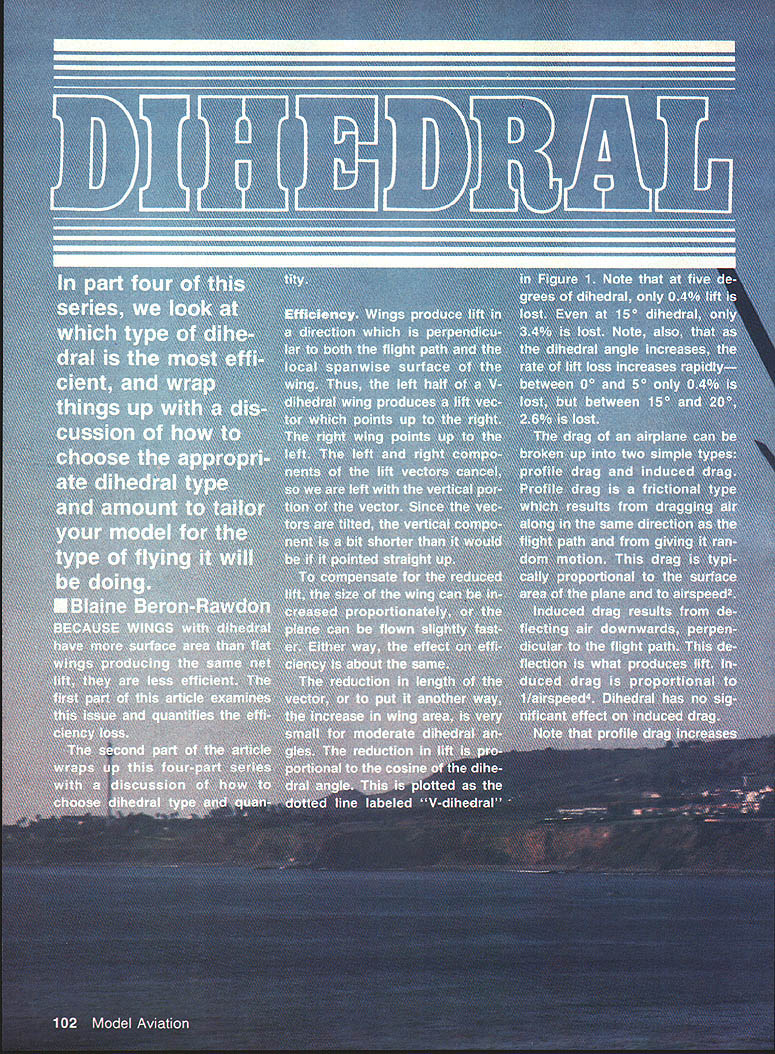
- At 5° dihedral, only about 0.4% of lift is lost.
- At 15° dihedral, about 3.4% is lost.
As dihedral angle increases, the rate of lift loss increases rapidly — between 0° and 5° only 0.49% is lost, but between 15° and 20° about 2.6% is lost.
Drag
Airplane drag can be broken down into two main types:
- Profile drag: a frictional drag from dragging air along the flight path and creating random motion. It is typically proportional to surface area and to airspeed squared.
- Induced drag: results from deflecting air downward to produce lift and is proportional to 1 / (airspeed squared).
Dihedral has no significant effect on induced drag. Straight-line efficiency falls off as dihedral is increased because the effective projected area of the wing is diminished relative to its actual surface area. Increased dihedral increases profile drag and thus the wing profile-drag fraction of total drag.
Dihedral distribution and efficiency
Different dihedral distributions give slightly different efficiencies. Parabolic dihedral and four-panel polyhedral wings are marginally more efficient; V-dihedral wings are the least efficient. However, the margin between these types is very small.
Two important points:
- Efficiency declines as Equivalent Dihedral Angle (EDA — see Part One) is increased.
- Parabolic dihedral and well-distributed polyhedral are marginally more efficient than V-dihedral, but the differences are small.
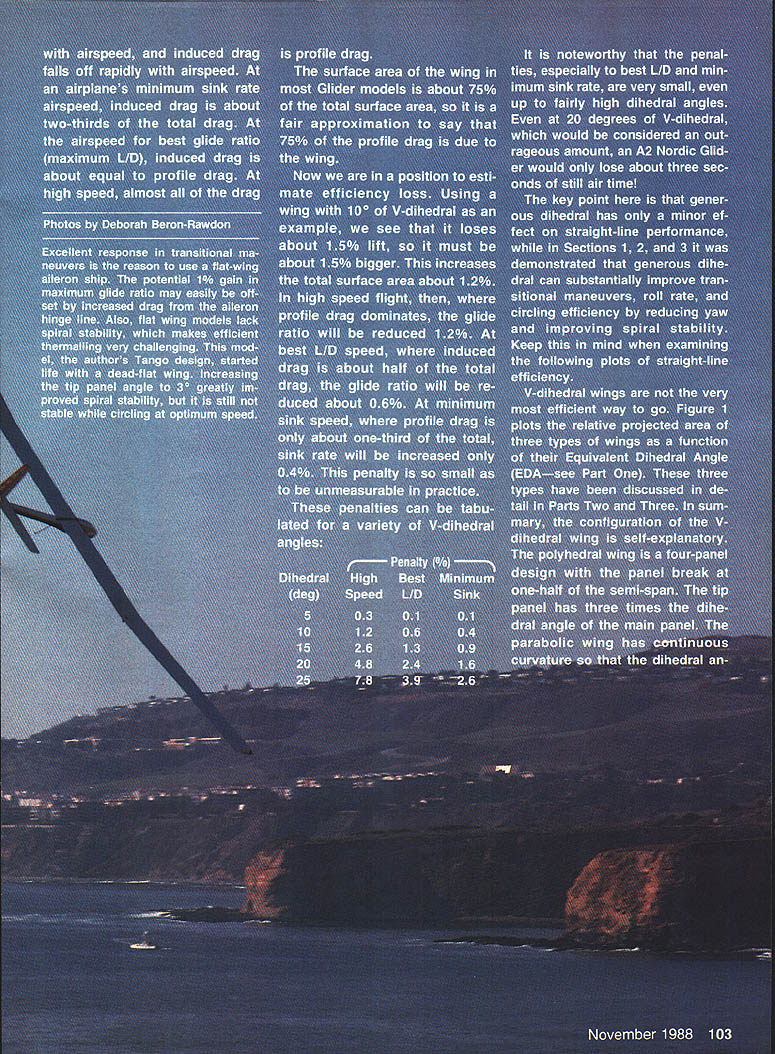
A key to minimizing the area penalty for a given EDA is putting the dihedral in the most effective place. The wing tip has the best leverage and is a good place for extra dihedral. However, concentrating all the dihedral in a small area forces very large local dihedral angles and increases projected-area penalty rapidly. In practice, the concentrated approach is the least efficient.
This concentrated-approach effect is illustrated by a four-panel polyhedral wing where the tip panel has 1,000 times the dihedral of the main panel (panel-dihedral ratio = 1000). With a 10° EDA, making the main panel much larger and the tip panel small forces the tip to bend up dramatically; the panel break moves out to about 0.07 semi-span and the tip panel may bend up to about 27° at around 0.27 semi-span, causing rapid loss of efficiency when the tip panel is reduced to less than half the semi-span.
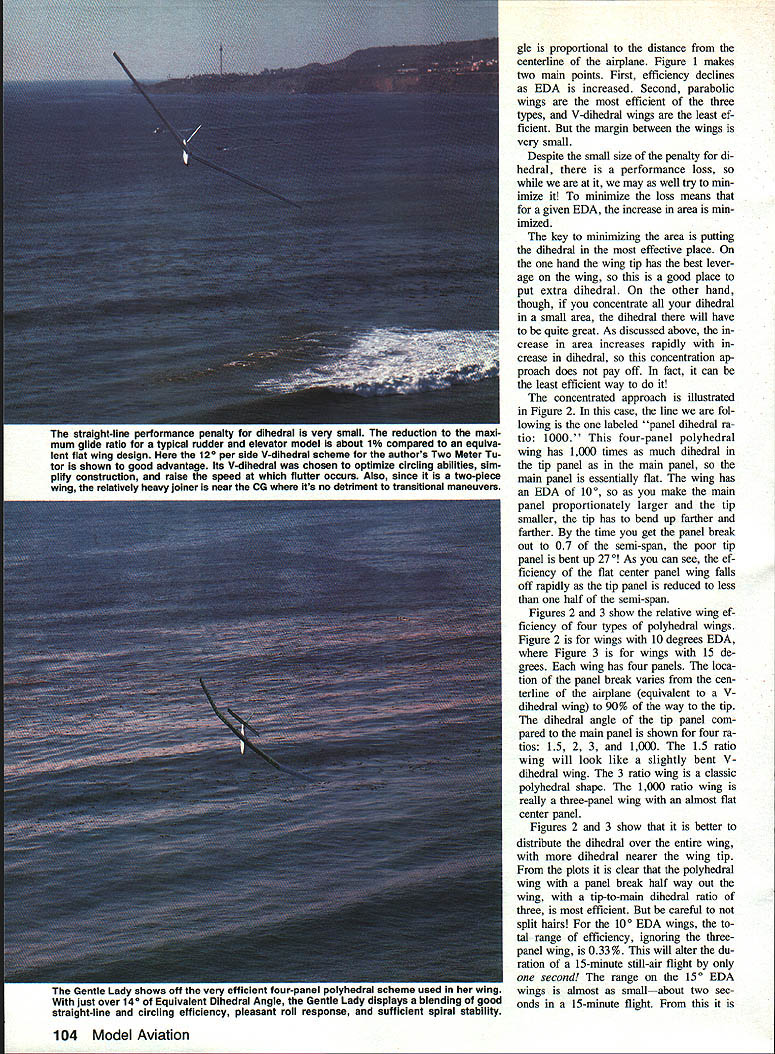
Figures comparing wings with 10° and 15° EDA and varying panel-break locations show that it is better to distribute dihedral over the entire wing, with more dihedral nearer the tip. A polyhedral wing with the panel break halfway out and a tip-to-main dihedral ratio of about three is near-optimal. But these are small differences — for a 10° EDA wing the total range of efficiency (ignoring extreme three-panel cases) is only about 0.33%, which would alter the duration of a 15-minute still-air flight by only a few seconds. For 15° EDA wings the change is similarly small (about two seconds on a 15-minute flight).
Model Aviation straight-line performance penalty for generous dihedral is very small in reduction of maximum glide ratio. A typical rudder-elevator model loses about 1% compared to an equivalent flat-wing design when fitted with 12° per side V-dihedral. The Two Meter Tutor used such a V-dihedral to optimize circling abilities, simplify construction, and raise flutter speed. Its very efficient four-panel polyhedral wing shows an EDA just over 14°.
Gentle Lady demonstrates a blend of good straight-line and circling efficiency, pleasant roll response, and sufficient spiral stability.
Quantified penalties
Typical straight-line performance penalties for various V-dihedral angles:
- 5°: High Speed 0.3%, Best L/D 0.1%, Minimum Sink 0.1%
- 10°: High Speed 1.2%, Best L/D 0.6%, Minimum Sink 0.4%
- 15°: High Speed 2.6%, Best L/D 1.3%, Minimum Sink 0.9%
- 20°: High Speed 4.8%, Best L/D 2.4%, Minimum Sink 1.6%
- 25°: High Speed 7.8%, Best L/D 3.9%, Minimum Sink 2.6%
Even at 20° of V-dihedral (an extreme amount), an A2 Nordic Glider would only lose about three seconds of still-air time on a typical flight. The penalties, especially to best L/D and minimum sink rate, are very small even at fairly high dihedral angles.
The key point: generous dihedral has only a minor effect on straight-line performance, while generous dihedral can substantially improve transition maneuvers, roll rate, and circling efficiency by reducing adverse yaw and improving spiral stability.
Choosing a dihedral type and amount
Aircraft design is a compromise. Dihedral amount affects straight-flight efficiency, roll rate, yaw during circling, and spiral stability.
- Less dihedral improves straight-flight efficiency.
- More dihedral improves performance during rolling or circling and enhances spiral stability.
Choose dihedral based on a balance of straight-line performance and maneuvering needs. The more time the model spends in transitional maneuvers or banked circles, the more dihedral it should have. Larger and slower models benefit more from generous dihedral for maneuvers and spiral stability.
New considerations
Flutter
Dihedral type affects flutter behavior of flutter-prone wings. Flutter is an interaction between a wing's bending and twisting oscillatory modes. Increasing the wing torsional oscillation frequency pushes the onset of flutter to higher speeds. Ways to do this:
- Make the wing more torsionally rigid (D-tubes, geodetic ribs).
- Move wing mass closer to the torsional axis (e.g., lightweight trailing edge).
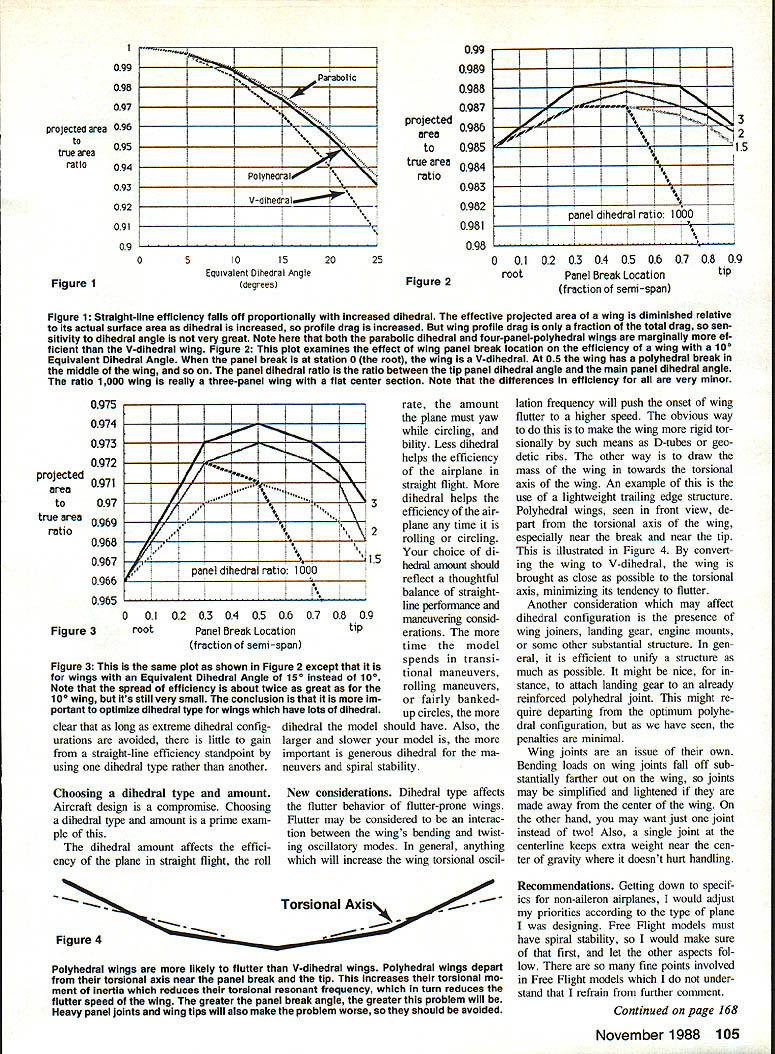
Polyhedral wings, in front view, depart from the torsional axis near the break and near the tip. Converting to V-dihedral brings the wing planform closer to the torsional axis, which can reduce tendency to flutter.
Wing joints
Wing joints have their own considerations. Bending loads on wing joints fall off substantially farther out on the wing, so joints can be simplified and lightened if placed away from the center. However, one joint at the centerline keeps extra weight near the center of gravity, which is often beneficial. You may prefer a single central joint or two outboard joints depending on trade-offs between weight, complexity, and strength.
Recommendations
For non-aerobatic airplanes, priorities should be adjusted by aircraft type.
Free Flight
Free Flight models must have spiral stability above all. Ensure spiral stability first; let other aspects follow.
RC sailplanes — thermal flying
RC sailplanes for thermal flying should have spiral stability, adequate roll rate, good transitional behavior, and good stall behavior while circling. These requirements can be met with either generous V-dihedral or generous polyhedral with substantial washout in the tip panels.
- Recommended EDA: absolute minimum 10°, more like 15° is preferred.
- Vertical tail moment arm: 35%–45% of wingspan.
- Vertical tail area: about 5%–6% of wing area.
- Keep wing tips and tail group light.
Long tail moment arms and ample vertical stabilizers provide control power and transitional damping.
RC sailplanes — aerobatic flying
Aerobatic sailplanes need high roll rate, good efficiency while rolling, and ample control power and damping.
- Use very generous four-panel polyhedral with tip panels about three times the main-panel angle.
- Consider six-panel wings for extreme roll behavior.
- Recommended EDA: 15°–20°.
- Use a fairly long tail moment arm and a large vertical stabilizer.
Rudder-and-elevator RC power trainers
Training power planes must stress spiral stability. Most power planes fly fast enough that roll rate is not a problem. Achieve spiral stability at lower speeds with ample dihedral and a long tail moment arm. Do not undersize the vertical stabilizer to try to gain spiral stability, as that will worsen tracking.
Rudder-and-elevator sport aerobatics
Rudder-and-elevator sport aerobatic power planes benefit from generous dihedral, a long tail moment arm, a larger vertical stabilizer, and lots of rudder throw for rapid roll rate and immediate response. Many Old-Timer models exemplify these traits. With modern wing sections and structure, such models can be spirited and enjoyable to fly.
Future developments
Further experimental work would be valuable:
- Measure roll rates of several sailplanes as a function of span, airspeed, dihedral, and EDA.
- Develop and publish systems to provide artificial spiral stability for otherwise unstable airplanes. Low-cost rate gyroscopes might allow practical schemes (for example, sensing yaw rate and driving the ailerons to achieve the yaw–roll coupling that dihedral provides naturally).
I hope this series on dihedral has been entertaining and of practical use to you.
Transcribed from original scans by AI. Minor OCR errors may remain.

