
The Dirigible Project
By popular demand: The Dirigible Project!
I have used and refined this project successfully with my junior-high-age aviation students for nearly 20 years, and it can't be beat for fun and an education as to how an airship works. Try it!
Aerostatics
We live at the bottom of an ocean of air, and the closer you get to the ground, the heavier (more dense) the air gets. A balloon filled with light hydrogen or helium will tend to rise until it reaches a level where the air around it has decreased in density. At this point the comparatively less-dense gas inside the envelope of the balloon can no longer lift it higher. The balloon will float at this level, in an aerostatic balance. By adding or subtracting ballast (extra weight), you can control, within inches, the altitude at which the balloon will hover.
Aerodynamics
A free balloon is an aerostat, having no power to move on its own, but a dirigible airship is dynamic and moving. Dirigibles, be they the old Zeppelin rigid-frame variety or the Goodyear-type that go limp when the gas is let out, are referred to as "lighter-than-air" as they are filled with a light gas (helium, these days).
Even though the gas takes care of lifting most of the flying machine's weight, they are flown a little on the heavy side aerostatically so that they will come down when they stop moving forward. The positive angle of attack of the ship moving forward under power provides dynamic lift to climb or cruise; the body of the ship acts like an airfoiled wing. Descending combines the aerostatic heaviness with "down" elevators, which operate only when the ship is moving to overcome this lifting body.
As this is a free-flying blimp, we can't put in down elevator in flight, so we rely on a tiny bit of extra weight, added in the form of modeling-clay ballast, to bring the model down slowly.
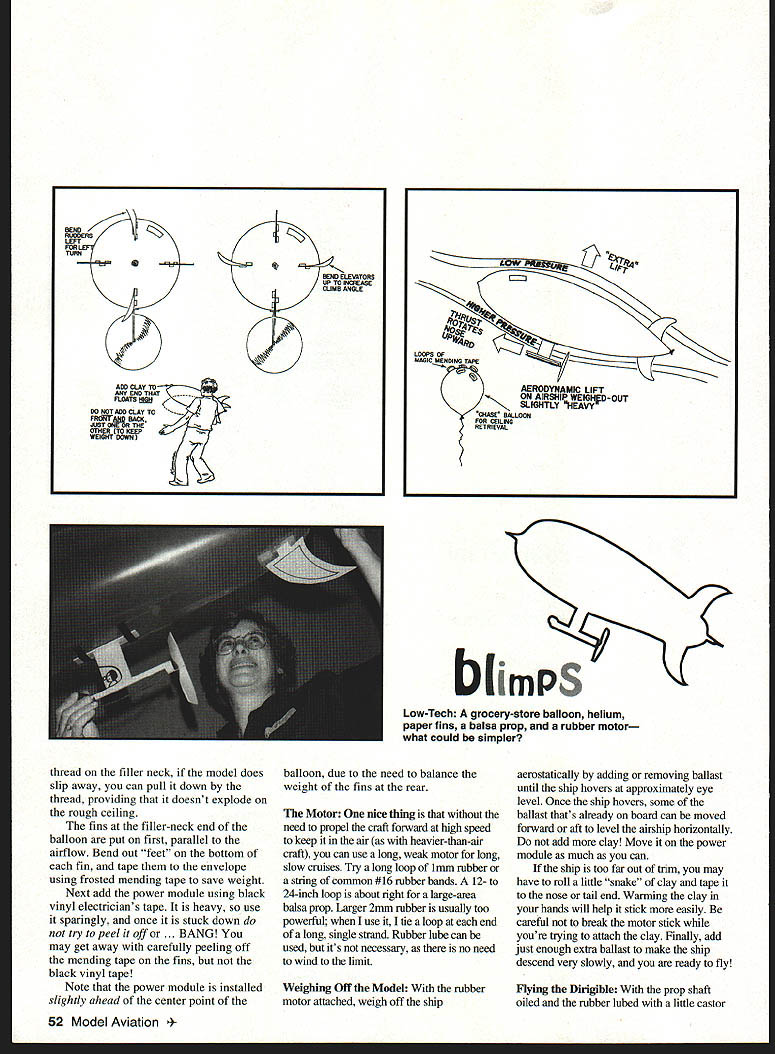
The thrustline of the dirigible's power module is low, and the center of mass and buoyancy is high, so the thrust pushing forward tends to push the nose up a little as the envelope (or hull) is rotated around the center of buoyancy. Drag on the envelope helps as well. The angle of climb can be controlled (within limits) with up or down elevators, which increase or decrease the dynamic lift produced from the angle of attack relative to the flight path.
The Envelope (Balloon)
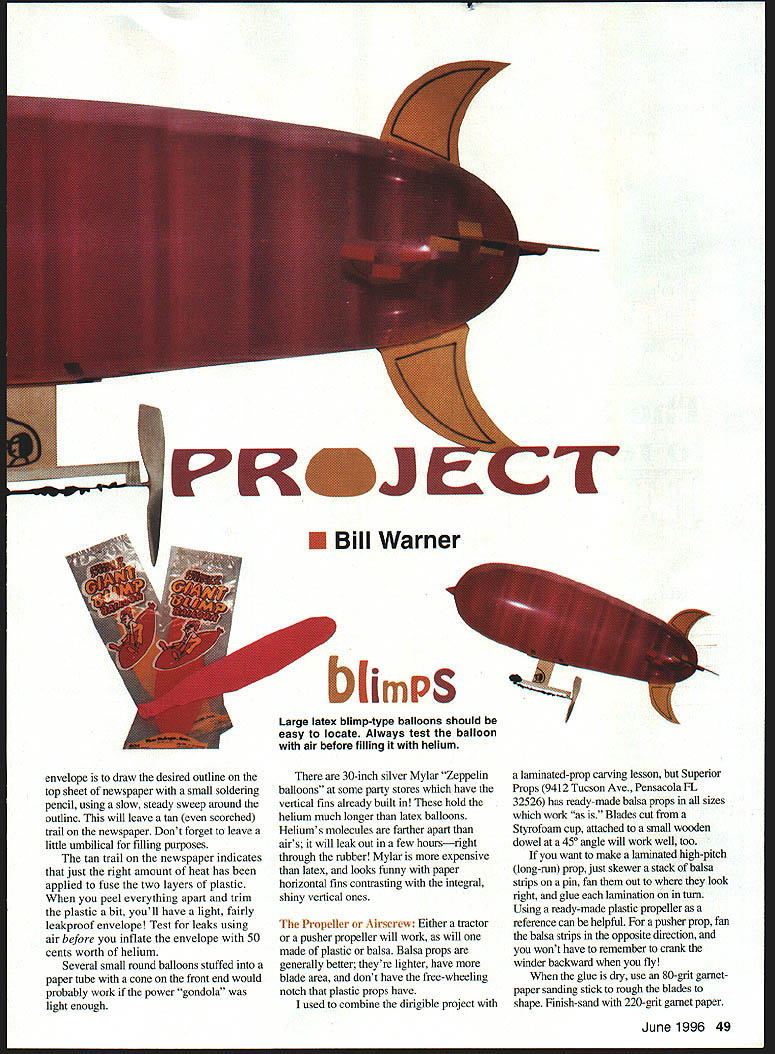
While helium is readily available at toy and party stores in small canisters (even my local welding-supply store and florist shop fill balloons), the 30-inch (inflated size) latex blimp balloon depicted may not be easy to find where you live. However, my supermarket in Porterville, California carries them, so if you can get them there you ought to be able to get them anywhere.
Actually, any long balloon or bundle of long balloons could work. One of my students made a tissue-covered Zeppelin using 1/16" balsa sticks and stuffed it in an envelope made from a dry-cleaning bag. It flew!
To make these custom envelopes:
- Place two layers of plastic on several layers of newspaper.
- Place a layer of newspaper on top of the plastic.
- Draw the desired outline on the top sheet of newspaper with a small soldering pencil, using a slow, steady sweep around the outline. This will leave a tan (even scorched) trail on the newspaper. Don't forget to leave a little umbilical for filling purposes.
- The tan trail on the newspaper indicates that just the right amount of heat has been applied to fuse the two layers of plastic. When you peel everything apart and trim the plastic a bit, you'll have a light, fairly leakproof envelope.
- Test for leaks using air before you inflate the envelope with 50 cents' worth of helium.
Several small round balloons stuffed into a paper tube with a cone on the front end would probably work if the power gondola was light enough.
There are 30-inch silver Mylar "Zeppelin balloons" at some party stores which have the vertical fins already built in! These hold the helium much longer than latex balloons. Helium's molecules are smaller than air molecules; it will leak out in a few hours—right through the rubber! Mylar is more expensive than latex, and looks funny with paper horizontal fins contrasting with the integral, shiny vertical ones.
The Propeller or Airscrew
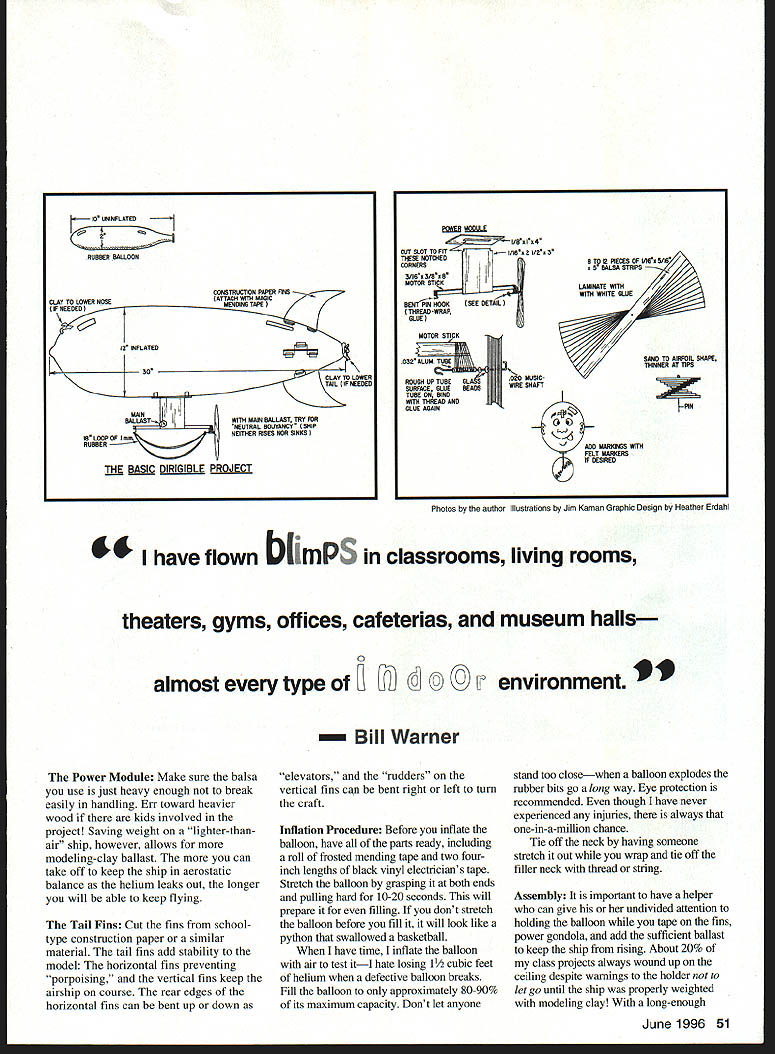
Either a tractor or a pusher propeller will work, as will one made of plastic or balsa. Balsa props are generally better; they're lighter, have more blade area, and don't have the free-wheeling notch that plastic props have.
Options and tips:
- Superior Props (9412 Tucson Ave., Pensacola, FL 32526) has ready-made balsa props in all sizes which work as is.
- Blades cut from a Styrofoam cup, attached to a small wooden dowel at a 45° angle, will work well.
- To make a laminated high-pitch (long-run) prop: skewer a stack of balsa strips on a pin, fan them out to where they look right, and glue each lamination on to turn. Use a ready-made plastic propeller as a reference.
- For a pusher prop, set the balsa strips in the opposite direction so you won't have to remember to crank the winder backward when you fly.
- When the glue is dry, use an 80-grit garnet-sanding stick to rough the blades to shape. Finish-sand with 220-grit garnet paper.
The Power Module
Make sure the balsa you use is just heavy enough not to break easily in handling. Err toward heavier wood if there are kids involved in the project. Saving weight on a lighter-than-air ship, however, allows for more modeling-clay ballast. The more you can take off to keep the ship in aerostatic balance as the helium leaks out, the longer you will be able to keep flying.
The Tail Fins
Cut the fins from school-type construction paper or a similar material. The tail fins add stability to the model: the horizontal fins prevent porpoising, and the vertical fins keep the airship on course. The rear edges of the horizontal fins can be bent up or down as elevators, and the rudders on the vertical fins can be bent right or left to turn the craft.
Inflation Procedure
Before you inflate the balloon, have all of the parts ready, including a roll of frosted mending tape and two four-inch lengths of black vinyl electrician's tape. Stretch the balloon by grasping it at both ends and pulling hard for 10–20 seconds. This will prepare it for even filling. If you don't stretch the balloon before you fill it, it will look like a python that swallowed a basketball.
If I have time, I inflate the balloon with air to test it—I hate losing 1/2 cubic foot of helium when a defective balloon breaks. Fill the balloon to only approximately 80–90% of its maximum capacity. Don't let anyone stand too close—when a balloon explodes the rubber bits go a long way. Eye protection is recommended. Even though I have never experienced any injuries, there is always that one-in-a-million chance.
Tie off the neck by having someone stretch it out while you wrap and tie off the neck filler with thread or string.
Assembly
It is important to have a helper who can give his or her undivided attention to holding the balloon while you tape on the fins, power gondola, and add sufficient ballast to keep the ship from rising. About 20% of my class projects always wound up on the ceiling despite warnings to the holder not to let go until the ship was properly weighted with modeling clay! With a long-enough thread on the filler neck, if the model does slip away, you can pull it down by the thread, providing that it doesn't explode on the rough ceiling.
The fins at the filler-neck end of the balloon are put on first, parallel to the airflow. Bend out "feet" on the bottom of each fin, and tape them to the envelope using frosted mending tape to save weight.
Next add the power module using black vinyl electrician's tape. It is heavy, so use it sparingly, and once it is stuck down do not try to peel it off or ... BANG! You may get away with carefully peeling off the mending tape on the fins, but not the black vinyl tape.
Note that the power module is installed slightly ahead of the center point of the balloon, due to the need to balance the weight of the fins at the rear.
The Motor
One nice thing is that without the need to propel the craft forward at high speed to keep it in the air (as with heavier-than-air craft), you can use a long, weak motor for long, slow cruises. Try a long loop of 1 mm rubber or a string of common #16 rubber bands. A 12- to 24-inch loop is about right for a large-area balsa prop. Larger 2 mm rubber is usually too powerful; when I use it, I tie a loop at each end of a long, single strand. Rubber lube can be used, but it's not necessary, as there is no need to wind to the limit.
Weighing Off the Model
With the rubber motor attached, weigh off the ship aerostatically by adding or removing ballast until the ship hovers at approximately eye level. Once the ship hovers, some of the ballast that's already on board can be moved forward or aft to level the airship horizontally. Do not add more clay; move it on the power module as much as you can.
If the ship is too far out of trim, you may have to roll a little snake of clay and tape it to the nose or tail end. Warning: the clay in your hands will help it stick more easily. Be careful not to break the motor stick while you're trying to attach the clay. Finally, add just enough extra ballast to make the ship descend very slowly, and you are ready to fly!
Flying the Dirigible
With the prop shaft oiled and the rubber lubed with a little castor oil or glycerin, wind 'er up. A mechanical winder is invaluable.
Launching the ship is simple. Aim it where you want it to go and release. No throw needed! The flight path can be controlled by bending the vertical fins to act as rudders. Bending the rear parts of both the top and bottom fins to the left (as seen from the rear) makes them into rudders for a left turn.
The rate of climb can be controlled by bending both of the horizontal fins up at the rear for more climb, or down for less. The slower the ship flies, the less effective these control surfaces will be.
Another way to alter the climb is to shift a little of the ballast forward for less climb, or aft for more. A too-fast climb can be tamed with a weaker rubber motor that will cut the flying speed and lessen the dynamic lift.
During high-ceiling flying sessions, we use a "chase balloon" on a thread (string is too heavy) with sticky-side-out loops of frosted mending tape spun on top. The tape loops will stick to the underside of the lost airship, so it can be gently and steadily pulled down.
Having fun: After you have mastered climbing and turning with your blimp, experiment! Try to get it to fly straight, see how long it will fly without hitting the walls or ceiling, or try to fly it under a table without it touching.
Make a little parachute and hang it from a toothpick wound into the very rear of the rubber motor. When the motor turns are exhausted, the toothpick and the parachute will be released. (Make sure to weigh off the airship before you add the toothpick, or it will go to the ceiling when the parachute is released!) Dream up your own stunts!
I have flown blimps in classrooms, living rooms, theaters, gyms, offices, cafeterias, and museum halls—almost every type of indoor environment. Just remember to take a chase balloon if the ceiling is high. Some kids tied long thread tails to the models to help get them down from the ceiling.
Remember: Don't fly outdoors until you are ready to say goodbye to your project—there are thicker bushes and always-moving currents of air, even when you think it's dead calm!
I am deeply indebted to Bill Watson for many of the ideas that are presented here. I worked with Bill in the Summer Science Workshop program at the California Museum of Science and Industry in Los Angeles.
Postscript: Once the basics of the aerostatic/aerodynamic nature of the dirigible airship have been learned, it probably wouldn't require much imagination to adapt the tiny Kenway electric motor system to the dirigible. The new superlight Czech RC systems could also provide directional control.
Transcribed from original scans by AI. Minor OCR errors may remain.

