
District IX Report - 2003/03
News from Colorado
Continued from last month is the story of the Arvada Associated Modelers Airpark. The photos and information were contributed by Chris Sturm.
Creative Frequency Control
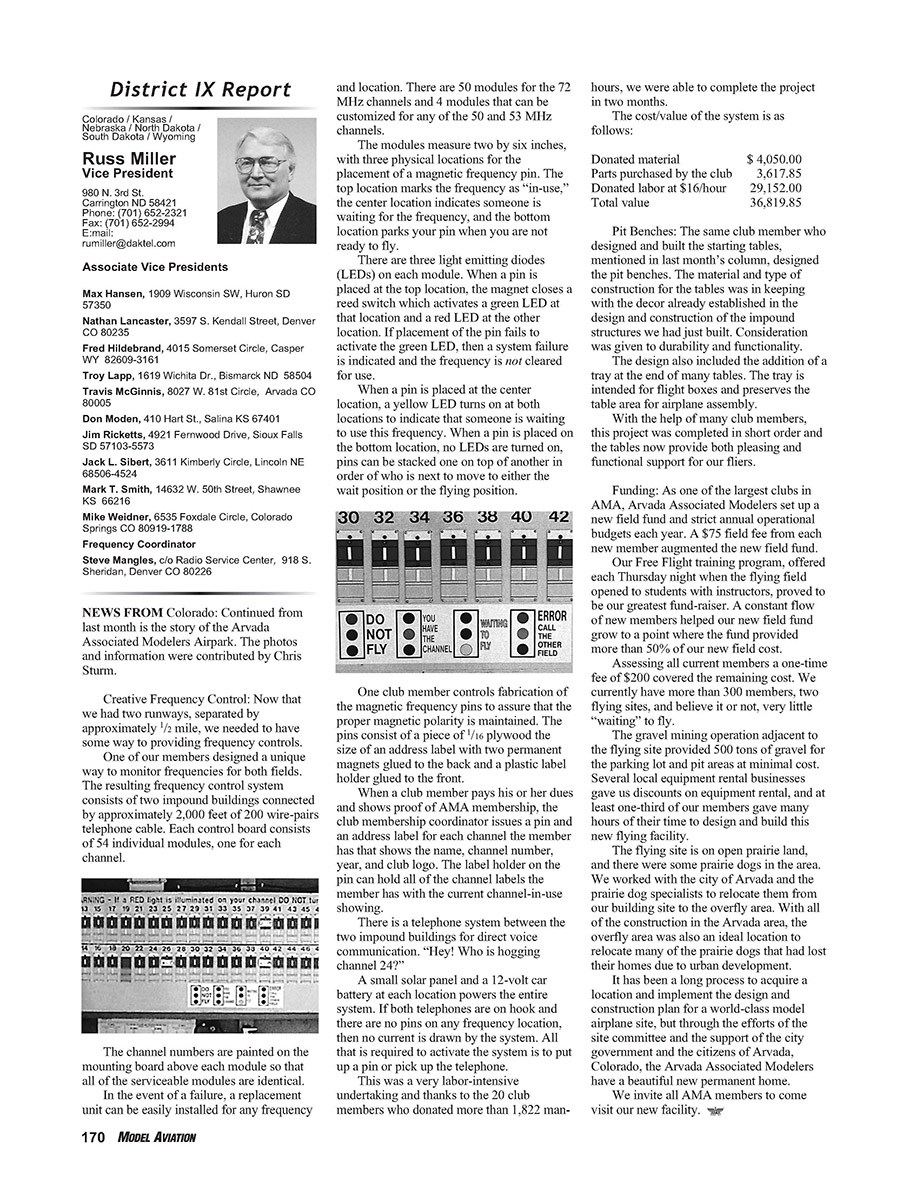
Now that we had two runways, separated by approximately 1/2 mile, we needed some way to provide frequency controls. One of our members designed a unique way to monitor frequencies for both fields. The resulting frequency control system consists of two impound buildings connected by approximately 2,000 feet of 200-pair telephone cable. Each control board consists of 54 individual modules, one for each channel.
The channel numbers are painted on the mounting board above each module so that all of the serviceable modules are identical. In the event of a failure, a replacement unit can be easily installed for any frequency and location. There are 50 modules for the 72 MHz channels and 4 modules that can be customized for any of the 50 MHz and 53 MHz channels.
The modules measure 2 by 6 inches, with three physical locations for the placement of a magnetic frequency pin. The top location marks the frequency as “in use,” the center location indicates someone is waiting for the frequency, and the bottom location parks your pin when you are not ready to fly.
There are three light-emitting diodes (LEDs) on each module:
- When a pin is placed at the top location, the magnet closes a reed switch which activates a green LED at that location and a red LED at the other location. If placement of the pin fails to activate the green LED, then a system failure is indicated and the frequency is not cleared for use.
- When a pin is placed at the center location, a yellow LED turns on at both locations to indicate that someone is waiting to use this frequency.
- When a pin is placed on the bottom location, no LEDs are turned on; pins can be stacked one on top of another in order of who is next to move to either the wait position or the flying position.
One club member controls fabrication of the magnetic frequency pins to assure that the proper magnetic polarity is maintained. The pins consist of a piece of 1/16" plywood the size of an address label with two permanent magnets glued to the back and a plastic label holder glued to the front. When a club member pays his or her dues and shows proof of AMA membership, the club membership coordinator issues a pin and an address label for each channel the member has; the label shows the name, channel number, year, and club logo. The label holder on the pin can hold all of the channel labels the member has with the current channel-in-use showing.
There is a telephone system between the two impound buildings for direct voice communication. “Hey! Who is hogging channel 24?” A small solar panel and a 12-volt car battery at each location power the entire system. If both telephones are on hook and there are no pins on any frequency location, then no current is drawn by the system. All that is required to activate the system is to put up a pin or pick up the telephone. This was a very labor-intensive undertaking and, thanks to the 20 club members who donated more than 1,822 man‑hours, we were able to complete the project in two months.
The cost/value of the system is as follows:
- Donated material ........................................ $4,050.00
- Parts purchased by the club ........................ $3,617.85
- Donated labor at $16/hour .......................... $29,152.00
- Total value ............................................ $36,819.85
Pit Benches
The same club member who designed and built the starting tables, mentioned in last month’s column, designed the pit benches. The material and type of construction for the tables was in keeping with the decor already established in the design and construction of the impound structures we had just built. Consideration was given to durability and functionality. The design also included the addition of a tray at the end of many tables. The tray is intended for flight boxes and preserves the table area for airplane assembly. With the help of many club members, this project was completed in short order and the tables now provide both pleasing and functional support for our fliers.
Funding
As one of the largest clubs in AMA, Arvada Associated Modelers set up a flying fund and strict annual operational budgets each year. A $75 field fee from each new member augmented the new-field fund. Our free flight training program, held each Thursday night when the flying field opened to students with instructors, proved to be the greatest fundraiser. A constant flow of new members helped our new field grow to a point where the fund provided more than 50% of our expenditures.
Assessing all current members a one-time fee of $200 covered the remaining cost. We currently have more than 300 members, two flying sites, and — believe it or not — very little “waiting” to fly.
The gravel-mining operation adjacent to the flying site provided 500 tons of gravel for the parking lot and pit areas at minimal cost. Several local equipment rental businesses gave us discounts on equipment rental, and at least one-third of our members gave many hours of their time to design and build this new flying facility.
The flying site is on prairie land, and there were some prairie dogs in the area. We worked with the city of Arvada and prairie-dog specialists to relocate them from our building site to the overflow area. With all of the construction in the Arvada area, the overflow area was an ideal location to relocate many of the prairie dogs that had lost their homes to urban development.
It has been a long process to acquire a location and implement the design and construction plan for a world-class model airplane site, but through the efforts of the site committee and the support of the city government and the citizens of Arvada, Colorado, the Arvada Associated Modelers have a beautiful new permanent home.
We invite all AMA members to come visit our new facility.
Transcribed from original scans by AI. Minor OCR errors may remain.

