
District IX Report - 2004/07
Colorado / Kansas / Nebraska / North Dakota / South Dakota / Wyoming
Russ Miller Vice President
980 N. 3rd St. Carrington, ND 58421 Tel.: (701) 652-2321 Fax: (701) 652-2994 E-mail: rumiller@daktel.com
Associate Vice Presidents
- Max Hansen, 1909 Wisconsin SW, Huron, SD 57350
- H. Michael Harrington, 6112 Ashton Ct., Ft. Collins, CO 80525
- Fred Hildebrand, 4015 Somerset Circle, Casper, WY 82609-3161
- Nathan Lancaster, 3597 S. Kendall Street, Denver, CO 80235
- Troy Lapp, 1619 Wichita Dr., Bismarck, ND 58504
- Travis McGinnis, 8027 W. 81st Circle, Arvada, CO 80005
- Don Moden, 410 Hart St., Salina, KS 67401
- Jim Ricketts, 4921 Fernwood Drive, Sioux Falls, SD 57103-5573
- Jack L. Sibert, 3611 Kimberly Circle, Lincoln, NE 68506-4524
- Mark T. Smith, 14632 W. 50th Street, Shawnee, KS 66216
Frequency Coordinator
- Steve Mangles, c/o Radio Service Center, 918 S. Sheridan, Denver, CO 80226
NEWS FROM COLORADO
Gayle Jackson of the Jefco Aeromod'lers club sent in the following article. It is a reminder to always take weather seriously.
It was approximately 6 p.m. one evening last summer. My son Matthew and I were at a local park where we were flying his Schoolboy ARF—a small RC trainer. As we were fueling up the airplane for another flight, you couldn't help but notice that bad weather was moving in.
The sky was dark and ugly. Breezes were starting to stir. On the distant horizon you could see little bolts of lightning shoot down to the ground; however, we were not too concerned because they were so far away you couldn't even hear them.
It was in this setting that Matt took off for the start of another 20-minute flight. Shortly after takeoff, Matt handed me the transmitter and said, "Here Dad, this flight is yours."
Roughly 10 minutes into the flight, the sky was noticeably darker than it was at takeoff. Those little lightning strikes on the distant horizon were still too far away to be heard, so I thought it would be okay to go ahead and continue with the flight. Just as a precaution, as to not invite a lightning strike, I held the transmitter at waist level with the antenna pointing approximately 45° down toward the ground.
After approximately 20 minutes of flight time, the Schoolboy ARF ran out of fuel. Since it was Matt's airplane, I thought he would want to make the dead-stick landing, so I gave the transmitter back to him. As Matt brought the model in for a landing, it touched down roughly 200 feet away.
Matt and I walked out together to get the model. As we picked it up, we turned off the receiver and transmitter and headed back for the car. I was carrying the airplane and Matt was carrying the transmitter. He was holding the transmitter waist high, with the antenna pointing upward at approximately a 30° angle.
Then it happened! There was a flash of light, and an earsplitting, cracking sound from a much-too-close-for-comfort bolt of lightning. It was so close that the flash and the sound seemed to arrive at the same time.
Now for the scary part. Just a fraction of a second before the lightning strike, the transmitter's antenna picked up a charge of static electricity that gave Matt a nasty zap on his right hand. The static charge was strong enough that Matt could feel it run up his arm, down his torso, and down his right leg where it jumped out the back of his heel on its way to the ground.
Without delay, we collapsed the antenna and ran for the car. While we were sitting in the car, we decided that the next thing on our agenda would be to have dinner at Taco Bell and to not put up another flight.
They say that experience is the best teacher, but that's only if you live through the experience. We were lucky, and yes, we did learn something from this.
As an interesting side note, imagine what could happen to a control-line (CL) model flying on steel cables at the top of a wingover in this same set of circumstances. I'm sure that we have all done dumb things at one time or another; however, it would definitely be in your best interest to not let this be one of them.
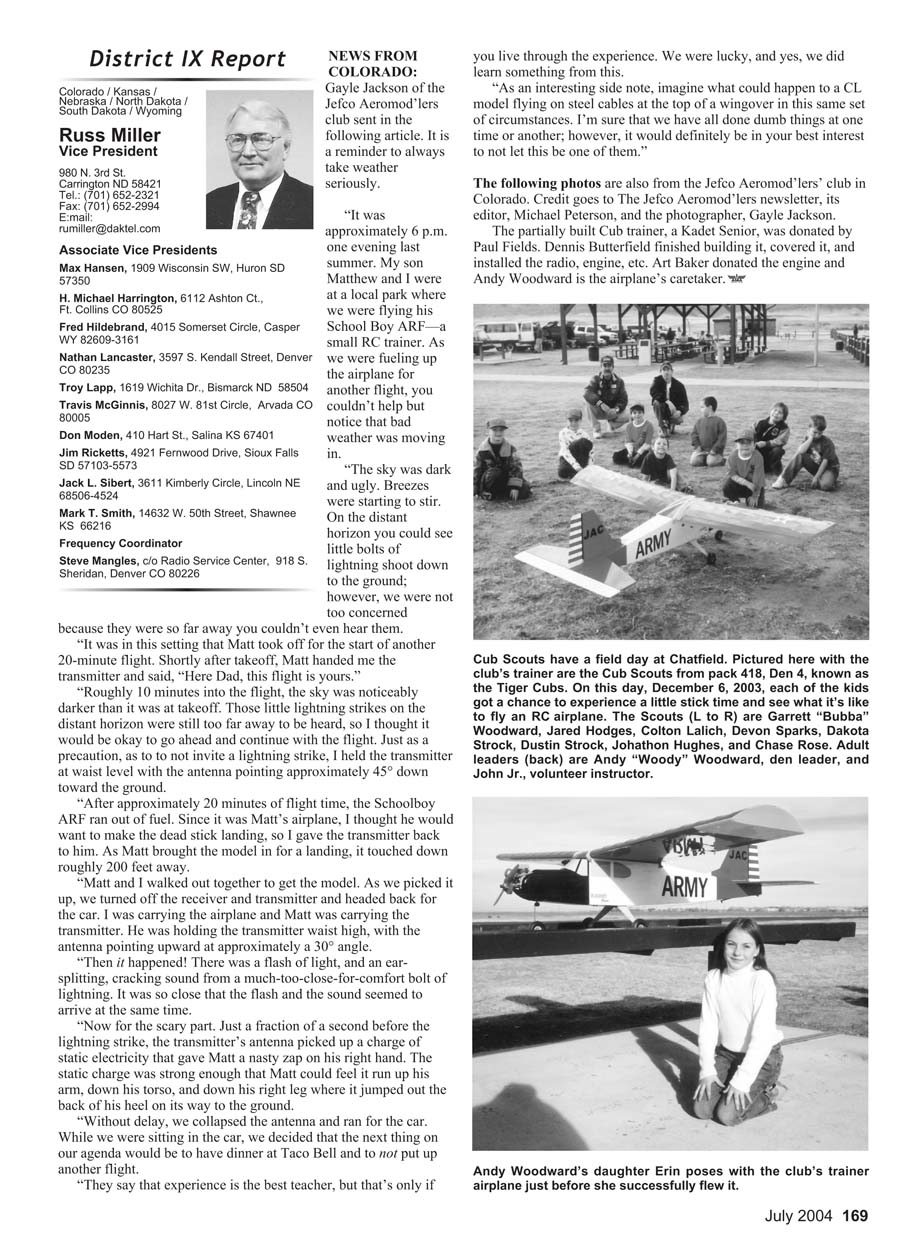
The following photos are also from the Jefco Aeromod'lers club in Colorado. Credit goes to the Jefco Aeromod'lers newsletter, its editor Michael Peterson, and the photographer Gayle Jackson.
The partially built Cub trainer, a Kadet Senior, was donated by Paul Fields. Dennis Butterfield finished building it, covered it, and installed the radio, engine, etc. Art Baker donated the engine and Andy Woodward is the airplane's caretaker.
Transcribed from original scans by AI. Minor OCR errors may remain.

