
Do It On The Water!
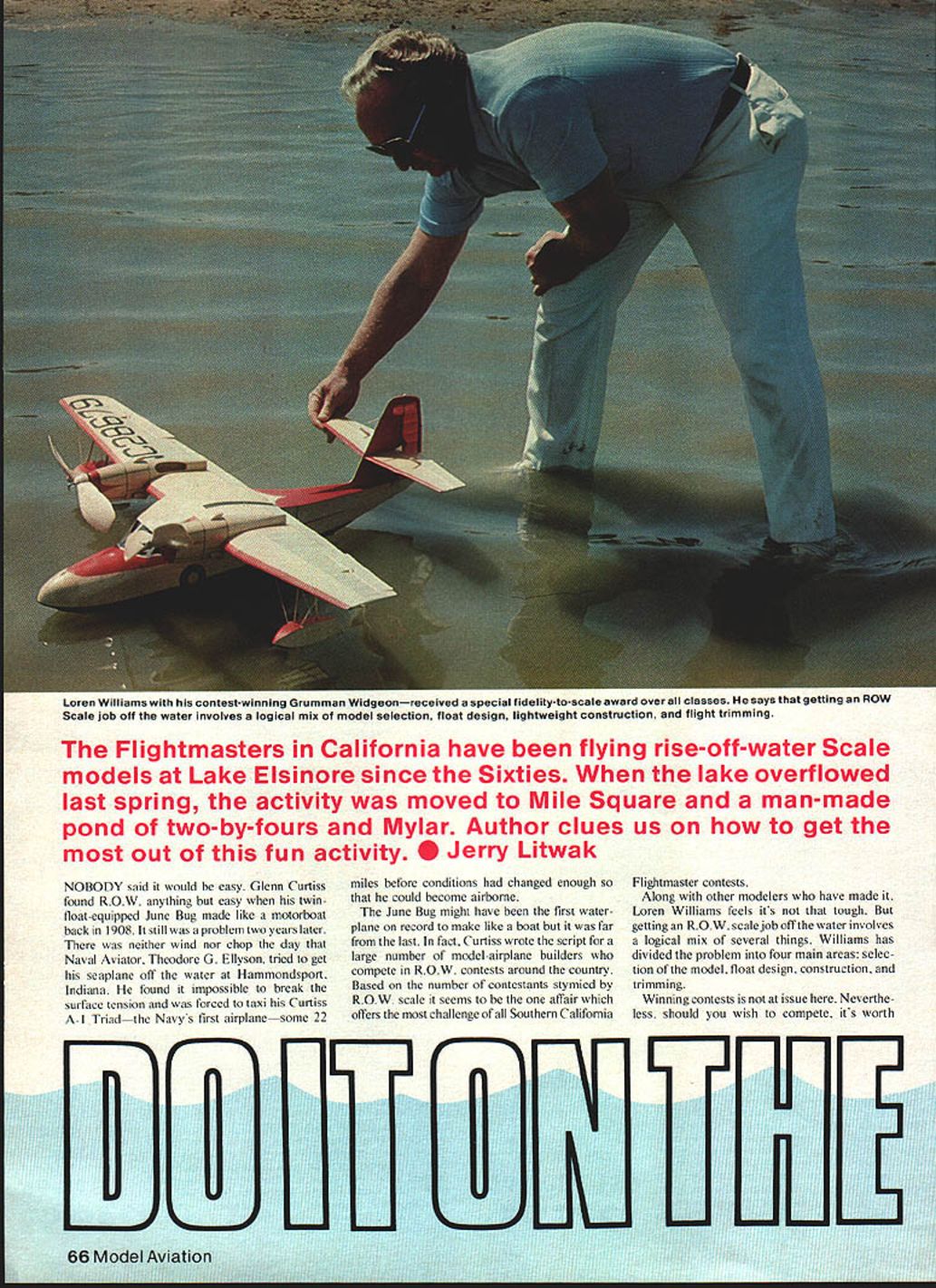
Loren Williams with his contest-winning Grumman Widgeon—recipient of a special fidelity-to-scale award over all classes—says that getting an R.O.W. scale job off the water involves a logical mix of model selection, float design, lightweight construction, and flight trimming.
The Flightmasters in California have been flying rise-off-water (R.O.W.) scale models at Lake Elsinore since the Sixties. When the lake overflowed last spring, the activity was moved to Mile Square and a man-made pond of two-by-fours and Mylar. The author explains how to get the most out of this fun activity. • Jerry Litwak
A Short History
Nobody said it would be easy. Glenn Curtiss found R.O.W. anything but easy when his twin-float-equipped June Bug made like a motorboat back in 1908. It still was a problem two years later. There was neither wind nor chop the day that Naval Aviator Theodore G. Ellyson tried to get his seaplane off the water at Hammondsport, N.Y. He found it impossible to break the surface tension and was forced to taxi his Curtiss A-1 Triad—the Navy's first airplane—some 22 miles before conditions changed enough for him to become airborne.
The June Bug might have been the first waterplane on record to make like a boat, but it was far from the last. In fact, Curtiss wrote the script for a large number of model-airplane builders who compete in R.O.W. contests around the country. Based on the number of contestants stymied by R.O.W. scale, it seems to be the one affair which offers the most challenge of all Southern California Flightmaster contests.
Four Key Areas
Along with other modelers who have made it, Loren Williams feels it's not that tough. But getting an R.O.W. scale job off the water involves a logical mix of several things. Williams has divided the problem into four main areas: selection of the model, float design, construction, and trimming.
Winning contests is not the primary issue here. Nevertheless, should you wish to compete, remember that the total score earned by your scale R.O.W. job is related directly to your choice of subject. Obviously, to get any scale points, the model must look like the airplane it represents. While the judges will reward scale detailing, the model must still fly the minimum time to qualify for judging. This makes your choice a compromise between scale attributes and flying qualities.
To minimize frustration, take your time before settling on a subject that, while affording a reasonable amount of scale detailing, will fly well and R.O.W. readily. It should have good moments and adequate areas, and suitable airfoil and control-surface arrangements.
So far we're on ground familiar to all scale free-flighters who have done any scratch building. Whatever your choice, it should be engineered for lightness at every step of construction. Williams suggests that a beginning R.O.W. flier would do well to choose one of the many popular light planes—like the Cub—build it 24 inches in span or larger, and marry it to a well-engineered float design.
For those who find the idea of a light plane too prosaic, some past successful R.O.W. subjects have included:
- Albatros W-4
- Voisin Canard
- Kawanishi Biplane
- Canadair CL-215
- DeHavilland DH60 Gypsy Moth
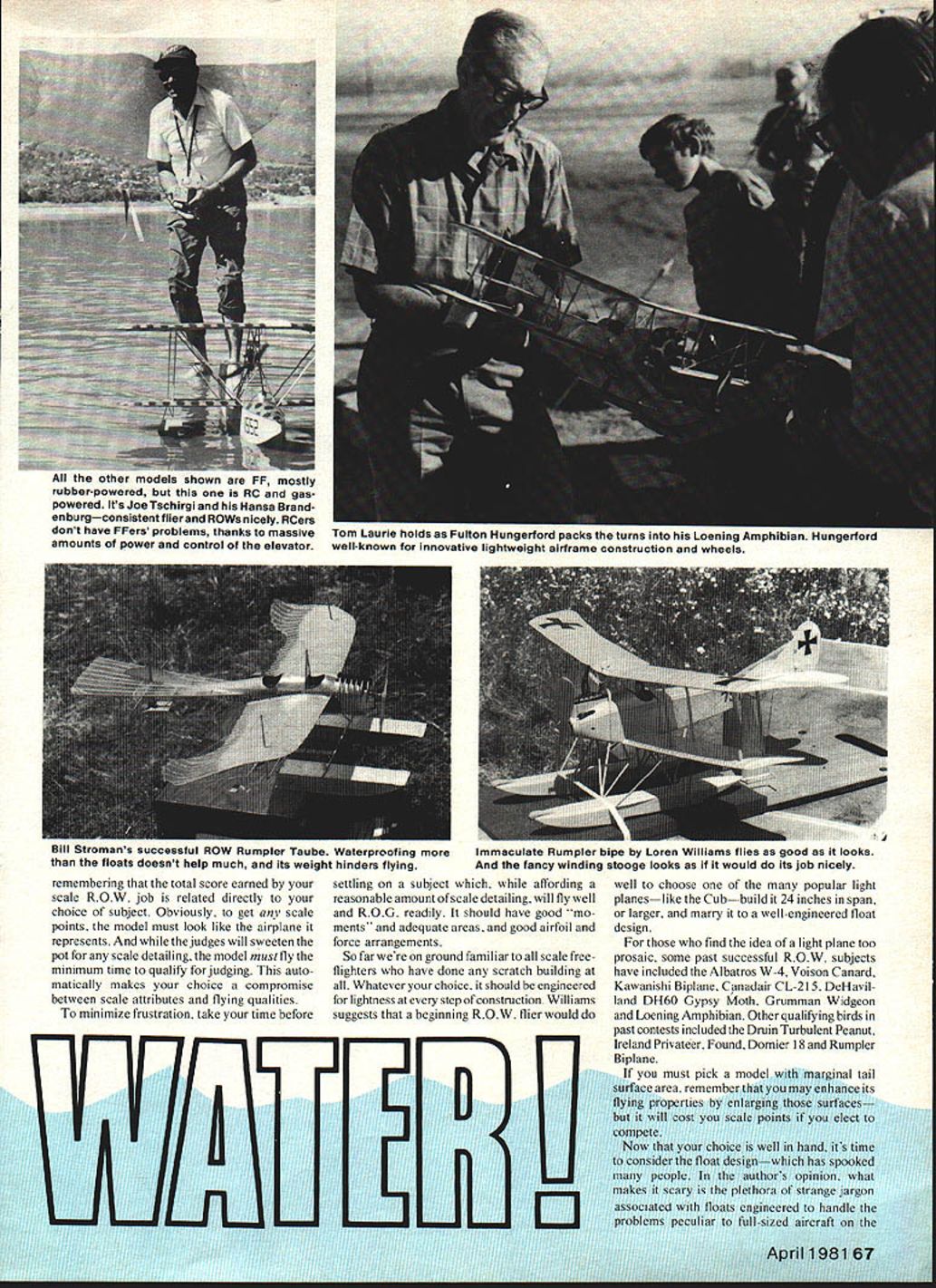
- Grumman Widgeon
- Loening Amphibian
Other qualifying birds in past contests included the Druin Turbulent Peanut, Ireland Privateer, Found, Dornier 18, and Rumpler Biplane.
If you must pick a model with marginal tail surface area, remember that you may enhance its flying properties by enlarging those surfaces—but it will cost you scale points if you elect to compete.
Float Design
Now that your choice is well in hand, it's time to consider float design—which has spooked many people. In the author's opinion, what makes it scary is the plethora of strange jargon associated with floats engineered to handle problems peculiar to full-sized aircraft on the water. Take the scary out of R.O.W.! Simply forget about most of the float nomenclature and theoretical discussions you may have read, and note well what the model R.O.W. experts have said on the subject.
Walt Mooney, the "Flying Professor," has found that the scale float configuration works quite well with R.O.W. models. Such a float would be the EDO; plans for which were published in Model Builder, Oct. 1973 and Model Airplane News, Sept. 1955. Unless you are building something about the size of Hal Cover's Puss Moth, the MAN plans are far more useful, since Paul Del Gatto included a table of sizes for different size models and his drawings are marked out in squares for ease of enlargement.
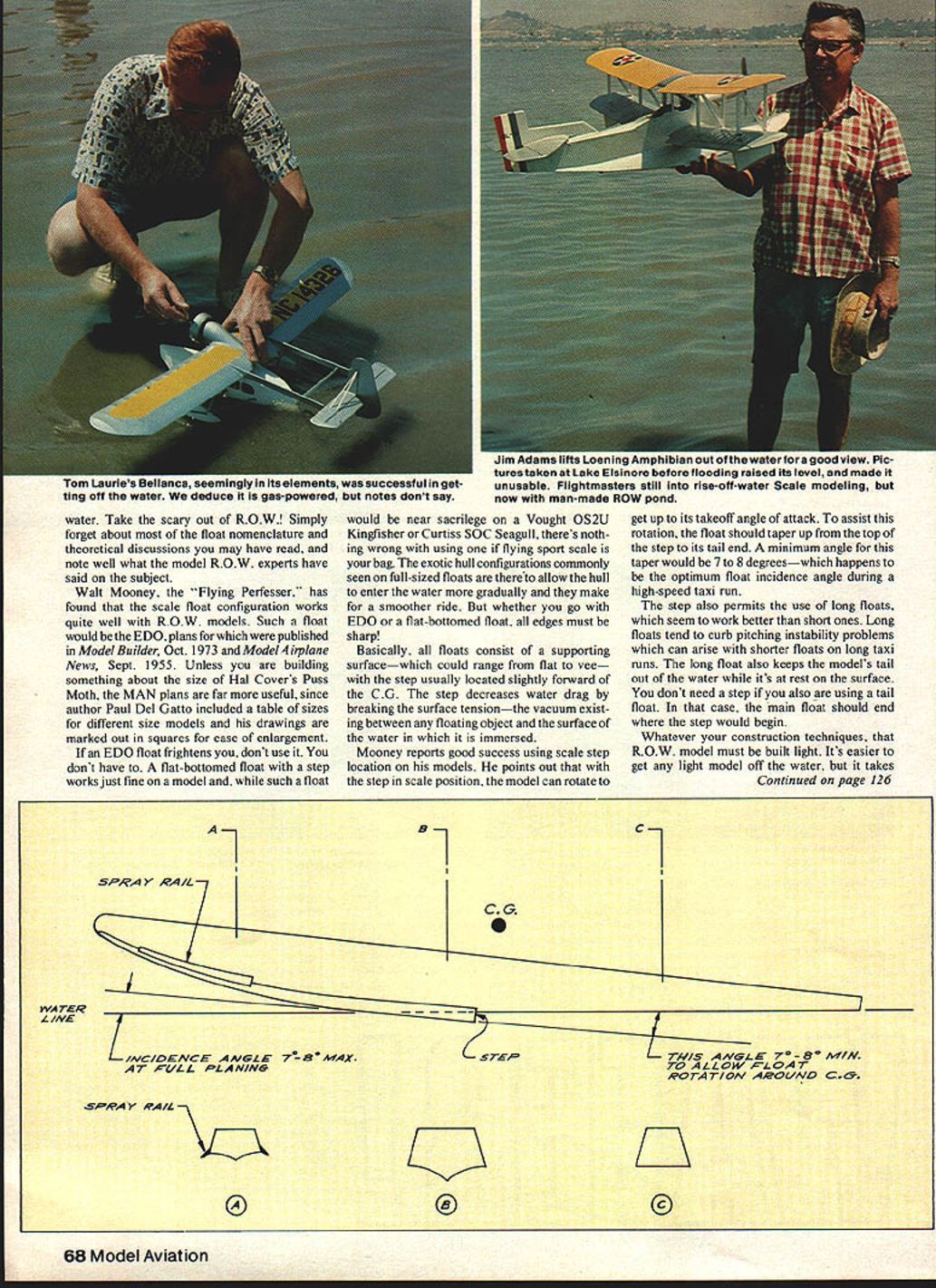
If an EDO float frightens you, don't use it. You don't have to. A flat-bottomed float with a step works just fine on a model and, while such a float would be near sacrilege on a Vought OS2U Kingfisher or Curtiss SOC Seagull, there's nothing wrong with using one if flying sport scale is your bag. The exotic hull configurations commonly seen on full-sized floats are there to allow the hull to enter the water more gradually and make for a smoother ride. But whether you go with EDO or a flat-bottomed float, all edges must be sharp!
Basically, all floats consist of a supporting surface—which could range from flat to vee—with the step usually located slightly forward of the C.G. The step decreases water drag by breaking the surface tension—the vacuum existing between any floating object and the surface of the water in which it is immersed.
Mooney reports good success using scale step location on his models. He points out that with the step in scale position, the model can rotate to set up to its takeoff angle of attack. To assist this rotation, the float should taper up from the top of the step to its tail end. A minimum angle for this taper would be 7 to 8 degrees—which happens to be the optimum float incidence angle during a high-speed taxi run.
The step also permits the use of long floats, which seem to work better than short ones. Long floats tend to curb pitching instability problems that can arise with shorter floats on long taxi runs. The long float also keeps the model's tail out of the water while it's at rest on the surface. You don't need a step if you are also using a tail float. In that case, the main float should end where the stern would begin.
Construction and Trimming
Whatever your construction techniques, that R.O.W. model must be built light. It's easier to get any light model off the water, but proper trimming is critical.
We're talking about trying various decalage relationships, making enough test flights so that you are satisfied with your thrust adjustments, power pattern, and glide as the power dissipates. It means that you have varied float-incidence angle so that it is correct with respect to wing incidence. All of this can be done over grass, and about the only remaining unknown will be whether or not the bird can get off water. When testing at the lake, this last test should be done with plenty of wind. Mooney practically guarantees, "Testing for R.O.W. takeoffs with low wings on a rubber model will dunk it almost every time!"
Even doing all the right things is no absolute guarantee that your bird will R.O.W. Fellows who today are experiencing no difficulty have learned some useful answers the hard way.
Troubleshooting (Common Fixes)
- Sometimes an airplane that wants to be a water taxi may be made to successfully R.O.W. if you get a fellow modeler to wade out and agitate the water in front of your bird. It also is possible to achieve R.O.W. by taping one or more pieces of wire to the float with the far end dragging in the water ahead of the float. Another device that works is depressing the model into the water up to 2 inches, depending upon the model's size, then letting the prop come to full rpm before letting go. Provided you aren't ham-fisted and haven't sent your bird to a watery grave, the float's buoyancy will cause the model to bounce out of the water, breaking the surface tension, and as it comes down it will be moving forward and on its way.
- A tendency toward pitching instability during long taxi runs can be caused by floats that are too small. The obvious remedy for this is larger floats.
- Behavior of models that don't track straight and tend to water-loop can be improved by the addition of a water rudder; thin aluminum sheet works well and bends readily to provide a straight run under high power.
- Jim Adams corrected water-looping tendencies of his Loening amphibian (now dearly departed) by tying a small length of string to the outside wing tip. The string created just enough drag to keep the bird taxiing straight until it had climbed up on the step, gained flying speed, and become airborne.
- Per Mooney, "If the model lifts one float and then gradually dips a wing tip into the water, and provided it will fly if hand-launched, add power—because you're trying to take off with too weak a motor." This is an area where the size of a larger model is an advantage because it allows you to experiment with varying-strength rubber motors. In the case of a gas job, the ability to physically replace an .049 with an .09 engine may mean the difference between an airplane and a water taxi.
- Sometimes a single-float bird or seaplane has a tip float which digs in at an attempted takeoff, whereupon the airplane turns downwind and simply taxis. The first attempted cure should be to add power and, failing to achieve R.O.W. at this point, a water rudder should be added. Finally, the tip floats should be raised so they are well clear of the water when the model is level.
- Frequently a model which planes well but doesn't get off is handicapped by a float design on which the under-portion behind the step is cut parallel to the forward portion. Your float must taper up from the step to the tail and so allow the model to rotate around the C.G. on takeoff.
- Like their larger prototypes, some models throw excessive spray which progressively soaks the model, increases aerodynamic drag and, by impinging on the prop, causes power loss. Bigger spray rails and water deflectors are the remedy. Make sure the spray doesn't wet the wing roots. If you're using balsa-covered floats, skim them with dope, then apply a coat of lacquer to reduce porosity.
A Simple Success
If the foregoing is of no interest to you and you are a free-flight (FF) scale type, then your name has got to be Jim Dean. Dean built an 18 in. Loening Kitten for a Southern California Antique Model Plane Society (S.C.A.M.P.S.) meet. When it was changed to R.O.W., he took the wheels off his Kitten and mounted a pair of simple sled floats instead. Contrary to the customary behavior of brand-new R.O.W. models built by those ignorant of water lore, the Kitten fairly leapt off the water, executed graceful circles until most winds were dissipated, then came in for a nice, smooth water landing.
Asked about the secret of his success, Dean replied, "I don't have any. The only thing I did was to build it light."
Acknowledgments
I wish to gratefully acknowledge the help and suggestions received from Walt Mooney, Loren Williams, Bill Warner, Bill Hannan, Jim Adams, Bill Stroman, Joe Tschirgi, and, finally, Jim Dean.
Transcribed from original scans by AI. Minor OCR errors may remain.

