
DOES SAFETY REALLY COME FIRST?
Fred Berman
Our guest columnist calls upon many years of modeling- and work-related experience to give us some words of wisdom. Read ’em and heed ’em!
"Errant model airplane crashes into schoolyard killing one and injuring another." Boy, wouldn't the media grab that one and splash it all over the continent—and possibly beyond! No, it did not happen, thank God. But the morbid fascination of the populace is with disaster and bloody gruesome newspapers, magazines, TV viewer ratings, and is fodder for politicians seeking the empathy of voters.
Such mayhem spawns the growth of a bureaucracy with "experts" who often know less about the problems than do the perpetrators. In my days back at the mill there were accidents—some very serious or even fatal. To a responsible supervisor, the victims were his own people—his "other" family. He suffered that gut sorrow and guilt for months after, spent sleepless nights pondering how such happenings might have been prevented, and how safeguards for the future could be implemented. Perhaps the toughest subsequent duty was notifying the families.
One such instance was mill-related only because it pertained to mill people. We had the task of informing one of our diligent supervisors then on duty that his beloved wife had just succumbed in an auto accident while returning from college with their daughter for the Christmas holiday. What a forever-haunting tragedy, especially when knowing of their close family relations! Just visualize having to bear the news of the schoolyard plane crash to the child's mother.
Workplace safety, or lack of it, has generated OSHA—the Federal Occupational Safety and Health Administration. But almost every human pursuit has a safety overseer of some sort who tries to guard the country's most precious commodity—people's health and welfare. Their overriding philosophy is, of course, that even one accident is too many.
Notwithstanding, accidents do happen. For legal as well as fiscal reasons, accidents usually have a lopsided focus: how much is equipment to blame, and how little have people contributed to the mishap? Generally we are stymied in finding sure-fire methods about how to switch on that "think before you act" chip in people's brains, or how to eradicate that "I'll take just this one chance" attitude.
Summarily, human nature and "safety" are often at odds. And that trite, much-maligned and overused word "safety" is respected only after the dam has already burst.
The hobby context
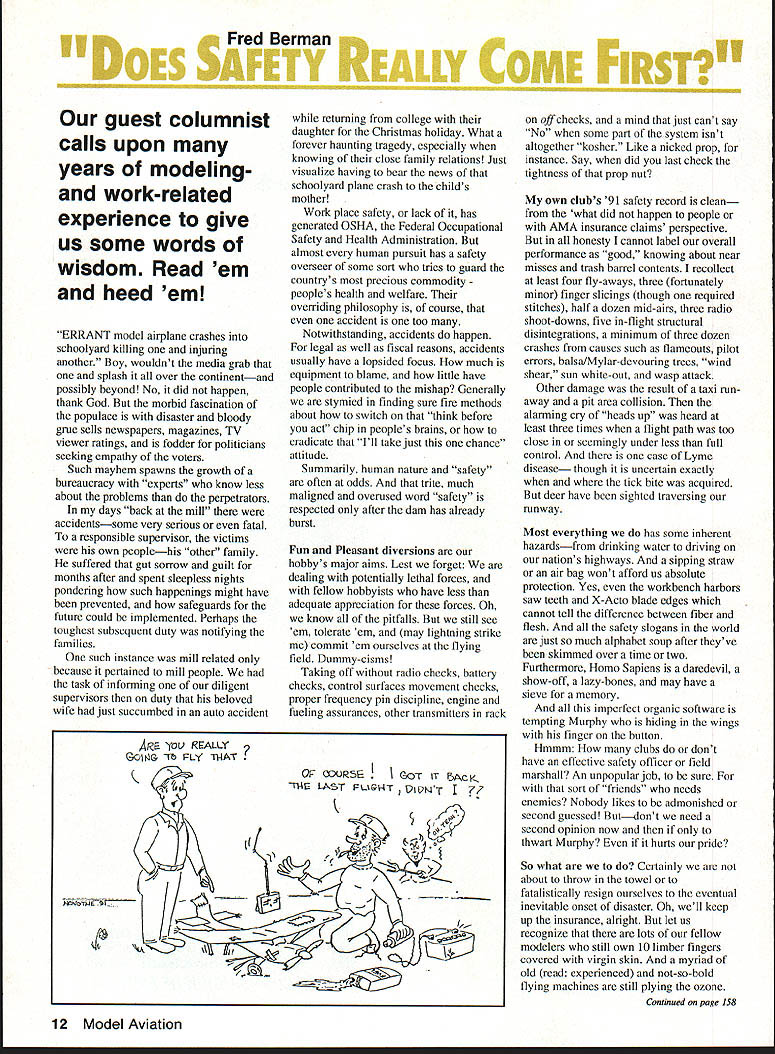
Fun and pleasant diversions are our hobby's major aims. Lest we forget: we are dealing with potentially lethal forces, and with fellow hobbyists who may have less than adequate appreciation for these forces. Oh, we know all of the pitfalls. But we still see them, tolerate them, and (may lightning strike me) commit them ourselves at the flying field. Dummy-cisms!
Common preflight and field omissions include:
- Taking off without radio checks.
- Skipping battery checks.
- Failing to check control surface movement.
- Poor frequency-pin discipline.
- Neglecting engine and fueling assurances.
- Not checking other transmitters in the rack (on/off).
- A mind that just can't say "No" when some part of the system isn't altogether kosher—like a nicked prop. When did you last check the tightness of that prop nut?
Club safety record (1991)
My own club's 1991 safety record is clean—from the "what did not happen to people" era—with AMA insurance-claims perspective. But in all honesty I cannot label our overall performance as "good," knowing about near misses and trash-barrel contents. I recollect at least:
- 4 fly-aways
- 3 (fortunately minor) finger slicings (one required stitches)
- 6 mid-airs
- 3 radio shoot-downs
- 5 in-flight structural disintegrations
- Minimum three dozen crashes
Causes included:
- Flameouts
- Pilot errors
- Balsa/Mylar-devouring trees
- Wind shear
- Sun whiteout
- Wasp attack
Other damage resulted from a taxi runaway and a pit-area collision. Then the alarming cry of "heads up" was heard at least three times when a flight path was too close in or seemingly under less than full control. And there is one case of Lyme disease—though it is uncertain exactly when and where the tick bite was acquired. Deer have been sighted traversing our runway.
Perspective
Most everything we do has some inherent hazards—from drinking water to driving on our nation's highways. A sipping straw or an air bag won't afford us absolute protection. Yes, even the workbench harbors saw teeth and X-Acto blade edges that cannot tell the difference between fiber and flesh. All the safety slogans in the world are just so much alphabet soup after they've been skimmed over a time or two. Furthermore, Homo sapiens is a daredevil, a show-off, a lazy-bones, and may have a sieve for a memory.
All this imperfect organic software is tempting Murphy, who is hiding in the wings with his finger on the button.
Hmmm: how many clubs do or don't have an effective safety officer or field marshal? An unpopular job, to be sure. With that sort of "friends" who needs enemies? Nobody likes to be admonished or second-guessed. But don't we need a second opinion now and then, if only to thwart Murphy? Even if it hurts our pride?
What are we to do?
Certainly we are not about to throw in the towel or fatalistically resign ourselves to the inevitable onset of disaster. We'll keep up the insurance, alright. But let us recognize that there are lots of our fellow modelers who still own ten limber fingers covered with virgin skin. A myriad of old (read: experienced) and not-so-bold flying machines are still plying the ozone (oh, maybe they sport a balsa band-aid, a couple of skin patches, or some undercover mildew).
Just what is their secret? It's so simple that it is embarrassing. Simply pull that floppy disk marked Common Sense out of your tool or flight box and insert it into your shoulder-top computer—habitually!
Every one of us knows best what is right, tight, or light with each of our balsa birds or our preflight preparation. We are just not serious enough in our appreciation of the Murphy scenario. Somehow we survived the 1991 flying season, perhaps more with luck than by design. How about resolving for 1992 to become more honest about truly putting safety first, the way John Preston felt about it?
And please pass on your unusual safety-related experiences to our editor. The rest of us just might learn a valuable lesson.
Thanks.
Transcribed from original scans by AI. Minor OCR errors may remain.

