
Don't Quit the Greatest Sport on Earth!
Editor’s note
In this thought-provoking article, a seldom-talked-about subject is handled head-on by the author.
In Alex’s own words, “I’m 74 years of age, been a member of AMA since 1938, was a CD [Contest Director] in the mid-’50s under Keith Storey, and know from personal experience that sometimes we deny what might be obvious to others: our age is affecting our reaction time while flying RC [radio control] airplanes. Not to worry! In RC model flying there is an alternative to just hanging it up because of the effects of aging.”
This article presents a solution that has come onto the scene in the last few years. It is encouraging because it allows us to transfer our interest to another category of models without missing a beat in the “Greatest Sport on Earth!”
Alex Morton
You’re up there in age, and you’ve just returned from the flying field and plunked down in your easy chair to think about the experience you had a few minutes ago — in front of all your friends!
You didn’t seem to have enough time to get your RC airplane out of a no-win attitude, and it crashed.
In the paper “A Literature Review on Reaction Time” by Robert J. Kosinski of Clemson University, he states that with respect to age, “Reaction time shortens from childhood into the late 20s, then increases slowly until the 50s and 60s, and then lengthens faster as the person gets into his 70s and beyond.”
There is a solution to some of the troubling aspects of slow reaction time (and less-than-perfect eyesight). You don’t have to hang it up and quit just because you’re getting older.
For roughly the last eight years, RC flight has held first place in my modeling life. Scratch-built, museum-quality military fine-scale, trainer, Pattern, and flying-boat models — I’ve built and flown them all. During those days, my reaction time and eyes were in good shape. But recently I decided to turn to another type of RC airplane that is enjoyable for any age! It also answers a very practical question we will all face someday.
My AMA club (Marymoor RC Club of Redmond, WA) is primarily devoted to teaching, and for several years I have had the honor of being one of the ground crew that preflights the typical .40- to .46-cubic-inch-powered training airplanes with a comprehensive checklist, to assure their airworthiness. My best friend, one of the flight instructors, drives the two of us to the field every Tuesday at 5 p.m. for Training Night. He and I were recently talking about age and its effect on overall flying ability. Many may not talk openly about this, think they are not that old, or think “it’s the other guy, not me” — but it is worth discussing.
We’re both in our early 70s, and he made the comment that he thought this year would be his last as a flight instructor, because his eyes and reaction time are less than what is required to assure confident instruction to a student. He said it isn’t fair to the student or to himself if there is any question about his full ability to handle any situation, so he’s hanging it up with respect to teaching others hands-on. Flying a buddy-box system as an instructor is more demanding than flying alone with your familiar transmitter/receiver/aircraft combo. When the student has the airplane in an unsafe attitude, you have to judge whether or not he or she will correct in time. If not, you have to let go of the training switch with the familiar “I’ve got it,” and act in time to maintain safety in the situation.
My friend came by today and said he had handed in all his buddy-box equipment to the club flightline manager. The Federal Aviation Administration has already spoken regarding airline pilots: 60 years of age is mandatory retirement — period. RC is not airline flying, but it still has to do with reaction time and eyesight. And it is the safety aspect of the sport I want to address.
Most RC airplanes fly at speeds of 35–100 mph (and sometimes more) at a typical model flying field. They can be lethal weapons in an uncontrolled situation.
People who no longer have the skills they once had because of age should reduce their involvement and eventually leave the larger, faster, heavier RC airplanes to others, and choose another type of RC model to enjoy.
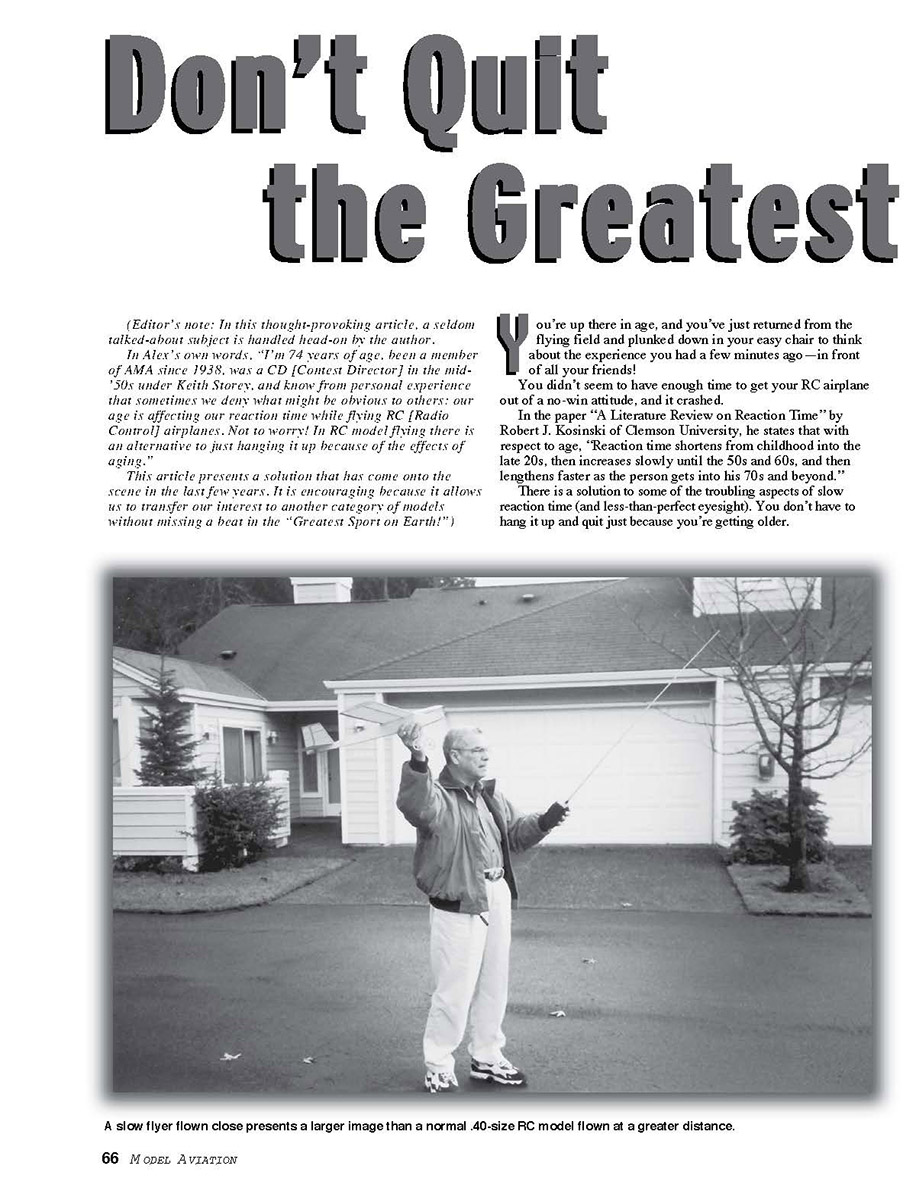
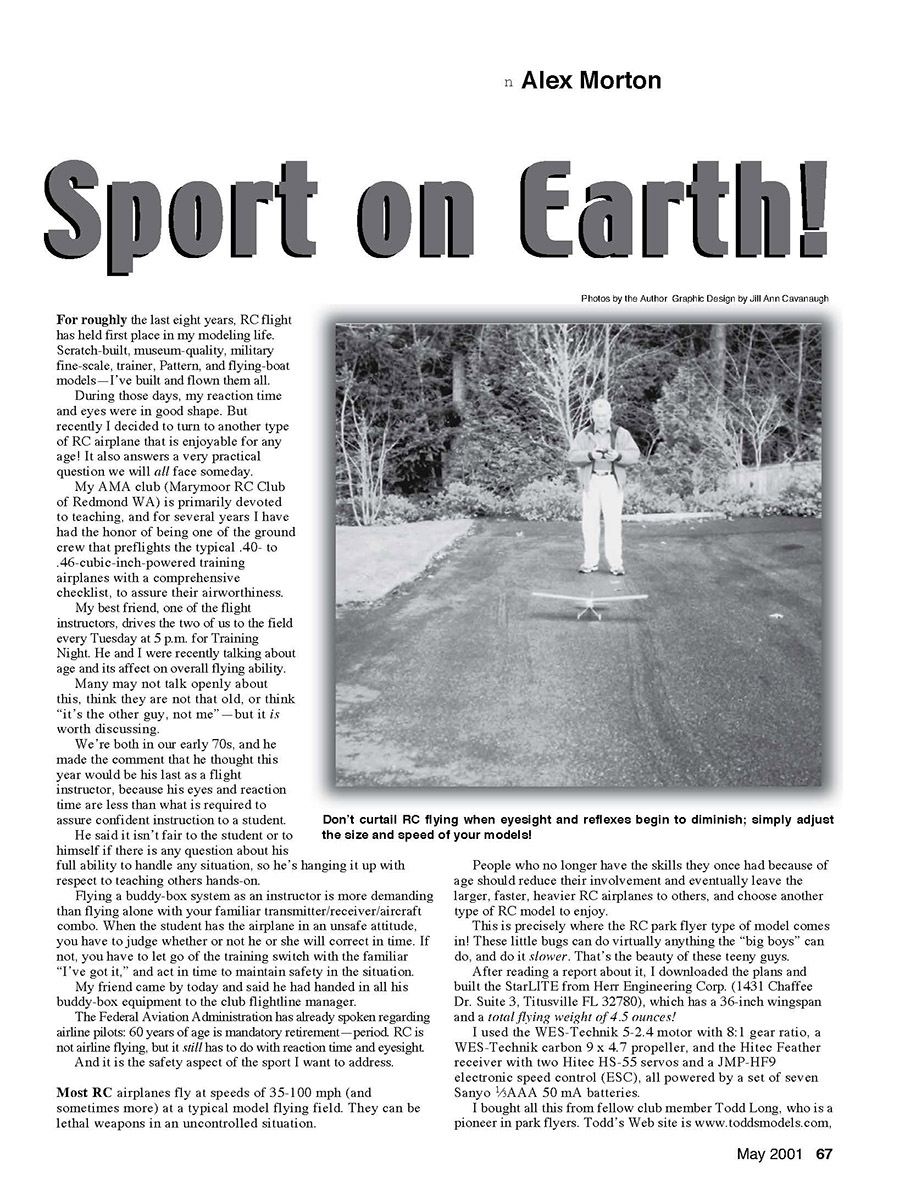
This is precisely where the RC park flyer type of model comes in! These little bugs can do virtually anything the “big boys” can do, and do it slower. That’s the beauty of these teeny guys.
After reading a report about it, I downloaded the plans and built the StarLITE from Herr Engineering Corp. (1431 Chaffee Dr., Suite 3, Titusville, FL 32780), which has a 36-inch wingspan and a total flying weight of 4.5 ounces!
I used the WES-Technik 5-2.4 motor with 8:1 gear ratio, a WES-Technik carbon 9 x 4.7 propeller, and the Hitec Feather receiver with two Hitec HS-55 servos and a JMP-HF9 electronic speed control (ESC), all powered by a set of seven Sanyo 1/4AAA 50 mAh batteries.
I bought all this from fellow club member Todd Long, who is a pioneer in park flyers. Todd’s Web site is www.toddsmodels.com.
I can almost write my name in the sky with the StarLITE for five to seven minutes. When the electric motor slows down, I know I need to bring it in for a landing.
I plug the battery pack into a 12-volt field charger, grab a cup of java, and 15 minutes later I'm getting another five to seven minutes in the sky!
And I don't have to go to the club field to fly! Out the front door of my condo or in the nearby school yard or meadow is adequate space. Reaction time is less of a concern, since my micro speed demon is racing around at roughly three to eight miles per hour!
Even if I end up hitting someone with one of these gems, I am likely to just surprise him or her. How much damage can I do with a 4.5-ounce model going that slow? Almost the only thing damaged would be my pride for having bumped into a person!
Things to do with these models are unlimited. You can stay in competition if you like; articles have been written about indoor pylon races, rise-off-water contests, endurance flying, and the list goes on. Or you can just lay back and have plain old fun by yourself or with a friend.
If you decide to get into park flying you'll be competing with younger people. Not to worry; they don't have the years of experience you have!
I should clarify something. This category has been called various names; I'm using the term "park flyer," but it includes slow flyers, indoor flyers, etc. There are even micro flyers, with wingspans as small as approximately five inches. This whole new category, by whatever name, includes fixed-wing airplanes and helicopters.
When my flight-instructor buddy and I had finished our discussion that day in the car, we agreed: RC park flying is a good way to keep active in the greatest sport on earth!
Recommendations for Mature Modelers
- If you have problems with building (arthritis, loss of dexterity, or eyesight loss, etc.), buy an Almost Ready to Fly (ARF) instead of a kit. There are plenty of each available.
- Stick with the recommended motor/equipment package for the ARF or kit you've chosen until you are versed in this category. You can experiment later.
- Research the field. It's new, and there are many types of airplanes/motors in the category. Pick a slow one to start with; get the feel of park flying.
- If you have access to the Internet, it will be invaluable to you. There are many sites that invite you to download lots of information.
- One site that proved very helpful to me is www.emspinc.com/motdata.html; Dick Miller gives an up-to-date list of most motors available and tells which propeller to use, current used, thrust, rpm, number of cells, motor weight, frame weight, total ready-to-fly model weight, and total wing area. He has two lists: one "Sorted by MOTOR" and the other "Sorted by AREA." The data lets you scratch-build within the proper parameters.
- I'm approximately 95% finished with a scratch-built, 30-inch-wingspan Curtiss JN-4D2 (Jenny). Total weight of the (uncovered) airplane parts is 1.395 ounces!
- A valuable and inexpensive piece of equipment you absolutely need is a beam balance scale, good from 0.001 ounce to 1.000 pound, available from Micro-Air Precision Products, Box 1129, Richland, WA 99352. Ask for part number 1081. There are more-expensive scales out there, but this one is adequate for those of us on a fixed/limited income.
- I've gone to the Focus III FM (Mode One) transmitter and the Hitec Feather receiver (www.hitecrcd.com/catalog/air/radio/focus_3fm.html). Park flyers are usually rudder/elevator/motor control or elevator/motor control; the Focus III has these capabilities in either case, along with servo reversing.
- Or you can continue to use your present transmitter and buy a micro‑lite receiver, of which there are many. I can't use my Channel 6 (Ham) transmitter, because a micro‑lite receiver in the Ham frequencies is not presently available.
- There is a basic tip I found very helpful for flying your model. Because it is a new category and I was ignorant about park flyers' flight characteristics, I took the StarLITE out in front of the condo on a cool afternoon when there weren't even any birds singing to disturb the air. I sat it down on the pavement and slowly increased the throttle until it started moving.
- I taxied the model all around to see how it handled. I increased the throttle until it was barely airborne, then I gently reduced the throttle and let it settle back to a nice, smooth landing.
- After doing this 15 or 20 times, I took my courage in both hands and increased it until the model was in the air approximately 20 feet, flying free as a bird. I did some gentle turns and a U-turn at the end of the street, so the model was heading straight at me.
- After a bit I was in heaven, having a blast at my manageable speed of three to eight miles per hour and loving every minute of it. You'll love it too!
- Caution: Some of the receivers (including the Hitec Feather) are of limited range and are NOT to be used for high-altitude or long-distance flying! The Feather is good for roughly 500 feet, but at that distance you can hardly see the model. Such receivers are for relatively close-up flying.
- Another caution: Remember that when you're flying out in front of your home, your transmitter affects roughly a two-mile radius; be sure you're not interfering with any other model sites nearby.
- Please don't kid yourself about your age. Perhaps the biggest problem some will face is admitting that they are getting older. Lighten up! Be realistic! Enjoy the time you have by flying what suits your situation. It will be more pleasure for you and safer for others!
Additional tips and notes
- There are many other Web sites related to this new category; once you start surfing you'll have more sites than you can use.
- To hold down the weight, I rigged the electronics together using Radio Shack D-subminiature connectors (#276-1429) and shrink tubing held together with cyanoacrylate.
- Park flyers can stay competitive: indoor pylon races, rise-off-water contests, endurance flying, and more are being written about. Or you can just have plain fun.
- This category can be the answer not only to those who are getting up in years, but also to those impaired in other ways that would otherwise exclude them from this great sport.
MA
Alex Morton 3604 225th Pl. SE Issaquah, WA 98029
Transcribed from original scans by AI. Minor OCR errors may remain.

