
Dorito
This futuristic flying-wing design is ready to bring in the next generation of carrier-based attack planes—when the Navy and its contractors can agree on a price.
- Don Berliner
Background
The U.S. government has found a brand-new way of debunking the notion of UFOs: it plans to build airplanes that look like UFOs.
Admittedly, that's a pretty expensive way to make a point. In fact, the first of these projected UFO look-alikes, the A-12 Avenger, which was originally scheduled to make its first flight in March 1992, has been canned because of cost and schedule overruns. Although for the present it has been unable to come to an agreement with manufacturers, the Navy still hopes to build the A-12 at a future date.
The A-12 Avenger is not to be confused with the venerable Grumman TBF torpedo bomber of World War II, which it resembles about as much as a Ferrari does a UPS truck. Rumor has it that this blatant bit of plagiarism was meant to influence President George Bush, who flew the original Avengers.
Design
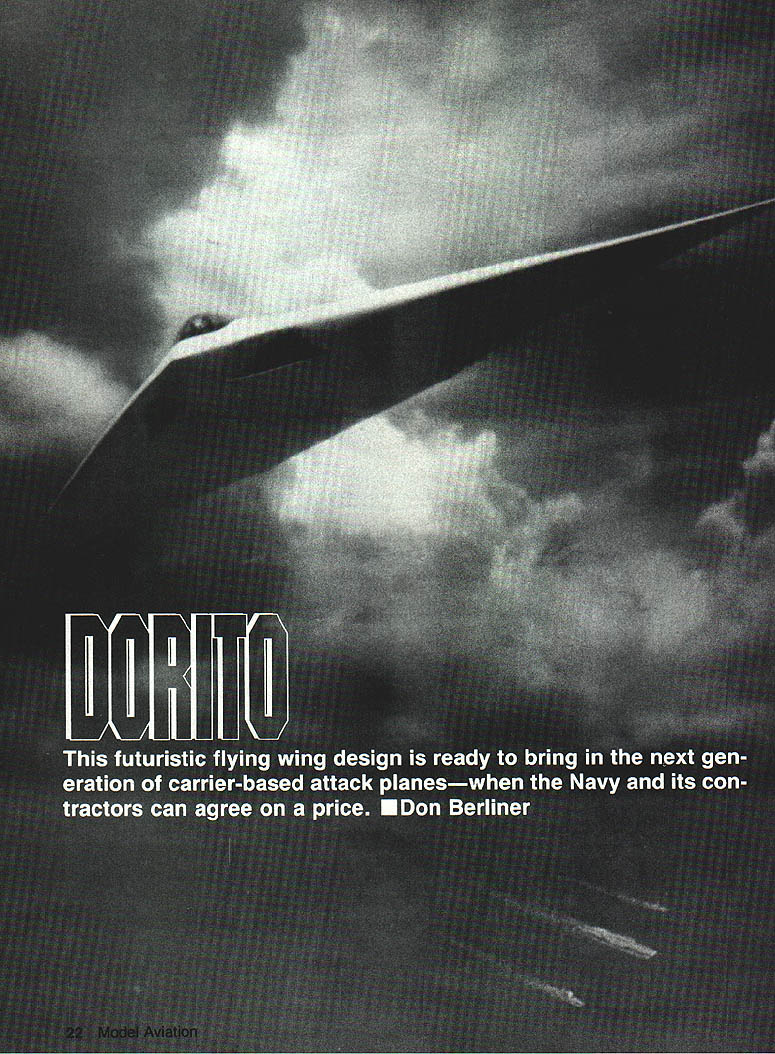
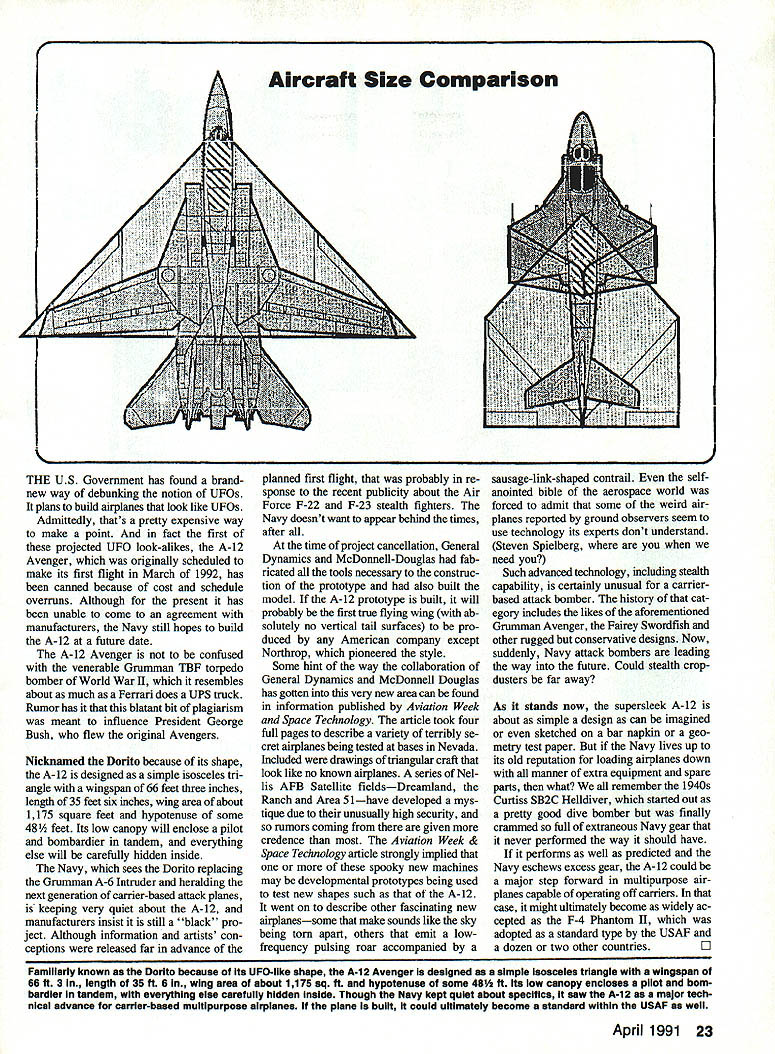
Nicknamed the "Dorito" because of its shape, the A-12 is designed as a simple isosceles triangle with a wingspan of 66 feet 3 inches, a length of 35 feet 6 inches, a wing area of about 1,175 square feet and a hypotenuse of some 48 1/2 feet. Its low canopy will enclose a pilot and bombardier in tandem, and everything else will be carefully hidden inside.
As it stands now, the supersleek A-12 is about as simple a design as can be imagined or even sketched on a bar napkin or a geometry-test paper.
Secrecy and development
The Navy, which sees the Dorito replacing the Grumman A-6 Intruder and heralding the next generation of carrier-based attack planes, is keeping very quiet about the A-12, and manufacturers insist it is still a "black" project. Although information and artists' conceptions were released well in advance of the planned first flight, that was probably in response to recent publicity about the Air Force F-22 and F-23 stealth fighters—the Navy doesn't want to appear behind the times, after all.
At the time of the project's cancellation, General Dynamics and McDonnell Douglas had fabricated all the tools necessary to construct the prototype and had also built the model. If the A-12 prototype is built, it will probably be the first true flying wing (with absolutely no vertical tail surfaces) to be produced by any American company except Northrop, which pioneered the style.
Some hint of how the collaboration of General Dynamics and McDonnell Douglas has ventured into this new area can be found in information published by Aviation Week & Space Technology. The article took four full pages to describe a variety of highly secret airplanes being tested at bases in Nevada, including drawings of triangular craft that look like no known airplanes. A series of Nellis AFB satellite fields—Dreamland, Ranch and Area 51—have developed a mystique due to their unusually high security, and rumors coming from there are given more credence than most. The Aviation Week & Space Technology article strongly implied that one or more of these spooky new machines may be developmental prototypes being used to test new shapes such as that of the A-12.
The article went on to describe other fascinating new airplanes—some that make sounds like the sky being torn apart, others that emit a low-frequency pulsing roar accompanied by a sausage-link–shaped contrail. Even the self-anointed bible of the aerospace world was forced to admit that some of the weird airplanes reported by ground observers seem to use technology its experts don't understand.
Potential and concerns
Such advanced technology, including stealth capability, is certainly unusual for a carrier-based attack bomber. The history of that category includes the likes of the aforementioned Grumman Avenger, the Fairey Swordfish and other rugged but conservative designs. Now, suddenly, Navy attack bombers are leading the way into the future.
If the A-12 performs as well as predicted and the Navy eschews excess gear, the A-12 could be a major step forward in multipurpose airplanes, perhaps capable of operating from carriers. In that case, it might ultimately become as widely accepted as the F-4 Phantom II, which was adopted as a standard type by the USAF and a dozen or two other countries.
But if the Navy lives up to its old reputation for loading airplanes down with all manner of extra equipment and spare parts, the A-12 could suffer the same fate as the 1940s Curtiss SB2C Helldiver, which started out as a pretty good dive bomber but was finally crammed so full of extraneous Navy gear that it never performed as it should have.
Transcribed from original scans by AI. Minor OCR errors may remain.

