
Double Barrel Fun-Fly
— Frank Kelly
Overview
Models and full-scale airplanes in the same fun-fly contest? Keeping things separate but equal is the key.
Model airplane clubs enjoy hosting fun-flys. So do pilots of full-scale airplanes. Everyone can compete, but no one gets too serious about it. Just as all modelers take at least a passing interest in full-scale airplanes, so all full-scale pilots own up to at least a little fascination with models. Indeed, many pilots fly both types of aircraft. For safety reasons, though, model and full-scale groups seldom attempt to fly together.
For the past few years, two Arizona clubs have been countering that tradition with some double-barreled competition. On February 29, 1992 — leap year day — the Lake Havasu City chapter of an international women's flying organization known as the Ninety-Nines and the Colorado River Airplane Pilots Society (CRAPS) of Bullhead City, Arizona, joined forces to host the fourth annual Needles Fun-Fly.
Background: Ninety-Nines and the Needles Fun-Fly
The Ninety-Nines was founded in 1929 and named for its 99 charter members (all licensed women pilots of the day had been invited to join). The organization elected Amelia Earhart as its first president. Many luminaries have joined in subsequent years, among them Jackie Cochran, Sally Ride, and Jeana Yeager.
For the Lake Havasu City chapter, the Needles Fun-Fly is the big money-maker of the year. The chapter uses proceeds from a fun-fly-sponsored raffle to finance a scholarship for flight lessons awarded annually to a local high school junior. This year's raffle generated $216 for the 1992 scholarship fund. No entry fee was charged for the models.
Event setup and conditions
Needles Airport hosted the fun-fly. Thanks to the efforts of Lake Havasu City Ninety-Nines chapter chairperson Joyce Wade and former champion race-boat driver Jimbo McConnell of the CRAPS, who spread the word throughout the Southwest, the airport was busier than usual during the event. Runway 29 was set aside for the two groups' activities, but otherwise the airport continued normal operations.
If the turnout was good, the weather couldn't have been better: a gentle breeze and about 80% cloud cover — just enough to keep everyone comfortable. Modelers were encouraged to bring more than one airplane for display; most brought several.
By 7:00 a.m., cars were parked on the desert beside the runway, with the models set up at the edge. During a pilots' meeting following registration and setup, fliers were admonished to respect at all times the orange flag that separated the model flying area from airport operations.
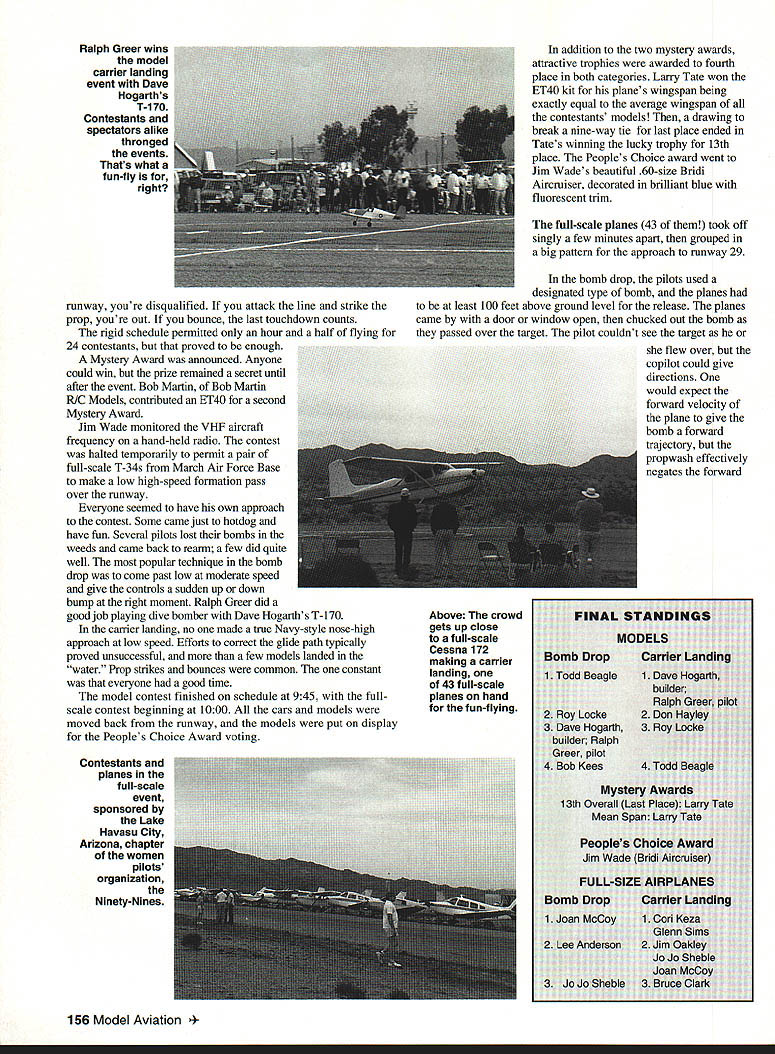
A half hour of open practice flying followed registration, limited to four planes at a time. A simple portable frequency control board prevented conflicts. Pilots enjoyed taking off across the smooth, level, paved runway, though the strip's narrowness required a precision landing approach; the big, solid rocks exacted a terrible toll on those who missed.
Model contest: format and results
The model fun-fly began on schedule at 8:15 a.m. Flying order followed registration; Jim passed out a sheet so each participant would know who was up next.
The task consisted of two parts:
- A bomb drop: No special bomb releases were permitted — just a foam cup with Popsicle sticks and rubber bands. The "bomb" was a padded washer with a colored ribbon attached. The idea was to fly smoothly, then perform a maneuver to kick the bomb toward a 30-foot circle marked on the runway. If you dropped the bomb early, you got one more try.
- A simulated carrier landing: The model whose main gear touched closest beyond the line won. If you landed short of the stripe, you were disqualified; if you struck the prop attacking the line, you were out; if you bounced, the last touchdown counted.
Sometimes contestants put on an air show for spectators while officials measured distances. The rigid schedule permitted an hour and a half of flying; 24 contestants proved enough.
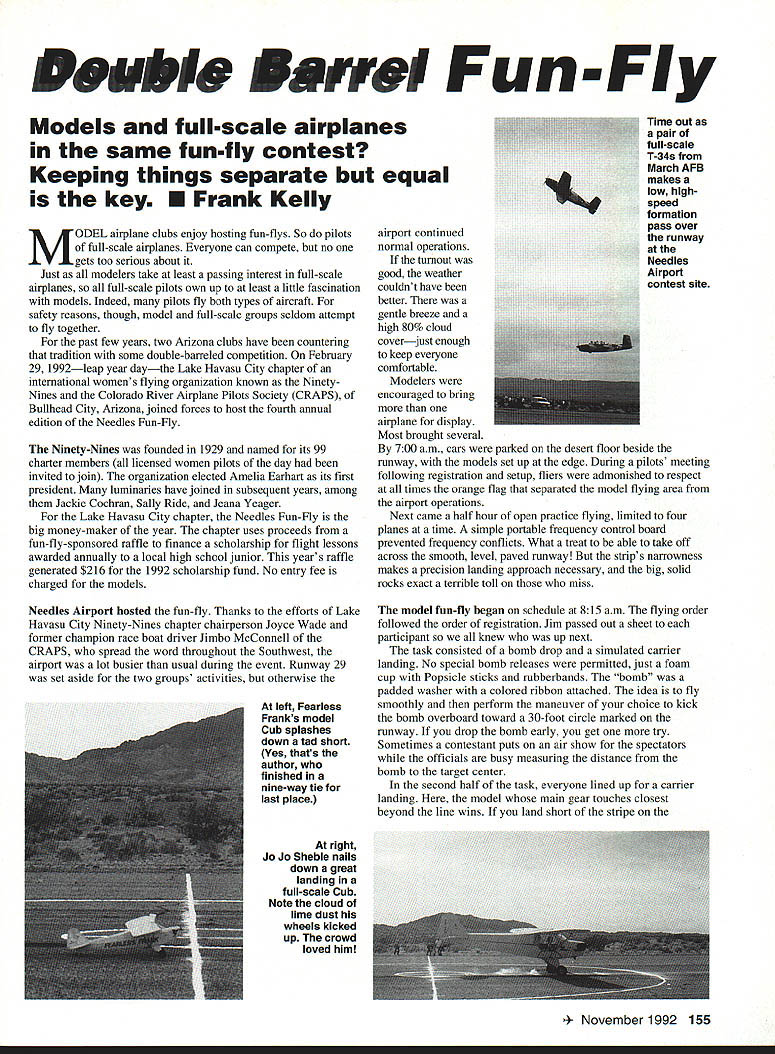
A Mystery Award was announced — anyone could win, but the prize remained secret until after the event. Bob Martin R/C Models contributed $140. Jim Wade monitored the VHF aircraft frequency with a hand-held radio. The contest halted temporarily to permit a pair of full-scale T-34s from March AFB to make a low, high-speed formation pass over the runway.
Everyone had their own approach. Some came just to hot-dog and have fun. Several pilots lost their bombs in the weeds and returned to rearm; a few did quite well. The most popular bomb-drop technique was to come past low at moderate speed and give the controls a sudden up- or down-bump at the right moment. Ralph Greer did a good job playing dive bomber with Dave Hogarth's T-170.
In the carrier landing, no one made a true Navy-style nose-high approach at low speed. Efforts to correct glide paths typically proved unsuccessful, and more than a few models landed in the "water." Pro strikes and bounces were common, but the one constant was that everyone had a good time.
The model contest finished on schedule at 9:45 a.m., with the full-scale contest beginning at 10:00 a.m. All the cars and models were moved back from the runway, and the models were put on display for People's Choice voting.
Awards (models)
- Fourth-place trophies were awarded in both categories.
- Larry Tate won an ET40 kit for his plane's wingspan being exactly equal to the average wingspan of all the contestants' models. A drawing to break a nine-way tie for last place ended in Tate's winning the lucky trophy for 13th place.
- The People's Choice award went to Jim Wade's beautiful .60-size Bridi Aircruiser, decorated in brilliant blue with fluorescent trim.
Bob Martin R/C Models contributed monetary support for prizes.
Full-scale contest
Forty-three full-scale planes participated. They took off singly a few minutes apart, then grouped in a big pattern for the approach to runway 29.
Bomb drop rules for full-scale:
- Pilots used a designated type of bomb.
- Planes had to be at least 100 feet above ground level for the release.
- The planes came by with a door or window open and chucked out the bomb as they passed over the target. The pilot couldn't see the target during the run, but the copilot could give directions.
Although one might expect forward velocity to carry the bomb forward, propwash effectively negated that forward motion and the bombs usually fell almost straight down. Many planes were disqualified for flying lower than 100 feet. Accuracy was about the same as with the models — roughly half the bombs landed in the circle. The full-scale carrier landings resembled the models' results: some pilots tried too hard and touched down rather heavily, though there were fewer bounces.
Notable full-scale moments:
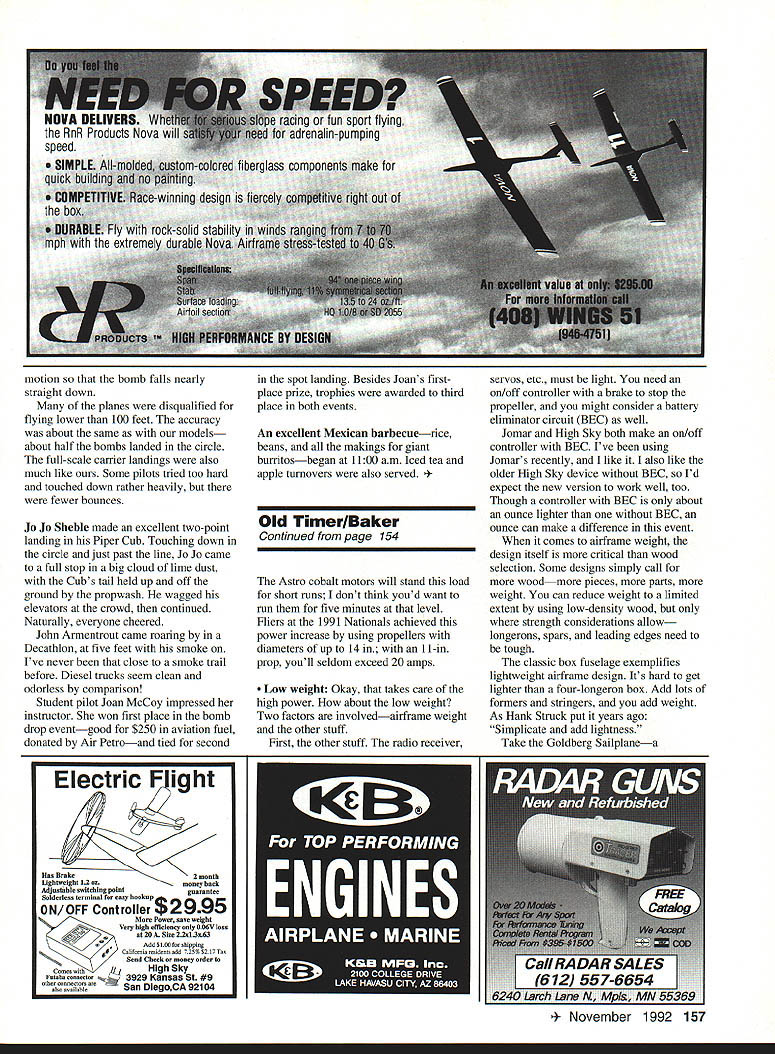
- Jo Jo Sheble made an excellent two-point landing in his Piper Cub, touching down in the circle just past the line, stopping in a cloud of lime dust with the Cub's tail held up by propwash. He wagged his elevators at the crowd to cheers.
- John Armentrout came roaring by in a Decathlon, at about five feet with smoke on — closer to a smoke trail than usual.
- Student pilot Joan McCoy impressed her instructor: she won first place in the bomb drop event (good for $250 in aviation fuel, donated by Air Petro) and tied for second in the spot landing. Trophies were also awarded to third place in both events.
Food and closing
An excellent Mexican barbecue — rice, beans, and all the makings for giant burritos — began at 11:00 a.m. Iced tea and apple turnovers were also served. The event combined fun, friendly competition, and community support for aviation scholarships.
Transcribed from original scans by AI. Minor OCR errors may remain.

