
Dragonfly P-30
"WHAT IN HEAVEN'S name," the reader may very well ask, "is a high-performance P-30?" Indeed it does sound like a contradiction in terms, as much an oxymoron as, say, "House ethics," "friendly foe," or "jumbo shrimp." After all, the P-30 event is designated as an entry-level rubber-powered affair; the P-30 model is a simple, easily built little plane with merely average flight performance. Most well-trimmed ones will fly a minute or so.
So why violate the whole intent by aiming for higher performance? Why slip in this Dragonfly? Just to see what can be done, that's why. If we're willing to stretch the boundaries (but not the rules) a little, and to tinker with the predictable, we can get more exciting performance and still be within the P-30 class specifications. The Dragonfly should be thought of as one example of what can be achieved.
— Dave Platt
Versions
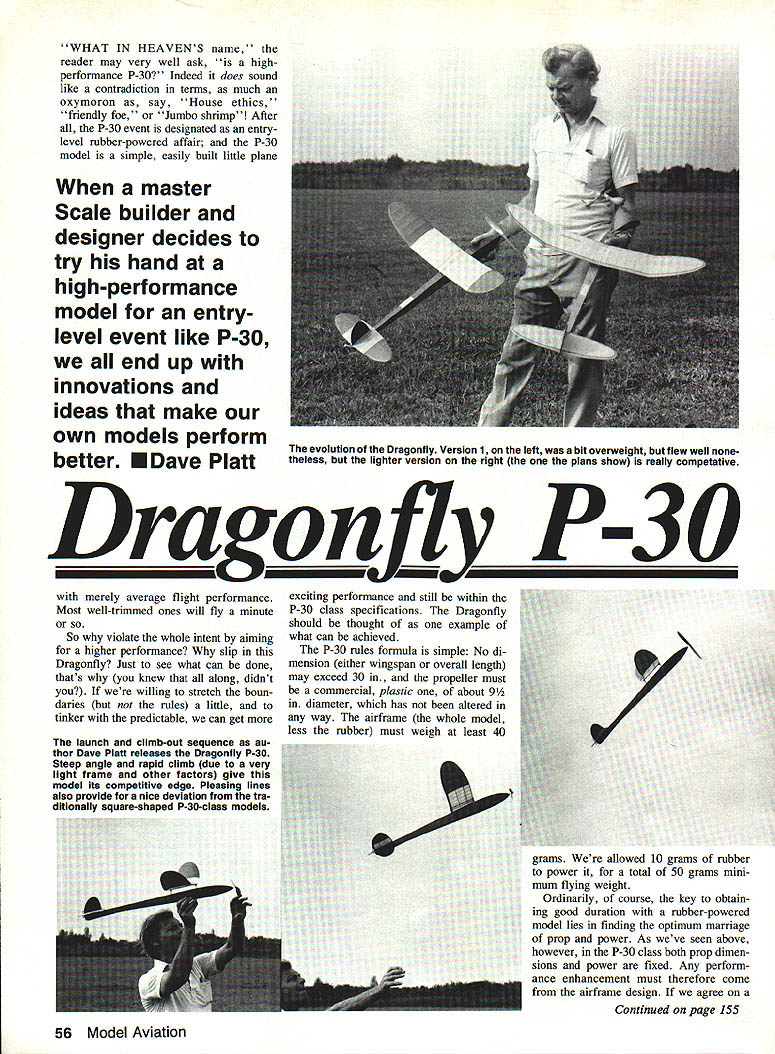
The Dragonfly was developed in two versions. Version 1 was a bit overweight but flew well nevertheless. The lighter version shown on the plans is really competitive and delivers exciting performance while still remaining within P-30 class specifications.
Construction notes
- Wing: Build the wing exactly as shown on the plan, keeping the structure light and true. Use the lightest appropriate balsa for ribs and sheeting; sand and fair surfaces carefully to minimize drag. Maintain accurate dihedral and washout as indicated.
- Tail surfaces: Make the tail surfaces as light as practical while retaining adequate stiffness. True the hinges and keep surfaces aligned precisely to prevent unwanted control coupling.
- Fuselage and pod: Keep the pod and boom structure minimal in weight but rigid. Use careful truss construction and spot-glue joints to preserve lightness. Fairing and shaping should reduce drag without adding unnecessary weight.
- Propulsion and rubber: Use the specified commercial plastic propeller and the allowed rubber weight. Proper winding practice and smooth, balanced installation of the prop are essential for consistent performance.
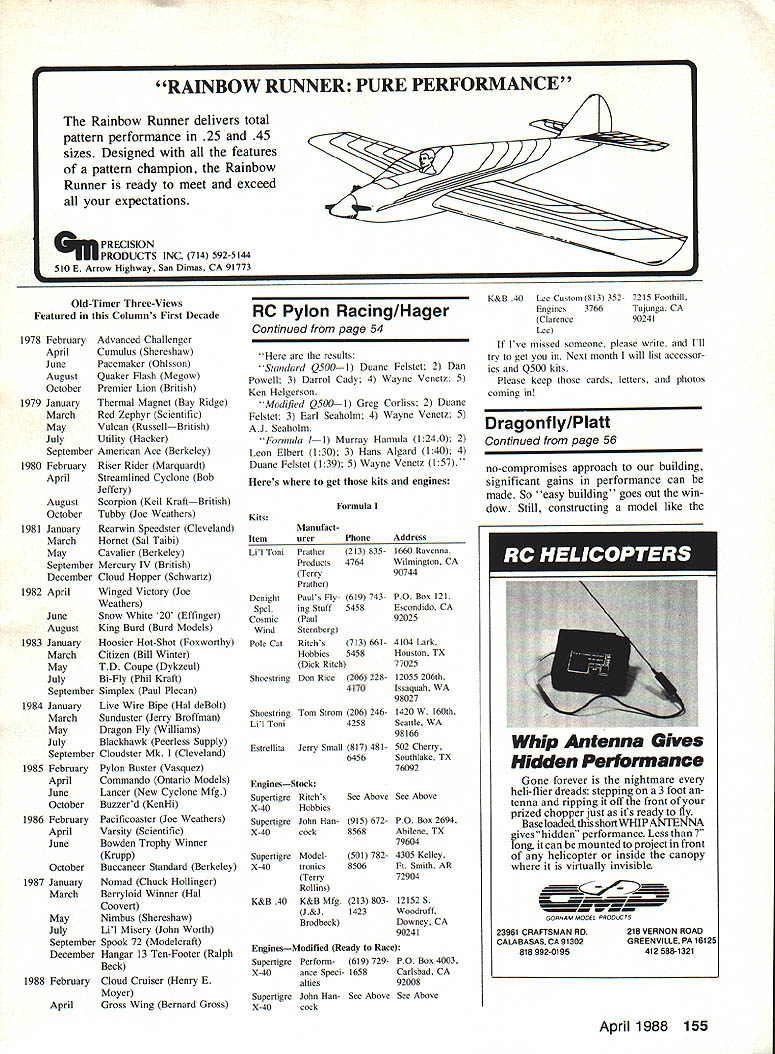
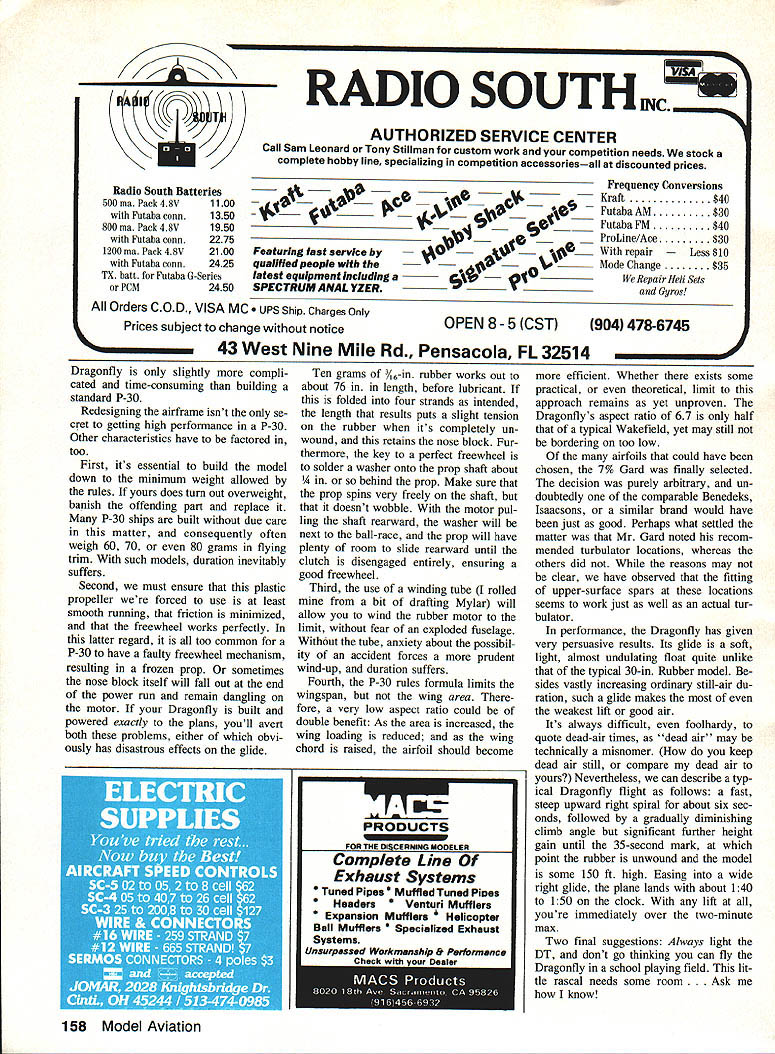
- Trim and flying: Initial trimming should concentrate on achieving a confident climb-out and a clean transition to glide. Small changes in thrust line, dihedral, and incidence can have significant effects; make adjustments incrementally. With careful trimming the Dragonfly will demonstrate steep rapid climbs and an efficient cruise, giving it a competitive edge in P-30.
Dragonfly is only slightly more complicated and time-consuming than building a standard P-30.
Additional considerations for high performance
- Build to the minimum weight
- It is essential to build the model down to the minimum flying weight allowed by the rules. If yours is overweight, remove and replace offending parts. Many P-30 ships are built without due care and consequently weigh 60, 70, or even 80 grams in flying trim; duration inevitably suffers with such weight.
- Ensure the prop and freewheel are perfect
- The forced-use plastic propeller must run smoothly, friction must be minimized, and the freewheel must work perfectly. It is common for a P-30 to have a faulty freewheel mechanism, resulting in a frozen prop. On some models the nose block will fall out at the end of the power run and remain dangling on the motor.
- Ten grams of 3/16-in. rubber works out to about 76 in. in length before lubricant. Folded into four strands as intended, the length puts slight tension on the rubber when unwound and helps retain the nose block.
- For a perfect freewheel, solder a washer onto the prop shaft about 3/64 in. behind the prop. Make sure the prop spins very freely on the shaft but does not wobble. With the motor pulling the shaft rearward, the washer will be next to the ball race and the prop will have room to slide rearward until the clutch is disengaged entirely, ensuring a good freewheel.
- Use a winding tube
- A winding tube (rolled from a bit of drafting Mylar, for example) allows you to wind the rubber motor to the limit without fear of an exploded fuselage. Without the tube, anxiety about accidents forces a more prudent wind-up and reduces duration.
- Exploit wing area (low aspect ratio)
- P-30 rules limit wingspan but not wing area. A very low aspect ratio can be doubly beneficial: increasing area reduces wing loading, and increasing chord can make the airfoil more efficient. The Dragonfly's aspect ratio of 6.7 is only half that of a typical Wakefield, yet may still be acceptable.
Airfoil, turbulator, and performance
Of the many airfoils that could have been chosen, the 7% Gard was finally selected. The decision was largely arbitrary; comparable Benedeks, Issacsons, or similar brands would likely perform as well. One practical reason for choosing the Gard was that it noted recommended turbulator locations. We have observed that the lift of upper-surface spars at these locations seems to work as well as an actual turbulator.
In performance, the Dragonfly has given very persuasive results. Its glide is a soft, light, almost undulating float quite unlike that of the typical 30-in. rubber model. Besides vastly increasing ordinary still-air duration, such a glide makes the most of even the weakest lift.
A typical Dragonfly flight (conditions and "dead air" vary) might be described as follows: a fast, steep upward right spiral for about six seconds, followed by a gradually diminishing climb angle but significant further height gain until about the 35-second mark, at which point the rubber is unwound and the model is some 150 ft. high. Easing into a wide right glide, the plane can land with about 1:40 to 1:50 on the clock. With any lift at all, you're immediately over the two-minute max.
Final tips
- Always light the DT.
- Don't try to fly the Dragonfly in a school playing field — this little rascal needs some room. Ask me how I know!
Transcribed from original scans by AI. Minor OCR errors may remain.

