
Duck Herding
David Andersen
A Fictional Tale
The following article is fiction and should not, under any circumstances, be taken seriously. This imaginary tale is presented for its humor and entertainment value only.
It nearly caused a range war.
Radio Control (RC) fliers in Minnesota have long known that migrating flocks of ducks, geese, and other birds can be maneuvered much as sheep can be controlled by a sheepdog. An RC model can move a flock to the left or right, or even turn it around. Flying through the flock divides it in two, then the halves can be merged again. It's great fun!
Conflict and Escalation
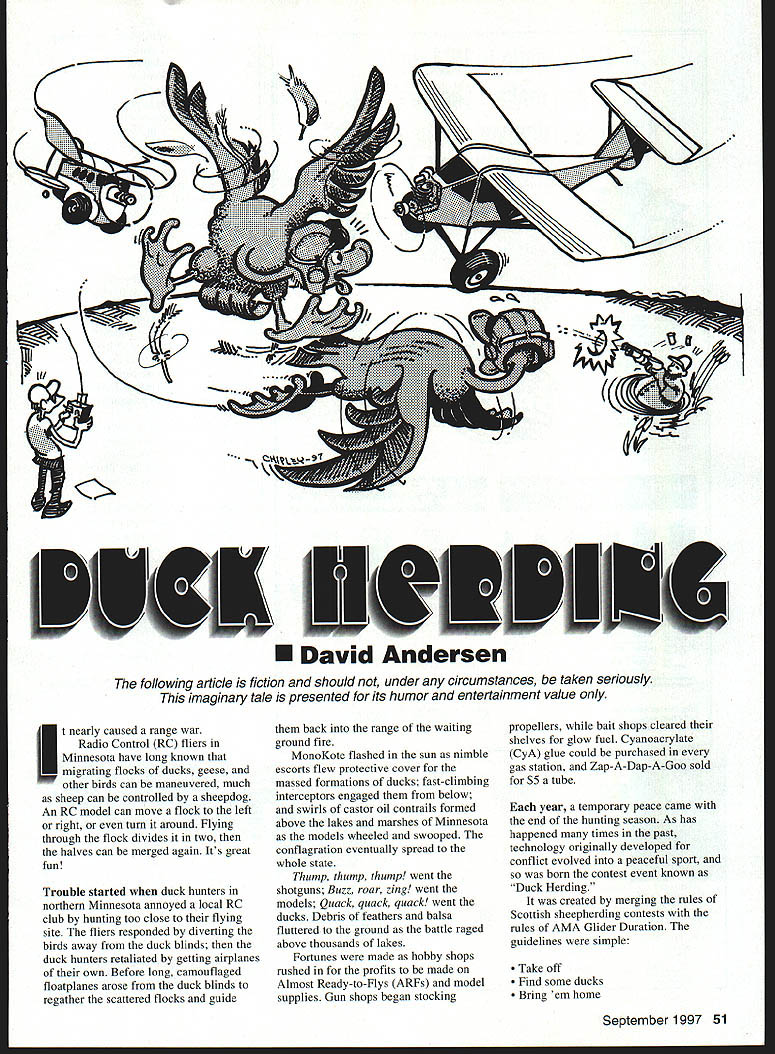
Trouble started when duck hunters in northern Minnesota annoyed a local RC club by hunting too close to their flying site. The fliers responded by diverting the birds away from the duck blinds; the duck hunters retaliated by getting airplanes of their own. Before long, camouflaged floatplanes arose from the duck blinds to regather the scattered flocks and guide them back into the range of the waiting ground fire.
MonoKote flashed in the sun as nimble escorts flew protective cover for the massed formations of ducks; fast-climbing interceptors engaged them from below; and swirls of castor-oil contrails formed above the lakes and marshes of Minnesota as the models wheeled and swooped. The conflagration eventually spread to the whole state.
Thump, thump, thump! went the shotguns; Buzz, roar, zing! went the models; Quack, quack, quack! went the ducks. Debris of feathers and balsa fluttered to the ground as the battle raged above thousands of lakes.
Fortunes were made as hobby shops rushed in for the profits to be made on Almost-Ready-to-Flys (ARFs) and model supplies. Gun shops began stocking propellers, while bait shops cleared their shelves for glow fuel. Cyanoacrylate (CyA) glue could be purchased in every gas station, and Zap-A-Dap-A-Goo sold for $5 a tube.
Each year, a temporary peace came with the end of the hunting season. As has happened many times in the past, technology originally developed for conflict evolved into a peaceful sport, and so was born the contest event known as "Duck Herding."
The Contest
It was created by merging the rules of Scottish sheepherding contests with the rules of AMA Glider Duration. The guidelines were simple:
- Take off
- Find some ducks
- Bring 'em home
Points were awarded for the number of ducks gathered overhead, while points were deducted for elapsed time. The objective was to gather birds as quickly as possible.
The event grew in popularity, and duck-herding contests were held in many small towns in Minnesota. There were new airplane designs specialized for climbing, searching, and gathering; onboard electronic duck calls quacked during the search phase; servo-operated mufflers barked like dogs during guidance; and miniature radars and head-mounted binoculars with head-up LCDs (Liquid Crystal Displays) appeared.
As the technology advanced, duck herding grew expensive. In an attempt to limit cost, Sportsman and Expert classes were created. Laser range finders, onboard video, and GPS receivers were restricted to Expert class, but it didn't help; nor did the simplified Fun Duck rules. Participation in competitive duck herding declined, and popularity shifted to noncompetitive herd-ins.
The final blow to the sport was when an animal-rights group formed a rare alliance with the hunting lobby, seeking legal restraint against duck herding, arguing that it was animal harassment.
Aftermath
Today, northern Minnesota is quiet. The hastily-built airstrips that once dotted the landscape have become overgrown with sandburs, and the hobby shops have been converted to gun and coffee shops. A few fliers occasionally gather in Hibbing and Warroad to reminisce about the old air battles. Graying pilots can be seen chatting in truck stops and bait shops, and as they tell and retell stories, their hands twist and dive above hot cups of coffee.
David P. Andersen 12106 Red Oak Court S. Burnsville, MN 55337
Transcribed from original scans by AI. Minor OCR errors may remain.

