
The Dunkin Project: University of Virginia Students Build an Electric Airship
By Tony Avak
Project overview
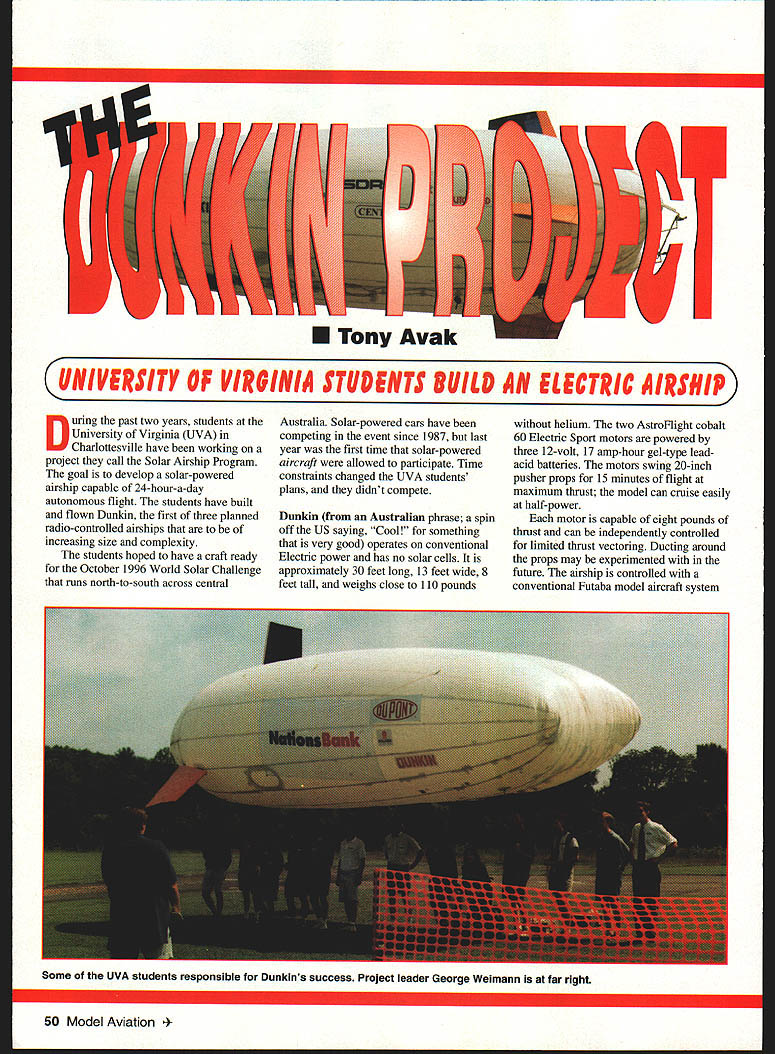
During the past two years, students at the University of Virginia (UVA) in Charlottesville have been working on the Solar Airship Program. The goal is to develop a solar-powered airship capable of 24-hour-a-day autonomous flight. The students have built and flown Dunkin, the first of three planned radio-controlled airships that are to be of increasing size and complexity.
The students had hoped to have a craft ready for the October 1996 World Solar Challenge, which runs north-to-south across central Australia. Solar-powered cars have been competing in the event since 1987, and 1995 was the first time solar-powered aircraft were allowed to participate. Time constraints prevented the UVA students from competing.
Dunkin: design and specifications
'Dunkin' (from an Australian phrase—a spin on the U.S. expression "Cool!" meaning very good) operates on conventional electric power and has no solar cells. Key specifications and features:
- Length: approximately 30 feet
- Width: 13 feet
- Height: 8 feet
- Weight: close to 110 pounds (without helium)
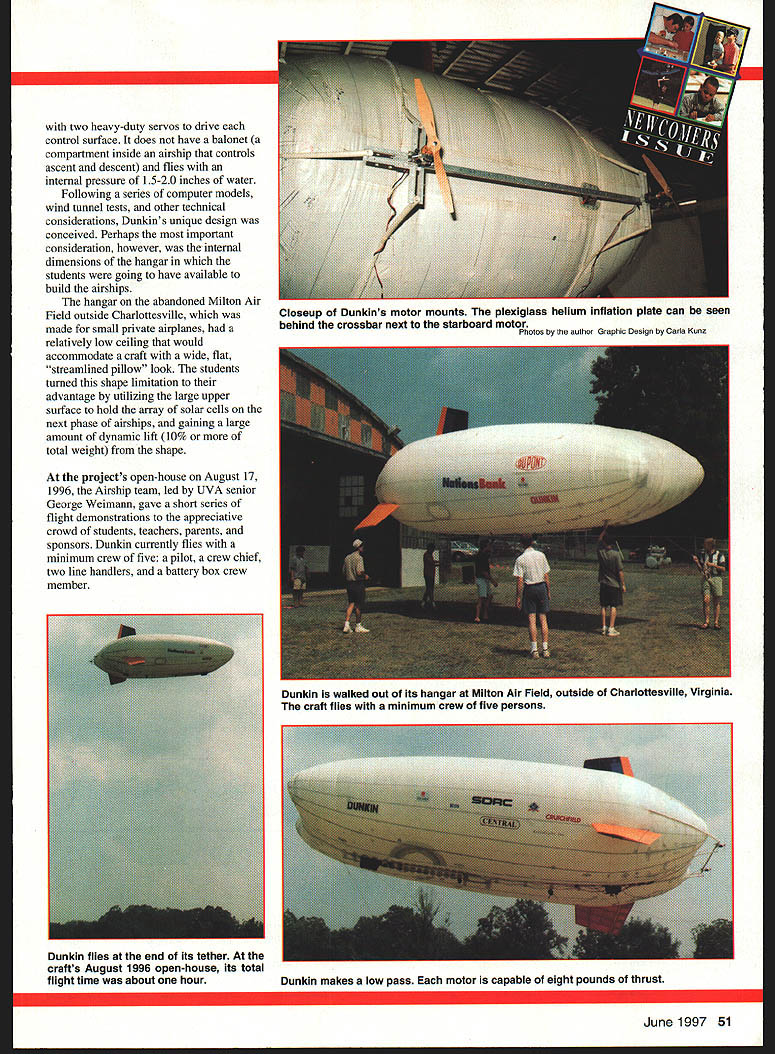
- Propulsion: two AstroFlight Cobalt 60 Electric Sport motors driving 20-inch pusher propellers
- Power source: three 12-volt, 17 amp-hour gel-type lead-acid batteries
- Flight endurance: about 15 minutes at maximum thrust; cruises easily at half power
- Thrust: each motor capable of about 8 pounds of thrust; motors can be independently controlled for limited thrust vectoring
- Control: conventional Futaba model aircraft radio system; two heavy-duty servos drive each control surface
- Internal pressure: flies with an internal pressure of 1.5–2.0 inches of water
- Ballonet: none (no internal compartment for ascent/descent control)
- Notes: ducting around the props may be experimented with in the future
Hangar influence on design
Following computer modeling, wind-tunnel tests, and other technical evaluations, Dunkin’s unique shape was conceived. Perhaps the single most important constraint was the internal dimensions of the hangar the students had available.
The hangar at the abandoned Milton Air Field outside Charlottesville, built for small private airplanes, had a relatively low ceiling. This limited the craft to a wide, flat, "streamlined pillow" shape. The students turned this limitation into an advantage by using the large upper surface for solar-cell arrays on the next-phase airships and by gaining significant dynamic lift (10% or more of total weight) from the shape.
Flight demonstrations and operations
At the project open house on August 17, 1996, the Airship team, led by UVA senior George Weimann, conducted a short series of flight demonstrations for students, teachers, parents, and sponsors. Dunkin currently flies with a minimum crew of five:
- Pilot
- Crew chief
- Two line handlers
- Battery box crew member
A long tether is attached to the aft end of the airship; a handler runs behind the ship at all times, ready to pull it away from trees at the edge of the small flying field. Dunkin is somewhat unstable in yaw; the tether will be eliminated as design changes improve handling and confidence grows. At the time of the open house, total outside flight time on the ship was about one hour.
Future phases
Dunkin is the program’s Phase I airship. Conceptual designs are underway for Aztec, the Phase II airship, which will be powered by solar energy and is scheduled to debut in the summer of 1997. At 16 meters long, Aztec will be recognized as an experimental aircraft by the Federal Aviation Administration (FAA) and will serve as the next milestone for the students’ mission.
In 1998, the UVA Airship Program proposes to present the 25-meter-long Phase III ship at Competitions Internationales d'Engins Légers (CIEL, or International Airship Races), a centennial celebration of the Aéro-Club de France in Paris.
Team and sponsors
The Airship Program has involved more than 80 UVA students. In addition to engineering students, majors in business (finance and accounting), art (presentations), journalism (publicity and public affairs), and others have been active.
Technical and financial sponsors include:
- University of Virginia
- NationsBank of Virginia
- Lockheed Martin
- Crutchfield
- Waverly Enterprises
- DuPont
- M.J. Systems
- Bosch Aerospace
- Oklahoma Science Foundation
- Kirkpatrick Foundation
- Solarex
- Gibbens & Associates
Contact information
For more information about Dunkin and the UVA Solar Airship Program, or to act as a sponsor, contact:
Solar Airship Program Department of MAE, University of Virginia Thornton Hall Charlottesville, VA 22903-4425
- Phone: (804) 924-4425
- Fax: (804) 982-2037
- E-mail: sacap@virginia.edu
- Web: http://www.virginia.edu/~sacap
Transcribed from original scans by AI. Minor OCR errors may remain.

