
Dust Removal System
By Windy Urtnowski
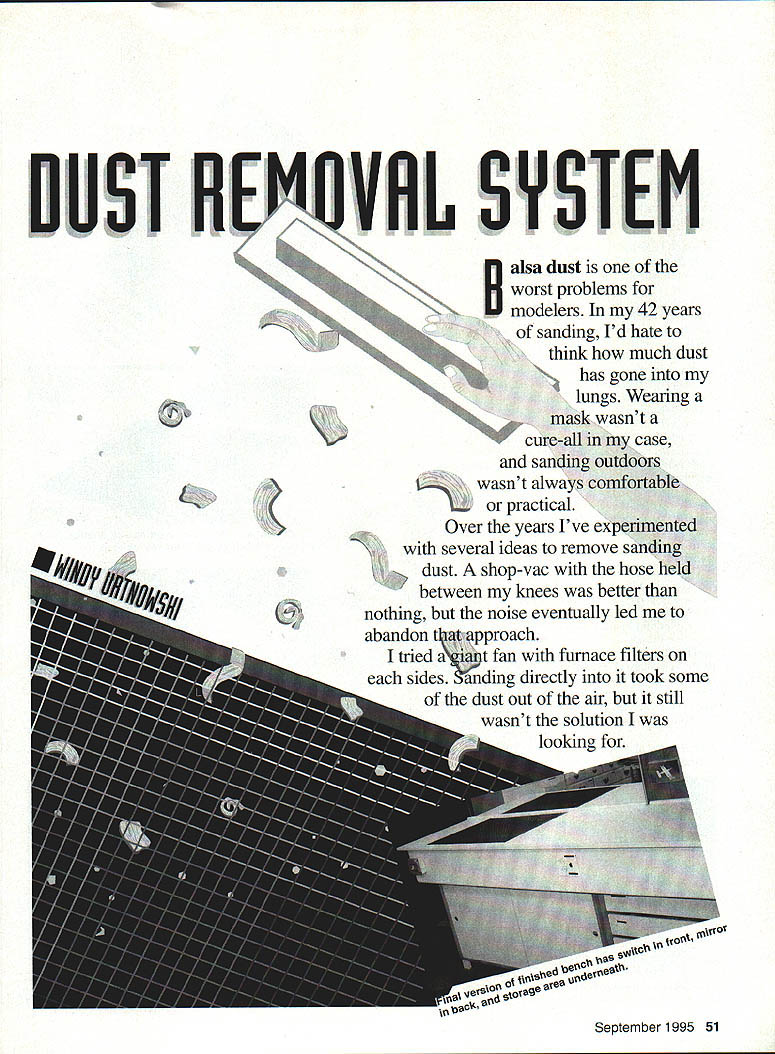
Balsa dust is one of the worst problems for modelers. In my 42 years of sanding, I'd hate to think how much dust has gone into my lungs. Wearing a mask wasn't a cure-all in my case, and sanding outdoors wasn't always comfortable or practical.
Early attempts to control dust
Over the years I've experimented with several ideas to remove sanding dust:
- A shop-vac with the hose held between my knees was better than nothing, but the noise eventually led me to abandon that approach.
- I tried a giant fan with furnace filters on each side. Sanding directly into it took some of the dust out of the air, but it still wasn't the solution I was looking for.
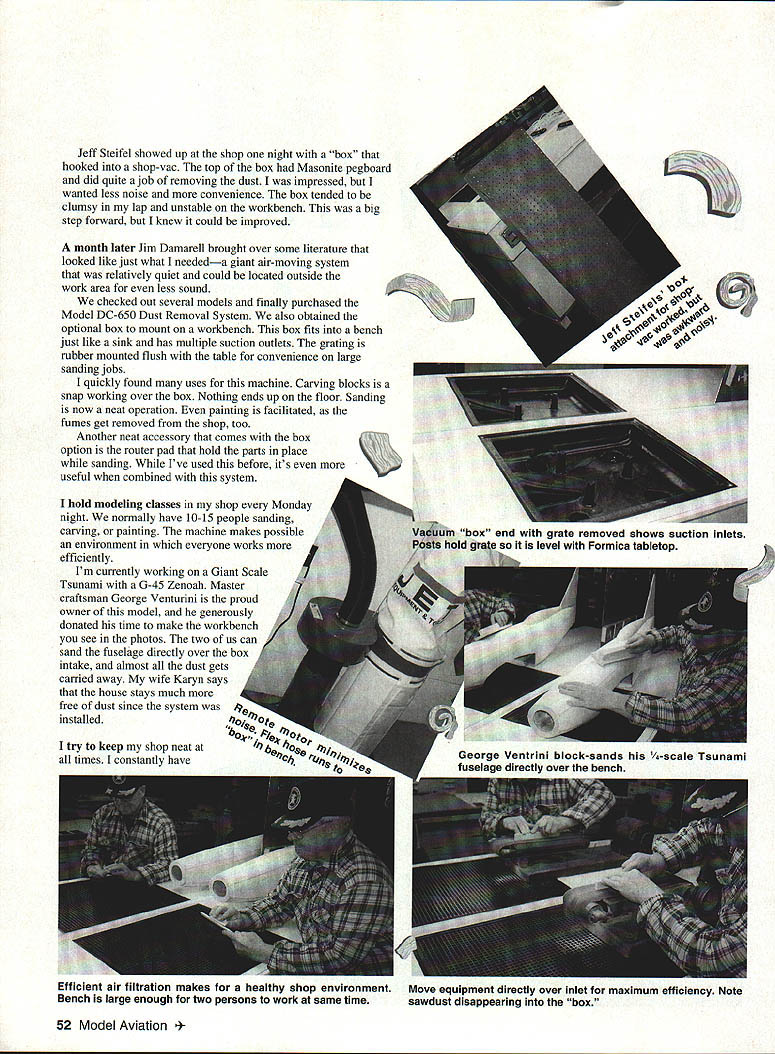
- Jeff Steifel showed up at the shop one night with a "box" that hooked into a shop-vac. The top of the box had Masonite pegboard and did quite a job of removing the dust. I was impressed, but I wanted less noise and more convenience. The box tended to be clumsy in my lap and unstable on the workbench. This was a big step forward, but I knew it could be improved.
Finding the right system
A month later Jim Damarell brought over some literature that looked like just what I needed—a giant air-moving system that was relatively quiet and could be located outside the work area for even less sound. We checked out several models and finally purchased the Model DC-650 Dust Removal System. We also obtained the optional box to mount on a workbench.
The bench-mounted box
The optional box fits into a bench just like a sink and has multiple suction outlets. The grating is rubber-mounted flush with the table for convenience on large sanding jobs. A neat accessory that comes with the box option is the router pad that holds parts in place while sanding. While I've used a router pad before, it's even more useful when combined with this system.
Uses and benefits
I quickly found many uses for this machine:
- Carving blocks is a snap working over the box; nothing ends up on the floor.
- Sanding has become a neat operation, and painting is facilitated since fumes get removed from the shop too.
- I hold modeling classes in my shop every Monday night with 10–15 people sanding, carving, or painting. The machine makes possible an environment in which everyone works more efficiently.
I'm currently working on a Giant Scale Tsunami with a G-45 Zenoah. Master craftsman George Venturini is the proud owner of this model, and he generously donated his time to make the workbench you see in the photos. The two of us can sand the fuselage directly over the box intake, and almost all the dust gets carried away. My wife Karyn says that the house stays much more free of dust since the system was installed.
Workbench and shop layout
I try to keep my shop neat at all times. I constantly have visitors, and the bench seems everyone's favorite place to work. I used two old dressers mounted on a 3/4" plywood top. George Venturini laminated a top of white Formica which makes a great work surface. I installed a mirror behind the bench and a four-inch fluorescent light above to maximize efficiency of the work station.
I used stovepipe corners and flexible hose to locate the motor part of the unit in an adjacent room. The bag empties easily and traps the smallest dust particles. It does a great job filtering the air when working directly over the box.
The unit can be wired for 110 volts or 220 if you'd like. As an energy saver, you may find a stand-up bench suits your shop needs best, but you could consider putting the box in an old kitchen-type table for a sit-down work station. Drawer space under the bench holds tools and sandpaper supplies.
Accessories and additional uses
Lots of accessories are available to suit your own situation. Additional uses include:
- Mounting a Dremel or scroll saw right over the box
- Using a belt sander over the box
- Expanding uses as needed to fit your workflow
Adding this tool work area was the single biggest step I've made toward improving the work environment and efficiency of my shop.
Cost and recommendations
Similar units are sold by woodworking supply houses—check around before buying. Dust removal systems cost $300–$400, which is well worth the money if you spend a lot of time in your shop. It's much cleaner now; my shop, TV and VCR stay clean. I'll bet my lungs are happier too. The initial price may seem high, but it's the kind of tool you'll wonder why you didn't invest in sooner.
I've also used it for furniture refinishing projects that would otherwise have been impossible because they make a tremendous mess. The dust removed even makes an excellent soil conditioner for the garden—last year's tomatoes were larger than normal but tasted a bit like wood.
Sources and contact information
- Jet Equipment & Tools, Box 1349, Auburn, WA 98071
- Woodworking Unlimited
The box referred to in this article and shown in the photos comes from Woodworking Unlimited; Tel.: (800) 762-7555.
I shot some video of the bench construction. If you'd like a copy, send $15 plus $3 shipping to:
Windy Urtnowski 93 Elliott Place Rutherford, NJ 07070
Transcribed from original scans by AI. Minor OCR errors may remain.

