
Duxford
There are associations, apart from the sounds commingling in the air. It all adds up to a place where the proud past comes alive.
Walking around Duxford, you inhale the familiar smells of dope, gasoline, oil, and very old fabric. You hear strains of "Roses of Picardie" from the First World War and Glenn Miller's "In the Mood" from the second. If you're lucky, the occasional Rolls‑Royce Merlin in the nose of a Hawker Hurricane or a Supermarine Spitfire will add its deep, throaty rumble to the old, nostalgic tunes.
The feeling comes over you when you stroll down a narrow paved road between rows of buildings that have been at Duxford for a very long time. On your left, away from the airfield, are long, low, 70‑year‑old brick shop buildings full of airplane parts, some of them stored, others being restored. On your right are utilitarian hangars that have played host to many of the most honored squadrons of the Royal Air Force and the U.S. Army Air Forces.
Duxford today is a museum. It's the official residence of the aeronautical collection of the Imperial War Museum, together with the holdings of the private Duxford Aviation Society. Located less than 50 miles north of London in the flat, open land of Cambridgeshire, Duxford is just a few miles from the ancient university town of Cambridge.
The land has always been flat, the university has been there since 1200; but Duxford, of course, hasn't always been a museum. It became an aerodrome during World War I, receiving its first three squadrons of De Havilland DH.9 bombers in 1918, before the first hangars were ready for use. Three of those hangars are still full of airplanes, while the smaller fourth one was intentionally blown up during the filming of The Battle of Britain. Recently two more have been built to house Duxford's rapidly growing collection of warplanes.
The airfield officially opened in September 1918 as a military flying school, and it remained active after the war ended. Pilots learned to fly in Avro 504s, Bristol Fighters (F2B), and DH.9As. In 1924 Duxford became a fighter station and continued as such until it was closed in 1961. During the 1930s Britain's future defenders flew biplane Sopwith Snipes, Gloster Grebes, and Armstrong Whitworth Siskins from the same grassy expanse that was bisected by its first concrete runway in 1944.
In 1938, as the Second World War loomed on the horizon, two squadrons of brand‑new Spitfires arrived. Among their pilots was the famed legless ace Douglas Bader. Duxford played a major role during the Battle of Britain, with a total of five squadrons operating from the airfield and from that of nearby Fowlmere.
At the end of 1940 the airfield became a center for testing new Allied airplanes as well as those captured from Axis powers. In 1942 the first military wing using Hawker Typhoon fighter‑bombers was based at Duxford. In June 1943 it became a USAAF base from which Eighth Air Force P‑51 Mustangs and P‑47 Thunderbolts escorted mass formations of B‑17 Flying Fortresses and B‑24 Liberators on raids to occupied Europe.
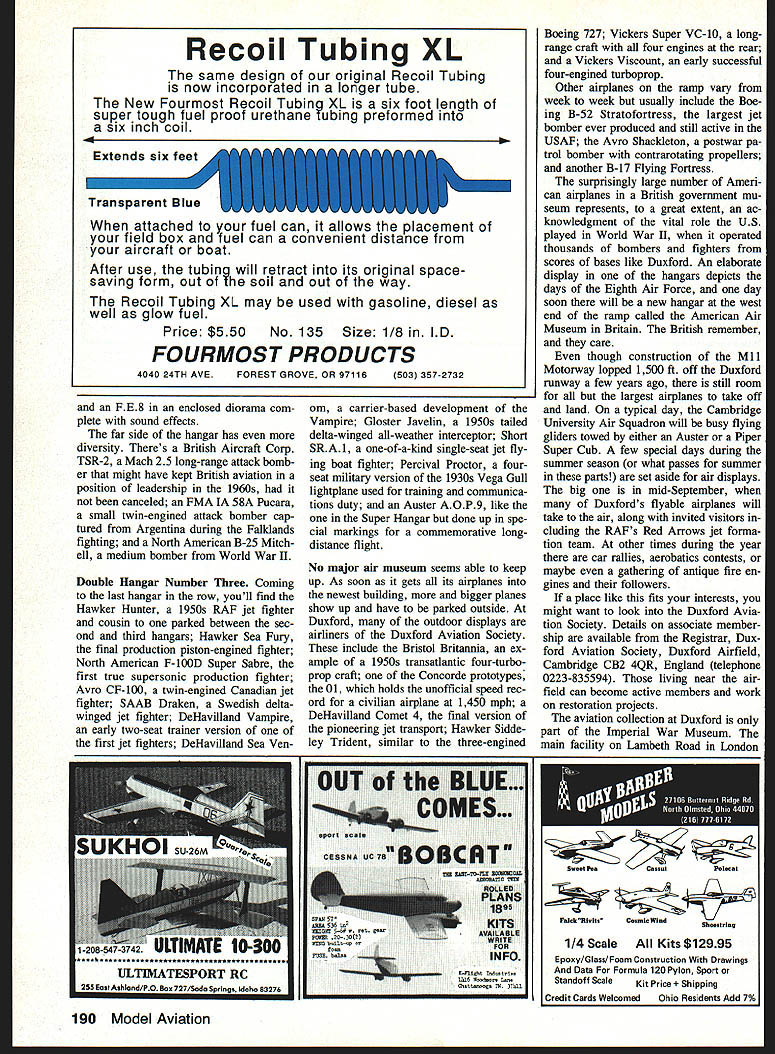
After the war the base was returned to the RAF, which used it for Spitfires and new Gloster Meteor jet fighters. The final flight by an RAF unit at Duxford was on July 31, 1961, when a Meteor NF.14 took off and flew away . . . forever. More than 40 years of military operations had come to an end.
The government considered other uses for the former air base: as a sports and recreation center, a correctional facility for young men, and even for storage of equipment having nothing to do with aviation. Such use of the hangars and ramp area might have been practical, but it would have permanently erased the site's long history. The first signs of its true future appeared in 1971. Assisted by the small, private East Anglian Aviation Society, the Imperial War Museum transferred some airplanes from its overcrowded downtown London building to Duxford for housing and restoration.
The first public showing, in October 1973, consisted of just 10 aircraft. By June 1976 Duxford was open to the public on a regular basis. Little by little the old buildings were renovated and filled with complete or nearly complete aircraft. The larger planes had to be parked on the ramp as the collection grew. In 1980 a hangar was transferred from another ex‑RAF base and erected at Duxford where an identical one had once stood.
In 1985 the first completely new building, called the Super Hangar, was built to house many of the larger military and civil airplanes in the collection. It's 260 ft square and 70 ft high, without a single supporting post in the middle. This is the building you enter, after paying 3.50 pounds (around $6) for adults, and 1.80 for children, students, and senior citizens.
Getting there Most travelers find themselves in London, and from there it's an hour's drive (at a legal 70 mph) north on the M11 Motorway to the well‑marked Junction 10. By train from London's Liverpool Street Station it's an hour to Cambridge and then another 35 minutes by bus.
Super Hangar
Once in the entrance building, you have a choice of shopping or gawking. Immediately on your left is a gift shop with everything from official museum pencil erasers to books, plastic kits, and T‑shirts. It's probably a good idea to control your urge to buy until you're ready to leave, as there's no point in dragging a full shopping bag around with you all day. A wonderful view of Duxford can be had from the second‑floor walkway which runs the full length of one side.
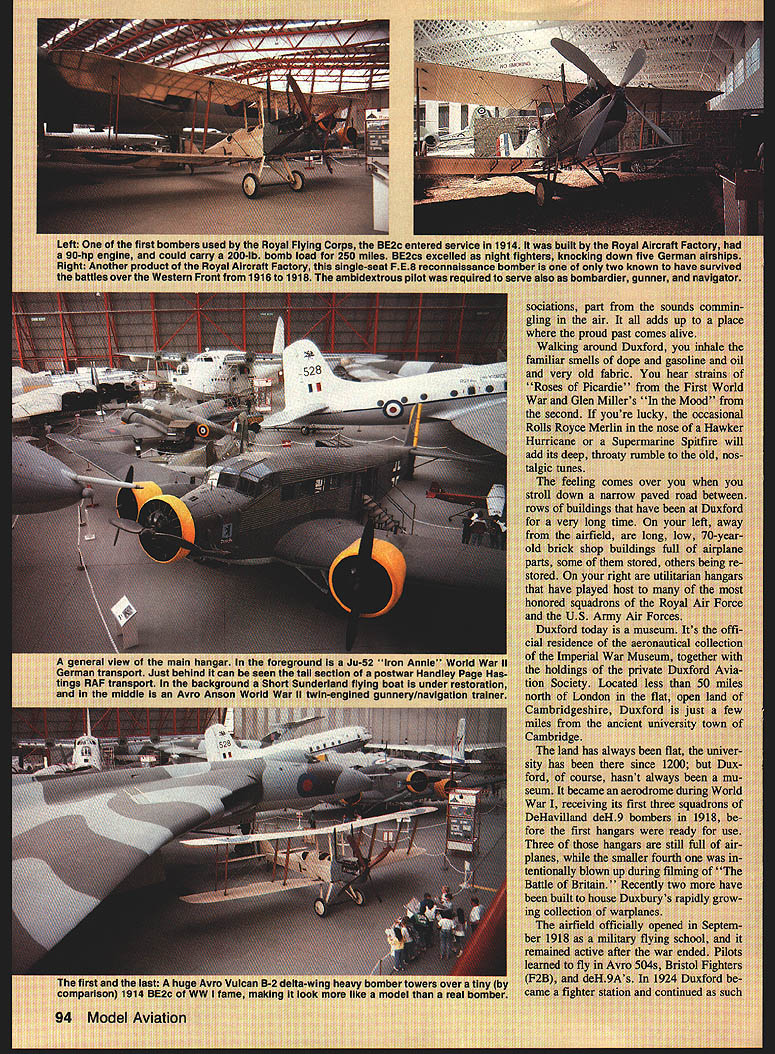
The Super Hangar houses more of the museum's 110 aircraft than any of the other buildings. Representing the World War I period is the only fully restored B.E.2c, a 1914 Royal Flying Corps reconnaissance bomber. Like most of the airplanes here, it can be approached from many angles by the enthusiast shooting pictures for a future modeling effort. Some are complete and others are being restored.
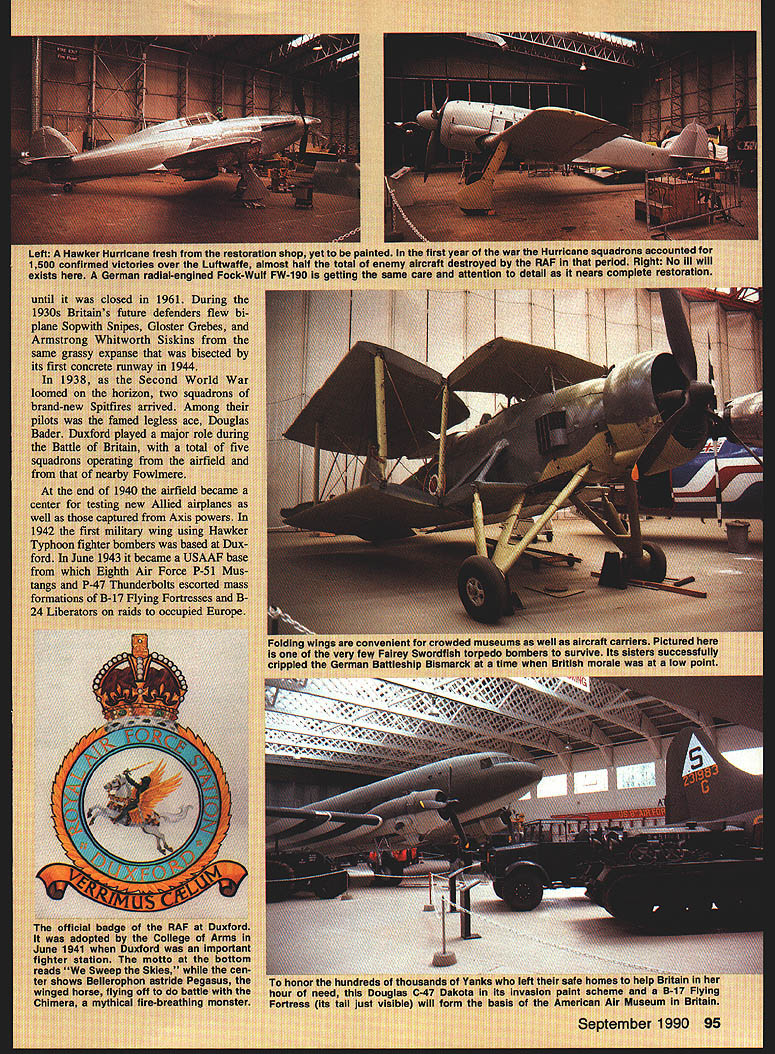
World War II, having been fought from and over Duxford, figures prominently in the collection. Highlights include the Short Sunderland, a huge flying‑boat patrol bomber that will be under restoration for a long time; Avro Anson, first used for sea patrol and then for training and as a light transport; Airspeed Oxford, the RAF's first twin‑engined monoplane advanced trainer (introduced in 1937 and served until 1954); Fairey Swordfish, an open‑cockpit biplane torpedo bomber; Boeing B‑29 Superfortress, an ex‑USAAF machine recovered from a scrap heap and dubbed the Washington by the RAF; Junkers Ju‑52 "Iron Annie," Germany's main transport of the war; and Messerschmitt Me‑163 Komet, the world's only rocket‑powered fighter.
From the postwar period are the Avro Vulcan, a beefy delta‑winged heavy bomber capable of close to Mach 1; an English Electric Lightning, the first British Mach 2 jet fighter, with vertically stacked engines and extreme sweepback on the wings; Auster A.O.P.9, a liaison plane developed from the American Taylorcraft lightplane; Avro Tudor, a minor postwar airliner resembling the Douglas DC‑4; and Handley Page Herald, a 1950s airliner that began with four piston engines and prospered with two turboprops.
Outside the hangar is a changing display which may include a suspicious‑looking Spitfire that, on close inspection, turns out to have been molded from fiberglass for display purposes, or possibly to sit in the background of a movie set.
Single‑Bay Hangar
West of the Super Hangar is a building used for a combination of storage and restoration. When we visited in July 1988 the Single‑Bay Hangar was filled with American airplanes, but of course the mix continually changes. You are welcome to watch the restorers at work, as long as you don't get too close. It's a great opportunity to see the innards of some important airplanes.
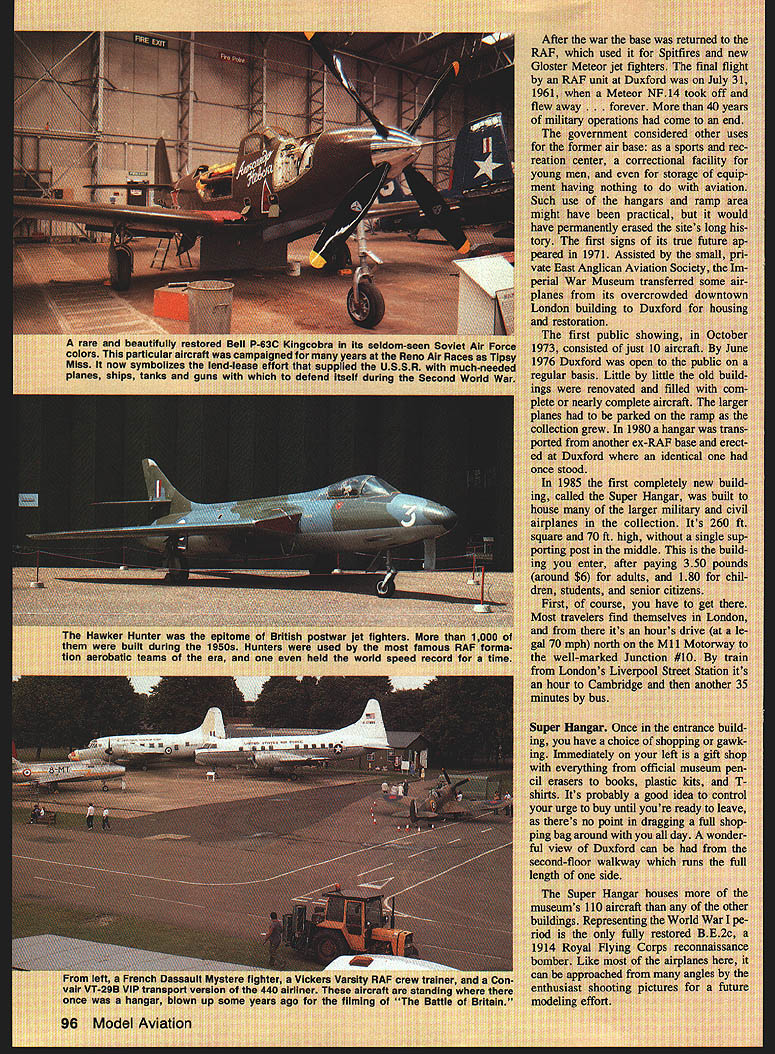
On our visit these included a Curtiss P‑40E (called the Kittyhawk I by the RAF); Republic P‑47D Thunderbolt, a rare example with a bubble canopy but no dorsal fin; North American F‑51D Mustang, whose Rolls‑Royce engine, as the British will tell you with pride, made it a success; Bell P‑63C Kingcobra, now in Soviet Air Force markings and once raced as #28 "Tipsy Miss"; Grumman F8F‑2N Bearcat in U.S. Navy and civil markings; two Spitfires (one complete and the other being restored — Duxford has five of these airplanes altogether); a Hawker Hurricane, almost fully restored and looking great; and a Focke‑Wulf FW‑190 that appeared to need little other than a paint job to be ready to fly.
Parked outside, not far from some large self‑propelled field guns, was a Fairey Gannet turboprop anti‑sub patrol plane with its wings double‑folded.
Double Hangar Number One
The first of the original double hangars is a bit slim on aircraft displays. An entire side is devoted to tanks and armored cars from both Allied and Axis armies, which will be meaningful mainly to specialists. The other side includes well‑restored examples of a B‑17 Flying Fortress and a Douglas C‑47 (called a Dakota locally and recognizable as a camouflaged DC‑3). Between the first two double hangars is an area once occupied by another hangar that was blown up for a movie. To the rear of this area stands a new small building, which is the restaurant where you can get snacks, sandwiches, or even hot meals. In front are more airplanes: the Dassault Mystère, a French swept‑wing jet fighter; Convair VT‑29B, the military VIP version of the old 240 airliner; and the Vickers Varsity, a postwar aircrew trainer about the size of a DC‑3.
Double Hangar Number Two
The first half of this hangar holds a mixture of World War I airplanes in realistic settings and more modern American types. You'll find a Curtiss P‑40 Kittyhawk II; North American P‑51D Mustang; Vought F4U‑8 Corsair in Royal Navy markings; Grumman TBM‑3 Avenger, also in Royal Navy colors; a SPAD VII in a well‑protected enclosure; and an F.E.8 in an enclosed diorama complete with sound effects.
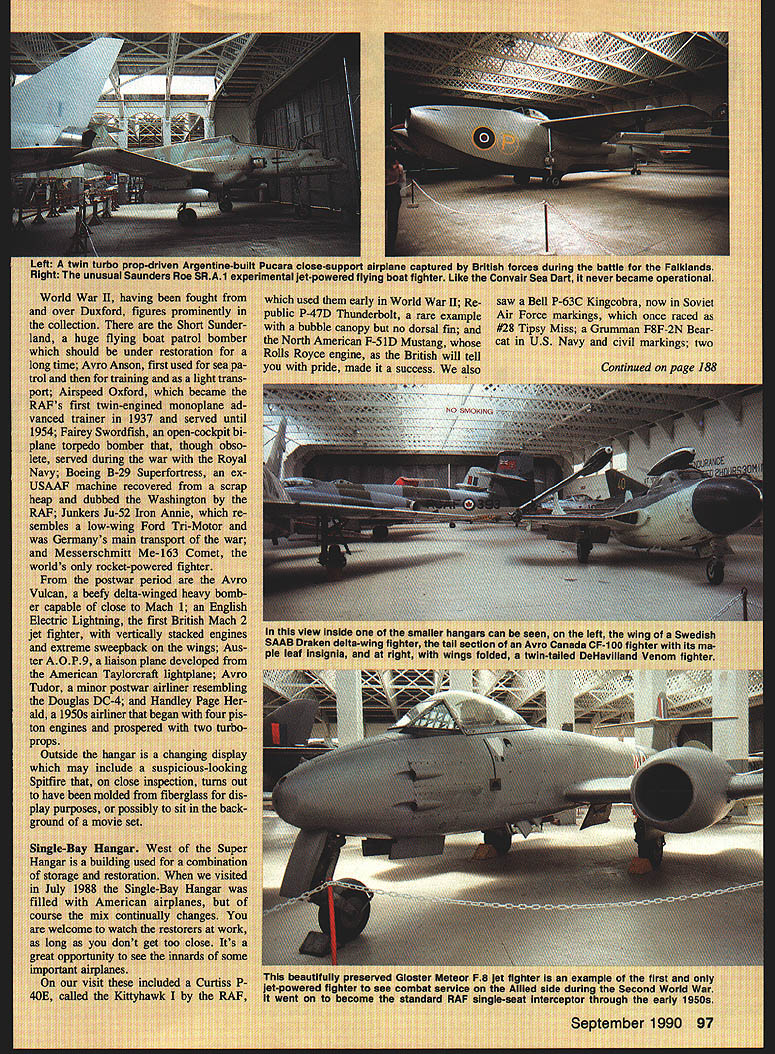
The far side of the hangar has even more diversity. There's a British Aircraft Corporation TSR‑2, a Mach‑2.5 long‑range attack bomber that might have kept British aviation in a leading position in the 1960s had it not been canceled; an FMA IA 58A Pucará, a small twin‑engined attack bomber captured from the Argentines during the Falklands fighting; and a North American B‑25 Mitchell, a medium bomber from World War II.
Double Hangar Number Three
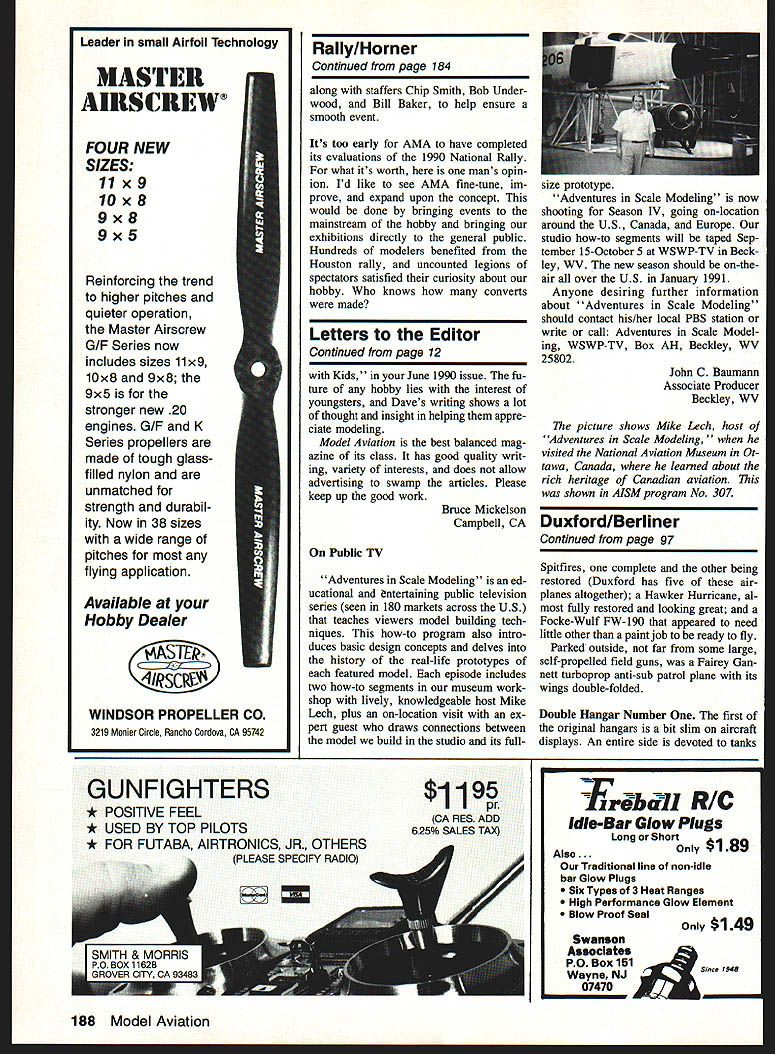
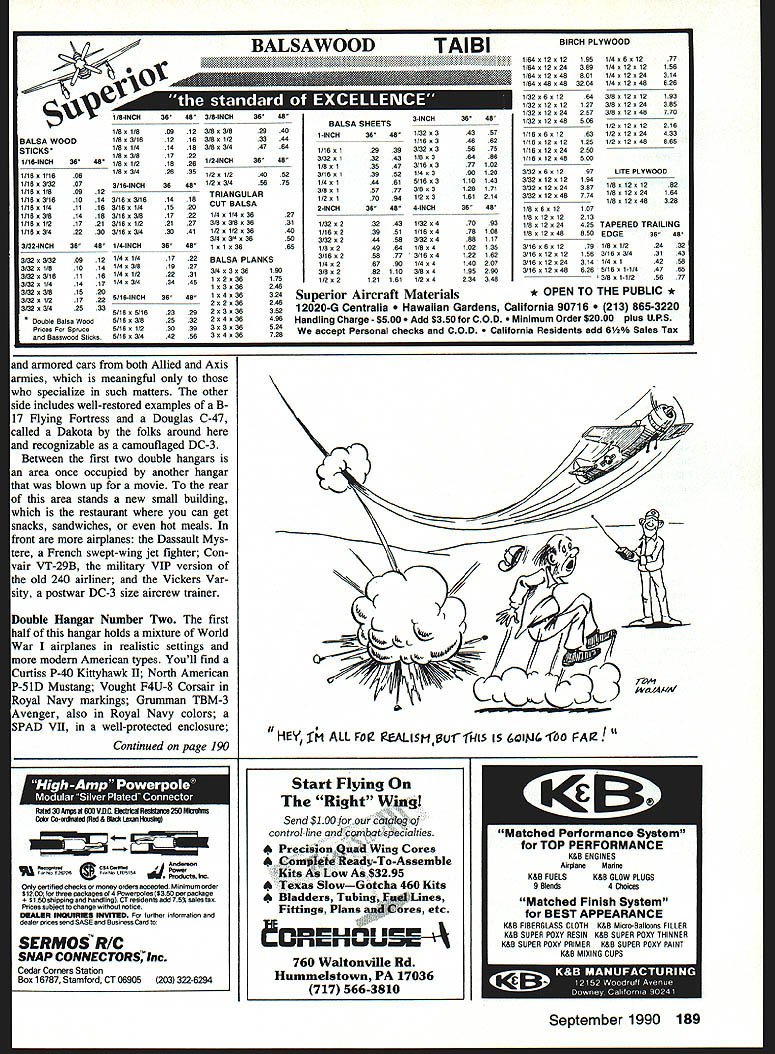
Coming to the last hangar in the row, you'll find a Hawker Hunter, a 1950s RAF jet fighter and cousin to one parked between the second and third hangars; Hawker Sea Fury, the final production piston‑engined fighter; North American F‑100D Super Sabre, the first true supersonic production fighter; Avro CF‑100, a twin‑engined Canadian jet fighter; SAAB Draken, a Swedish delta‑winged jet fighter; de Havilland Vampire (an early jet) and a two‑seat trainer version; de Havilland Sea Venom, a carrier‑based development of the Vampire; Gloster Javelin, a 1950s tailed‑delta all‑weather interceptor; Short S.R.A.1, a one‑of‑a‑kind single‑seat jet flying‑boat fighter; Percival Proctor, a four‑seat military version of the 1930s Vega Gull used for training and communications; and an Auster A.O.P.9, like the one in the Super Hangar but done up in special markings for a commemorative long‑distance flight.
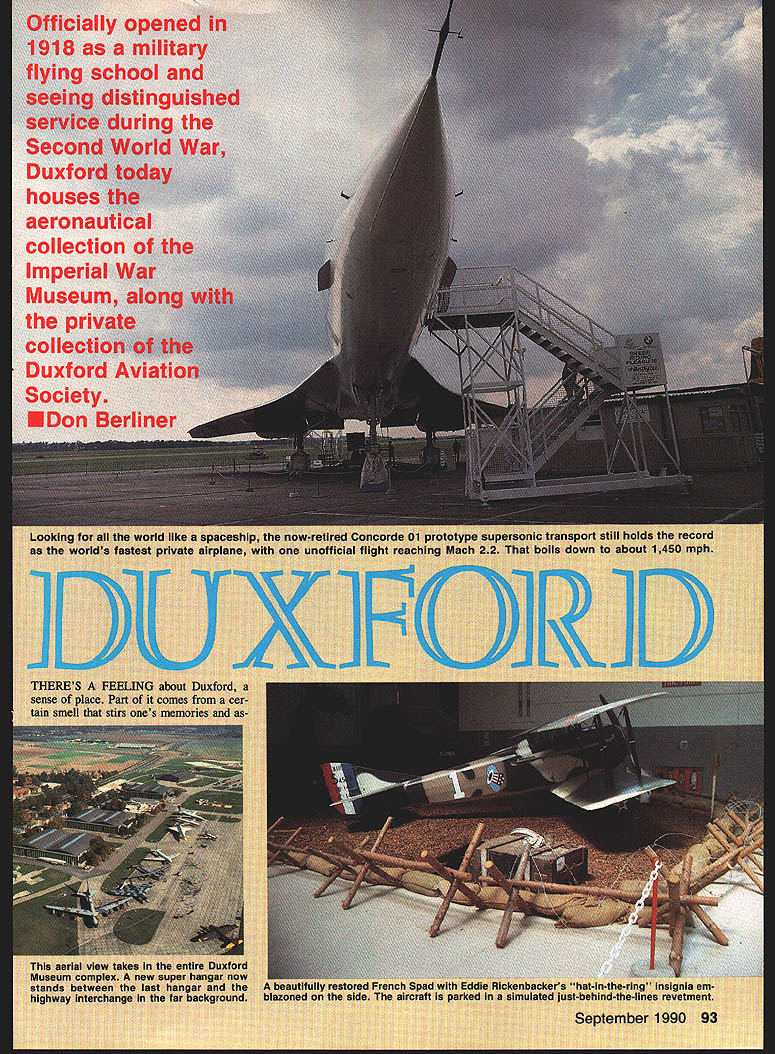
No major air museum seems able to keep up. As soon as it gets all its airplanes in the newest building, more and bigger planes show up and have to be parked outside. At Duxford, many of the outdoor displays are airliners of the Duxford Aviation Society. These include the Bristol Britannia, a 1950s transatlantic four‑turbojet craft; one of the Concorde prototypes, 01, which holds the unofficial speed record for a civilian airplane at 1,450 mph; a de Havilland Comet 4, the final version of the pioneering jet transport; Hawker Siddeley Trident, similar to the three‑engined Boeing 727; Vickers Super VC‑10, a long‑range craft with all four engines at the rear; and a Vickers Viscount, an early successful four‑engined turboprop.
Other airplanes on the ramp vary from week to week but usually include the Boeing B‑52 Stratofortress, the largest jet bomber ever produced and still active in the USAF; the Avro Shackleton, a postwar patrol bomber with contrarotating propellers; and another B‑17 Flying Fortress.
The surprisingly large number of American airplanes in a British government museum represents, to a great extent, an acknowledgment of the vital role the U.S. played in World War II, when it operated thousands of bombers and fighters from scores of bases like Duxford. An elaborate display in one of the hangars depicts the days of the Eighth Air Force, and one day soon there will be a new hangar at the west end of the ramp called the American Air Museum in Britain. The British remember, and they care.
Even though construction of the M11 Motorway looped 1,500 ft off the Duxford runway a few years ago, there is still room for all but the largest airplanes to take off and land. On a typical day, the Cambridge University Air Squadron will be busy flying gliders towed by either an Auster or a Piper Super Cub. A few special days during the summer season (or what passes for summer in these parts) are set aside for air displays. The big one is in mid‑September, when many of Duxford's flyable airplanes will take to the air, along with invited visitors including the RAF's Red Arrows and a formation team. At other times during the year there are car rallies, aerobatics contests, or maybe even a gathering of antique fire engines and their followers.
If a place like this fits your interests you might want to look into the Duxford Aviation Society. Details on associate membership are available from the Registrar, Duxford Aviation Society, Duxford Airfield, Cambridge CB2 4QR, England (telephone 0223‑855594). Those living near the airfield can become active members and work on restoration projects.
The aviation collection at Duxford is only part of the Imperial War Museum. The main facility on Lambeth Road in London houses relics and displays of both World Wars. HMS Belfast is moored on London's Thames. The newest exhibit is the Cabinet War Rooms, recently restored to their World War II condition as the underground emergency headquarters of Prime Minister Winston Churchill. Taken together, these installations tell the story of two enormous wars that raged all around England—particularly in the skies over now‑peaceful settings like Duxford Airfield.
Transcribed from original scans by AI. Minor OCR errors may remain.

