
E.A.A.
Text and Photos by Dick Stouffer
The Experimental Aircraft Association and the Academy of Model Aeronautics share a lot — air models, kites, wind tunnels — things that helped the Wright brothers become airborne at Kitty Hawk. Perhaps the greatest sharing is the simple love and appreciation of aviation in its varied aspects. EAA communicates that love of sharing through one of the largest privately sustained air museums in the country.
With 45,000 square feet of museum floor space, the EAA Air Museum ranks with the Air Force and Smithsonian Air and Space museums.
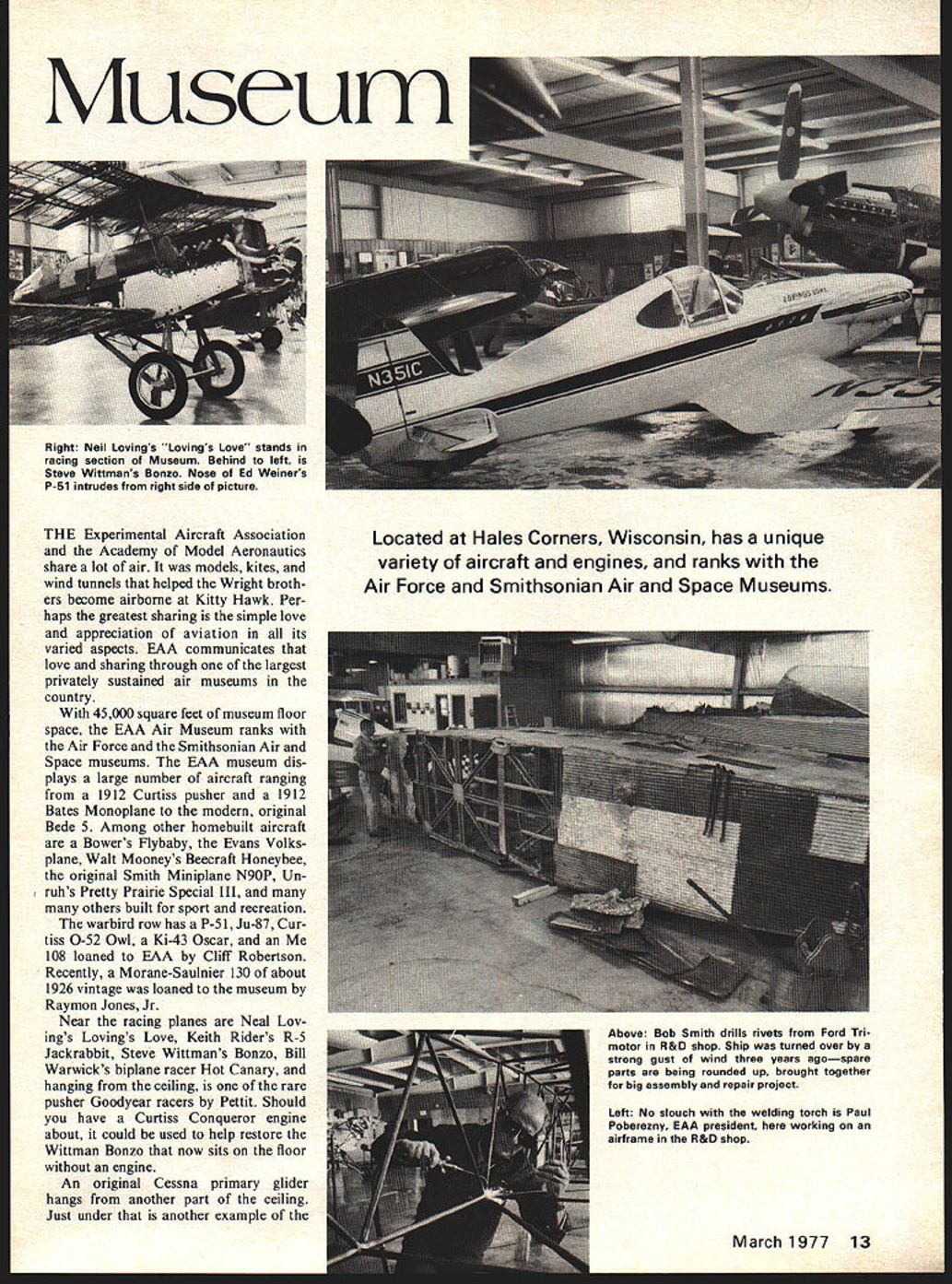
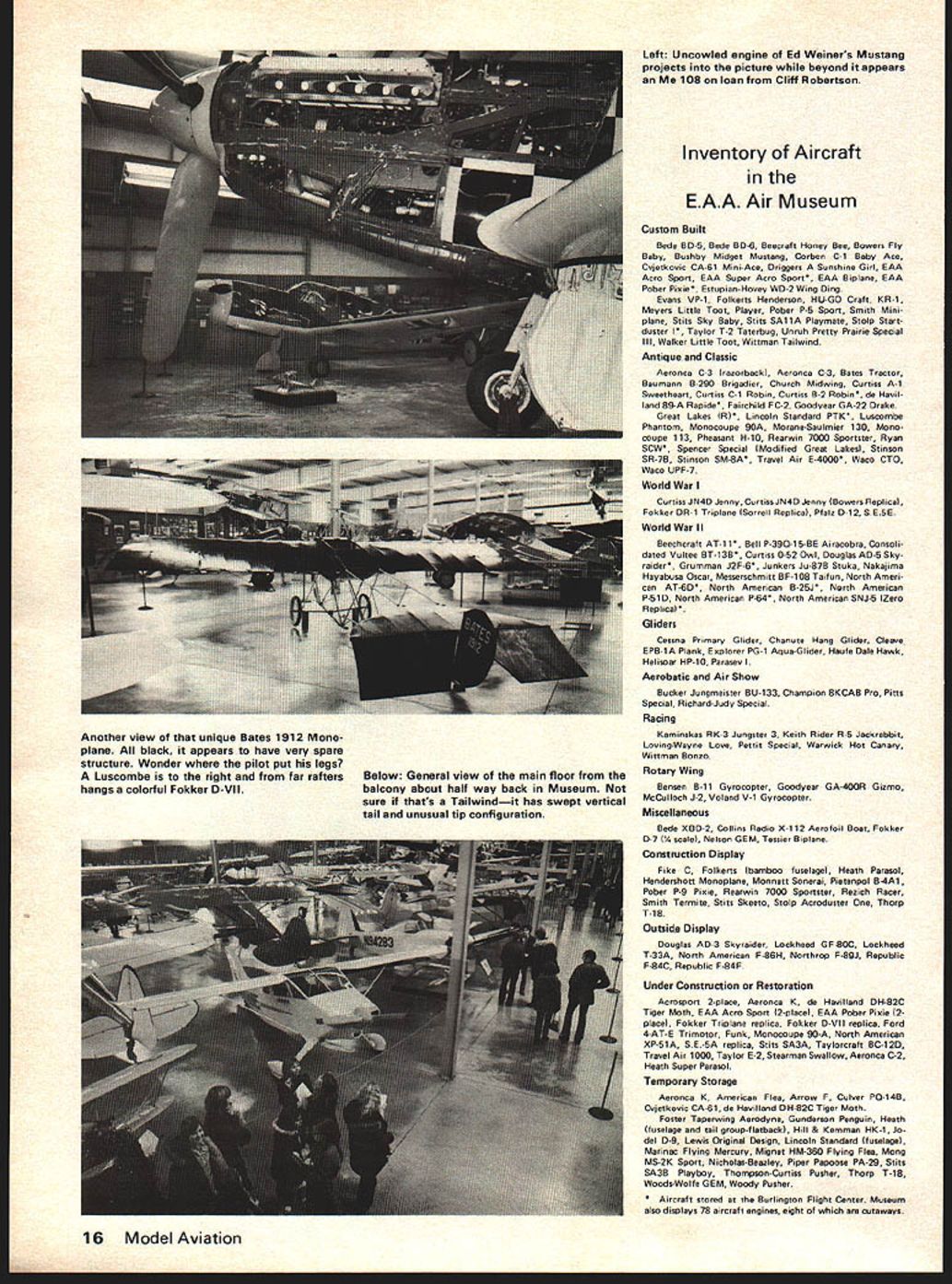
The EAA museum displays a large number of aircraft ranging from a 1912 Curtiss pusher and a 1912 Bates monoplane to the modern original Bede 5. Among other homebuilt aircraft are the Bowers Flybaby, Evans Volksplane, Walt Mooney’s Beecraft Honeybee, the original Smith Miniplane N9OP, Unruh’s Pretty Prairie Special III and many others built for sport and recreation.
The warbird row has a P-51, Ju-87, Curtiss O-52, Owl, Ki-43 “Oscar” and an I-108 (loaned to EAA by Cliff Robertson). Recently a Morane-Saulnier 130, about 1926 vintage, was loaned to the museum by Raymond Jones, Jr.
Near the racing planes are Neal Loving’s “Lovings Love,” Keith Rider’s R-5 Jackrabbit, Steve Wittman’s Bonzo, Bill Warwick’s biplane racer “Hot Canary” (hanging from the ceiling), rare pusher Goodyear racers and Pettit (which should have a Curtiss Conqueror engine). The Wittman Bonzo now sits on the floor without its engine and could use help to restore.
An original Cessna primary glider hangs in another part of the ceiling, just under another example.
Located at Hales Corners, Wisconsin, the museum has a unique variety of aircraft and engines and indeed ranks with the Air Force and Smithsonian Air and Space museums.
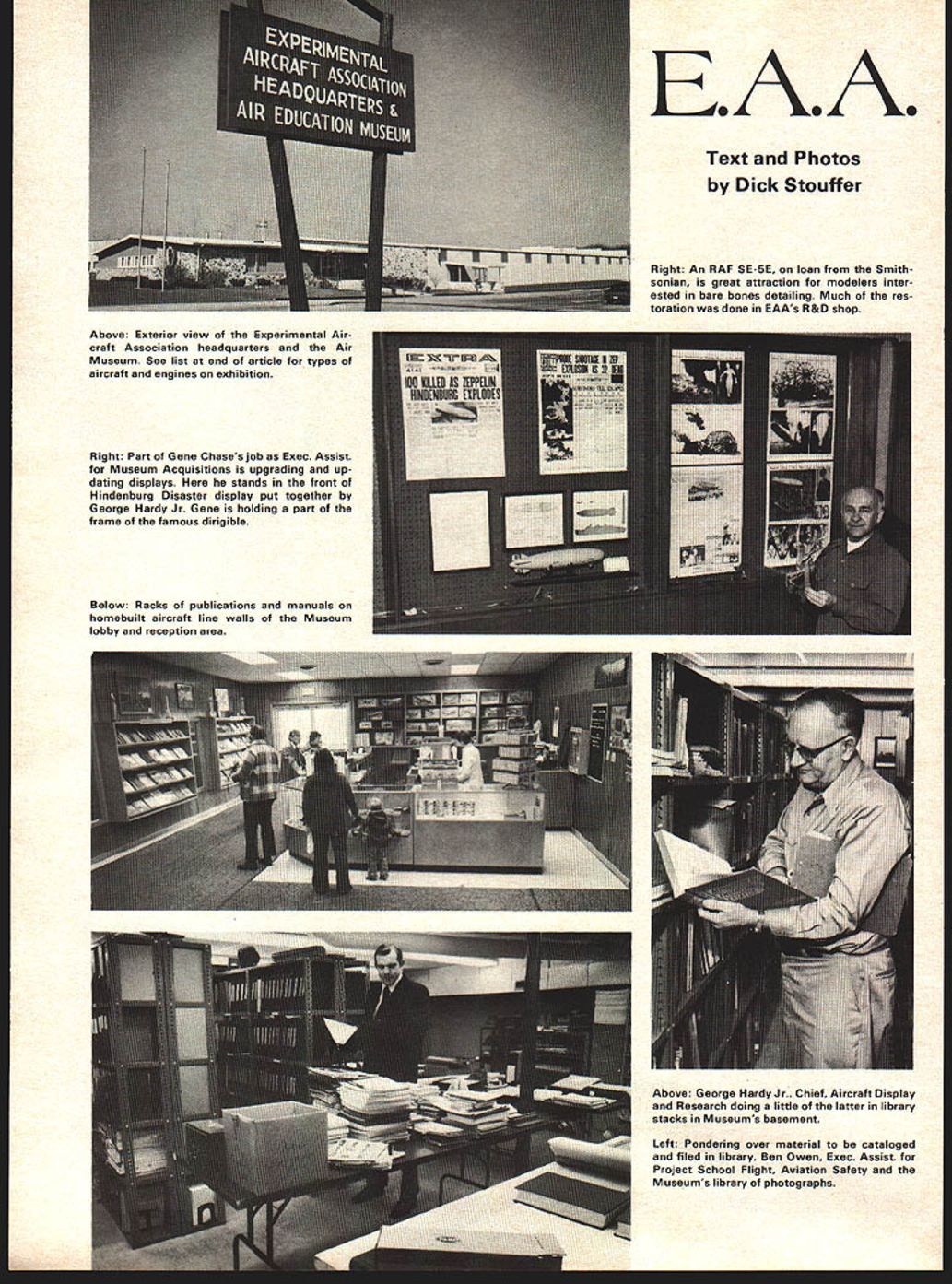
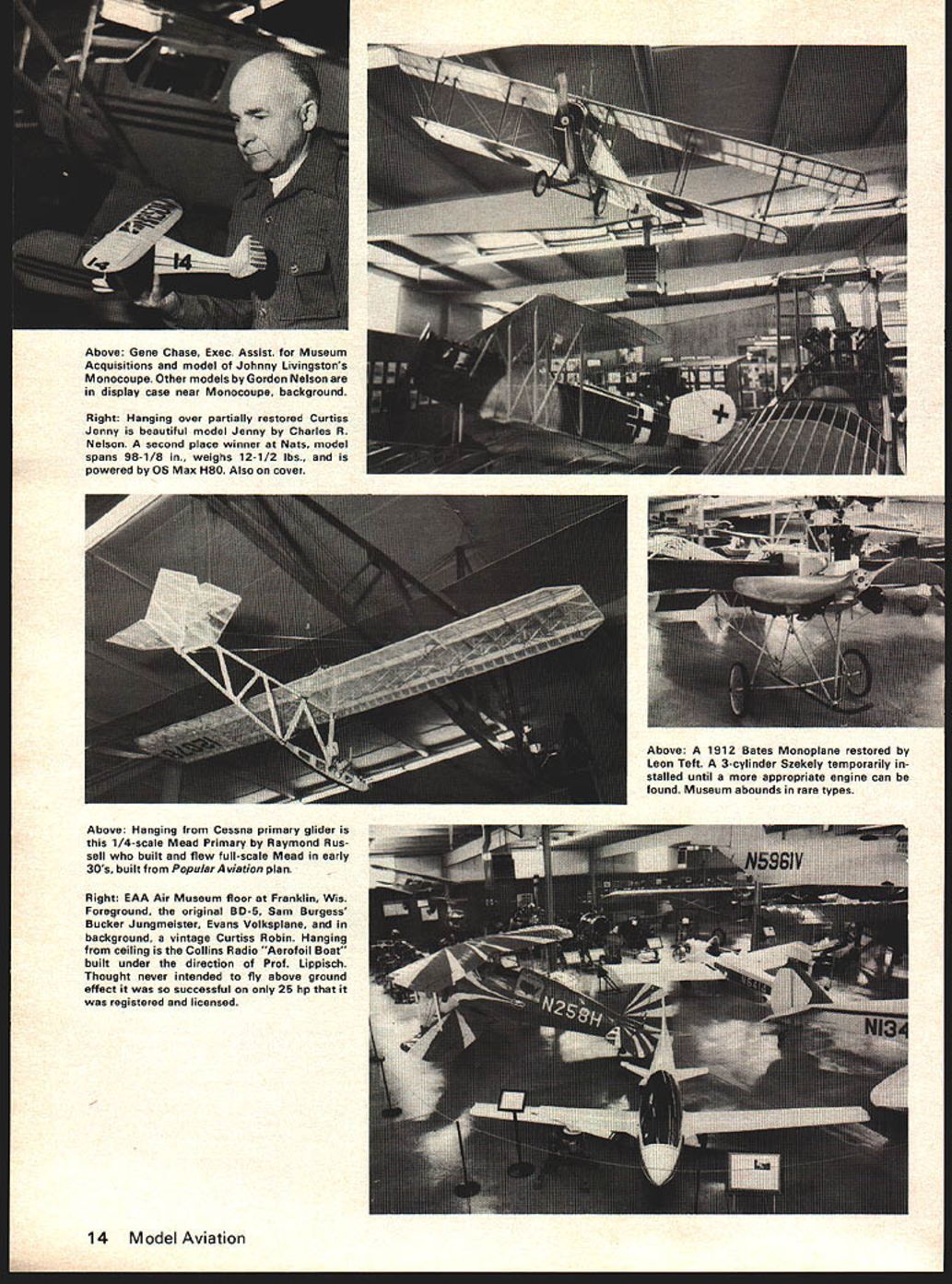
Now that’s sharing — a lot of aviation. Sharing, helping. — Bob Underwood Above: Gene Chase, Exec. Assist. for Museum Acquisitions and model of Johnny Livingston's Monocoupe. Other models by Gordon Nelson are in display case near Monocoupe, background.
Right: Hanging over partially restored Curtiss Jenny is beautiful model Jenny by Charles R. Nelson. A second place winner at Nats, model spans 98-1/8 in., weighs 12-1/2 lbs., and is powered by OS Max H80. Also on cover.
Above: Hanging from Cessna primary glider is this 1/4-scale Mead Primary by Raymond Russell who built and flew the full-scale Mead in the early 30's. Built from Popular Aviation plan.
Above: A 1912 Bates Monoplane restored by Leon Teft. A 3-cylinder Szekely temporarily installed until a more appropriate engine can be found. Museum abounds in rare types.
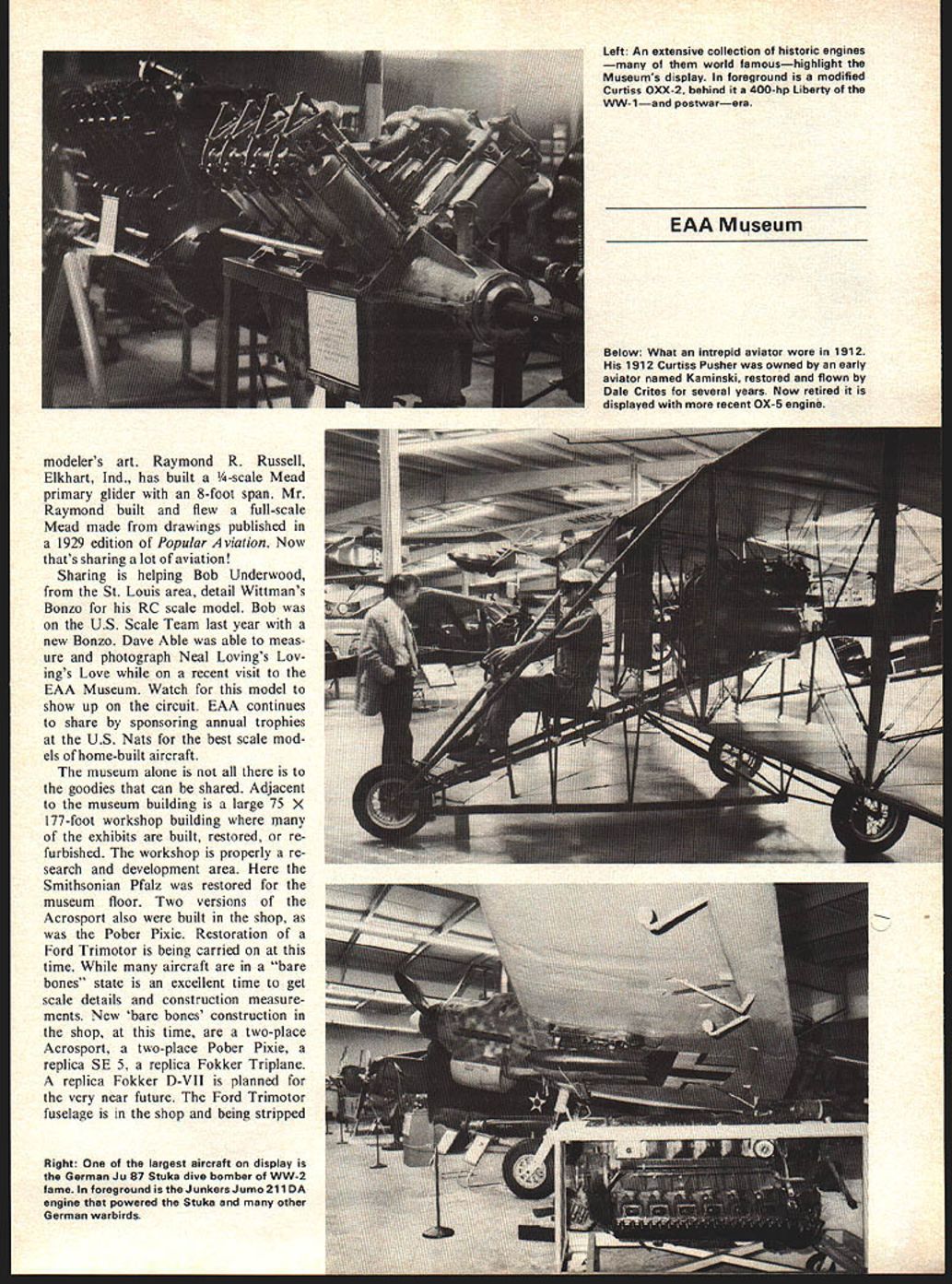
Right: EAA Air Museum floor at Franklin, Wis. Foreground, the original BD-5, Sam Burgess' Bucker Jungmeister, Evans Volksplane, and in background, a vintage Curtiss Robin. Hanging from ceiling is the Collins Radio "Aerofoil Boat" built under the direction of Prof. Lippisch. Thought never intended to fly above ground effect, it was so successful on only 25 hp that it was registered and licensed. modeler's art. Raymond R. Russell, Elkhart, Ind., has built a 1/4-scale Mead primary glider with an 8-foot span. Mr. Raymond built and flew a full-scale Mead made from drawings published in a 1929 edition of Popular Aviation. Now that's sharing a lot of aviation!
Sharing is helping Bob Underwood, from the St. Louis area, detail Wittman's Bonzo for his RC scale model. Bob was on the U.S. Scale Team last year with a new Bonzo. Dave Able was able to measure and photograph Neal Loving's Loving's Love while on a recent visit to the EAA Museum. Watch for this model to show up on the circuit. EAA continues to share by sponsoring annual trophies at the U.S. Nats for the best scale models of home-built aircraft.
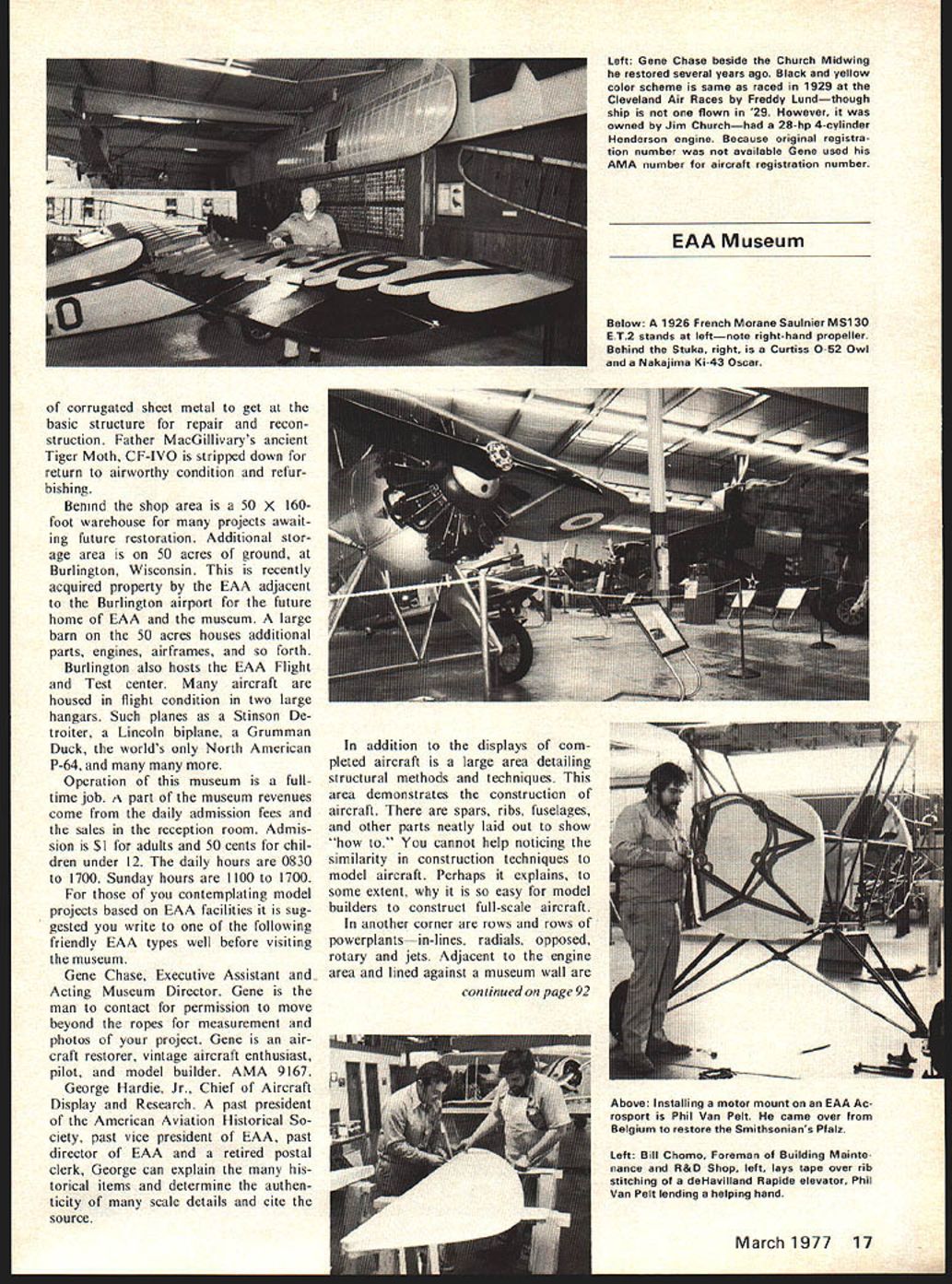
The museum alone is not all there is to the goodies that can be shared. Adjacent to the museum building is a large 75 x 177-foot workshop building where many of the exhibits are built, restored, or refurbished. The workshop is properly a research and development area. Here the Smithsonian Pfalz was restored for the museum floor. Two versions of the Acrosport also were built in the shop, as was the Pober Pixie. Restoration of a Ford Trimotor is being carried on at this time. While many aircraft are in a "bare bones" state it is an excellent time to get scale details and construction measurements. New "bare bones" construction in the shop, at this time, are a two-place Acrosport, a two-place Pober Pixie, a replica SE-5, a replica Fokker Triplane. A replica Fokker D-VII is planned for the very near future. The Ford Trimotor fuselage is in the shop and being stripped.
Inventory of Aircraft in the E.A.A. Air Museum
Custom Built
- Bede BD-5, Bede BD-4, Beecraft Honey Bee, Bowers Fly Baby, Bushby Midget Mustang, Corben C-1 Baby Ace, Cyclone CA-51 Mini-Ace, Dingess "A Sunshine Girl", EAA Aero Sport, EAA Super Aero Sport, EAA Biplane, EAA Pober Pixie, Estupinan-Hovey WD-2 Wing Ding, Evans VP-1, Folkerts Henderson, HUGO Craft, KR-1, Meyers Little Toot, Player, Pober P-5 Sport, Smith Mini-Plane, Stits Sky Baby, Stits SA-1A Playmate, Stolp Starduster I, Taylor T-2 Taterbug, Unruh Pretty Prairie Special III, Walker Little Toot, Wittman Tailwind
Antique and Classic
- Aeronca C-3 (several), Aeronca C-3 (transitional), Bates Tractor, Bequette? B-200 Brigadier, Church Midwing, Curtiss Robin, Curtiss C-1 Robin, Curtis C-2 Robin, de Havilland 89A Rapide, Fairchild FC-2, Goodyear GA-22 Drake, Great Lakes (R), Lincoln Standard PT-? Luscombe Phantom, Monocoupe 90A, Morane-Saulnier 130, Monocoupe 113, Pheasant H-10, Rearwin 7000 Sportster, Ryan SCW, Spencer Special (modified Great Lakes), Stinson SR-7B, Stinson SM-8A, Travel Air E-4000, Waco CTO, Waco UPF-7
World War I
- Curtiss JN-4D Jenny, Curtiss JN-4D Jenny (Bowers Replica), Fokker DR-1 Triplane (Sorrell Replica), Pfalz D-12, S.E.5E
World War II
- Beechcraft AT-11, Bell P-39Q-15 (B.E. Airacobra), Consolidated Vultee BT-13B, Curtiss O-52 Owl, Douglas AD-5 Skyraider, Grumman F6F-5, Junkers Ju-87B Stuka, Nakajima Hayabusa Oscar, Messerschmitt Bf-108 Taifun, North American AT-6D, North American B-25J, North American P-51D, North American P-64, North American SNJ-5 (Zero Replica)
Gliders
- Cessna Primary Glider, Chanute Hang Glider, Cleave EPB-1A Plank, Explorer PG-1 Aqua-Glider, Hauke Dale Hawk, Heilman HP-10, Prasner I
Aerobatic and Air Show
- Bucker Jungmeister BÜ-133, Champion 8KCAB Pro, Pitts Special, Richard/Jacky Special
Racing
- Kaminskas RK-3 Jungster 3, Keith Rider R-5 Jackrabbit, Loving/Wayes? Love, Pettit Special, Warwick Hot Canary, Wittman Bonzo
Rotary Wing
- Bensen B-11 Gyrocopter, Goodyear GA-400R Gizmo, McCulloch J-2, Vertol V-1 Gyrocopter
Miscellaneous
- Bede XBD-2, Collins Radio X-112 Aeroboat, Fokker D-7 (scale), Nelson GEM, Tessier Biplane
Construction Display
- Flite C, Folkernes (bamboo fuselage), Heath Parasol, Henderson Monoplane, Monnett Sonerai, Pietenpol B4-A, Pober P-3 Pixie, Rearwin 7000 Sportster, Reich Racer, Smith Termite, Stits Skooter, Stolp Acroduster One, Thorpe T-18
Outside Display
- Douglas AD-3 Skyraider, Lockheed GF-80C, Lockheed T-33A, North American F-86H, Northrop F-89J, Republic F-84C, Republic F-84F
Under Construction or Restoration
- Aeronca 2-place, Aeronca K, de Havilland DH-82C Tiger Moth, EAA Acro Sport (2-place), EAA Pober Pixie (2-place), EAA Pfalz Tri-motor replica, Fokker D-VII replica, Ford 4-AT Tri-motor, Funk, Monocoupe 90A, North American XP-51A, S.E.5A replica, Stits SA3A, Taylorcraft BC-12D, Travel Air 4000, Taylor E-2, Stearman Swallow, Aeronca C-2, Heath Super Parasol
Temporary Storage
- Aeronca K, American Flea, Arrow F, Culver PQ-14B, OBerg? Waco C-4, de Havilland DH-82C Tiger Moth, Foster Tagayama Aerodrome, Guarded Penguin, Heath (several) plus group of photo-identified aircraft including Kinner K-5, Laird Swallow, Lincoln Standard (fuselage), Marinens Flying Mercury, Nieuport 62? Flying Flea, Monocoupe 110, NAS-2K Sport, Nicholas-Beasley, Piper Pawnee PA-? Stits SA-8 Playboy, Thompson-Curtiss Pusher, Thorpe T-18, Wood-Nolte GEM, Woody Pusher
- Aircraft stored at the Burlington Flight Center. Museum also displays 78 aircraft engines, eight of which are cutaways.
Of corrugated sheet metal to get at the basic structure for repair and reconstruction. Father MacGillivray's ancient Tiger Moth, CF-IVO, is stripped down for return to airworthy condition and refurbishing.
Behind the shop area is a 50 x 160-foot warehouse for many projects awaiting future restoration. Additional storage area is on 50 acres of ground, at Burlington, Wisconsin. This is recently acquired property by the EAA adjacent to the Burlington airport for the future home of EAA and the museum. A large barn on the 50 acres houses additional parts, engines, airframes, and so forth.
Burlington also hosts the EAA Flight and Test Center. Many aircraft are housed in flight condition in two large hangars. Such planes as a Stinson Detroiter, a Lincoln biplane, a Grumman Duck, the world's only North American P-64, and many, many more.
Operation of this museum is a full-time job. A part of the museum revenues come from the daily admission fees and the sales in the reception room. Admission is $1 for adults and 50 cents for children under 12. The daily hours are 0830 to 1700. Sunday hours are 1100 to 1700.
For those of you contemplating model projects based on EAA facilities it is suggested you write to one of the following friendly EAA types well before visiting the museum.
Gene Chase, Executive Assistant and Acting Museum Director. Gene is the man to contact for permission to move beyond the ropes for measurement and photos of your project. Gene is an aircraft restorer, vintage aircraft enthusiast, pilot, and model builder. AMA 9167.
George Hardie, Jr., Chief of Aircraft Display and Research. A past president of the American Aviation Historical Society, past vice president of EAA, past director of EAA and a retired postal clerk, George can explain the many historical items and determine the authenticity of many scale details and cite the source.
In addition to the displays of completed aircraft is a large area detailing structural methods and techniques. This area demonstrates the construction of aircraft. There are spars, ribs, fuselages, and other parts neatly laid out to show "how to." You cannot help noticing the similarity in construction techniques to model aircraft. Perhaps it explains, to some extent, why it is so easy for model builders to construct full-scale aircraft.
In another corner are rows and rows of powerplants—in-lines, radials, opposed, rotary and jets. Adjacent to the engine area and lined against a museum wall are
E.A.A.
racks of propellers from the very earliest types to a Consolidated B-36 prop blade. There is even a wooden prop from an early dirigible that is so massive that it requires two men to lift and carry it about. The scale detailer should be greatly interested in this area. Since airframes do not generally move or fly without some form of power, this historical display of engines and props should create a greater appreciation of early flying and reliability.
Displays and photos from the earliest times to the most recent Fly-Ins hang from all the museum walls. At the front is a large display area showing the construction details of the original Acro-Sport. There are drawings and photos of the actual parts described in plans.
Showcases of model airplanes are scattered around the museum area. These house both the usual detailed plastic models and the built-up variety. Dave Brasighella's RC DeHavilland Hornet, spanning 78¾ inches and weighing 15 pounds, has its own display case. This twin-engine beauty must really be "close-nosed" to truly appreciate the artistry of its detail.
Model aircraft are used in other ways at the EAA Air Museum. Over a floor exhibit of a partially restored Curtiss JN-4D is Charles Nelson's beautiful RC scale model of a Curtiss Jenny. The model spans 98½ inches and weighs in at 12½ pounds. Since the partially restored project does not bear a strong resemblance to the finished aircraft, Nelson's model shows what the flying completed Jenny will look like.
Ben Owen, Executive Assistant for Project School Flight, Aviation Safety, and Photo Library. If you need to research the Photo Library, just contact Ben for time and availability arrangements.
Because of their limited time and great number of duties, please write ahead so that Gene, George, or Ben may be available to help you. Appended to the end is a complete listing of the display aircraft at the various EAA facilities. EAA's address is: P. O. Box 229, Hales Corners, Wisc., 53130. The street address is 11311 West Forest Home Ave., Franklin, Wisc., a Southwest Milwaukee suburb. Phone 414-425-4860.
Transcribed from original scans by AI. Minor OCR errors may remain.

