
EARLY BIRD ENGINES
Well before World War One, British pioneers produced a phenomenal array of model aircraft and engines. Especially engines.... ■ L. D. Bookbinder
THE VERY first gasoline-powered model airplanes were more-or-less scale models of full-size airplanes. Not because of the fascinating challenge of making little ones exactly like the big ones, but out of sheer necessity. Since only a few full-size airplanes had so far managed to stagger through the air, it was assumed that only by making models as similar as possible was there a chance that they, too, might fly.
As far back as 1908, hobbyists in Great Britain were leading the way, building and trying to fly miniature craft powered by small, gasoline-fueled engines. The models were large and clumsy by modern standards, and their engines were huge and slow-turning and weak. But they were, without a doubt, the forerunners of today's efficient designs. And considering that man-carrying airplanes had been flying in Europe only since late 1906, and in Britain only from late 1908, gas models were not far behind.
Actually, there is very good reason to believe that at least one gas model flew in Britain before the first man-carrying airplane had left the ground there! In March of 1908, David Stanger exhibited a 7½-span model, powered by an air-cooled V-4 which reportedly developed 1¼ hp, at all of 1,300 rpm. It wasn't until October 1908 that Samuel Cody (an American and a descendant of Buffalo Bill!) flew the first airplane in England. He travelled almost 1,400 feet before crashing, while the best that Stanger claimed in that year was about 600 feet at 16 mph. But the model apparently preceded the airplane.
Stanger's model was a biplane with an amazing 45 sq. ft. of wing area, and a flying weight of some 21 lbs. Of that, 5½ lbs. was engine, not counting its 24"-diameter, 36"-pitch, laminated, black walnut propeller. By today's standards, Stanger's machine was about halfway between a gas model and a homebuilt full-size airplane, and so one must be broad-minded when passing judgment on pioneers.
The show where the English public (and the world, for that matter) got its first look at a gas model was the Aeronautical Section of Cordingley's Motor Car Exhibition, held at the Agricultural Hall. Most of the aeronautical display consisted of balloons and their equipment, with flying and static models taking second place. A V-2 engine shown by builder Leslie Lambert was said to produce 3.2 hp at 1,800 rpm, and to weigh 15 lbs., including its carburetor. The bore and stroke were 2", giving a displacement of more than 12 cu. in., which is more than some modern small motorcycles.
Lambert soon came forth with a smaller 2.45-hp engine which weighed just 10 lbs. The cylinders were steel, with only the heads having cooling fins; the crankshaft was of nickel steel. The ignition system consisted of a single coil and distributor for the two cylinders, while the carburetor was of the spray type.
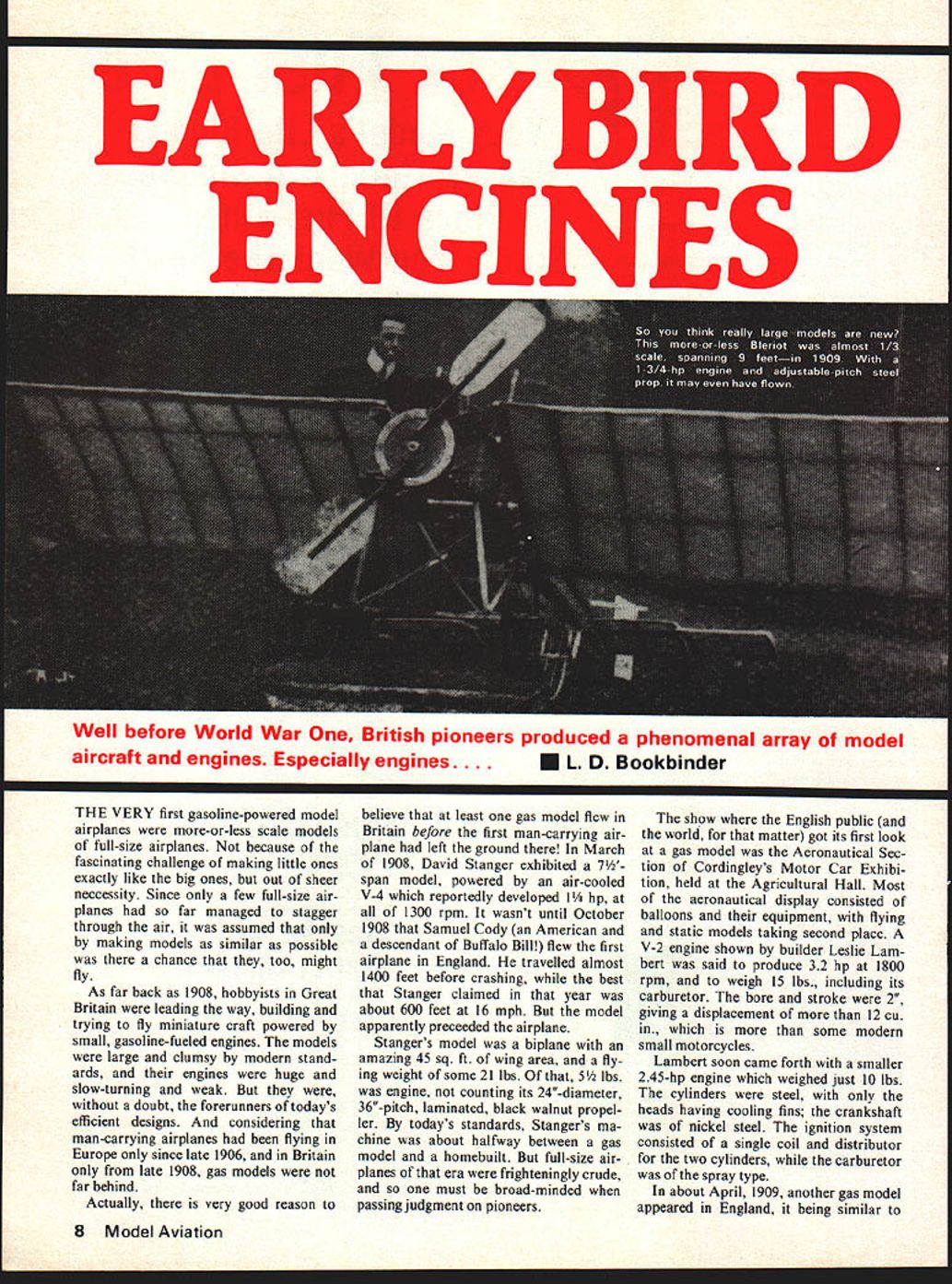
In about April, 1909, another gas model appeared in England, it being similar to the Voisin biplanes then leading the way among European airplanes. Builder J. D. M. Tinling used some kind of two-cylinder engine known to be the smallest model ever to fly.
Late in 1909 C. Burkitt, backed by history books, ran into a problem the hobbyist will recognize — he could find no place to fly his model. London County Council refused him permission to fly on Hampstead Heath. His more-or-less Bleriot monoplane was powered by a 1-hp Kingdom engine, turning an adjustable-pitch steel propeller; at the last report he was still looking for a flying field.
Somebody must have solved the problem; the hobby was growing. A January 1910 issue of Aeronautics carried advertisements for petrol motors ranging in size up to a full hp, the cheapest said to be selling at the equivalent of $2.50. At the time, a single copy of Flight cost 2d; now it's up to 5d. By November 1910 there was enough activity in the miniature gas engine hobby to warrant a British magazine doing a roundup of the different types of commercially available engines. At least five firms were building and selling gasoline engines (and some steam engines) for model planes — happening in England, of course, because the USA did not seem to realize such devices existed.
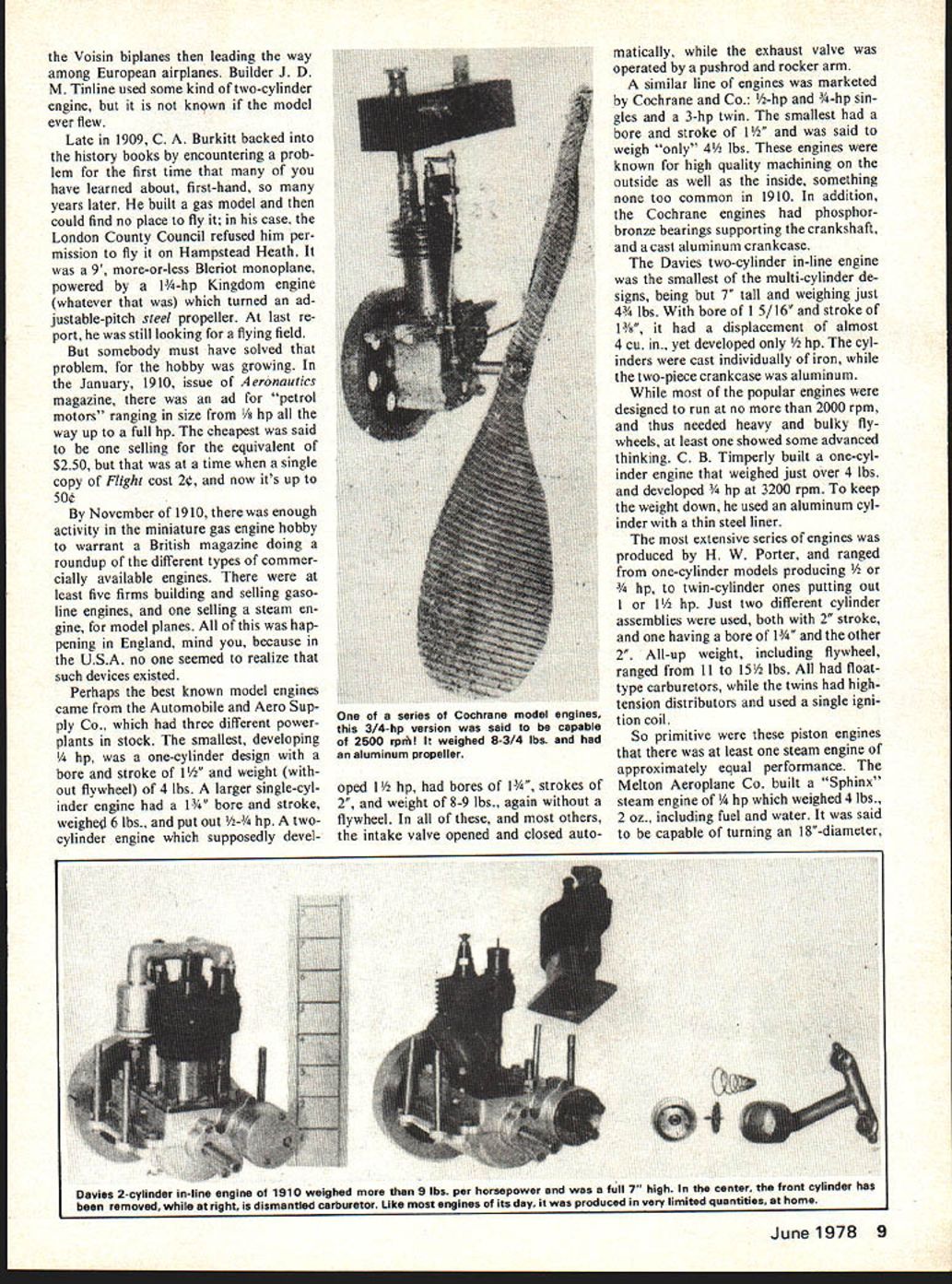
Perhaps the best known model engines came from the Automobile Aero Supply Co., which offered three different powerplants in stock. The smallest developed ¾ hp in a one-cylinder design, bore and stroke 1"—weighing out with flywheel 4 lbs. The larger single-cylinder engine, 1" bore by 1½" stroke, weighed 6 lbs. and put out 1½ hp. The two-cylinder engine supposedly developed 2 hp, bores 1", strokes 2", weight 8–9 lbs., again including flywheel. Others had intake valves which opened and closed automatically, and exhaust valves operated by pushrod and rocker arm.
A similar line of engines was marketed by the Cochrane Co.: ¾-hp and 1½-hp singles, and a 3-hp twin. The smallest, bore and stroke 1", was said to weigh 4 lbs. These engines were known for high quality machining on the outside as well as the inside — something too common. In a 1910 addition Cochrane used phosphor-bronze bearings supporting the cranksha ft, and a cast aluminum crankcase.
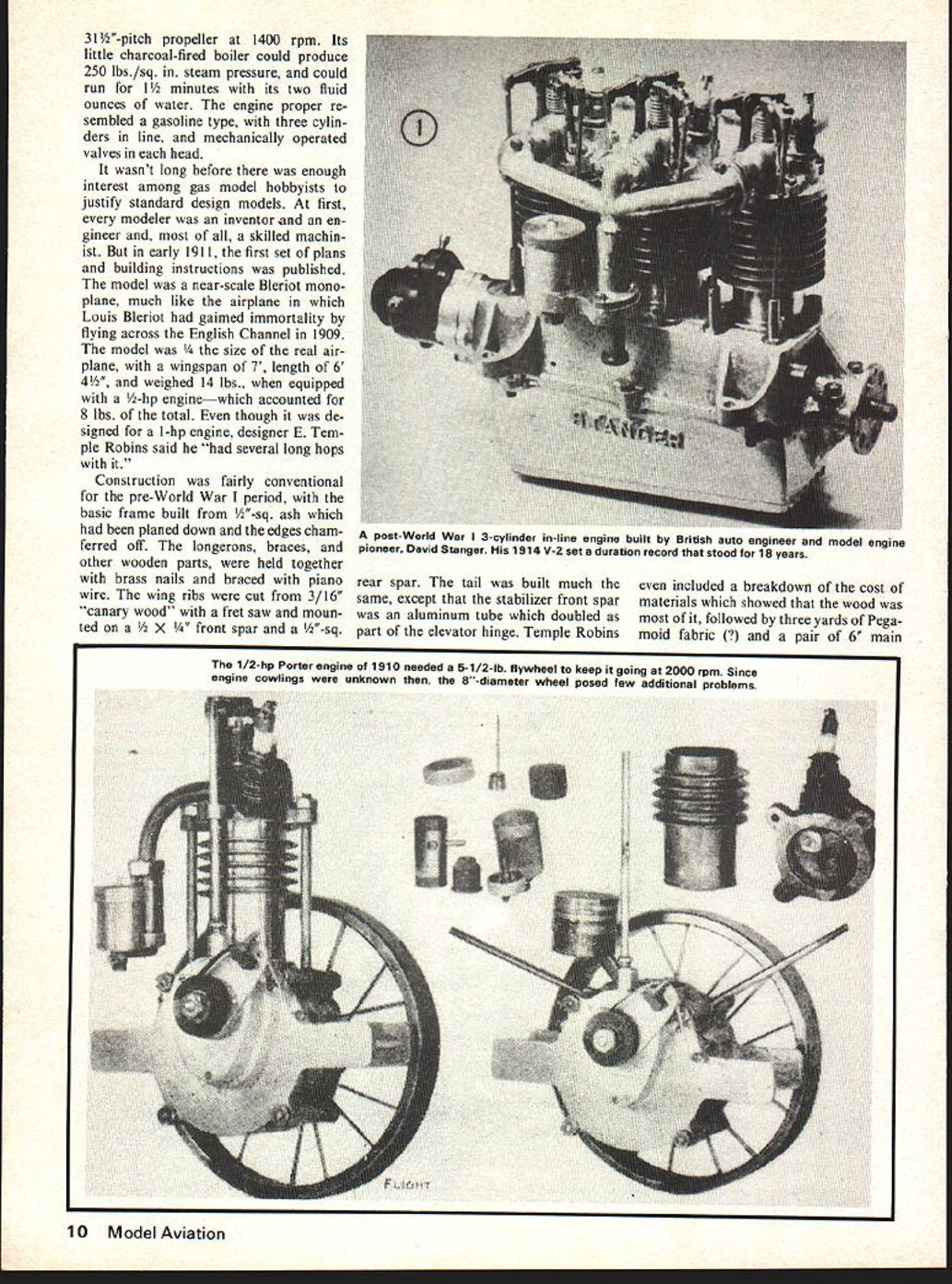
The Davies two-cylinder in-line engine was the smallest of the multi-cylinder designs, being but 7" tall and weighing just 4¾ lbs. With bore of 1 5/16" and stroke of 1 3/8", it had a displacement of almost 4 cu. in., yet developed only ½ hp. The cylinders were cast individually of iron, while the two-piece crankcase was aluminum.
While most of the popular engines were designed to run at no more than 2000 rpm, and thus needed heavy and bulky flywheels, at least one showed some advanced thinking. C. B. Timperly built a one-cylinder engine that weighed just over 4 lbs. and developed ¾ hp at 3200 rpm. To keep the weight down, he used an aluminum cylinder with a thin steel liner.
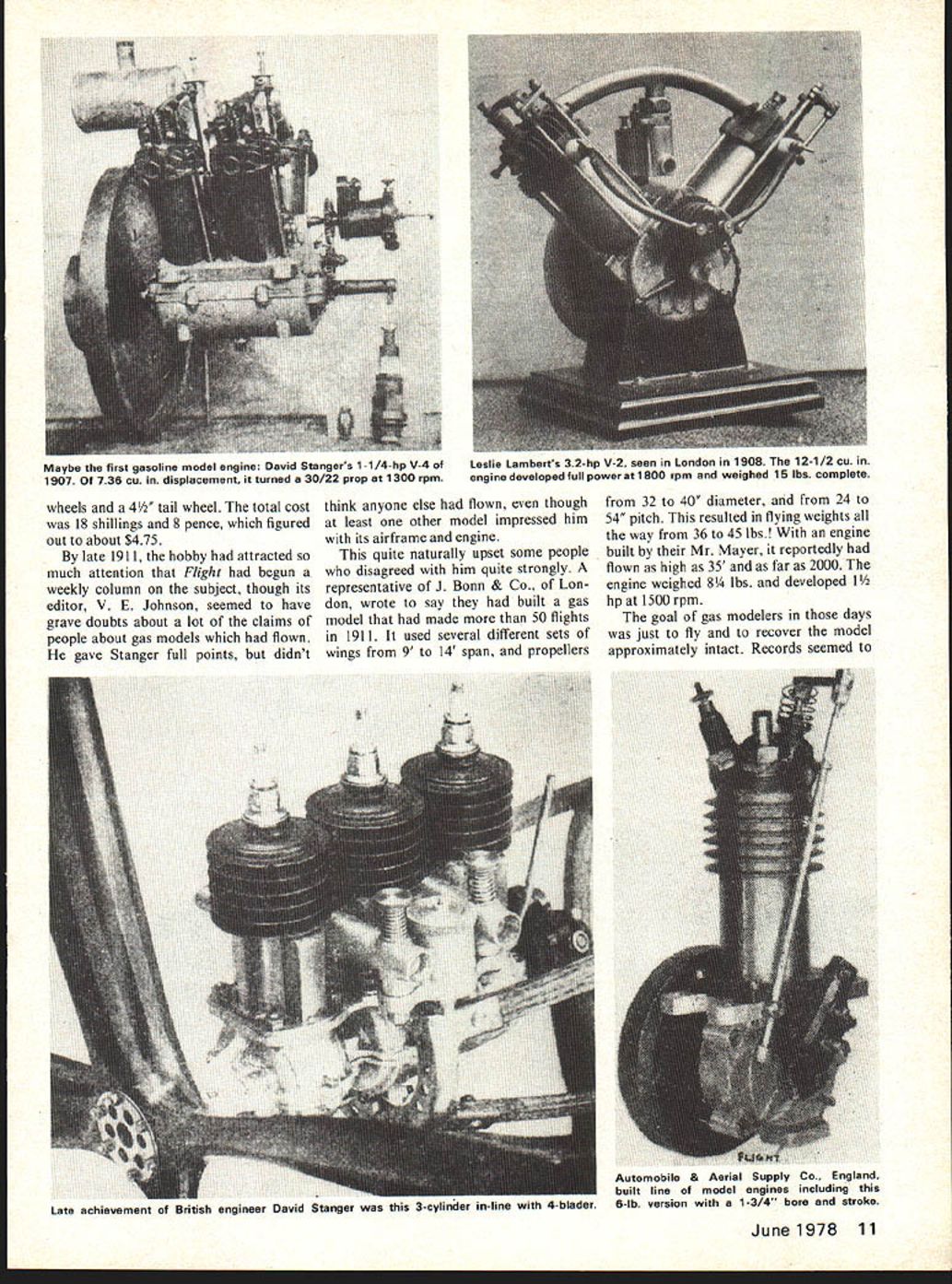
The most extensive series of engines was produced by H. W. Porter, and ranged from one-cylinder models producing ½ or ¾ hp, to twin-cylinder ones putting out 1 or 1½ hp. Just two different cylinder assemblies were used, both with 2" stroke, and one having a bore of 1¾" and the other 2". All-up weight, including flywheel, ranged from 11 to 15½ lbs. All had float-type carburetors, while the twins had high-tension distributors and used a single ignition coil.
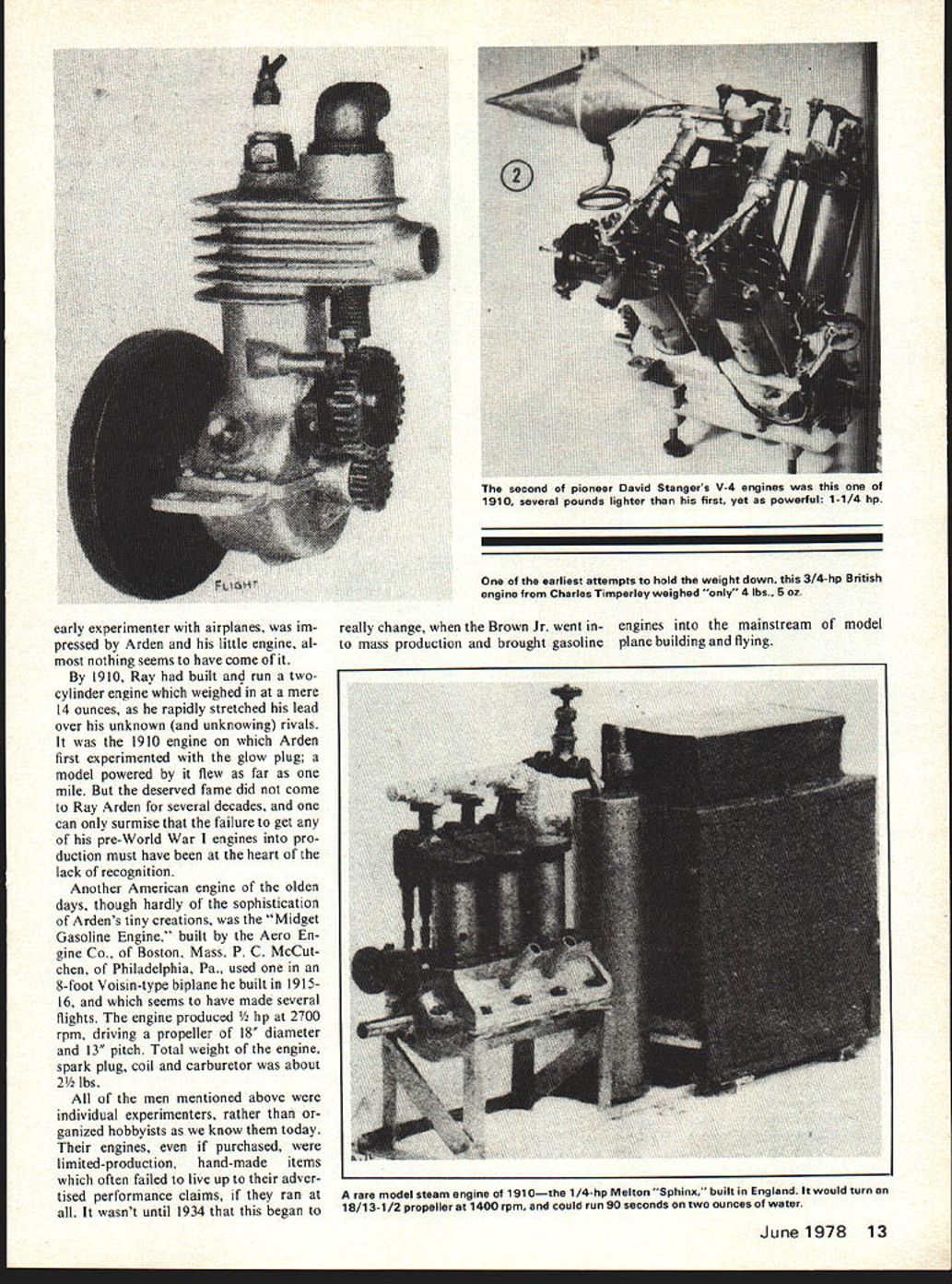
So primitive were these piston engines that there was at least one steam engine of approximately equal performance. The Melton Aeroplane Co. built a "Sphinx" steam engine of ½ hp which weighed 4 lbs., 2 oz., including fuel and water. It was said to be capable of turning an 18"-diameter, 31½"-pitch propeller at 1400 rpm. Its little charcoal-fired boiler could produce 250 lbs./sq. in. steam pressure, and could run for 1½ minutes with its two fluid ounces of water. The engine proper resembled a gasoline type, with three cylinders in line, and mechanically operated valves in each head.
It wasn't long before there was enough interest among gas model hobbyists to justify standard design models. At first, every modeler was an inventor and an engineer and, most of all, a skilled machinist. But in early 1911, the first set of plans and building instructions was published. The model was a near-scale Bleriot monoplane, much like the airplane in which Louis Bleriot had gained immortality by flying across the English Channel in 1909. The model was ¼ the size of the real airplane, with a wingspan of 7', length of 6' 4½", and weighed 14 lbs., when equipped with a ½-hp engine—which accounted for 8 lbs. of the total. Even though it was designed for a 1-hp engine, designer E. Temple Robins said he "had several long hops with it."
Construction was fairly conventional for the pre-World War I period, with the basic frame built from ½"-sq. ash which had been planed down and the edges chamfered off. The longerons, braces, and other wooden parts, were held together with brass nails and braced with piano wire. The wing ribs were cut from 3/16" "canary wood" with a fret saw and mounted on a ½" × ¼" front spar and a ½"-sq. rear spar. The tail was built much the same, except that the stabilizer front spar was an aluminum tube which doubled as part of the elevator hinge. Temple Robins even included a breakdown of the cost of materials which showed that the wood was most of it, followed by three yards of Pegamoid fabric (?) and a pair of 6" main wheels and a 4½" tail wheel. The total cost was 18 shillings and 8 pence, which figured out to about $4.75.
By late 1911, the hobby had attracted so much attention that Flight had begun a weekly column on the subject, though its editor, V. E. Johnson, seemed to have grave doubts about a lot of the claims of people about gas models which had flown. He gave Stanger full points, but didn't think anyone else had flown, even though at least one other model impressed him with its airframe and engine.
This quite naturally upset some people who disagreed with him quite strongly. A representative of J. Bonn & Co., of London, wrote to say they had built a gas model that had made more than 50 flights in 1911. It used several different sets of wings from 9' to 14' span, and propellers from 32" to 40" diameter, and from 24" to 54" pitch. This resulted in flying weights all the way from 36 to 45 lbs.! With an engine built by their Mr. Mayer, it reportedly had flown as high as 35' and as far as 2,000'. The engine weighed 8½ lbs. and developed 1½ hp at 1,500 rpm.
The goal of gas modelers in those days was just to fly and to recover the model approximately intact. Records seemed to be perennially disputed, but by and large the British modelers were in the lead. The growth of the hobby in Britain is reflected by the increasing availability of small gasoline engines advertised for model use. A January 1910 issue of Aeronautics carried an advertisement for petrol motors ranging in size up to 1½ hp; the cheapest was said to be selling for the equivalent of $2.50. At that time a single copy of Flight cost 2d; by 1910 it was up to 5d.
By November 1910 there was enough activity in the miniature gas-engine hobby to warrant a British magazine doing a roundup of the different types of commercially available engines. At least five firms were building and selling gasoline engines and one maker even advertised a steam engine for model planes. This was happening in England, mind you, because the United States did not yet seem to realise such devices existed.
Perhaps the best-known model engines came from the Automobile & Aerial Supply Co. The firm listed three different powerplants in its catalogue. The smallest developed 1/4-hp in a single-cylinder design (1" bore, 1" stroke) and weighed about 4 lbs. including flywheel. A larger single-cylinder motor with 1-1/4" bore and 1-1/4" stroke weighed about 6 lbs. and put out 1/2 hp. A two-cylinder engine was said to develop 1 hp with 1-3/4" bores and 2" strokes and weighed about 8–9 lbs., again including flywheel. The intake valve opened and closed automatically while the exhaust valve was operated by a pushrod and rocker arm.
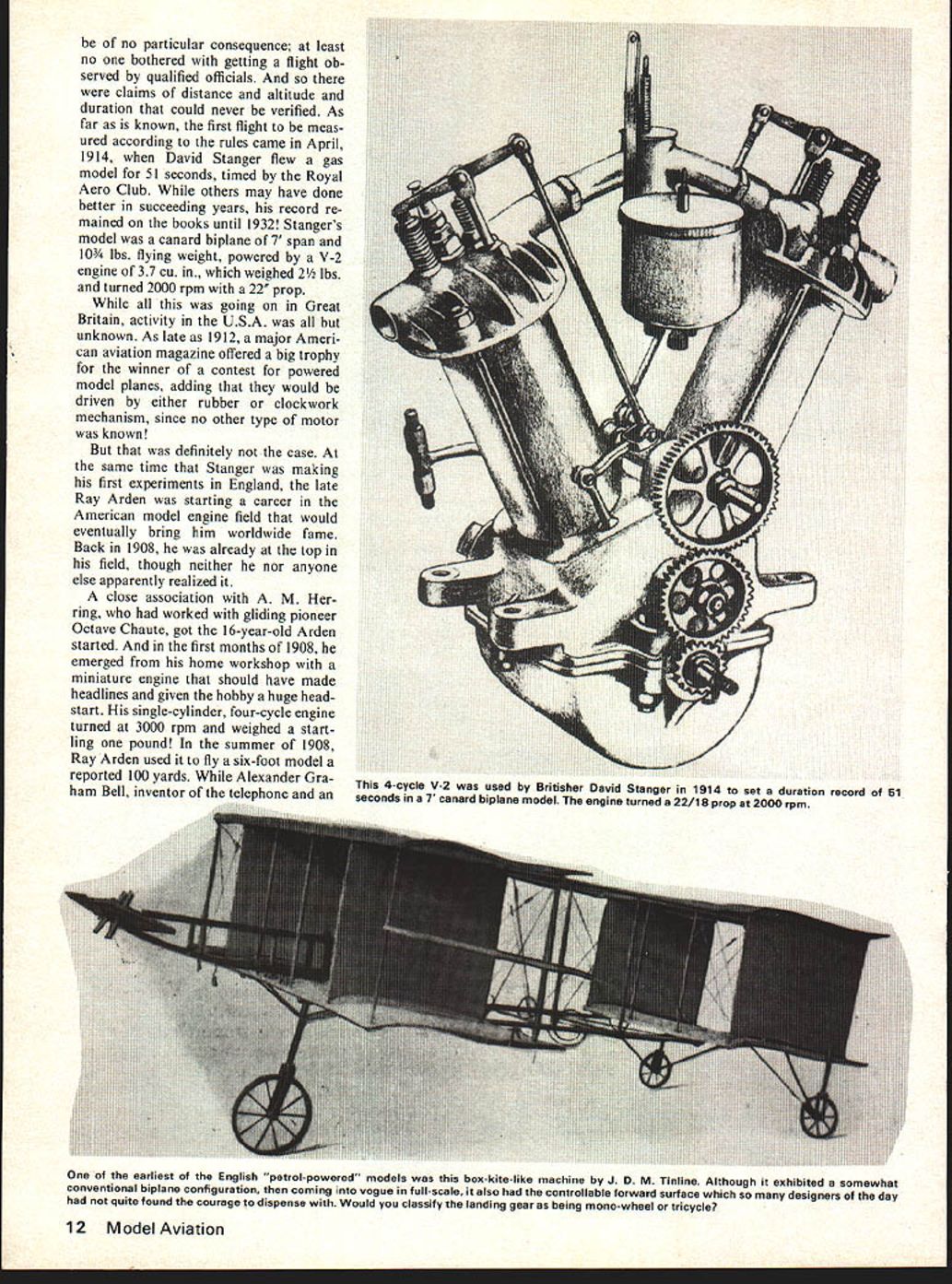
A similar line of engines was marketed by the Cochrane Co.: 1/4-hp and 1/2-hp singles and a 3-hp twin. The smallest had a 1" bore and 1" stroke and was said to weigh 4 lbs. Cochrane engines were known for high-quality machining inside and out. About 1910 Cochrane added phosphor-bronze bearings to support the crankshaft. be of no particular consequence; at least no one bothered with getting a flight observed by qualified officials. And so there were claims of distance and altitude and duration that could never be verified. As far as is known, the first flight to be measured according to the rules came in April, 1914, when David Stanger flew a gas model for 51 seconds, timed by the Royal Aero Club. While others may have done better in succeeding years, his record remained on the books until 1932! Stanger's model was a canard biplane of 7' span and 10¾ lbs. flying weight, powered by a V-2 engine of 3.7 cu. in., which weighed 2½ lbs. and turned 2000 rpm with a 22" prop.
While all this was going on in Great Britain, activity in the U.S.A. was all but unknown. As late as 1912, a major American aviation magazine offered a big trophy for the winner of a contest for powered model planes, adding that they would be driven by either rubber or clockwork mechanism, since no other type of motor was known!
But that was definitely not the case. At the same time that Stanger was making his first experiments in England, the late Ray Arden was starting a career in the American model engine field that would eventually bring him worldwide fame. Back in 1908, he was already at the top in his field, though neither he nor anyone else apparently realized it.
A close association with A. M. Herring, who had worked with gliding pioneer Octave Chanute, got the 16-year-old Arden started. And in the first months of 1908, he emerged from his home workshop with a miniature engine that should have made headlines and given the hobby a huge headstart. His single-cylinder, four-cycle engine turned at 3000 rpm and weighed a startling one pound! In the summer of 1908, Ray Arden used it to fly a six-foot model a reported 100 yards. While Alexander Graham Bell, inventor of the telephone and an early experimenter with airplanes, was impressed by Arden and his little engine, almost nothing seems to have come of it.
By 1910, Ray had built and run a two-cylinder engine which weighed in at a mere 14 ounces, as he rapidly stretched his lead over his unknown (and unknowing) rivals. It was the 1910 engine on which Arden first experimented with the glow plug; a model powered by it flew as far as one mile. But the deserved fame did not come to Ray Arden for several decades, and one can only surmise that the failure to get any of his pre-World War I engines into production must have been at the heart of the lack of recognition.
Another American engine of the olden days, though hardly of the sophistication of Arden's tiny creations, was the "Midget Gasoline Engine," built by the Aero Engine Co., of Boston, Mass. P. C. McCutchen, of Philadelphia, Pa., used one in an 8-foot Voisin-type biplane he built in 1915-16, and which seems to have made several flights. The engine produced 1/2 hp at 2700 rpm, driving a propeller of 18" diameter and 13" pitch. Total weight of the engine, spark plug, coil and carburetor was about 2 1/2 lbs.
All of the men mentioned above were individual experimenters, rather than organized hobbyists as we know them today. Their engines, even if purchased, were limited-production, hand-made items which often failed to live up to their advertised performance claims, if they ran at all. It wasn't until 1934 that this began to really change, when the Brown Jr. went into mass production and brought gasoline engines into the mainstream of model plane building and flying.
Transcribed from original scans by AI. Minor OCR errors may remain.

