
East Coast Slope Soaring
If you'd like more bang for your R/C buck, consider taking up Slope Soaring. Nothing quite matches the quiet euphoria of watching your sailplane glide into the wind off a hill or a seaside dune. Part One of a two-part article. — David Garwood
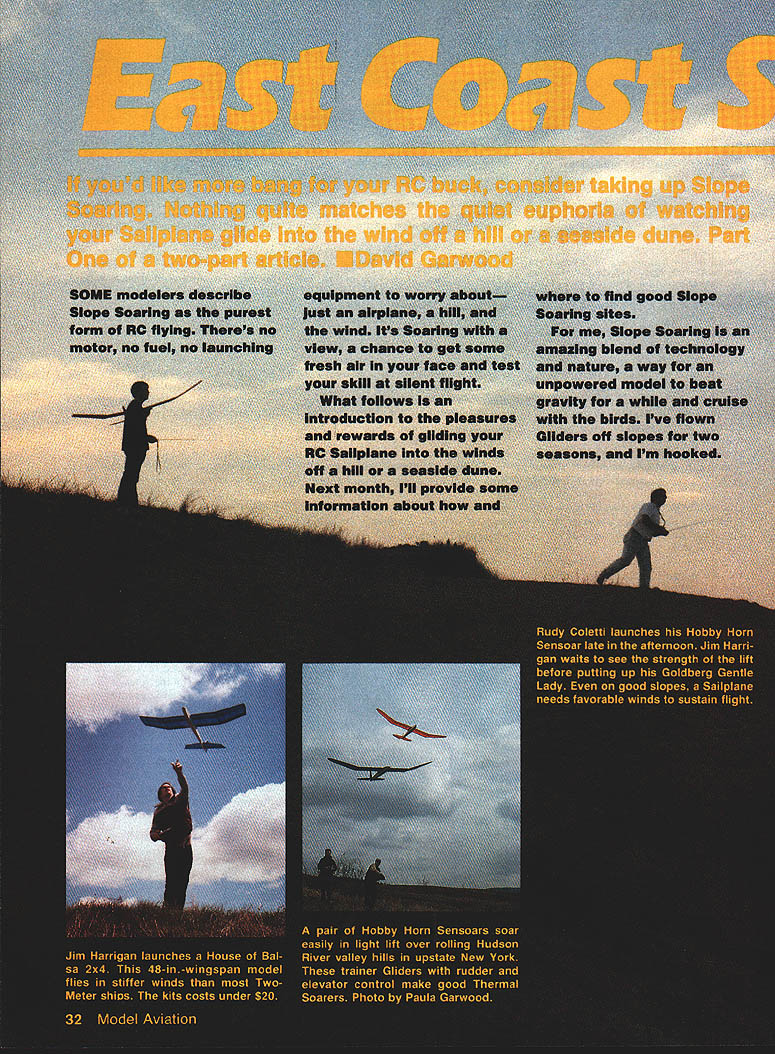
Some modelers describe Slope Soaring as the purest form of RC flying. There's no motor, no fuel, no launching equipment to worry about — just an airplane, a hill, and the wind. It's soaring with a view, a chance to get some fresh air and test your skill at silent flight.
What follows is an introduction to the pleasures and rewards of gliding your RC sailplane into the winds off a hill or seaside dune. Next month I'll provide information about how and where to find good slope-soaring sites.
For me, slope soaring is an amazing blend of technology and nature, a way for an unpowered model to beat gravity for a while and cruise with the birds. I've flown gliders off slopes for two seasons, and I'm hooked. While I'm not a terribly experienced RC pilot, in two years of RC involvement I've logged 58 days of slope flying with 11 different airplanes. With fellow slope fliers, I've also found 10 flying sites — five in upstate New York and five in Massachusetts.
How do they stay up?
Sailplanes need rising air in order to fly. The two predominant sources are thermals and slope lift.
- Thermals are rising air currents created by the uneven heating of the Earth's surface. They produce the type of lift preferred by hawks and eagles. When you see a hawk circling upward on outstretched wings, you know it's benefitting from thermal lift.
- Slope lift is created when wind blows against a hill and is forced upward. Seagulls gliding along sand dunes without flapping are making practical use of slope lift. You'll notice they fly above the dunes parallel to the waterline and only in an onshore breeze — when the wind blows from the water to the land and flows upward over dunes, sea cliffs, or other obstructions. It's the rising air created as the wind meets a hill and is forced upward that sustains soaring flight for the gulls — and for our models. Slope-flying sites, then, are essentially hills with the wind blowing up the slope.
How long can a model stay aloft in slope lift? Three of my flying buddies completed flights of over 45 minutes in their first season. My longest flight to date was two hours 35 minutes. The League of Silent Flight program requires slope flights ranging from 15 minutes to eight hours to advance through its achievement levels. The AMA record for slope flight duration is 12 hours eight minutes. With an appropriate airplane, a suitable hill, and good wind, you can fly for hours.
Selection of model aircraft
Slope soaring gives you as much or more bang for your buck as any form of radio-control modeling. In what other branch of RC can you fly a $20 kit for two hours using only a two-channel radio?
You don't need a field box full of equipment. Most common sailplane support gear can be left at home, since the models are launched without winches or hi-starts. A typical slope pilot carries only a model airplane and a radio for a day at the hill, although a roll of repair tape and a bottle of CyA (cyanoacrylate adhesive) are useful. Slope landings tend to be rough compared with three-point touchdowns on close-cropped grass, so minor damage throughout the day is to be expected. Most slopers quickly gain skill in making field repairs.
In selecting a model, anticipated wind speed is as important as pilot skill and experience. Generally:
- Low winds and low hills require larger, lighter models with high-lift, flat-bottom airfoils.
- Faster winds and taller hills can sustain smaller, heavier, and faster sailplanes.
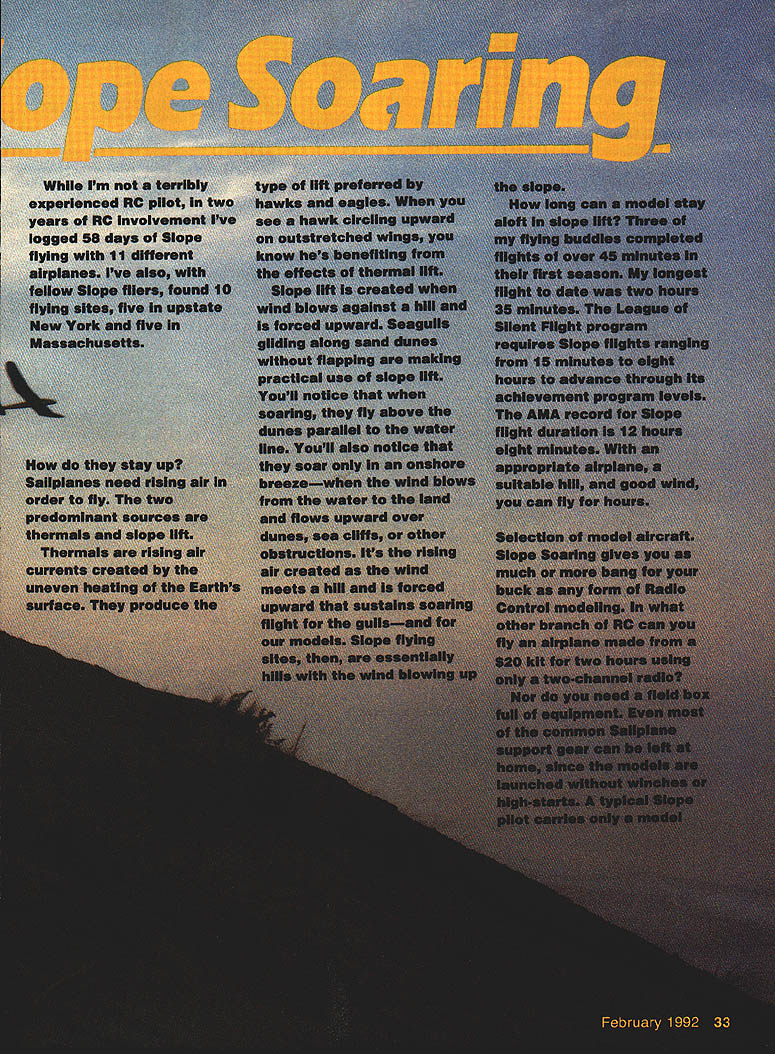
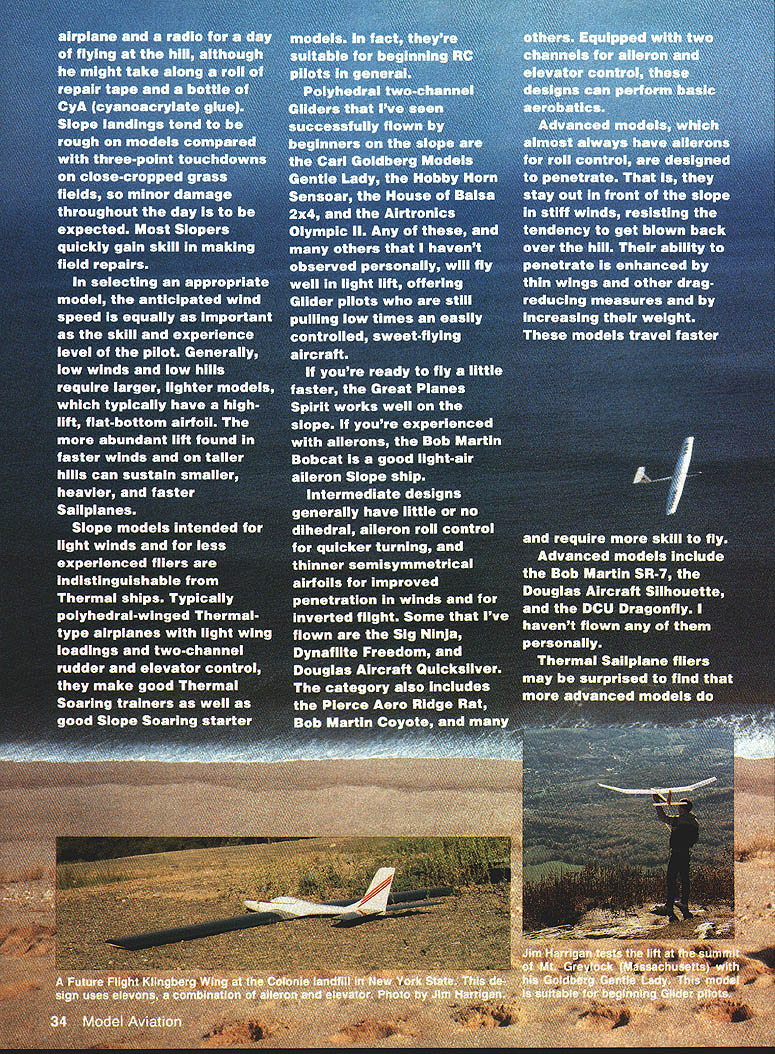
Slope models intended for light winds and less experienced fliers are often indistinguishable from thermal ships: polyhedral-winged, light wing loading, and two-channel (rudder and elevator) control. They make good thermal trainers and good slope-starter models. Examples successfully flown by beginners on the slope include:
- Carl Goldberg Models Gentle Lady
- Hobby Horn Sensoar
- House of Balsa 2x4
- Airtronics Olympic II
If you're ready to fly faster, the Great Planes Spirit works well on the slope. For those experienced with ailerons, the Bob Martin Bobcat is a good light-air aileron slope ship.
Intermediate designs generally have little or no dihedral, aileron roll control for quicker turning, and thinner semisymmetrical airfoils for improved penetration in winds and for inverted flight. Examples I've flown or seen flown include:
- Sig Ninja
- Dynaflite Freedom
- Douglas Aircraft Quicksilver
Other intermediate models include the Pierce Aero Ridge Rat and the Bob Martin Coyote. These designs, typically equipped with aileron and elevator, can perform basic aerobatics.
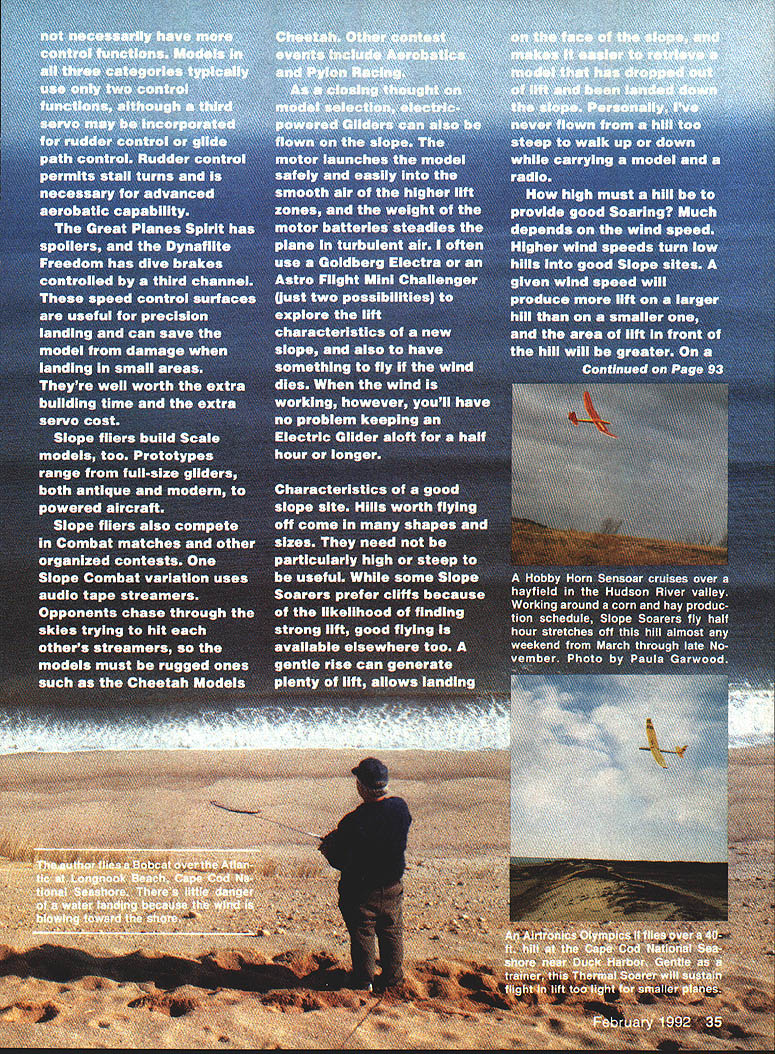
Advanced models almost always have ailerons for roll control and are designed to penetrate — that is, to stay out in front of the slope in stiff winds and resist being blown back over the hill. Penetration is enhanced by thin wings, drag-reducing measures, and increased weight. These models fly faster and require more skill. Examples include:
- Bob Martin SR-7
- Douglas Aircraft Silhouette
- DCU Dragonfly
Thermal sailplane fliers may be surprised to find that more advanced slope models do not necessarily have more control functions. Models in all three categories typically use only two control functions, although a third servo may be incorporated for rudder control or glide-path control. Rudder permits stall turns and is necessary for advanced aerobatics.
Some models feature speed-control surfaces controlled by a third channel. For example:
- The Great Planes Spirit has spoilers.
- The Dynaflite Freedom has dive brakes.
These surfaces are useful for precision landings and can save the model from damage when landing in small areas. They're often worth the extra building time and servo cost.
Slope fliers build scale models, too — prototypes range from antique and modern full-size gliders to powered aircraft. Slope fliers also compete in organized events:
- Combat matches (one variation uses audio-tape streamers — opponents chase each other trying to hit streamers; rugged models like the Cheetah are preferred)
- Aerobatics
- Pylon racing
Electric-powered gliders can also be flown on the slope. The motor launches the model safely into the smoother, higher-lift zones, and the added weight of batteries steadies the plane in turbulence. I often use a Goldberg Electra or an Astro Flight Mini Challenger to explore the lift characteristics of a new slope or to have something to fly if the wind dies. When the wind is working, an electric glider can be kept aloft for a half hour or longer.
Characteristics of a good slope site
Hills worth flying from come in many shapes and sizes. They need not be particularly high or steep to be useful. A gentle rise can generate plenty of lift, allow landing on the face of the slope, and make it easier to retrieve a model that has dropped out of lift and landed down the slope. Personally, I've never flown from a hill too steep to walk up or down while carrying a model and a radio.
How high must a hill be to provide good soaring? Much depends on wind speed. Higher wind speeds turn low hills into good slope sites. A given wind speed will produce more lift on a larger hill than on a smaller one, and the area of lift in front of the hill will be greater. On a steep hill about 40 feet above the upwind terrain, flying may be possible in winds as light as 10 mph. Lower hills and gentler slopes are likely to require faster winds. It's easier to fly from big hills because the lift zone is larger; small hills can be used in favorable winds. To know for sure, try a hill in different wind conditions.
The single most important characteristic of a good slope is that it faces into the wind. If you're lucky enough to find slopes that face the prevailing wind in your area, you'll be able to fly often. It's important that a hill have a minimum of trees and vegetation. Upwind obstructions create turbulence at the top, and trees or bushes on the slope face or at its top make finding a good landing spot tricky. If the hill has a road to the top, you won't have to hike with model and radio in tow — optional, but helpful.
The wind
Which is more important, a good hill or good wind? Wind is more critical. Favorable wind can sustain flight on marginal hills; conversely, even the world's best hill is of little use if the wind is from the wrong direction. Sometimes, when you're flying in the flatlands and can't catch thermals, you can grab a few minutes' flying time by heading for ridge lift produced by a treeline.
Ridge lift can be produced by unexpected features. Dave Thornberg has talked of gliding for two minutes on lift produced by a pile of dirt left after excavating a basement. Once, during a thermal sailplane contest in 20–25 mph winds, I won a round by staying aloft four minutes on lift generated by a single tree. Of course, the wind must be favorable for these tricks to work.
You'll need wind fast enough to generate enough lift for your particular model: low winds will support light models; higher winds will support heavier, faster models. To test for lift, stand at the top of a hill holding your model in the launch position. If the wind tends to raise the model out of your hand, there's enough lift to fly. If the model doesn't lighten in your hand but there's plenty of wind, a small hi-start may be useful; it can launch the plane into productive lift.
Is it ever too windy to fly? If you can't stand up into the wind, you'll have trouble — that's about the upper limit. I've flown a Douglas Quicksilver for an hour in 30-knot (34-mph) winds.
The conclusion next month will discuss how and where to find good slope sites.
Transcribed from original scans by AI. Minor OCR errors may remain.

