
East Coast Slope Soaring
David Garwood
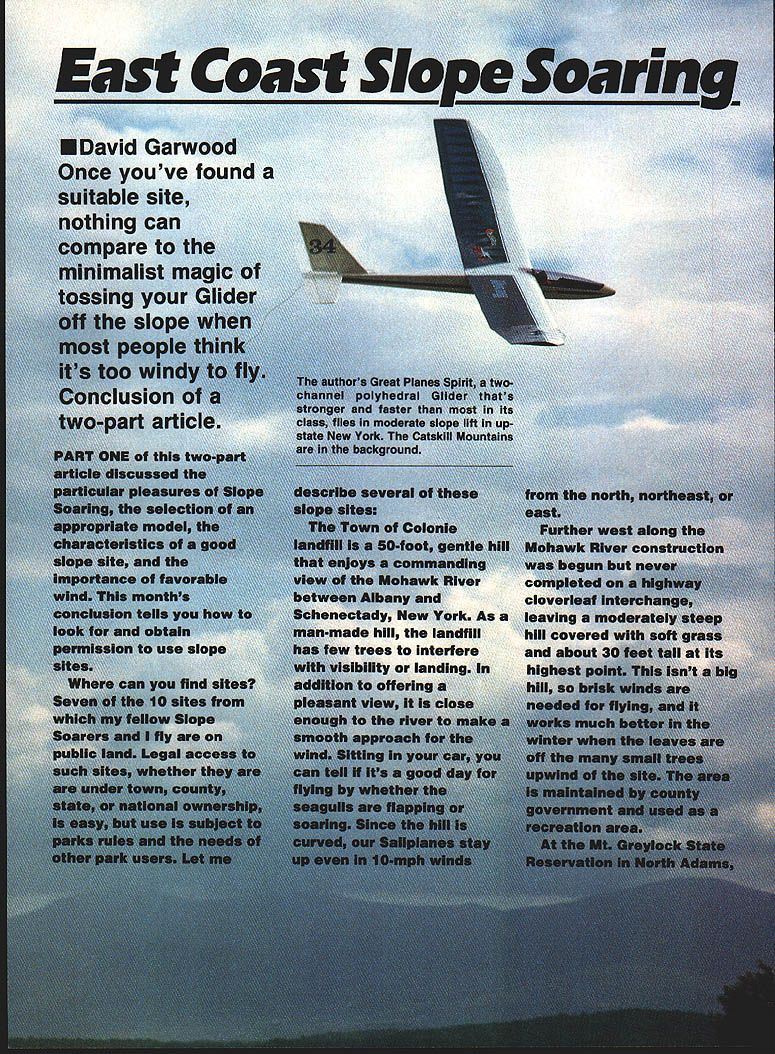
Once you've found a suitable site, nothing can compare to the minimalist magic of tossing your glider off the slope when most people think it's too windy to fly. Conclusion of a two-part article.
PART ONE of this two-part article discussed the particular pleasures of slope soaring, the selection of an appropriate model, the characteristics of a good slope site, and the importance of favorable wind. This month's conclusion tells you how to look for and obtain permission to use slope sites.
Where can you find sites? Seven of the 10 sites from which my fellow slope soarers and I fly are on public land. Legal access to such sites, whether they are under town, county, state, or national ownership, is easy, but use is subject to parks rules and the needs of other park users. Let me describe several of these slope sites:
The Town of Colonie landfill is a 50-foot, gentle hill that enjoys a commanding view of the Mohawk River between Albany and Schenectady, New York. As a man-made hill, the landfill has few trees to interfere with visibility or landing. In addition to offering a pleasant view, it is close enough to the river to make a smooth approach for the wind. Sitting in your car, you can tell if it's a good day for flying by whether the seagulls are flapping or soaring. Since the hill is curved, our sailplanes stay up even in 10-mph winds from the north, northeast, or east.
Further west along the Mohawk River, construction was begun but never completed on a highway cloverleaf interchange, leaving a moderately steep hill covered with soft grass and about 30 feet tall at its highest point. This isn't a big hill, so brisk winds are needed for flying, and it works much better in the winter when the leaves are off the many small trees upwind of the site. The area is maintained by county government and used as a recreation area.
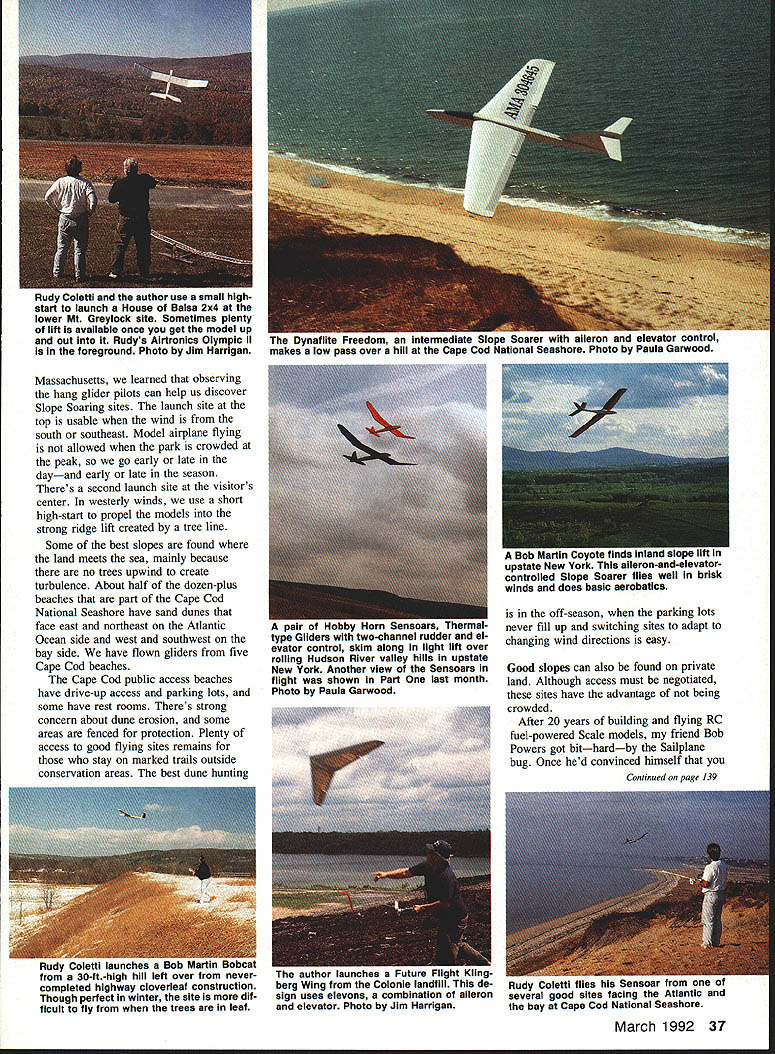
At the Mt. Greylock State Reservation in North Adams, Massachusetts, I learned observing hang-glider pilots can help us discover slope-soaring sites. The launch site's top usable winds are from the south to southeast. Model airplane flying is allowed in the park; the peak can be crowded, so go early in the day and early in the season. There's a second launch site near the visitors' center for westerly winds; use a short, high-start to propel models because strong ridge lift is created by the tree line.
Some of the best slopes are found where land meets sea, mainly because no trees upwind create less turbulence. About half a dozen-plus beaches that are part of Cape Cod National Seashore have sand dunes that face east to northeast on the Atlantic Ocean side and west to southwest on the bay side. I have flown gliders on five Cape Cod beaches. Cape Cod public access beaches have drive-up access and parking lots; some have rest rooms. There's strong concern about dune erosion, and some areas are fenced for protection. Plenty of access to good flying sites remains if you stay on marked trails and outside conservation areas. The best dune hunting is off-season; parking lots never fill up. Switching sites to adapt to changing wind directions is easy.
Good slopes can also be found on private land. Although access must be negotiated, private sites have the advantage of being less crowded.
After 20 years of building and flying R/C fuel-powered scale models, my friend Bob Powers got bit—hard—by the sailplane bug. Once he'd convinced himself that you really can perform rolls and fly inverted, he became hooked on slope soaring.
With a slope soarer, he began to search for hills near his home. He rediscovered a northwest-facing hill (northwest winds are the second most common type in our area) from which, as he told me, "I used to try to fly power models, but it was always too windy." The hill has a road and a paved area at the top. Bob knew the landowner and obtained permission for us to use the site. Currently, we do half of our slope soaring there.
Once Bob and I spent a frustrating afternoon on this slope tossing a variety of models for about 50 one-minute flights.
Just a week before, we had scored easy half-hour flights. But that day, although the wind speed was sufficient, the wind direction was not; it was about 30° away from perpendicular to the slope.
Bob suggested we take a closer look at a slope he had spotted a few miles away. We drove there and found a recently cut hillside hayfield. The farmer was driving down his lane toward us. We stopped, he introduced himself, and we quickly assembled a sailplane for an impromptu hand-launch demonstration.
When we explained how slope lift could sustain long flights, the farmer, who had never seen an unpowered model before, invited us to try his hill, pointing out where we could walk to avoid trampling his alfalfa. We now have permission to use a southwest-facing site as long as we take care to avoid crop damage.
One of the most interesting anecdotes about the search for slope-soaring sites on private land concerns another hayfield. As we had done for several weekends, my friend Dave Knight and I were driving back roads searching for new hills. Spotting a 200-acre hillside pasture with a road leading to the top, we knew we had a find. The only problem was to get permission to fly there.
We knocked at the farmhouse and explained to the landowner, who introduced himself as Rudy Coletti, what we wanted to do. Before we had finished, Rudy asked, "Did you bring the planes today?" We had, and he immediately invited us to mount the hill for a demonstration.
Rudy, it turned out, was a gas-power RC flier who had never experienced slope soaring. He told us he didn't mind our using his land in small groups. (He later confided that he'd been relieved that we weren't hunters.) Within a few months, Rudy had taken up glider flying and become a hard-core slope-soaring trekker, even traveling to Mt. Greylock and Cape Cod in search of the perfect site. We've been flying on his hill about once a week for the past two seasons, and it's proven one of our most productive. Rudy currently holds the site duration record of 58 minutes, earned with an Airtronics Olympic.
Where do you look for slope sites?
Confirmed slope soarers can be spotted peering out their car windows as they drive, ever hoping to discover a new site. With a little luck, this may be all you'll need to do to track down good sites. I've had success using both topographic and standard road maps to find promising areas to explore. Look especially at river valleys, as the land often slopes upward away from the river.
Model airplane club members or hobby shop proprietors may be able to tell you about already discovered sites or offer ideas about finding new ones. I've found competitors at sailplane contests willing to discuss slope sites in their states.
Finally, ask everyone you know, especially fishermen, hunters, and other outdoor types. The lead to Rudy Coletti's hill came from an angler with whom I work after I'd described to him the requirements of a good slope-soaring hill.
Asking permission to use a site
It's important to seek owner permission to fly off private land. We don't want sailplane fliers to develop a reputation for ignoring the rights and wishes of landowners. Further, flying on a site without permission temporarily invalidates your AMA insurance. Securing the landowner's cooperation usually isn't difficult.
Since some landowners are concerned about noise, the first step is to show the landowner a glider and explain that you want to fly a nonpowered model. Other landowners worry about accident liability or undisciplined people using their land. To assuage these fears, show your AMA card and the AMA Safety Code, and explain the insurance coverage.
Listen to the landowner's needs. Some do not want large groups; others are concerned about crop damage; still others want a phone call before you come out to fly. Once you have found a site and obtained permission to fly there, take care to preserve the relationship by attending to the owner's needs, honoring the land, and flying safely.
It's thrilling and rewarding to toss an inexpensive model off a hill when most think it's too windy to fly, and to fly it until you're ready to land. The other side of the coin is that you need to find an appropriate hill and wait for suitable wind to perform this minimalist magic. Now you know how to find the hill, and the right wind will come sooner or later. Let's get cracking on building that slope ship.
Note: A photoprint in Part One last month incorrectly identified the slope soarer pictured at the Colonie landfill in New York State as a Future Flight Klingberg Wing. The aircraft should have been identified as a Bob Martin Coyote. Model Aviation regrets the error.
Transcribed from original scans by AI. Minor OCR errors may remain.

