
Easy-Adjust Releasable Towhook
The beauty of a releasable (captured) towhook is that the towline won't release until the flier is ready. The hangup is when you need to change the towhook location for a particular launching condition. The author's easy-adjust scheme solves that. — R. C. Owens
Introduction
The biggest complaint about the releasable towhook is that it must be built into the fuselage fairly solidly and is difficult to relocate for optimum placement under different conditions. Relocation usually requires readjusting the linkage between the hook and the servo. During competition the transmitter is impounded and cannot be used to fine-tune the hook release point with respect to elevator or spoiler operation. Even when a separate servo is used, adjustments are tedious.
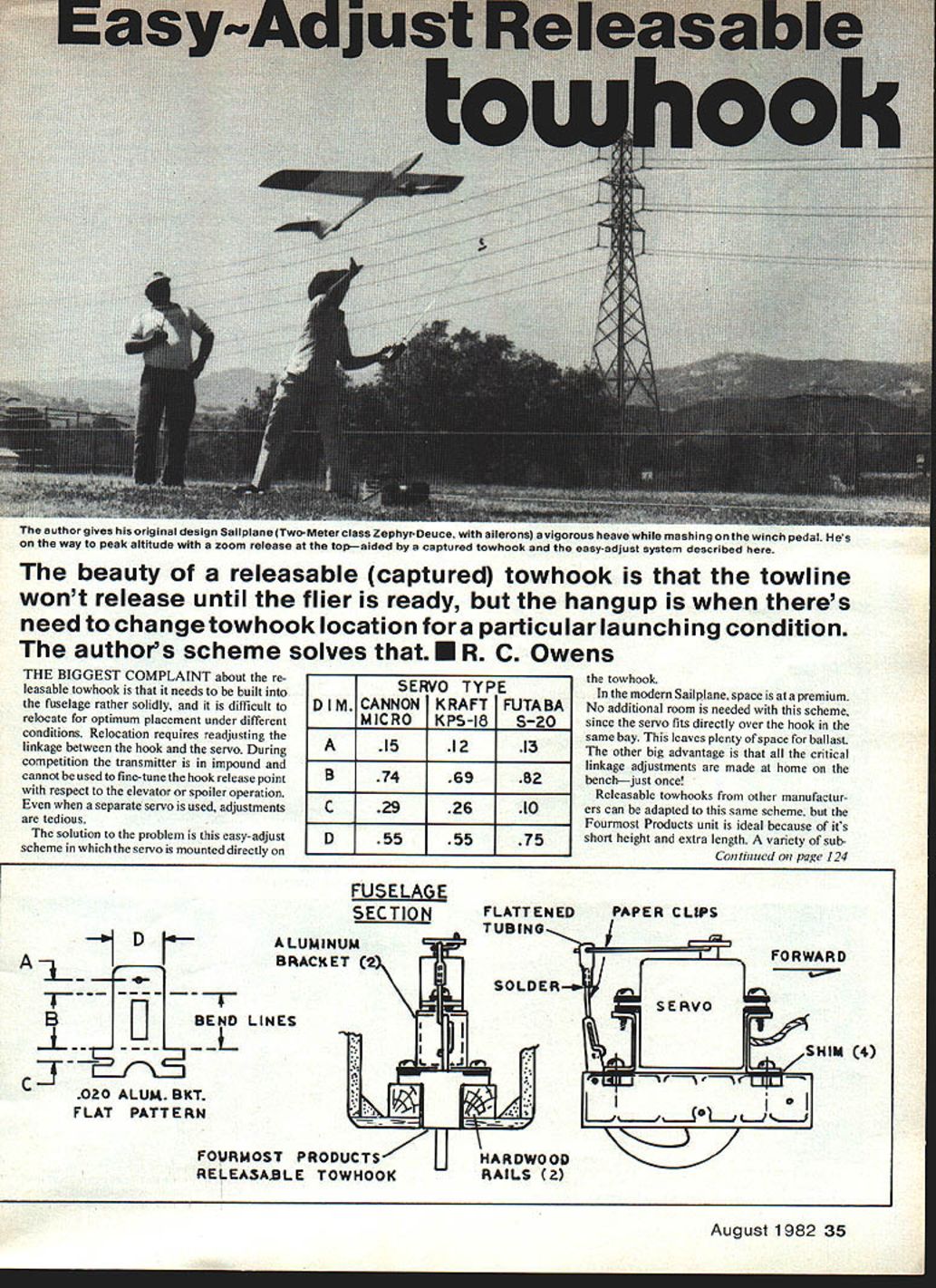
The solution is an easy-adjust scheme in which the servo is mounted directly on the towhook. No additional room is needed, since the servo fits directly over the hook in the same bay, leaving plenty of space for ballast. Another big advantage is that all the critical linkage adjustments are made at home on the bench—just once.
Servo dimensions
A variety of subminiature/micro servos will work equally well. Dimensions for three popular micro servos are shown below (dimensions correspond to points A–D on the bracket/hook assembly):
- A: Cannon Micro .15, Kraft KPS-18 .12, Futaba S-20 .13
- B: Cannon Micro .74, Kraft KPS-18 .69, Futaba S-20 .82
- C: Cannon Micro .29, Kraft KPS-18 .26, Futaba S-20 .10
- D: Cannon Micro .55, Kraft KPS-18 .55, Futaba S-20 .75
Most servos can be used by modifying aluminum brackets and, if necessary, turning the front bracket around to make room. Just be sure the fuselage is large enough to handle the necessary alteration.
Fourmost Products' releasable towhook is ideal because of its short height and extra length, though releasable towhooks from other manufacturers can be adapted to this scheme.
Fuselage mounting — Fourmost towhook installation
- Fit two hardwood rails flush with the bottom of the fuselage, spaced just far enough apart so the towhook fits snugly between them.
- Make the rails long enough to permit the hook to slide back and forth about 1 inch.
- Drill a series of mounting holes in the rails; use the towhook as a guide to precisely locate the holes.
- Reposition the hook in intervals—drill holes and mark the number adjacent each hole set to permit easy identification of position. This makes it simple to repeat a particular hook location for specific wind conditions.
- Use two simple brackets bent to appropriate dimensions to attach the servo. Drill mounting holes to match the servo and hook. Attach the servo brackets with normal mounting screws and grommets.
- Make the linkage from a paper clip and a piece of 1/16" brass tubing; solder the tubing to the wire.
This arrangement keeps the servo and hook in the same bay, preserving space for ballast and making pre-flight adjustments quick and repeatable.
Relocating the towhook
- Loosen the four mounting screws.
- Use the extended hook handle to push the hook-servo assembly up in the fuselage just far enough.
- Slip the assembly forward or aft to the desired set of holes.
- Tighten the screws.
The servo can be actuated by the elevator/spoiler channel. For greater flexibility (or to avoid interfering with primary controls), operate it on a separate channel, such as a fifth channel or a landing-gear/retract switch.
Advantages of the releasable towhook
- Consistent, nearly vertical launches without premature pop-offs. Generally, the farther aft the hook position, the steeper the launch—up to a point. If the model becomes hard to control or begins to stall, move the hook one hole forward.
- At the top of the launch, the releasable hook gives a big zoom that can add roughly 50 feet of altitude.
Launch technique
For a first-class launch:
- Hold the plane tightly while standing on the winch pedal.
- When line tension nearly pulls the plane out of your hand, javelin-throw it upward at about a 45-degree angle.
- If the wings are not very strong, operate the winch judiciously; otherwise, “stand in it.”
- As peak altitude approaches, ease in some down elevator to relieve wing strain and build up speed.
- Just before the winch line begins pulling the plane down, release the hook and apply some up-elevator to convert excess speed into height (zoom).
- Level off just before stall and search or enter the speed course.
It takes practice to get the timing right. Once you master it, you’ll prefer this launch method to a high-start.
Notes
- Releasable towhooks from other manufacturers can be adapted to this scheme with appropriate brackets and spacing.
- Ensure any modified brackets and the fuselage can accommodate the chosen servo dimensions.
Transcribed from original scans by AI. Minor OCR errors may remain.

