
An Easy Balsa Stripper
Need a special size strip, or the hobby shop is closed, or you can't find the exact grade of wood? Cheer up. It takes only minutes to make up this handy tool. A. A. Lidberg
SEARCHING FOR good strip wood in many hobby shops can be a very frustrating experience. Smaller strips in the dealer's stock bin suffer quite a lot from handling and are often broken. What can quickly turn off a model project is looking through the stock for a half dozen sizes of strip wood and finding that three of the sizes are out of stock, one comes only as warped strips that look like long, skinny props, and the remaining sizes are either broken or are suitable only for models of boat anchors! Perhaps I'm being overly hard on the hobby shops. Of course, many shops keep good track of their stock and try hard to satisfy their customers' needs. But, the point I'm trying to make is that the lack of ready-made strip wood need not discourage a modeler.
Cutting your own strip wood has some real advantages. Being able to examine a whole sheet of balsa means that it is easier to select proper grain and weight for the strips needed. Worm holes, cross-grain cracks, lengthwise splits, or small hard spots (knots?) can be more easily seen and avoided. There's even a money saving aspect to cutting your own strips.
Many approaches to cutting strip wood are possible and include the use of a razor blade or X-acto and straightedge, the X-acto stripper, a couple of commercial strippers costing from $10 to $20, and the easily made stripper shown in this article.
If only a few strips of wood are needed, the straightedge and knife or razor blade idea works fairly well. However, unless some kind of a jig is used to locate the straightedge, each strip may differ slightly in width. Also, it's not easy to maintain a 90° angle with a hand-held knife, so the strips tend to be shaped like trapezoids or parallelograms instead of the desired square or rectangular cross sections. Even if a 36" or 48"-long metal straightedge is available, cutting strips that long is very difficult because of the problems in locating the straightedge and in holding it securely to the balsa. The X-acto stripper is fairly convenient but suffers from some of the difficulties noted for knife and straightedge cutting. Some of the commercial strippers (often made for use with poster board) may work well, but have the disadvantage of high cost.
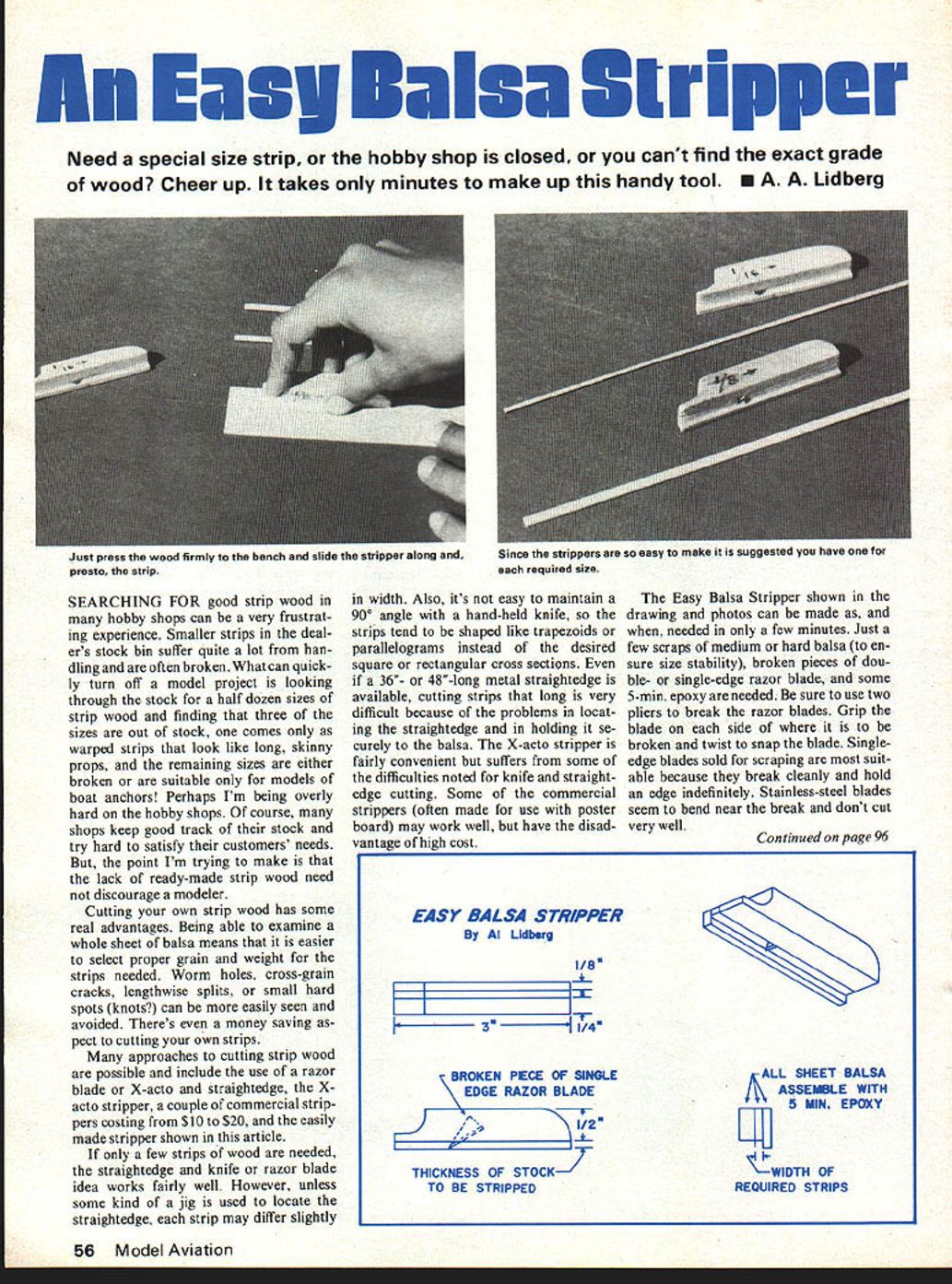
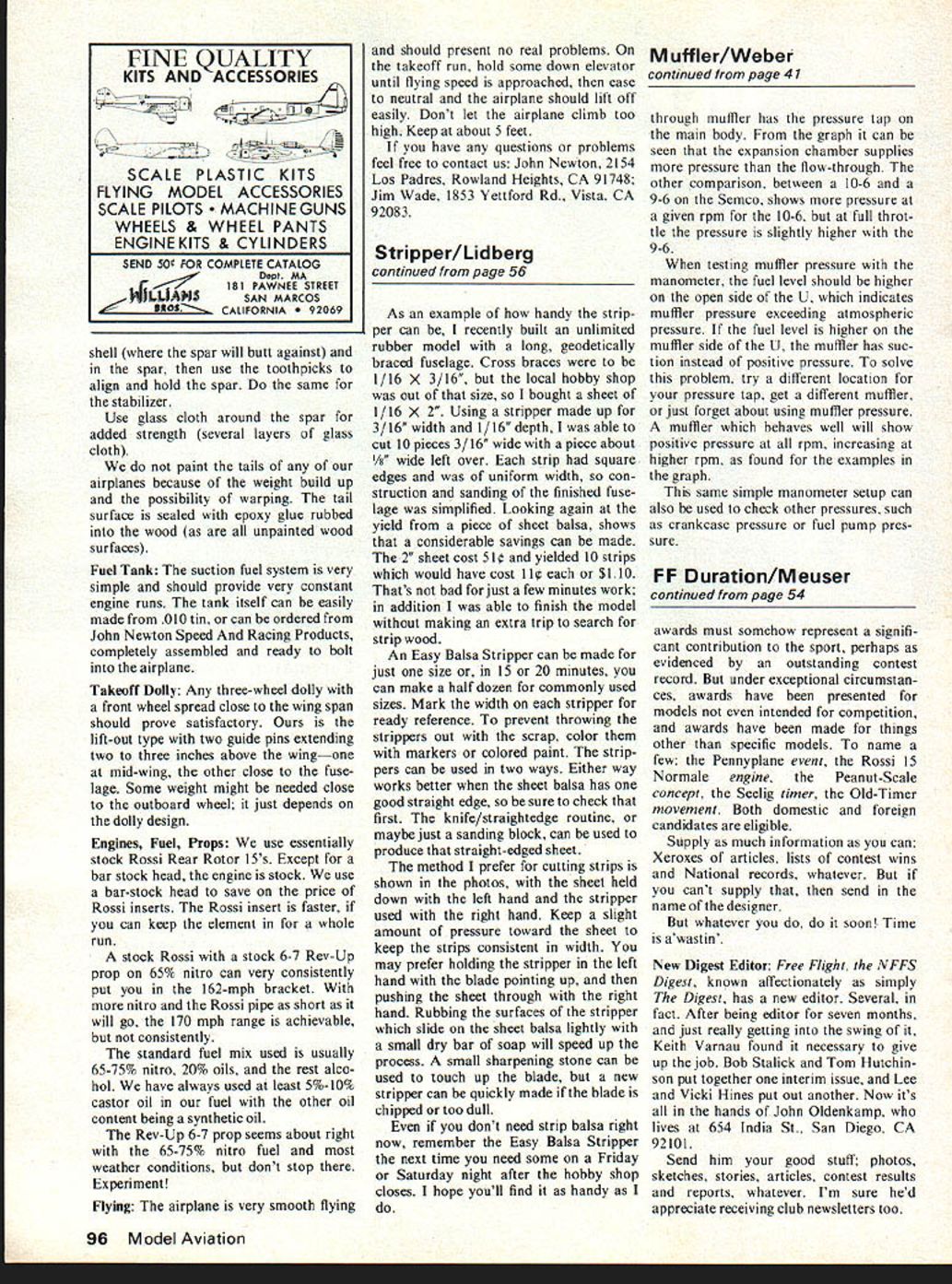
The Easy Balsa Stripper shown in the drawing and photos can be made as, and when, needed in only a few minutes. Just a few scraps of medium or hard balsa (to ensure size stability), broken pieces of double- or single-edge razor blade, and some 5-min. epoxy are needed. Be sure to use two pliers to break the razor blades. Grip the blade on each side of where it is to be broken and twist to snap the blade. Single-edge blades sold for scraping are most suitable because they break cleanly and hold an edge indefinitely. Stainless-steel blades seem to bend near the break and don't cut very well. As an example of how handy the stripper can be, I recently built an unlimited rubber model with a long, geodetically braced fuselage. Cross braces were to be 1/16 x 3/16", but the local hobby shop was out of that size, so I bought a sheet of 1/16 x 2". Using a stripper made up for 3/16" width and 1/16" depth, I was able to cut 10 pieces 3/16" wide with a piece about 1/8" wide left over. Each strip had square edges and was of uniform width, so construction and sanding of the finished fuselage was simplified. Looking again at the yield from a piece of sheet balsa, shows that a considerable savings can be made. The 2" sheet cost 51c and yielded 10 strips which would have cost 11c each or $1.10. That's not bad for just a few minutes work; in addition I was able to finish the model without making an extra trip to search for strip wood.
An Easy Balsa Stripper can be made for just one size or, in 15 or 20 minutes, you can make a half dozen for commonly used sizes. Mark the width on each stripper for ready reference. To prevent throwing the strippers out with the scrap, color them with markers or colored paint. The strippers can be used in two ways. Either way works better when the sheet balsa has one good straight edge, so be sure to check that first. The knife/straightedge routine, or maybe just a sanding block, can be used to produce that straight-edged sheet.
The method I prefer for cutting strips is shown in the photos, with the sheet held down with the left hand and the stripper used with the right hand. Keep a slight amount of pressure toward the sheet to keep the strips consistent in width. You may prefer holding the stripper in the left hand with the blade pointing up, and then pushing the sheet through with the right hand. Rubbing the surfaces of the stripper which slide on the sheet balsa lightly with a small dry bar of soap will speed up the process. A small sharpening stone can be used to touch up the blade, but a new stripper can be quickly made if the blade is chipped or too dull.
Even if you don't need strip balsa right now, remember the Easy Balsa Stripper the next time you need some on a Friday or Saturday night after the hobby shop closes. I hope you'll find it as handy as I do.
Transcribed from original scans by AI. Minor OCR errors may remain.

