
The Easy Way: Out of Trees
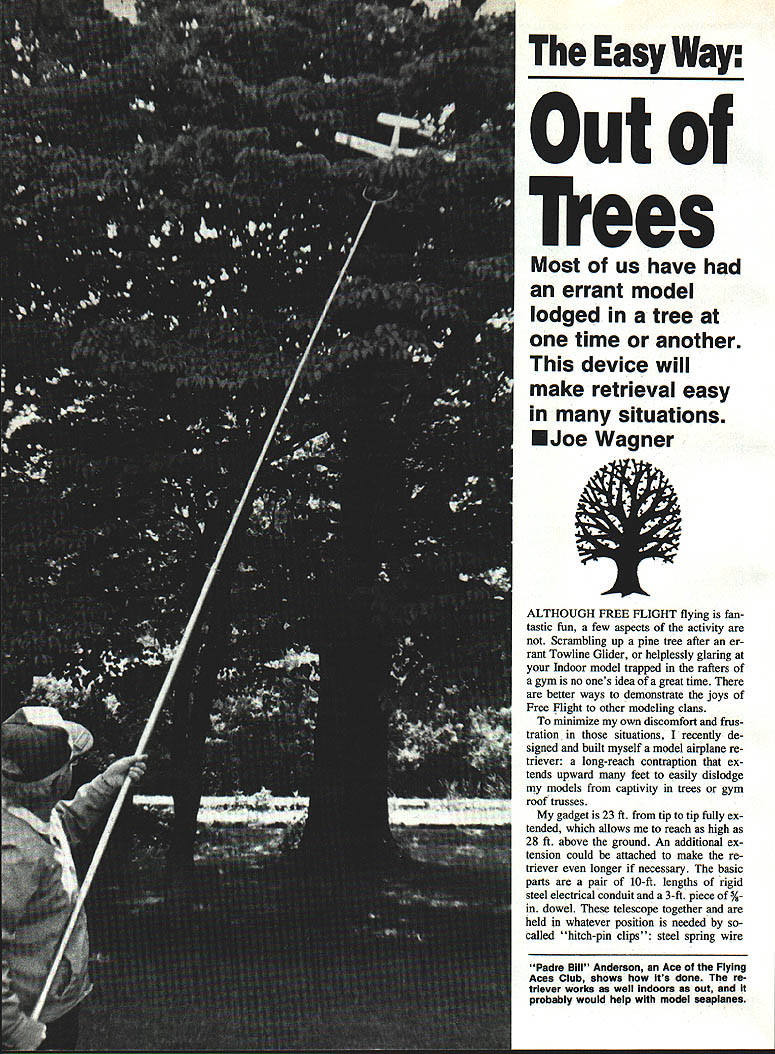
Most of us have had an errant model lodged in a tree at one time or another. Scrambling up a pine after an errant Towline Glider, or helplessly glaring at an indoor model trapped in gym rafters, is no one's idea of a great time. To minimize my own discomfort and frustration in those situations, I designed and built a model-airplane retriever: a long-reach contraption that extends many feet to dislodge models from trees or gym roof trusses.
My gadget is 23 ft. from tip to tip fully extended, which allows me to reach as high as 28 ft. above the ground. An additional extension can be attached to make the retriever even longer if necessary.
Materials
- Two 10-ft. lengths of rigid steel electrical conduit (two sizes, one slightly smaller to telescope inside the other)
- 3-ft. piece of 3/4-in. dowel (business end)
- Heavy-duty wire coat hanger (for the slingshot-shaped grabber)
- Silicone fuel tubing (to protect model finishes)
- Epoxy (for anchoring the wire in the dowel) — Hobbypoxy or similar
- 1/2-in. pop rivets (about twelve)
- Hitch-pin clips (steel spring wire)
- White bicycle handlebar tape (for the handle)
- Optional: about four inches of the small end of a hoe handle for an extra operator-end extension
Construction
- Conduit and sliding fit
- Electrical conduit comes in two sizes; the smaller should be a loose fit inside the larger to minimize rattling.
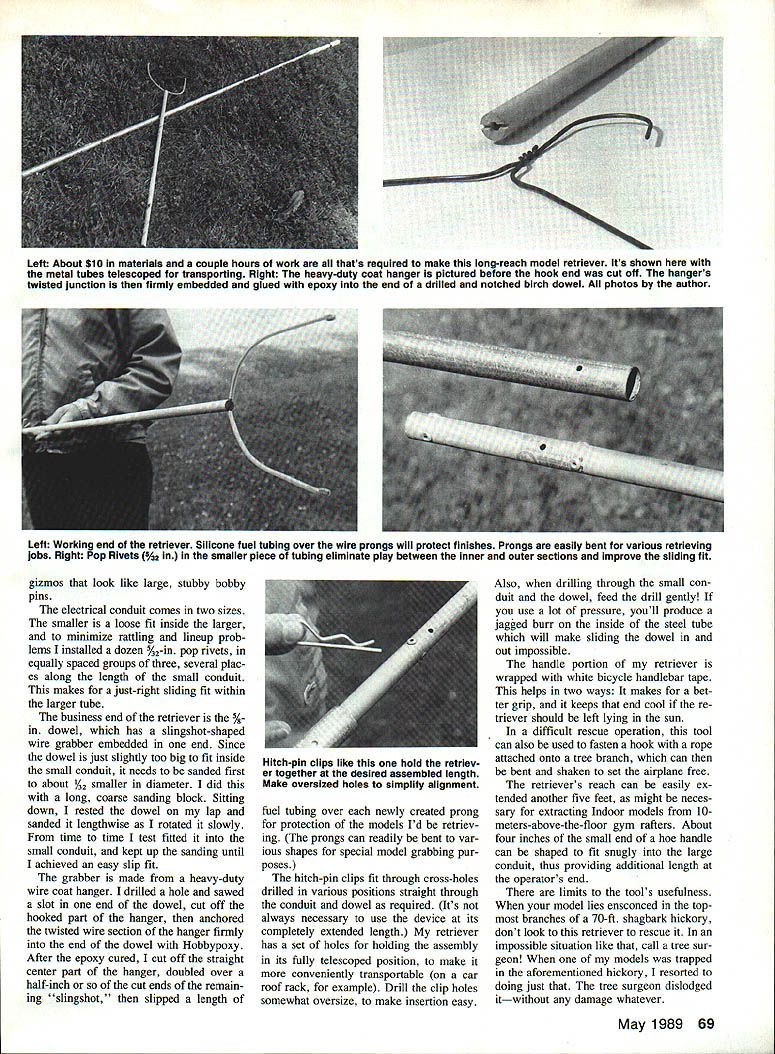
- To improve sliding fit and alignment, install twelve 1/2-in. pop rivets, arranged in groups of three at several points along the length of the small conduit. This reduces play between the inner and outer sections.
- Dowel sizing
- The business end is the 3/4-in. dowel with the wire grabber embedded in one end. Since the dowel is slightly too big to fit inside the small conduit, sand it down about 1/32 in. in diameter.
- I used a long coarse sanding block, sat down, rested the dowel in my lap, and sanded lengthwise while rotating slowly. Test-fit frequently until an easy slip fit was achieved.
- Making and installing the grabber
- Make the grabber from a heavy-duty wire coat hanger. Drill a hole and saw a slot in the end of the dowel.
- Cut off the hooked part of the hanger and anchor the twisted wire section firmly in the dowel end with epoxy. After the epoxy cures, cut off the straight center part of the hanger.
- Double over about a half-inch of the cut ends of the remaining slingshot, then slip lengths of silicone fuel tubing over the prongs to protect model finishes.
- The prongs can be bent to various shapes for special model-grabbing needs.
- Securing positions
- Drill cross-holes straight through the conduit and dowel at the positions where hitch-pin clips will hold the assembly in the desired telescoped positions.
- Drill the clip holes somewhat oversize to make insertion easy.
- When drilling through the small conduit, feed the drill gently. Excessive pressure can create a jagged burr on the inside of the steel tube that will prevent smooth sliding of the dowel.
- Handle and finish
- Wrap the handle portion with white bicycle handlebar tape. This improves grip and keeps the end cooler if the retriever is left in the sun.
- For additional operator-end length, shape about four inches of the small end of a hoe handle to fit snugly into the large conduit.
Use and Tips
- The retriever is set up to be used at less than its completely extended length in many situations. My retriever includes holes for holding the assembly fully telescoped for convenient transport (for example, on a car roof rack).
- You can also fasten a hook and rope to the retriever and hook it over a branch to bend or shake the branch free, setting an airplane free without directly grabbing the model.
- The retriever's reach can be easily extended another five feet if needed—for example, when extracting indoor models from gym rafters about 10 meters above the floor.
Safety and extreme cases
- If a model lies ensconced in the top branches of a very tall tree (for example, a 70-ft. shagbark hickory), consider calling a professional tree surgeon. I did that once to dislodge a model without damage.
Transcribed from original scans by AI. Minor OCR errors may remain.

