
The Edgley Optica
"HEY, Martha, will ya lookit them little ants down there... they're really people!"
Usually the biggest surprise a person gets on his first flight is how different things look up there, and how much more he can see than from down here. Barring smog and low clouds, the view is so much better aloft that it has inspired poets and even an occasional journalist to words of high praise.
History of aerial observation
This special feature of flying was noticed about the time that the first men lifted off in a hot-air balloon from downtown Paris, back in 1783. The first practical use for balloons (not counting just drifting along with the happy breezes) was for observation of enemy forces in some long-ago European wars. In those days, generals knew nothing about hiding their armies from aerial snoopers.
In the U.S.A., the flamboyant Thaddeus Lowe contributed to the Union victory in the Civil War by watching the Confederate Army from his coal-gas balloon tethered just behind the front and sending messages down a telegraph line to the soldiers below.
In World War I, the first months saw Sopwith, Nieuport and Fokker scout planes used strictly for observation until things turned ugly and they began carrying guns and bombs. The Second World War saw reconnaissance develop into a fine art, with special versions of the P-38 Lightning, Mosquito, Junkers Ju 86 and other standard types disarmed and filled with cameras to record troop movements and bombing damage.
From there, things progressed rapidly to specially designed high-altitude spy planes like the Lockheed U-2 and SR-71, which can shoot pictures with terribly expensive cameras well above 60,000 feet. Now, however, much of their work has been taken over by satellites which can photograph and scan any spot on earth, using sensors with astonishing resolving power.
Yet, with all this sophisticated military observation going on, there is a growing need for aerial observing that serves purely peaceful purposes. Airplanes from Piper Super Cubs to light twins are used for patrolling power lines and pipelines. Bigger turboprop twins and converted small business jets are used for maritime patrol, checking fishing boats which may have violated legal limits and searching for smugglers. Helicopters are increasingly popular for radio and TV traffic reports, and the police use flying machines as airborne patrol cars.
Most aircraft used for these and other purposes are modified standard types, ranging from little Cessnas to Beech King Air 200s and Learjets.
Much the same kind of thinking resulted in the Abrams Aerial Explorer introduced in 1937. It was a twin-boom affair with its pilot far out front in a glassy nose, the observer sitting behind him and just ahead of a pusher-mounted radial engine. Several were built and did admirable work, though the type is remembered mainly because thousands of cast-iron models flooded toy stores and are now treasured antique novelties.
The Optica — an airplane expressly for observation
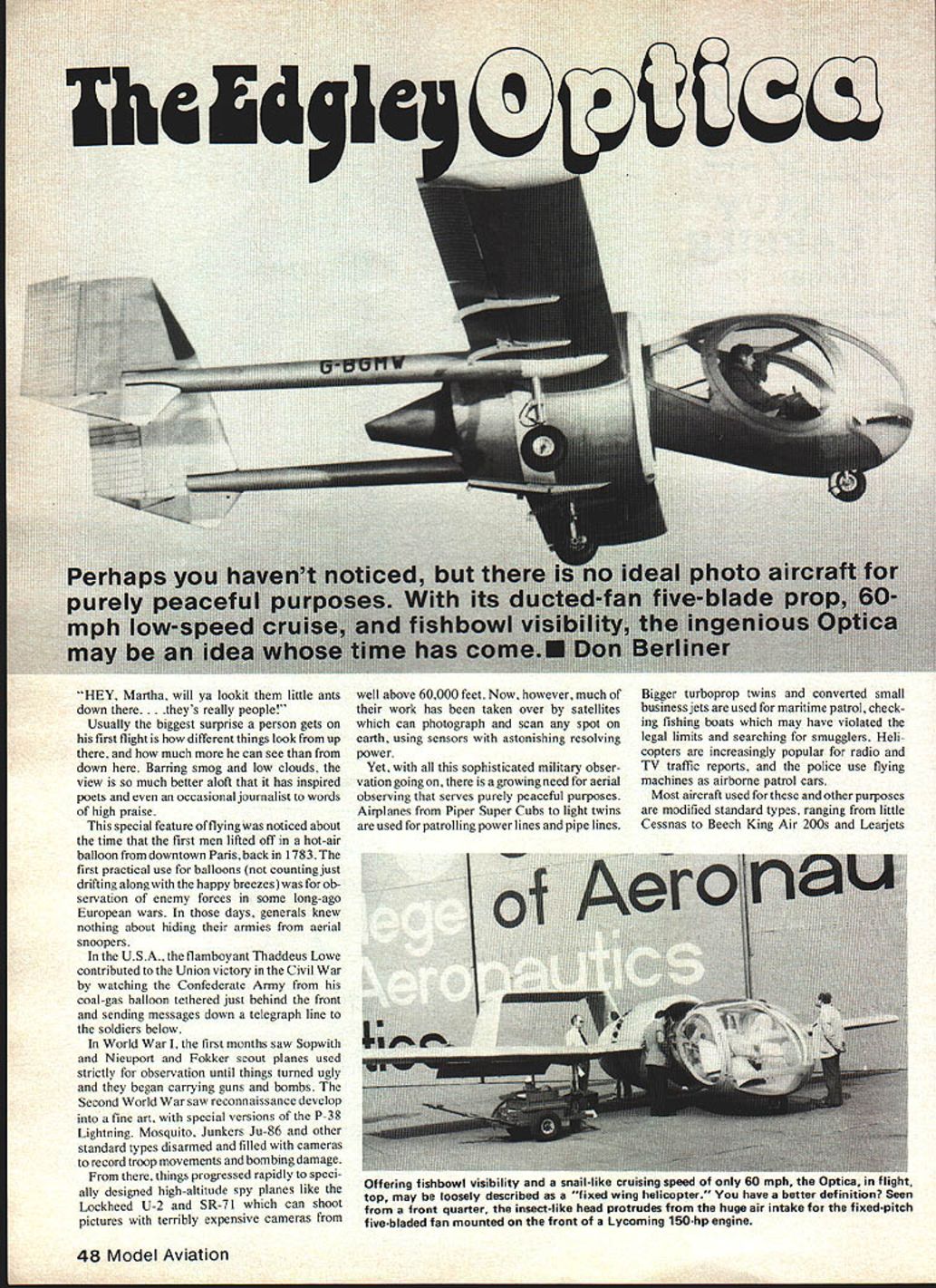
Much the same kind of thinking has resulted in the latest effort to create an airplane expressly for observation — the Edgley Optica. Designed by John Edgley of London and built in a small production run at Cranfield Airport, the Optica is a stem-to-stern improvement on the old Explorer; its intended uses are as a sort of fixed-wing helicopter offering low-speed cruising (about 60 mph) and superb visibility. Unlike a helicopter it should be relatively cheap to produce and operate and no more difficult to fly than any other fixed-wing airplane.
The nose of the Optica is a fishbowl. Unlike the popular little Bell 47G helicopter, the pilot and two observers sit side-by-side surrounded by 5-mm-thick Plexiglas. The Bell helicopter is noisy; communication between pilot and passenger often demands shouting across each other's ears. The Optica's noise level should be lower than ordinary airplanes because of the shroud around its propeller.
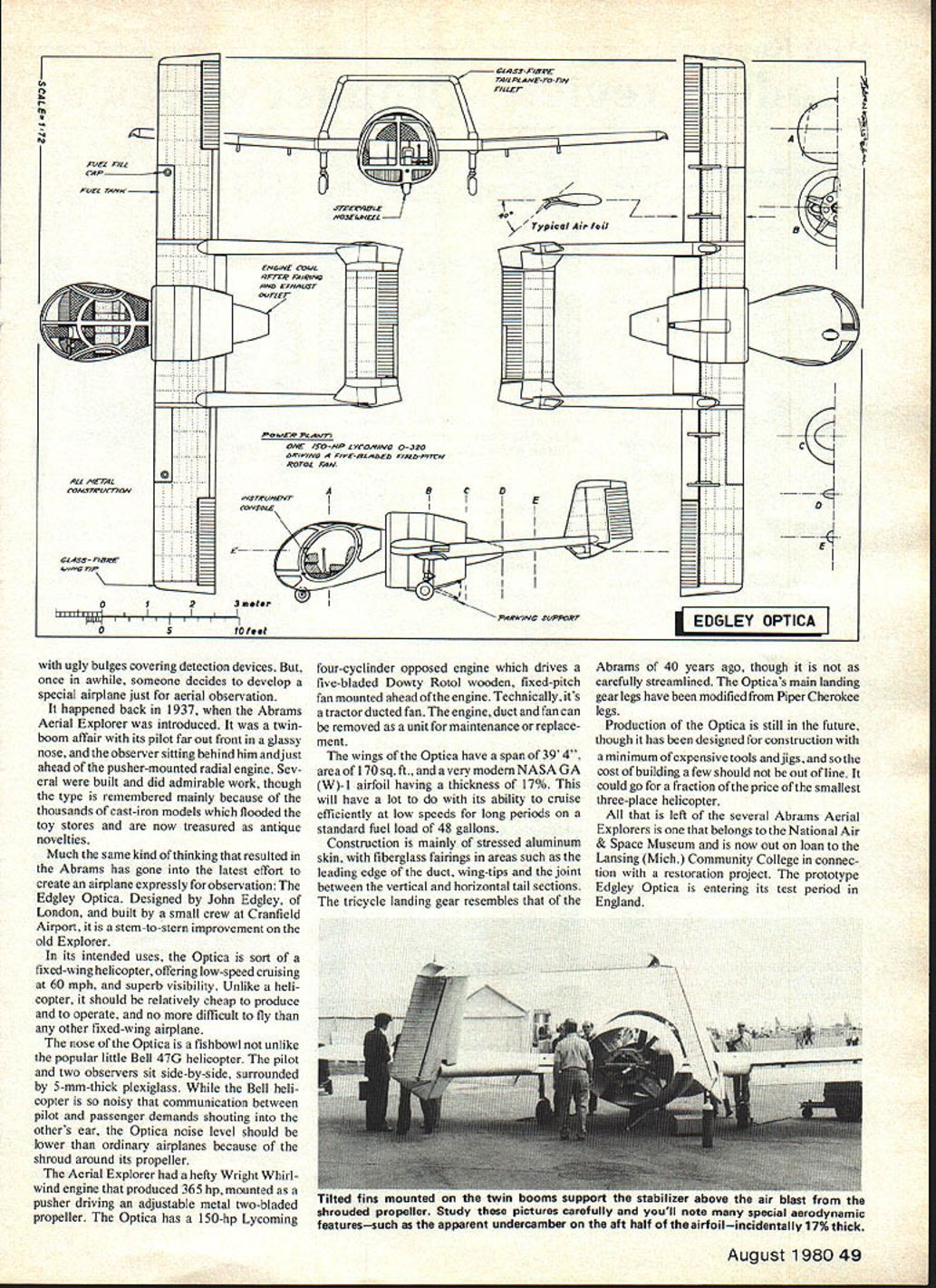
The Abrams Aerial Explorer used a hefty Wright Whirlwind engine producing 365 hp mounted as a pusher and driving an adjustable metal two-bladed propeller. The Optica, by contrast, has a 150-hp Lycoming four-cylinder opposed engine which drives a five-bladed Dowty Rotol wooden fixed-pitch fan mounted ahead of the engine. Technically it is a tractor ducted-fan; the engine-and-duct-fan can be removed as a unit for maintenance or replacement.
Key features:
- Ducted five-blade propeller (Dowty Rotol) for reduced noise and improved low-speed efficiency
- Fishbowl nose with side-by-side seating for pilot and two observers, surrounded by 5-mm Plexiglas
- 150-hp Lycoming four-cylinder opposed engine driving the tractor ducted fan
- Low-speed cruise around 60 mph, intended for prolonged observation work
Construction and performance
The Optica's wings have a span of 39 ft 4 in and an area of 170 sq ft. The very modern NASA GA(W)-1 airfoil, having a thickness of 17%, will have a lot to do with its ability to cruise efficiently at low speeds for long periods on a standard fuel load of 48 gallons.
Construction is mainly of stressed-aluminum skin, with fiberglass fairings in areas such as the leading edge of the duct, wing-tips and the joint between the vertical and horizontal tail sections.
The tricycle landing gear resembles that of the Abrams of 40 years earlier, though it is not as carefully streamlined. The Optica's main landing gear legs have been modified from Piper Cherokee legs.
Production and status
Production of the Optica is still in the future, though it has been designed for construction with a minimum of expensive tools and jigs, and so the cost of building a few should not be out of line. It could sell for a fraction of the price of the smallest three-place helicopter.
All that is left of the several Abrams Aerial Explorers is one that belongs to the National Air & Space Museum and is now out on loan to the Lansing (Mich.) Community College in connection with a restoration project. The prototype Edgley Optica is entering its test period in England.
Transcribed from original scans by AI. Minor OCR errors may remain.

