
Editing & Publishing a Club Newsletter
Les Hard Editor, The Bee Line
Whether you already have a newsletter, or intend to publish one, these many valuable tips will prove helpful. SO YOU PLAN to edit and publish a newsletter for your club. The object of putting out a club newsletter is to report to fellow club members and others, the activities that have taken place and will be taking place within the club, at the activities' sites, at contests in your area, in the state and around the country. Tips on how-to, who has been building and what, brief sketches on members... items are limitless that can be published in your club newsletter and will be of interest to the members. You must convey the following: What, Why, Where, and How, Who, When.
In deciding on publishing a newsletter, the club officials should plan a program on how, and what, the club can afford to spend on the publication each month and how they will pro-rate financing. Some clubs set aside a percentage of yearly dues, others sell advertising space to hobby shops to help pay for the publishing of the newsletter. In this session of the officials, the name of the newsletter should be decided upon, or a suggestion contest could be held within the club to let the members offer possible names for the publication.
Designing Your Newsletter
Masthead
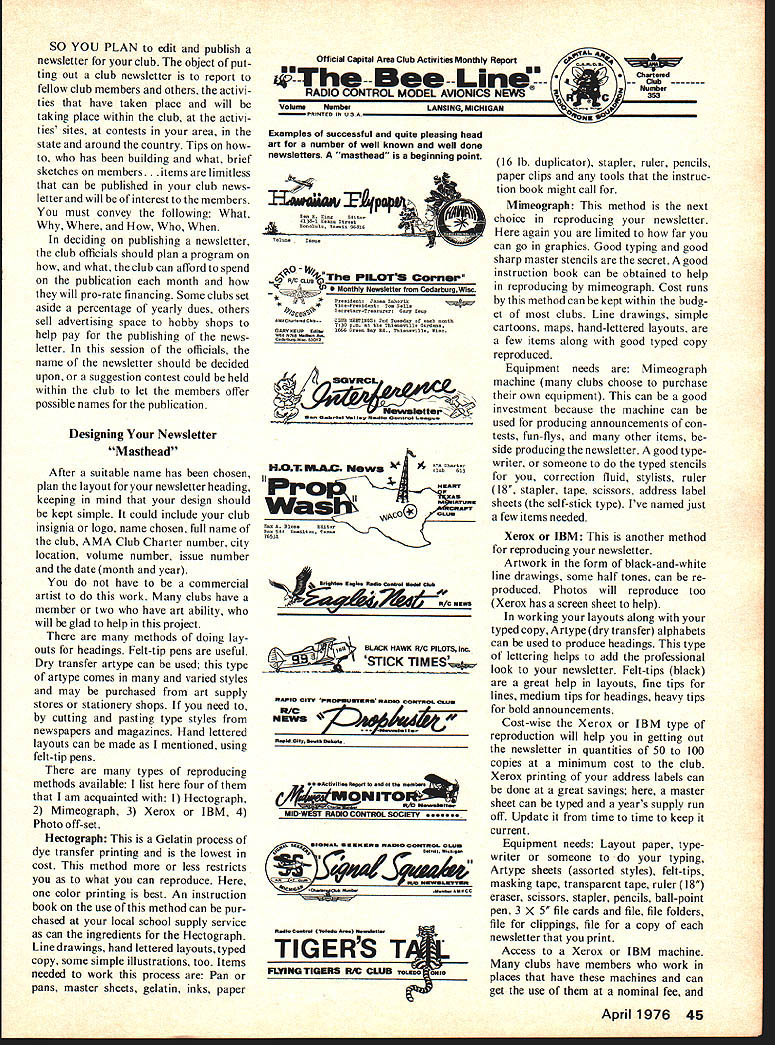
After a suitable name has been chosen, plan the layout for your newsletter heading, keeping in mind that your design should be kept simple. It could include your club insignia or logo, name chosen, full name of the club, AMA Club Charter number, city location, volume number, issue number and the date (month and year).
You do not have to be a commercial artist to do this work. Many clubs have a member or two who have art ability, who will be glad to help in this project.
There are many methods of doing layouts for headings. Felt-tip pens are useful. Dry transfer Artype can be used; this type of Artype comes in many and varied styles and may be purchased from art supply stores or stationery shops. If you need to, by cutting and pasting type styles from newspapers and magazines. Hand lettered layouts can be made as I mentioned, using felt-tip pens.
There are many types of reproducing methods available; I list here four of them that I am acquainted with: 1) Hectograph, 2) Mimeograph, 3) Xerox or IBM, 4) Photo off-set.
Hectograph: This is a gelatin process of dye transfer printing and is the lowest in cost. This method more or less restricts you as to what you can reproduce. Here, one color printing is best. An instruction book on the use of this method can be purchased at your local school supply service as can the ingredients for the Hectograph. Line drawings, hand lettered layouts, typed copy, some simple illustrations, too. Items needed to work this process are: Pan or pans, master sheets, gelatin, inks, paper (16 lb. duplicator), stapler, ruler, pencils, paper clips and any tools that the instruction book might call for.
Mimeograph: This method is the next choice in reproducing your newsletter. Here again you are limited to how far you can go in graphics. Good typing and good sharp master stencils are the secret. A good instruction book can be obtained to help in reproducing by mimeograph. Cost runs by this method can be kept within the budget of most clubs. Line drawings, simple cartoons, maps, hand-lettered layouts, are a few items along with good typed copy reproduced.
Equipment needs are: Mimeograph machine (many clubs choose to purchase their own equipment). This can be a good investment because the machine can be used for producing announcements of contests, fun-flys, and many other items, besides producing the newsletter. A good typewriter, or someone to do the typed stencils for you, correction fluid, stylists, ruler (18"), stapler, tape, scissors, address label sheets (the self-stick type). I've named just a few items needed.
Xerox or IBM: This is another method for reproducing your newsletter.
Artwork in the form of black-and-white line drawings, some half tones, can be reproduced. Photos will reproduce too (Xerox has a screen sheet to help). In working your layouts along with your typed copy, Artype (dry transfer) alphabets can be used to produce headings. This type of lettering helps to add the professional look to your newsletter. Felt-tips (black) are a great help in layouts, fine tips for lines, medium tips for headings, heavy tips for bold announcements.
Cost-wise the Xerox or IBM type of reproduction will help you in getting out the newsletter in quantities of 50 to 100 copies at a minimum cost to the club. Xerox printing of your address labels can be done at a great savings; here, a master sheet can be typed and a year's supply run off. Update it from time to time to keep it current.
Equipment needs: Layout paper, typewriter or someone to do your typing, Artype sheets (assorted styles), felt-tips, masking tape, transparent tape, ruler (18"), eraser, scissors, stapler, pencils, ball-point pen, 3 x 5 file cards and file, file folders, file for clippings, file for a copy of each newsletter that you print.
Access to a Xerox or IBM machine. Many clubs have members who work in places that have these machines and can get the use of them at a nominal fee, and would be glad to help in reproducing the newsletter each month.
The Off-set: This is the clearest method in reproducing your newsletter and, in the long run (100 or more copies), the most economical cost-wise. Photos reproduce the clearest (your off-set printer can help you here). Line drawings can be used, many of the same methods of layout can be used as mentioned above.
If you choose the off-set method in getting out your newsletter, make arrangements with the printer to do your letter at the same time each month, allowing plenty of time to do it. Most off-set printing places like, "Copy-Quick," "Insty-Print," "Speedy Printing," and many small printing plants equipped to do off-set printing have a set schedule of prices that will help you to determine what your cost per month will be for a given number of copies.
In setting up your place to work on your newsletter layouts, include a small piece of 3/4" birch plywood approximately 20" wide and 24" long, to be used as a working surface. Cover it with a piece of heavy art board (same size). This gives a really smooth surface. Another useful item is an X-acto knife.
Now that we have touched on Why and How, let's proceed with the makeup.
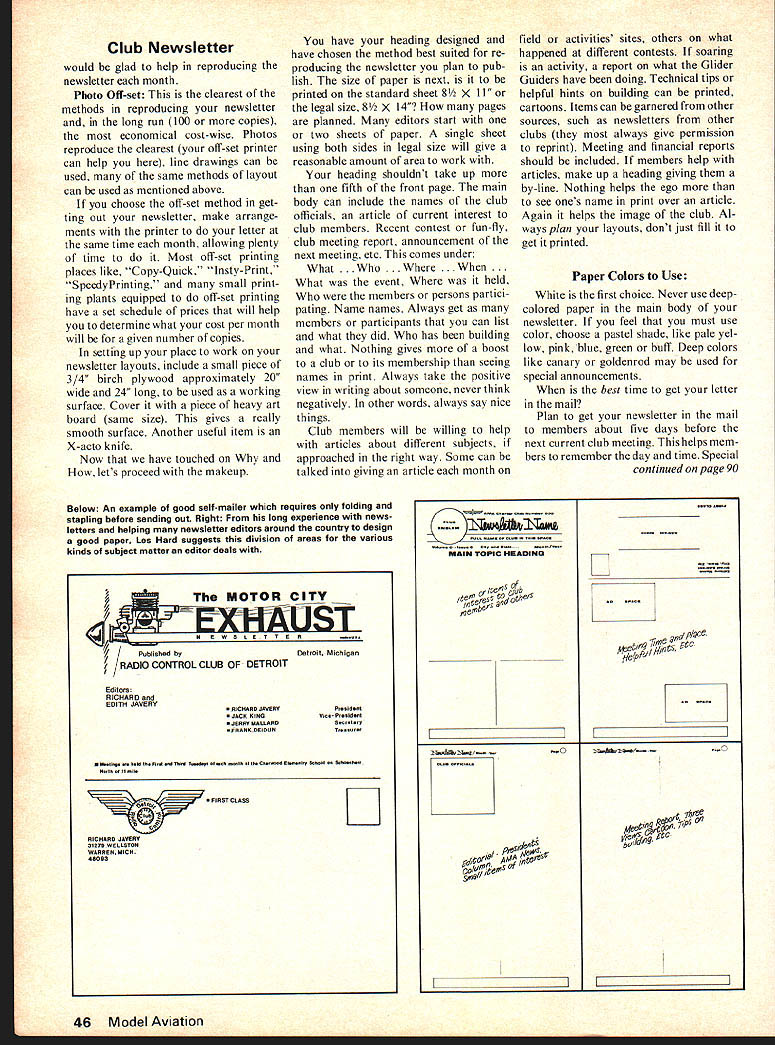
You have your heading designed and have chosen the method best suited for reproducing the newsletter you plan to publish. The size of paper is next. Is it to be printed on the standard sheet 8 1/2" x 11" or the legal size, 8 1/2" x 14"? How many pages are planned. Many editors start with one or two sheets of paper. A single sheet using both sides in legal size will give a reasonable amount of area to work with.
Your heading shouldn't take up more than one fifth of the front page. The main body can include the names of the club officers, an article of current interest to club members. Recent contest or fun-fly, club meeting report, announcement of the next meeting, etc. This comes under:
What . . . Who . . . Where . . . When . . .
What was the event, Where was it held, Who were the members or persons participating. Name names. Always get as many members or participants that you can list and what they did. Who has been building and what. Nothing gives more of a boost to a club or to its membership than seeing names in print. Always take the positive view in writing about someone, never think negatively. In other words, always say nice things.
Club members will be willing to help with articles about different subjects, if approached in the right way. Some can be talked into giving an article each month on the field or activities' sites, others on what happened at different contests. If soaring is an activity, a report on what the Glider Builders have been doing. Technical tips or helpful hints on building can be printed, cartoons. Items can be garnered from other sources, such as newsletters from other clubs (they most always give permission to reprint). Meeting and financial reports should be included. If members help with articles, make up a heading giving them a by-line. Nothing helps the ego more than to see one's name in print over an article. Again it helps the image of the club. Always plan your layouts, don't just fall it to get it printed.
Paper Colors to Use:
White is the first choice. Never use deep-colored paper in the main body of your newsletter. If you feel that you must use color, choose a pastel shade, like pale yellow, pink, blue, green or buff. Deep colors like canary or gordon may be used for special announcements.
When is the best time to get your letter in the mail?
Plan to get your newsletter in the mail to members about five days before the next current club meeting. This helps members to remember the day and time. So you plan to edit and publish a club newsletter. The object in putting out a club newsletter is to report to fellow club members and others what activities have taken place and what will take place within the club: activities, sites, contests in the area, state and around the country. Tips, how-tos on building, brief sketches of members' work — the possibilities are limitless. Whatever can be published in a club newsletter will interest members. It must convey the following:
What to decide about publishing a newsletter: Club officials should plan the program and determine what the club can afford to spend for publication each month. Will the cost be prorated? Some clubs set aside a percentage of yearly dues; others sell advertising space. Hobby shops may help pay for publishing the newsletter.
The name of the newsletter should be decided upon. A suggestion contest could be held within the club; let members offer possible names for the publication.
Designing the Newsletter
Masthead
After a suitable name has been chosen, plan the layout of the newsletter heading. Keep in mind the design should be kept simple. It could include the club insignia or logo, the name chosen, the full name of the club, AMA club charter number, city and location, volume number, issue number, and the date (month and year). Have a commercial artist do the job if you can. If the club has a member with art ability, he will be glad to help.
Methods of doing layouts and headings: Felt-tip pens are useful. Dry-transfer alphabets (ar type) can be used; artype comes in varied styles and may be purchased from art supply stores and stationery shops. You will need cutting and pasting supplies and type styles from newspapers and magazines. Hand-lettered layouts can be made as mentioned using felt-tip pens.
Reproducing Methods
Types of reproducing methods available (four I am acquainted with):
- Hectograph
- Mimeograph
- Xerox (IBM)
- Photo offset
Hectograph
Hectograph (gelatin process, dye-transfer printing) is the lowest cost method and least restrictive in what can be reproduced. Color printing is possible. An instruction book on the use of this method can be purchased from the local school supply service and will list the ingredients. Hectograph reproduces line drawings, hand-lettered layouts, typed copy and some simple illustrations.
Items needed for the process: pans, master sheets, gelatin, inks, and paper.
Mimeograph
The mimeograph is the next choice for reproducing a newsletter, again limited for graphics. Good typing and sharp master stencils are the secret. A good instruction book can be obtained to help in reproducing by mimeograph. The cost of this method can be kept within the budget of most clubs.
Line drawings, simple cartoons, maps, hand-lettered layouts and a few items along with good typed copy can be reproduced.
Equipment needs: a mimeograph machine (many clubs choose to purchase their own equipment because the machine can also be used producing announcements, contests, fun-flys and other items), a good typewriter, someone to type stencils, correction fluid, stylus, ruler, stapler, tape, scissors and address label sheets (self-stick type). I've named just a few items needed.
Xerox (Photocopy)
Xerox (photocopy) is another method of reproducing a newsletter. Artwork in the form of black-and-white line drawings and some half-tones can be reproduced. Photos will reproduce too. Xerox has screen sheets to help working layouts along with typed copy. Dry-transfer alphabets can be used to produce headings and type lettering.
Transcribed from original scans by AI. Minor OCR errors may remain.

