
The Effects of Atmospheric Conditions on Engine Performance
David Gierke
An understanding of how weather affects your engine performance can lead to more efficient engine operation.
OVER THE YEARS, how many times have modelers come to the conclusion that their old reliable sport engine has gone over the hill? This deduction usually comes after varnish has been removed from the cylinder wall and piston, plugs changed, filters checked, screws tightened, and needle valve assemblies examined without success in bringing back lost power.
Before sending the mill back to Clarence for some freshening, it might be well to take stock of the elements. On this day that the engine goes sour, the sky is heavily overcast with the temperature well into the 80's, and a promised summer storm is moving into the area. These deteriorating weather conditions, with reduced air density, could well cause a reduction in power and overheating. Many of us don't recognize the symptoms. It's costing us.
"Everyone complains about the weather but nobody ever does anything about it." To a certain degree this is a true statement. On the other hand, an understanding of how the weather affects engine performance will lead to more efficient engine operation. Our small two-stroke cycle semi-diesels are, without exception, sophisticated air pumps. They require air in large quantities to develop the power or useful mechanical energy needed for our vehicles. Air as a gas has the freedom to expand and contract as it flows about the earth's surface. This same air contains about one part in five of the vital combustion element — oxygen. Air is affected by a number of factors which either increases or decreases the availability of this oxygen to the engine's cylinder.
To many individuals in the world of high performance motor sports and serious laboratory experimentation, the condition of the air (air density) is of great importance. To be specific, just how much can air density affect engine performance? Personally, I have experienced an engine power difference of 25% from one day to the next. For an engine producing two horsepower at excellent conditions the reduction could be as much as 1/2 horsepower under poor conditions.
If the oxygen is unavailable for the engine's consumption, fuel must be reduced in order to maintain the proper air-to-fuel ratio. This reduction in the flow of fuel through the system in a given period of time must result in a reduction of power. We now know that the air and its condition has a direct bearing upon how our engines perform. Let's look at the specific factors and observe how they affect air density. To begin with, it should be explained that air density refers to the weight per given volume. In other words, a high density atmospheric condition means that air molecules are packed tightly together and thus contain more oxygen per cubic foot.
Temperature: As the temperature of a gas increases, so does its molecular activity. The molecules of nitrogen (four parts) and oxygen (one part) are moving about in greater vibrating patterns which, in effect, moves them further apart. This reduces the density of the air and decreases engine performance.
Pressure: Refers to the force exerted by the weight of the atmosphere on every square inch of the earth's surface (unit area). The standard measure of pressure is sea level and is 29.92 inches of mercury (Hg) or approx. 14.7 lbs. per square inch. This is known as standard pressure. If you were to travel to the mile-high city of Denver, Colo., the air pressure would be greatly reduced from standard pressure (to about 24 inches of Hg). Actually, atmospheric pressure is reduced about one inch for each 1,000 feet above sea level up to almost 10,000 feet. A significant power loss would be experienced at these altitudes. Air pressure forces the air into the engine. The greater the atmospheric pressure, the greater the pressure differential that exists between the engine's crankcase and atmospheric pressure. This pressure differential results in greater air volume entering the engine. Improved air volume generally increases cylinder packing and volumetric efficiency.
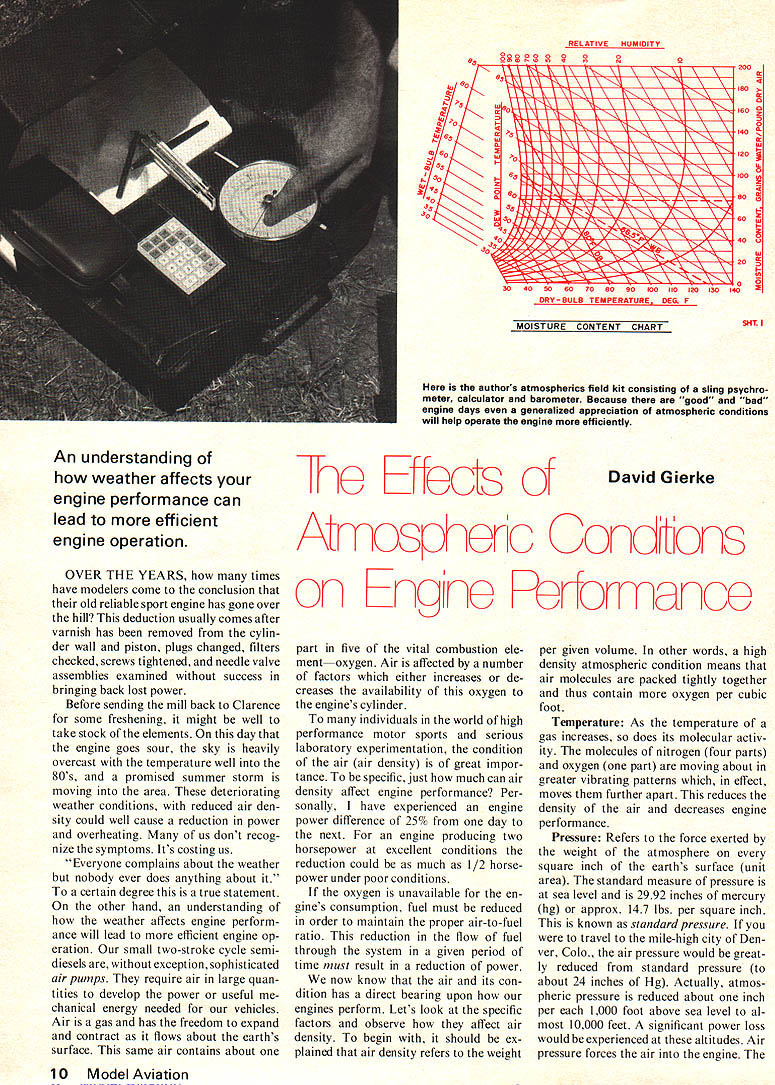
Humidity: Water vapor — the nature of air has the ability to absorb great quantities of water and hold it for extended periods of time. The amount of water absorbed by air is directly related to the air's temperature. To illustrate the point: air can hold about ten times as much water at 90°F as it possibly could at 30°F. Water molecules tend to push oxygen and nitrogen molecules further apart, decreasing the element density and thus reducing engine power output.
In review, it may be stated the following atmospheric conditions are necessary for maximum engine performance:
- High atmospheric pressure
- Low air temperature
- Low humidity
Two methods will be discussed concerning how to handle your newly acquired knowledge about the weather. First will be the Rule of Thumb Method. Secondly will be the Technical Method based upon weather instrumentation.
Rule of Thumb Method
What is a good or bad engine day? This largely depends upon one further discussion. The relationship between air pressure and water vapor content. The total air pressure as determined by the barometer is always the sum of normal air components and the pressure exerted by the water vapor. This is particularly important on high temperature days as the potential for large quantities of water vapor being present is significant.
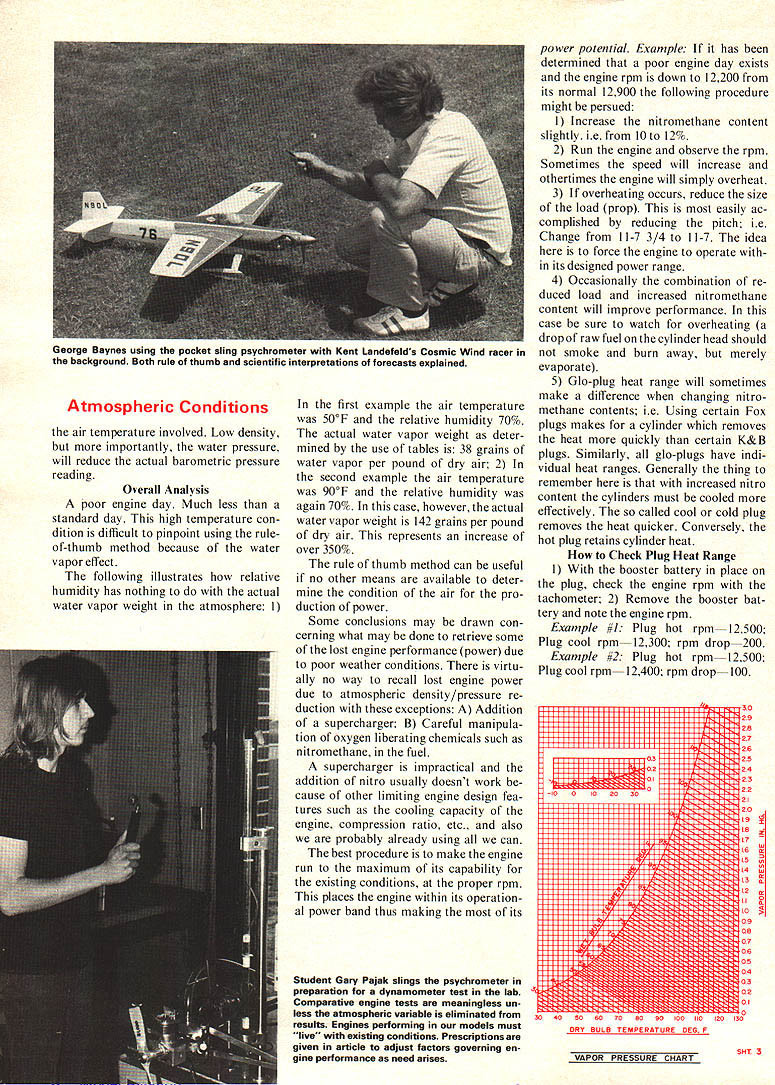
The barometer may be falsely high in conditions of high humidity because, as we have previously mentioned, water vapor reduces the air element density (O2). To obtain a more representative air pressure readout, the water vapor pressure must be subtracted from the barometer reading.
As you can see, the importance of accurate weather instrumentation is of prime concern to the determination of engine power potential. If the temperature of the air is low (below 60°F) the effect of water vapor pressure is minimal and can generally be disregarded in "Rule of Thumb" determination of air density. Listening to the radio or television weather forecast can give you some clue to engine performance but this can also lead to serious miscalculations as we shall see later.
Typical Forecast
1) Temperature 50°F; 2) Barometer 30.00" Hg and rising; 3) Relative humidity 70%.
Rule of Thumb Analysis
1) Temperature is low (below the standard of 60°F) showing good density here; 2) Pressure is high (above the standard of 29.92" Hg) and is getting better. This should improve the pressure differential between engine and atmosphere. A good sign; 3) Since the air temperature is low the amount of water which may enter the air is low. This will not affect the barometric readout to any great degree.
Overall Analysis
A better than average engine performance day. The basis for this analysis should be standard air conditions which include: 1) Temperature 60°F; 2) Air pressure 29.92" Hg at sea level; 3) 0% humidity.
Any condition which lowers the temperature to less than 60°F and raises the barometer above 29.92" Hg, with low humidity should be considered a "Good" engine day. The most important factor affecting air character is the barometric pressure. This is followed by the temperature and finally the humidity. Humidity plays a dual role. It reduces the element air density while giving the barometer a falsely high readout.
The term relative humidity is a very misleading term that generally leads to great confusion when trying to determine the rule of thumb air condition. The instrumentation method, as we shall see later, is far superior.
Another Typical Forecast
1) Temperature 90°F; 2) Barometric pressure 29.15" Hg; 3) Relative humidity 70%.
Rule of Thumb Analysis
1) Temperature is relatively high (well above standard). Poor air density; 2) Barometric pressure is below standard and will be significantly affected by the high vapor pressure which accompanies the elevated temperature; 3) Humidity is quite high for
Atmospheric Conditions
the air temperature involved. Low density, but more importantly, the water pressure, will reduce the actual barometric pressure reading.
Overall Analysis
A poor engine day. Much less than a standard day. This high temperature condition is difficult to pinpoint using the rule-of-thumb method because of the water vapor effect.
The following illustrates how relative humidity has nothing to do with the actual water vapor weight in the atmosphere: 1)
In the first example the air temperature was 50°F and the relative humidity 70%. The actual water vapor weight as determined by the use of tables is: 38 grains of water vapor per pound of dry air; 2) In the second example the air temperature was 90°F and the relative humidity was again 70%. In this case, however, the actual water vapor weight is 142 grains per pound of dry air. This represents an increase of over 350%.
The rule of thumb method can be useful if no other means are available to determine the condition of the air for the production of power.
Some conclusions may be drawn concerning what may be done to retrieve some of the lost engine performance (power) due to poor weather conditions. There is virtually no way to recall lost engine power due to atmospheric density/pressure reduction with these exceptions:
- A) Addition of a supercharger;
- B) Careful manipulation of oxygen liberating chemicals such as nitromethane, in the fuel.
A supercharger is impractical and the addition of nitro usually doesn't work because of other limiting engine design features such as the cooling capacity of the engine, compression ratio, etc., and also we are probably already using all we can.
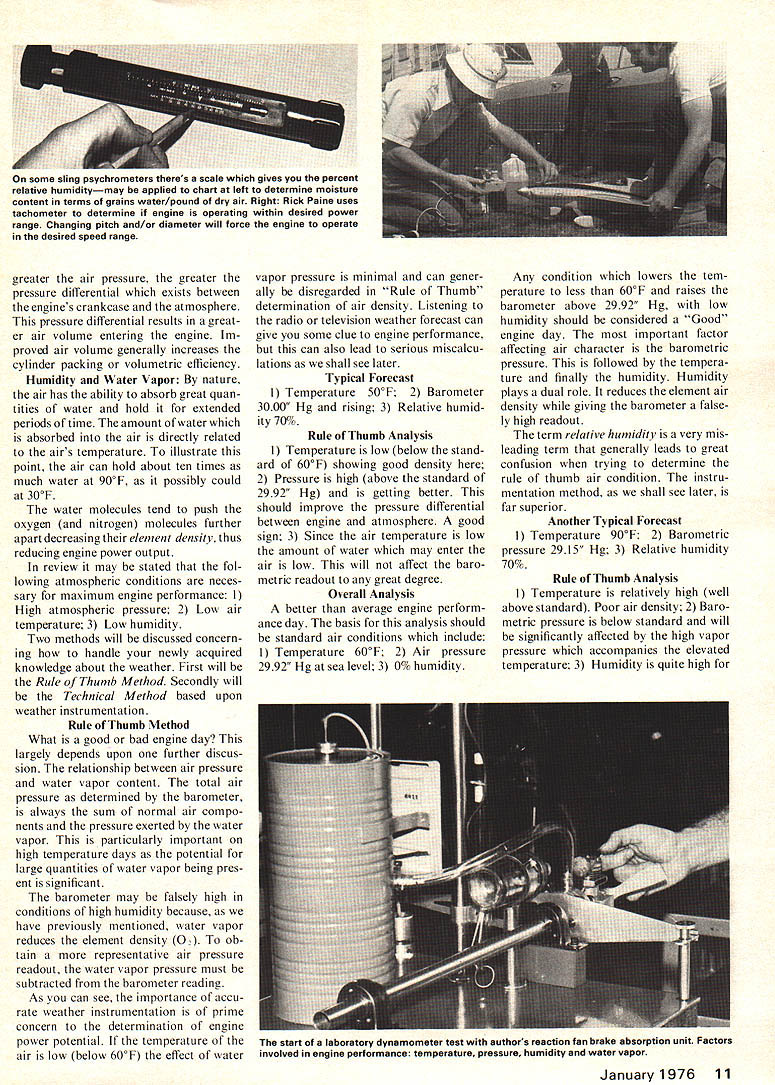
The best procedure is to make the engine run to the maximum of its capability for the existing conditions, at the proper rpm. This places the engine within its operational power band thus making the most of its power potential. Example: If it has been determined that a poor engine day exists and the engine rpm is down to 12,200 from its normal 12,900 the following procedure might be pursued:
- Increase the nitromethane content slightly, i.e. from 10 to 12%.
- Run the engine and observe the rpm. Sometimes the speed will increase and other times the engine will simply overheat.
- If overheating occurs, reduce the size of the load (prop). This is most easily accomplished by reducing the pitch; i.e. change from 11-3/4 to 11-7. The idea here is to force the engine to operate within its designed power range.
- Occasionally the combination of reduced load and increased nitromethane content will improve performance. In this case be sure to watch for overheating (a drop of raw fuel on the cylinder head should not smoke and burn away, but merely evaporate).
- Glo-plug heat range will sometimes make a difference when changing nitromethane contents; i.e. Using certain Fox plugs makes for a cylinder which removes the heat more quickly than certain K&B plugs. Similarly, all glo-plugs have individual heat ranges. Generally the thing to remember here is that with increased nitro content the cylinders must be cooled more effectively. The so called cool or cold plug removes the heat quicker. Conversely, the hot plug retains cylinder heat.
How to Check Plug Heat Range
- With the booster battery in place on the plug, check the engine rpm with the tachometer;
- Remove the booster battery and note the engine rpm.
Example #1: Plug hot rpm—12,500; Plug cool rpm—12,300; rpm drop—200.
Example #2: Plug hot rpm—12,500; Plug cool rpm—12,400; rpm drop—100. In the first case, the rpm drop indicated a cool or cold plug for that particular operation. This was determined because the combustion process deteriorated. The engine would normally operate with relatively low cylinder head temperatures in this condition.
In the second case the rpm reduction was less still, showing a cool plug but warmer than example #1. In other experiments you may find plugs which offer little or no rpm loss. This plug may be too hot for the conditions. The ideal situation in most cases is to find a plug which delivers a slight rpm drop when removing the booster but not more than 100 or so. If the rpm loss is too great the "fire" may go out, especially during the idle mode of operation.
The visual method of categorizing glo-plugs is to observe the relative thickness of the wire. Generally, larger wire diameters indicate colder plugs.
I must re-emphasize that no one procedure will probably work to restore lost engine power due to poor atmospheric conditions. Some power may be restored by carefully adjusting the compression ratio upward. In most cases other than racing this is just too impractical to be seriously considered. The most important consideration is to operate the engine within its designed speed range or power band.
In terms of power band it may be useful to consult Peter Chinn's torque and horsepower curves for your particular engine. In most cases the peak of the horsepower curve, or slightly beyond (on the rpm scale) is where this type of engine wants to operate.
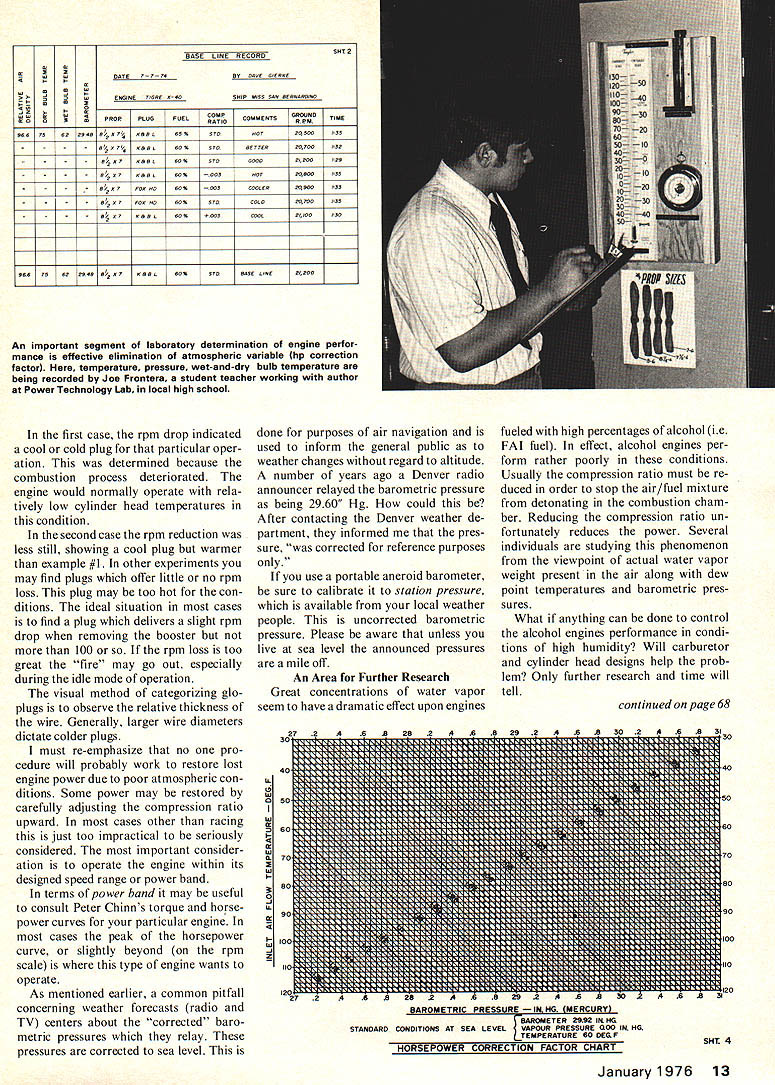
As mentioned earlier, a common pitfall concerning weather forecasts (radio and TV) centers about the "corrected" barometric pressures which they relay. These pressures are corrected to sea level. This is done for purposes of air navigation and is used to inform the general public as to weather changes without regard to altitude. A number of years ago a Denver radio announcer relayed the barometric pressure as being 29.60" Hg. How could this be? After contacting the Denver weather department, they informed me that the pressure, "was corrected for reference purposes only."
If you use a portable aneroid barometer, be sure to calibrate it to station pressure, which is available from your local weather people. This is uncorrected barometric pressure. Please be aware that unless you live at sea level the announced pressures are a mile off.
An Area For Further Research
Water concentrations of water vapor seem to have a dramatic effect upon engines fueled with high percentages of alcohol (i.e. FAI fuel). In effect alcohol engines perform rather poorly in these conditions. Usually the compression ratio must be reduced in order to stop the air/fuel mixture from detonating in the combustion chamber. Reducing the compression ratio unfortunately reduces the power. Several individuals are studying this phenomenon from the viewpoint of actual water vapor present in the air along with dew point temperatures and barometric pressures.
What if anything can be done to control the alcohol engines performance in conditions of high humidity? Will carburetor and cylinder head designs help the problem? Only further research and time will tell.
Because good or bad engine days a generalized appreciation of atmospheric conditions will help operate an engine efficiently. An understanding of how weather affects engine performance can lead to more efficient engine operation.
Over the years modelers have come to the conclusion the old reliable sport engine has gone over the hill. The deduction usually comes after varnish has removed, cylinder wall, piston, plugs changed, filters checked, screws tightened, needle valve assemblies examined — success bringing back lost power. Before sending the mill back to Clarence some freshening might well take stock of the elements present the day the engine goes sour: sky heavily overcast, temperature well into those promised summer storm moving into the area — deteriorating weather conditions and reduced air density could well cause a reduction in power and overheating. If we don't recognize the symptoms it's costing us. Everyone complains about weather; nobody ever does anything about it. To a certain degree that is a true statement. On the other hand, understanding how weather affects engine performance will lead to more efficient engine operation.
Small two-stroke cycle (semi-diesels excepted) and sophisticated air pumps require large quantities of air to develop the power useful mechanical energy needed by vehicles. Air or gas has the freedom to expand, contract and flow about the earth's surface. The same air contains the vital combustion element oxygen. Air is affected by a number of factors which either increase or decrease the availability of oxygen to an engine's cylinder. Individuals involved with high performance motor sports and serious laboratory experimentation emphasize the importance of air density — just how much can air density affect engine performance? Personally I have experienced engine power differences of 25% from one day to the next: an engine producing two horsepower on excellent days could reduce by much as 1/2 horsepower under poor conditions when oxygen is less available. Engines' consumption of fuel must be reduced in order to maintain proper air-to-fuel ratio. A reduction in the flow of fuel through the system for a given period of time must result in a reduction of power. Now we know air and its condition have a direct bearing upon engine performance.
Let's look at the specific factors which affect air density. First it should be explained that air density refers to weight per given volume. In other words high density atmospheric conditions means air molecules are packed tightly together and thus contain more oxygen per cubic foot.
Temperature As the temperature of a gas increases so does its molecular activity. Molecules of nitrogen (four parts) and oxygen (one part) move about with greater vibratory patterns and the effect is the molecules move further apart, reducing the density of the air and decreasing engine performance.
Pressure Refers to the force exerted by the weight of the atmosphere on a square inch of the earth's surface. The unit of measure is inches of mercury (in. Hg). Standard measure at sea level is 29.92 inches Hg, approximately 14.7 lbs per square inch, known as standard pressure. If you travel to a mile-high city like Denver, Colo., air pressure would be greatly reduced from standard pressure to about 24 inches Hg. Actually atmospheric pressure is reduced about 1 inch per 1,000 feet above sea level. At 10,000 feet significant power loss would be experienced. Air pressure forces air into the engine. The greater the air pressure the greater the pressure differential that exists between the engine's crankcase and the atmosphere. This pressure differential results in a greater air volume entering the engine. Improved air volume generally increases cylinder packing (volumetric efficiency).
Humidity Water vapor is a natural part of the air and it has the ability to absorb great quantities of water and hold it for extended periods of time. The amount of water absorbed by the air is directly related to the air's temperature. To illustrate the point: air can hold about ten times as much water at 90°F as it could at 30°F. Water molecules tend to push oxygen and nitrogen molecules further apart, decreasing the air's density and thus reducing engine power output.
In review we may state the following atmospheric conditions necessary for maximum engine performance:
- High atmospheric pressure
- Low air temperature
- Low humidity
Transcribed from original scans by AI. Minor OCR errors may remain.

