
The Electric Connection
You say free-flight sites are drying up? That you have to drive an hour to fly RC? You don't need a shrink. Be happy like this group—with their Old Timer .020 electric models.
While many modelers are building larger and larger models, some with 10- and 12-foot wingspans and powered with chainsaw engines, reduction drives, etc., there is a group of fliers in the Northeast headed in the opposite direction. Faced with the lack of suitable flying fields for free-flight activity, and in many cases the need to drive for up to an hour even to fly radio control, we are going electric.
Electric-powered aircraft offer numerous advantages, not the least of which is simple operation. All that is required to start the motor is to flip a switch or plug in a connector, much like turning on a light or switching on a radio. Unlike glow engines, there is no messy cleanup following a flying session; just turn off the switch and put the aircraft away. Another advantage of electric flight is the diminutive noise level, permitting operation out of the local school yard or ball field. This allows the modeler to fly more frequently, not having a lengthy drive to the club flying field. A quick flight or two after dinner is within the realm of possibility.
The primary disadvantage of electric power is the weight of the motor and battery, frequently several times that of an equivalent glow engine. Due to the additional weight, aircraft powered with an electric motor must be lightly constructed with sufficient wing area to reduce the wing loading to acceptable limits. Old Timer aircraft lend themselves ideally to these parameters. One of the first attempts to combine the electric flight system and Old Timer competition was by Joe Beshar, who at the time was president of SAM (Society of Antique Modelers). Using the Astro Flight .020 electric free-flight system and reduced-size .020 Old Timer aircraft designs, Joe devised a simple set of rules for electric Old Timer free-flight competition.
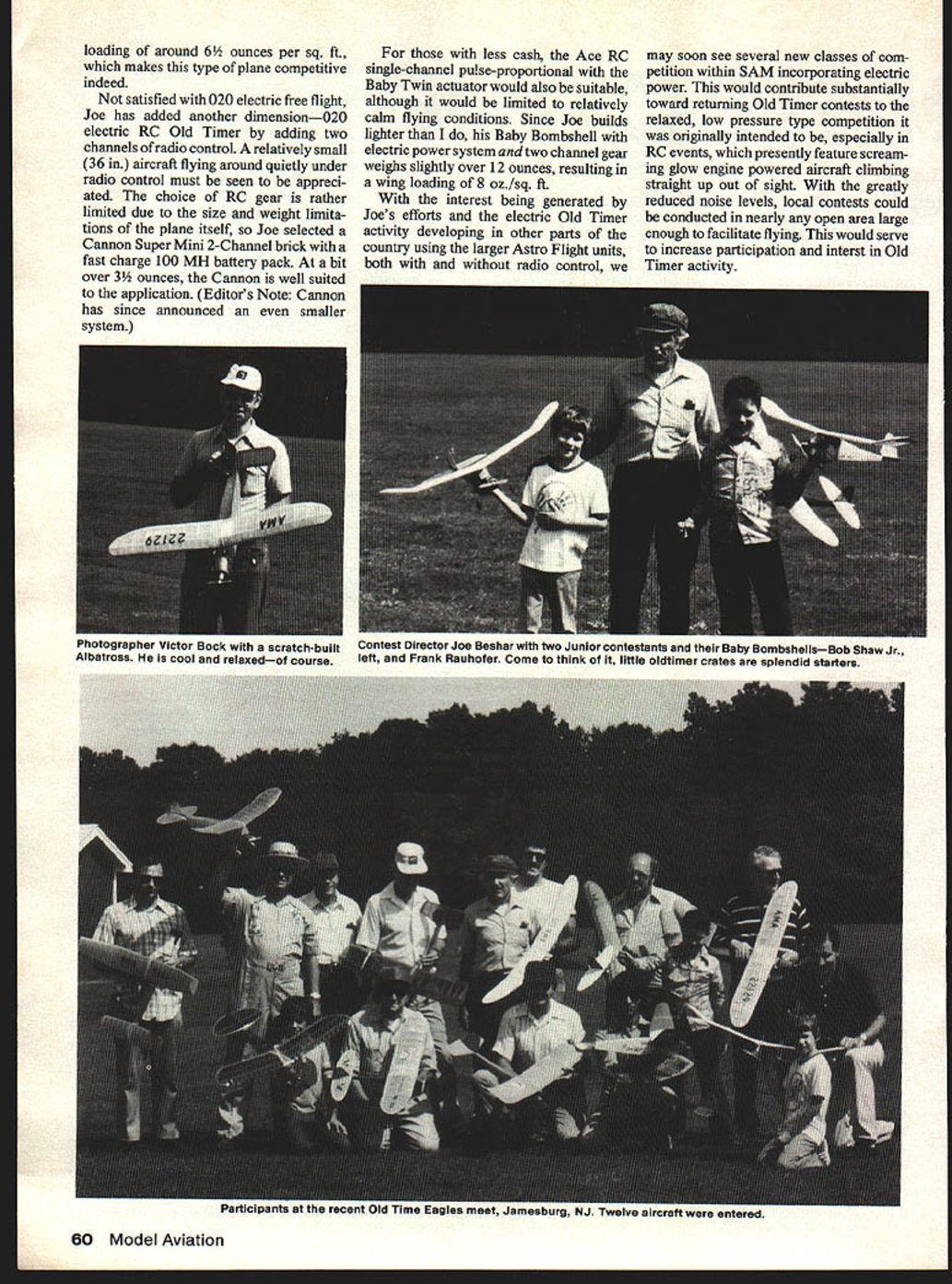
Originally devised in 1977, the rules were tested when Joe sponsored and conducted an event at Lakehurst in the summer of that year. Encouraged by the success of that meet, Joe, in cooperation with Astro Flight, has since conducted three additional contests, including the .020 electric free-flight event at the 1978 SAM Champs in which 16 contestants participated. A recent .020 electric event at the Old Timer Eagles Fly-In held at Thompson Park Model Airport drew a total of 12 entries, including two Juniors—not bad for a special event at a local contest.
Several factors contribute to the appeal of .020 electric. The aircraft themselves require a minimum investment of time and money. There are several .020 free-flight kits on the market, such as:
- Baby Bombshell by 4K Models of Torrance, California
- Playboy, Strato Streak, So Long, and Brooklyn Dodger kitted by J&R Models of Phoenix, Arizona
Numerous scratch-built designs have also been published in various model magazines over the past several years. Most of these aircraft are easily built and require only two to three evenings to complete. These small, light structures are not easily damaged, and should damage occur it is usually minor in nature and quickly repaired, making this an ideal manner for a beginner to get into free flight.
The .020 electric flight system, including motor, battery pack, and switch assembly, is available from Astro Flight, 13377 Beach Avenue, Venice, CA 90291. Astro Flight offers several other electric flight systems which are capable of powering aircraft with up to a 7-foot wingspan when used with their belt-driven speed reducer. For the purpose of this article we will deal with the smallest, lightest, and least expensive system offered. The .020 free-flight system, including motor and battery pack, weighs slightly more than 4 ounces.
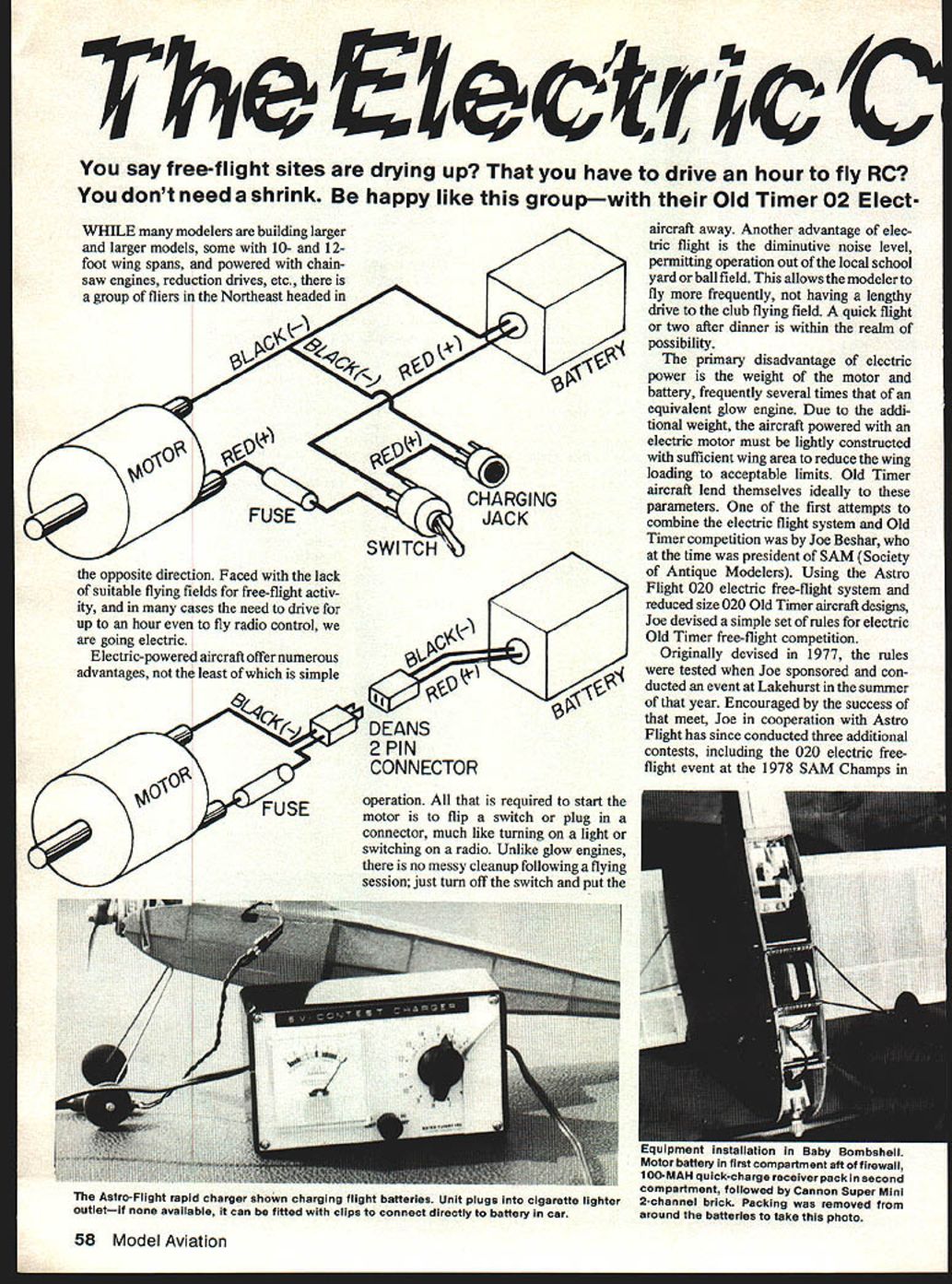
Although the additional weight of the switch, harness, and charging jack would be inconsequential with the larger motors, the extra 3/4 ounce is best eliminated when using the .020-size unit, substituting instead a two-pin Deans connector, available from most well-stocked hobby shops or from Ace R/C, P.O. Box 511, Higginsville, MO 64037 (part number 19K53-C2). Turning the unit on or off is accomplished by plugging or unplugging the connectors. Insure the female portion is wired to the battery if you plan to participate in any of Joe's contests since his contest charger is wired that way.
As shown in the sketch, it is advisable to install a 7-1/2 amp glass automotive-type fuse in the hot side of the battery lead, using the lightest-weight fuse holder available. The fuse is necessary to prevent excess current draw from burning out the motor in the event the aircraft noses into the ground, stopping the propeller before the battery runs down.
In addition to the flight system, a suitable battery charger is necessary to charge the battery at the flying field. The Astro Flight Rapid Charger satisfies the requirement nicely and incorporates a built-in ammeter and timer to terminate the charge when the charge cycle is completed. The unit operates off the automobile cigarette lighter outlet, if available, or off a 12-volt gel cell, using alligator clips, if a car is not available. With a full charge (15 minutes) the flight system will provide close to 90 seconds running time, enough to fly the free-flight aircraft out of sight.
One advantage of electric power is the fact the duration of the motor run can be determined by the length of time the battery is charged, eliminating the need for a motor shut-off timer. For competition purposes, Joe charges the battery for two minutes, which results in a motor run of 25–30 seconds. I would suggest starting with a one-minute charge and working up from there as the aircraft is trimmed out. Unlike a glow engine which runs at nearly constant speed from the time the aircraft is launched until the engine is either shut off or runs out of fuel, the electric-powered plane performs almost as though it were rubber powered, with an initial burst of power followed by a gradual reduction in speed and power as the battery runs down. Flight adjustments are made exactly as one would adjust a rubber-powered ship: hand-glide without power to achieve a reasonably flat glide with a gradual turn, and then gently apply power by short charging the battery while making the necessary thrust adjustments.
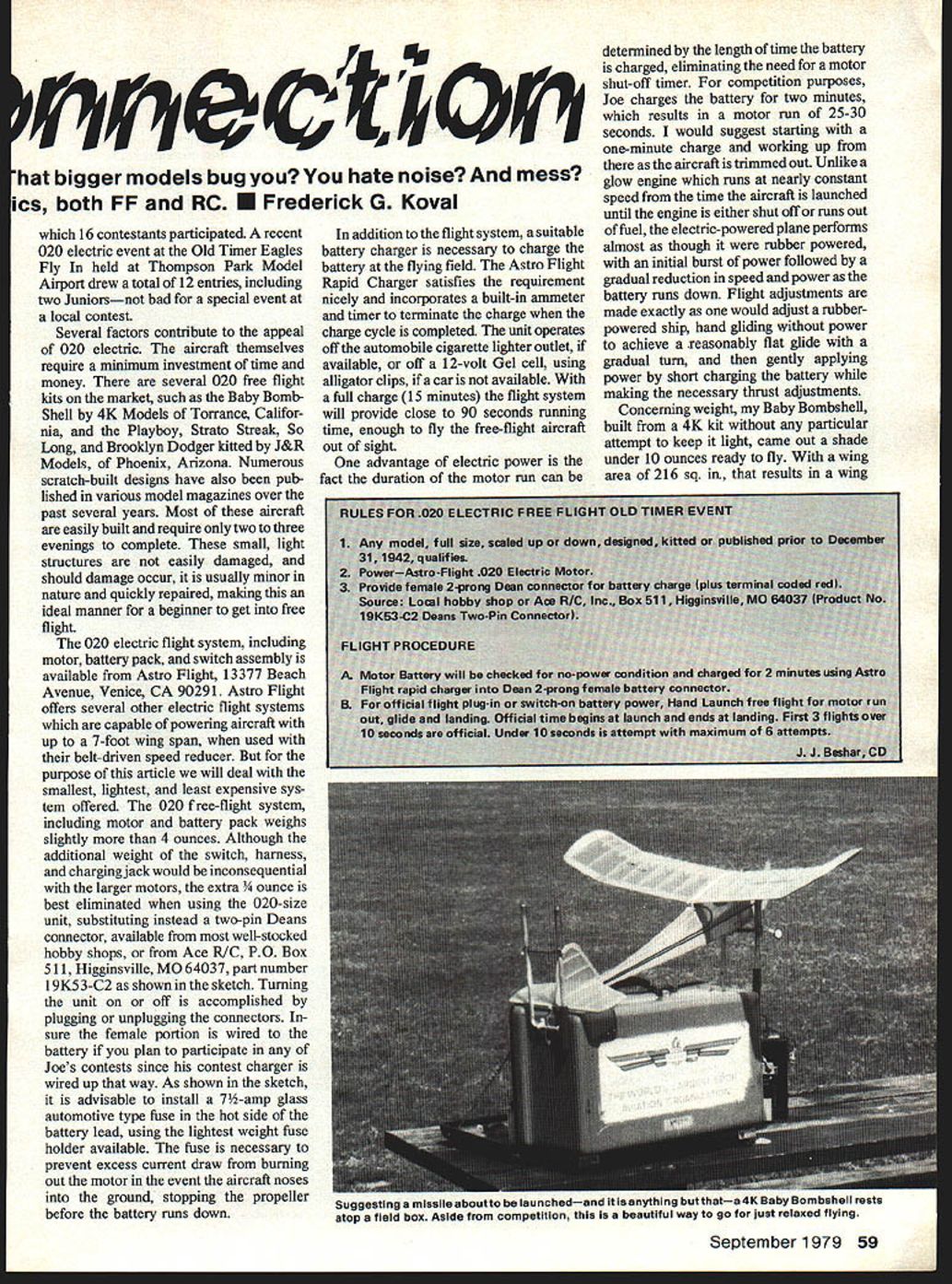
Concerning weight, my Baby Bombshell, built from a 4K kit without any particular attempt to keep it light, came out a shade under 10 ounces ready to fly. With a wing area of 216 sq. in., that results in a wing loading of about 6.6 oz. per sq. ft.
RULES FOR .020 ELECTRIC FREE FLIGHT OLD TIMER EVENT
- Any model, full size, scaled up or down, designed, kitted or published prior to December 31, 1942, qualifies.
- Power—Astro Flight .020 electric motor.
- Provide female 2-prong Deans connector for battery charge (positive terminal coded red). Source: local hobby shop or Ace R/C, P.O. Box 511, Higginsville, MO 64037 (Product No. 19K53-C2, Deans Two-Pin Connector).
FLIGHT PROCEDURE
A. Motor battery will be checked for no-power condition and charged for 2 minutes using the Astro Flight Rapid Charger into the Deans 2-prong female battery connector.
B. For official flight, plug in or switch on battery power. Hand-launch for motor run out, glide and landing. Official time begins at launch and ends at landing. First 3 flights over 10 seconds are official. Flights under 10 seconds are attempts, with a maximum of 6 attempts.
J. J. Beshar, CD
Not satisfied with .020 electric free flight, Joe has added another dimension—.020 electric RC Old Timer—by adding two channels of radio control. A relatively small (36 in.) aircraft flying around quietly under radio control must be seen to be appreciated. The choice of RC gear is rather limited due to the size and weight limitations of the plane itself, so Joe selected a Cannon Super Mini 2-channel "brick" with a fast-charge 100 mAh battery pack. At a bit over 3½ ounces, the Cannon is well suited to the application. (Editor's note: Cannon has since announced an even smaller system.)
For those with less cash, the Ace R/C single-channel pulse-proportional with the Baby Twin actuator would also be suitable, although it would be limited to relatively calm flying conditions. Since Joe builds lighter than I do, his Baby Bombshell with electric power system and two-channel gear weighs slightly over 12 ounces, resulting in a wing loading of 8 oz./sq. ft.
With the interest being generated by Joe's efforts and the electric Old Timer activity developing in other parts of the country using the larger Astro Flight units, both with and without radio control, we may soon see several new classes of competition within SAM incorporating electric power. This would contribute substantially toward returning Old Timer contests to the relaxed, low-pressure type competition they were originally intended to be, especially in RC events which presently feature screaming glow engine–powered aircraft climbing straight up out of sight. With the greatly reduced noise levels, local contests could be conducted in nearly any open area large enough to facilitate flying. This would serve to increase participation and interest in Old Timer activity.
Transcribed from original scans by AI. Minor OCR errors may remain.

