
ELECTRIC CONVERSION
Randy Smithhiller
Introduction
Electric power is used in every type of model—world-class gliders, high-performance Pylon racers, and majestic Old-Timers. But perhaps the real niche for electric is in large scale models.
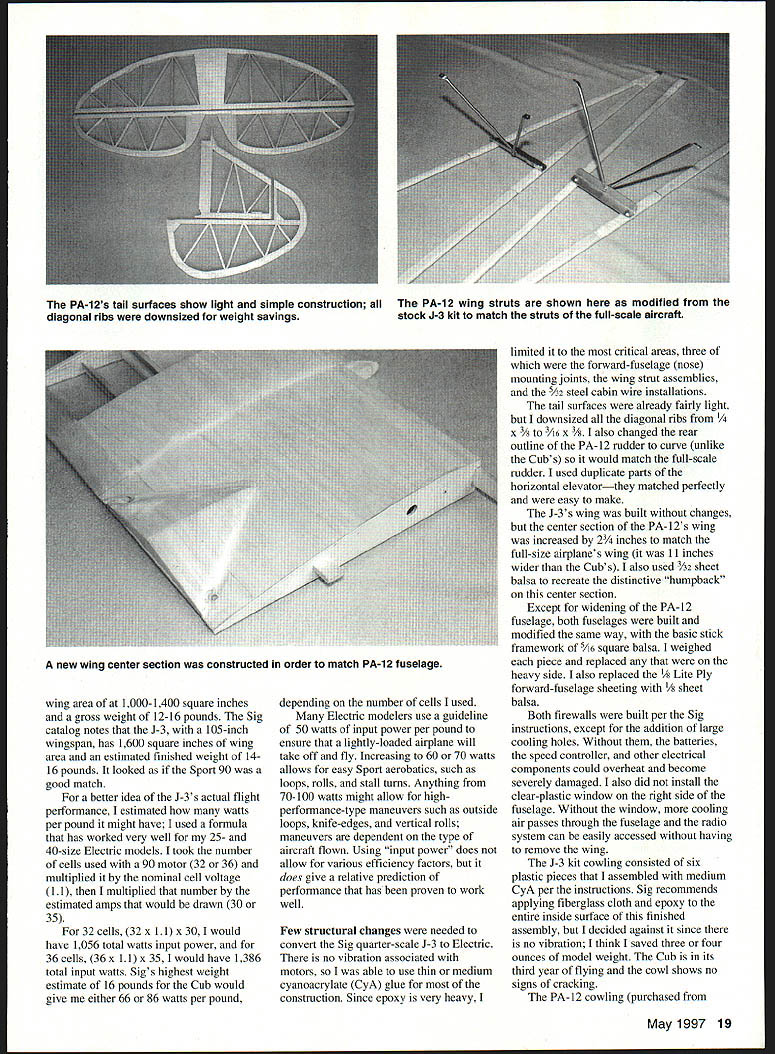
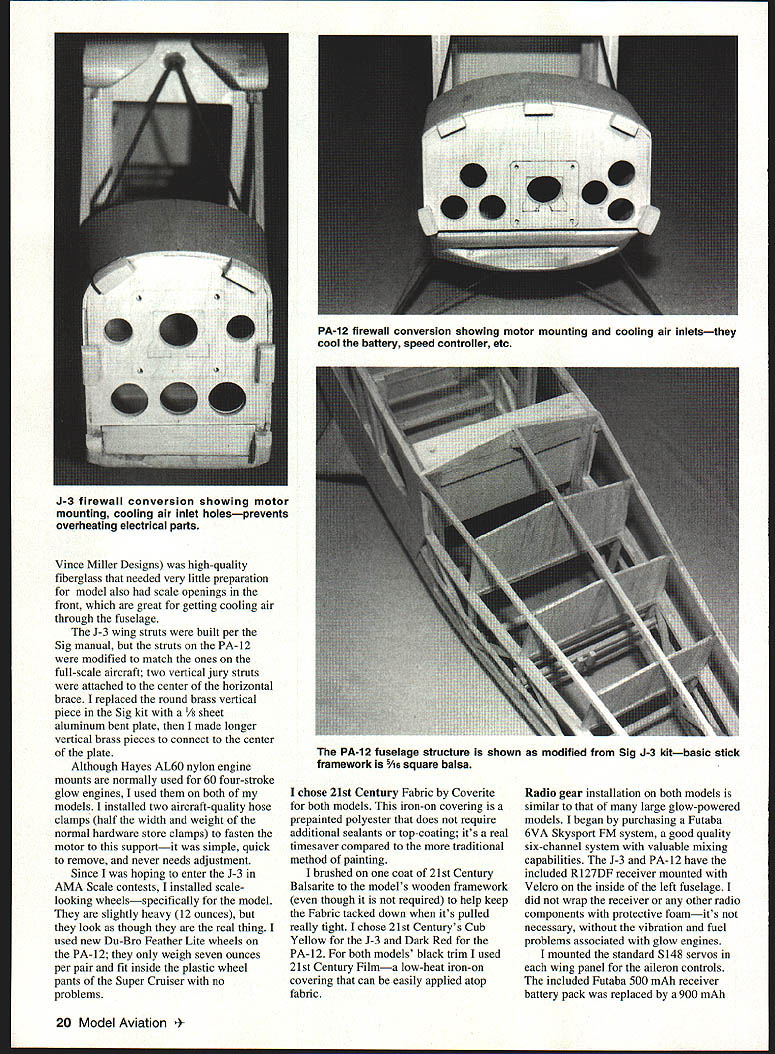
Over the past three years I built and competed with two 1/4-scale models using AstroFlight electric motors. The first was a converted Sig Piper J-3 Cub fitted with a direct-drive AstroFlight Cobalt 90 Sport motor. I liked it so much that I built a second similar airplane: a Sig J-3 kit converted into a Piper PA-12 Super Cruiser powered by an AstroFlight 90 with one of Astro's helical gearboxes.
Choosing a kit
Choosing a kit to convert from glow to electric was probably the hardest part of the project. Kits designed specifically for large-scale electrics are rare, but a few glow kits adapt well when converted to "clean power." The Sig 1/4-scale J-3 fits many design requirements for a good electric: it relies on good engineering rather than heavy structure and uses balsa instead of unnecessary amounts of Lite Ply. That careful material selection keeps the finished weight down.
Motor sizing and expected performance
Matching motor size to the J-3 was straightforward. AstroFlight recommended the 90 Sport for models with a wing area of 1,000–1,400 sq in and a gross weight of 12–16 lb. The Sig J-3 (105 in span) has about 1,600 sq in of wing area and an estimated finished weight of 14–16 lb, so the Sport 90 was a good candidate.
To estimate flight performance I used a watts-per-pound formula that has worked well for 25- and 40-size electrics:
- Total input watts = (number of cells) × (nominal cell voltage 1.1 V) × (estimated motor amps)
Examples:
- 32 cells: 32 × 1.1 × 30 = 1,056 W input
- 36 cells: 36 × 1.1 × 35 = 1,386 W input
Using Sig's high weight estimate of 16 lb, that gives about 66 W/lb (32 cells) or 86 W/lb (36 cells). General guidelines:
- ~50 W/lb: ensures a lightly loaded airplane will take off and fly
- 60–70 W/lb: allows easy sport aerobatics (loops, rolls, stall turns)
- 70–100 W/lb: supports higher-performance maneuvers (outside loops, knife-edges, vertical rolls)
Using input power allows for various efficiency factors while giving a good relative prediction of performance.
Structural changes and adhesives
Few structural changes were needed to convert the Sig quarter-scale J-3 to electric. With no engine vibration, I could use thin and medium cyanoacrylate (CyA) glue for most construction and limited epoxy (because it is heavy) to only the most critical areas:
- the three forward-fuselage (nose) mounting joints
- the wing strut assemblies
- the 5/32-inch steel cabin-wire installations
Tail surfaces were already fairly light; I downsized all diagonal ribs from 1/4 × 3/16 to 3/32 × 3/16. I also changed the PA-12 rudder rear outline to a curved shape to match the full-scale rudder and used duplicate parts for the horizontal elevator—those matched perfectly and were easy to make.
Wings and fuselage modifications
- The J-3 wing was built essentially per the kit.
- The PA-12 center section was increased by 2-3/4 inches to match the full-size airplane (the PA-12 wing is 11 inches wider than the Cub's). I used 3/32-inch sheet balsa to recreate the distinctive "humpback" of the center section.
Except for widening the PA-12 fuselage, both fuselages were built and modified the same way using a basic stick framework of 5/16-inch square balsa. I weighed each piece and replaced any that were heavy. I replaced the 1/8-inch Lite Ply forward-fuselage sheeting with 3/32-inch sheet balsa.
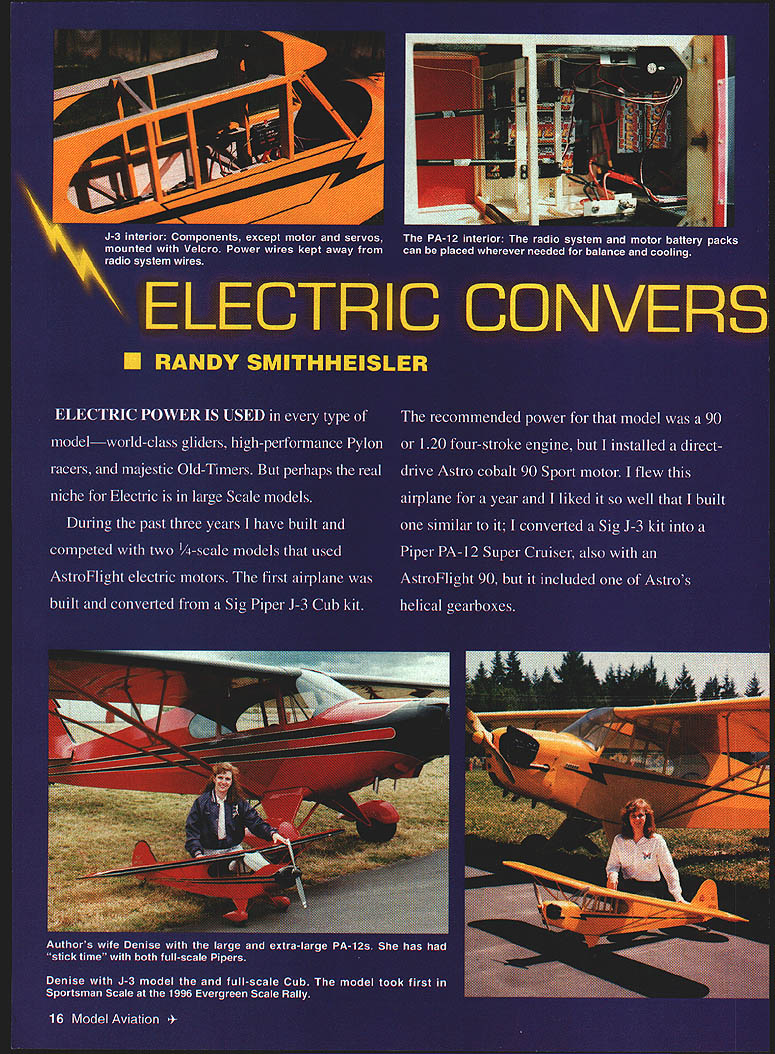
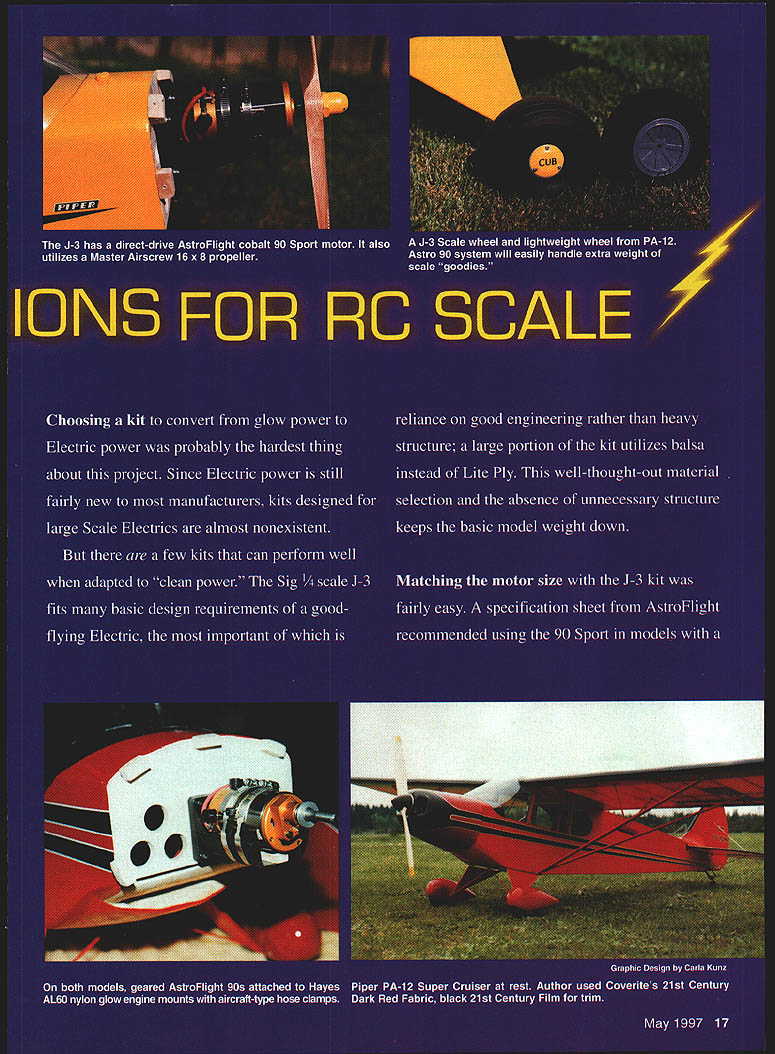
Both firewalls were built per Sig instructions but with large cooling holes added. Without good airflow the batteries, speed controller, and other electrical components could overheat. I did not install the clear-plastic window on the right side of the fuselage — without that window more cooling air passes through and the radio system is more easily accessed without removing the wing.
Cowling and struts
- The J-3 cowling consisted of six plastic pieces assembled with medium CyA. Although Sig recommends applying fiberglass cloth and epoxy to the inside surface, I omitted that step (no vibration) and saved three to four ounces of weight. After three years of flying the Cub's cowl showed no cracking.
- The PA-12 cowl (Vince Miller Designs) is a high-quality fiberglass piece with scale openings to feed cooling air through the fuselage.
Wing struts:
- J-3 struts were built per the Sig manual.
- PA-12 struts were modified to match the full-scale airplane. Two vertical jury struts attached to the center horizontal brace were replaced by 5/32-inch round brass vertical pieces. The kit's aluminum center plate was lengthened so the brass pieces could connect to it.
Engine mounts and wheels
Although Hayes AL60 nylon engine mounts (normally for 60 four-stroke engines) were used on both models, I fastened the motor support with two aircraft-quality hose clamps (half-width of normal hardware-store clamps). The method is simple, quick to remove, and requires no adjustment.
For scale contests I installed scale-looking wheels. The stock wheels were slightly heavy (~12 oz) and didn't look quite right, so I used new Du-Bro Feather-Lite wheels. The PA-12 wheels weigh about seven ounces per pair and fit inside the plastic wheel pants without problems.
Covering and finish
I used 21st Century Fabric by Coverite for both models. This iron-on, prepainted polyester does not require sealants or top-coating—it's a real timesaver compared to traditional painting. I brushed on one coat of 21st Century Balsarite to help hold the fabric when pulled tight. Colors: Cub Yellow for the J-3 and Dark Red for the PA-12. Black trim was done with 21st Century Film (a low-heat iron-on applied atop the fabric).
Radio gear and servos
Radio installation is similar to many large glow-powered models:
- System: Futaba 6YAX Skysport FM six-channel with mixing.
- Receiver: R127DF mounted with Velcro on the inside left fuselage. No foam wrapping—no vibration or fuel issues.
- Ailerons: standard Futaba S148 servos mounted on each wing panel.
- Receiver battery: replaced the stock 500 mAh Futaba pack with a 900 mAh SR Batteries pack (virtually same weight, almost twice the capacity).
- Rudder and elevator: Futaba S9202 coreless servos (virtually same weight as S148 but deliver 69 oz of torque vs. 42 oz).
- Throttle: AstroFlight high-rate electronic speed controllers — model 207 in the J-3 and model 204 in the PA-12. Each handles up to 36 cells and 50 amps. Controllers mounted with Velcro.
Electrical harness and batteries
Two items unique to electrics were installed:
- Main wiring harness: 13-gauge wiring to connect motor, battery, speed controller, charging jack, etc. I added two safety items in each harness:
- a master on/off switch
- a 40-amp automotive fuse
- Rechargeable Ni-Cd motor battery packs: Sanyo SCR C 1,700 mAh cells arranged in six- and seven-cell packs, wired together in series (using Sermo connectors) to achieve 32 cells for the J-3 and 35 cells for the PA-12. Packs were secured with Velcro to the fuselage bottoms.
Using separate packs instead of a single hardwired pack made balancing the model easier.
Weights and predicted performance
Both models were electronically weighed before first flights:
- Cub (J-3): 17 lb — estimated wing loading ~24.5 oz/sq ft, ~62 W/lb
- Super Cruiser (PA-12): 19 lb 2 oz — wing loading ~27 oz/sq ft, ~68 W/lb
These numbers matched well with actual flight performance.
Flight testing and contests
I asked electric-power pioneer Bob Benjamin to make checkout flights. Bob had been the first to install and test-fly the prototype AstroFlight 90 motor.
- J-3: We were surprised at how well it performed. Bob had it lifting off at half-throttle and doing a complete ten-maneuver scale routine by the third flight.
- PA-12: Even better. The geared motor allowed the PA-12 to loop from level flight and perform smooth, scale-like rolls with ease. Climb rate was noticeably better than the direct-drive J-3. The AstroFlight gearbox turning a large 20 × 10 prop produced a remarkably deep, realistic scale-like sound.
We entered both models in the 1996 Evergreen Scale Rally at Hubbard, Oregon (a qualifying event for the US Scale Masters Final). I entered the J-3 in AMA S1 Sportsman Scale and Bob and I entered the PA-12 in Expert Team Scale. After a few nervous flights:
- The J-3 took first place in Sportsman Scale.
- The PA-12 placed second in Expert Team Scale.
Conclusion
I expect electric power in large scale models to continue growing. The advantages—no messy glow fuel to clean from detailed surfaces, super-reliable starting, quiet operation, and consistent performance—make electrics very attractive. Consider electric power for your next dream scale model and enjoy flying cleanly and quietly.
Randy Smithhiller 1703 105th Ave. Ct. E Edgewood, WA 98372
Transcribed from original scans by AI. Minor OCR errors may remain.

