
Electric Endurance Trends
By Ken Cashion
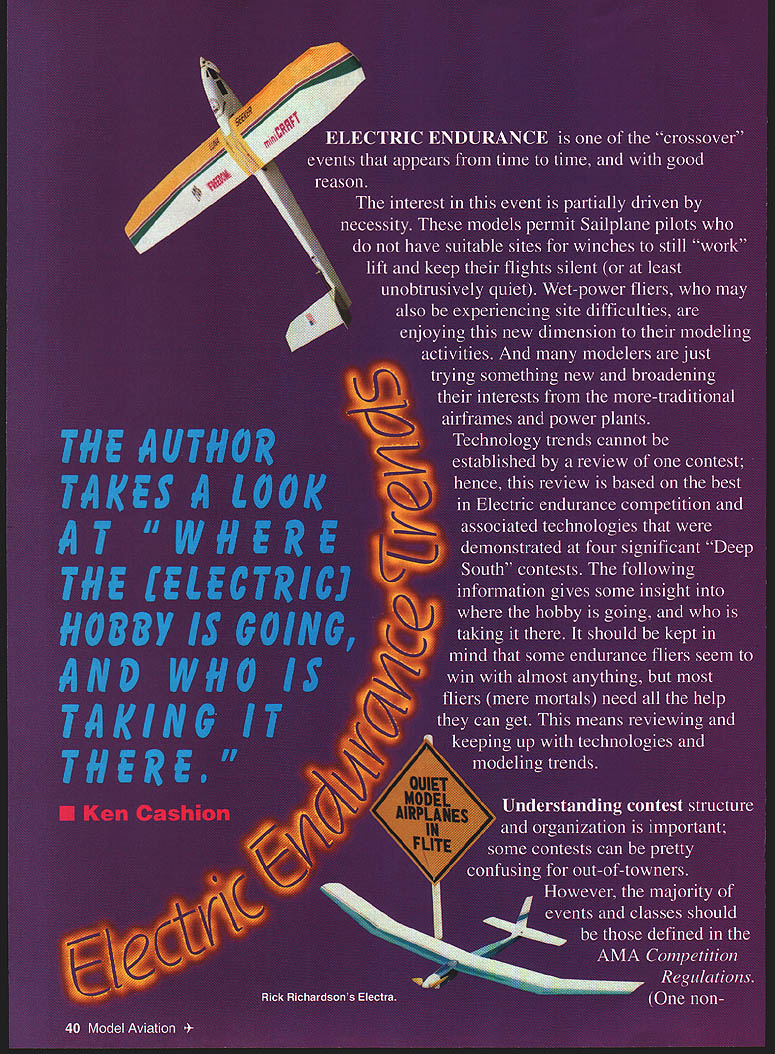
Electric endurance is one of the "crossover" events that appears from time to time — and with good reason. Interest in this event is driven partly by necessity: sailplane pilots without suitable winch sites can still work lift and keep flights quiet. Wet-power fliers facing site difficulties are enjoying a new dimension to their modeling activities, and many modelers are simply broadening their interests beyond traditional airframes and power plants.
This review is based on the best in electric endurance competition and associated technologies demonstrated at four significant "Deep South" contests. Technology trends cannot be established from a single contest, so the following summarizes patterns and who is leading the way. Remember that flier skill, model, motor, prop, and battery all combine to determine results.
Contest Structure and Classes
Understanding contest structure is important; some contests can be confusing for out-of-towners. However, most events and classes follow the AMA Competition Regulations. One non-regulation event worth special mention is All-Up-Last-Down (AULD).
The more popular AMA electric endurance events have been:
- Class A Sailplane (LMR and BA variants)
- Class B Sailplane (LMR and BA variants)
- Class A Old Timer (primarily LMR)
- AULD (open, efficiency-based)
At the contests covered here there were 17 electric endurance events and two sport-scale events. Breakdown:
- Class A Sailplane: four LMR, two BA
- Class B Sailplane: two LMR, two BA
- Old Timer events: primarily LMR
- AULD: four events, largely Class B-type entries
In LMR (Limited Motor Run) and BA (Battery Allotment) events, optimizing different components is required. LMR emphasizes motor-run control and motor performance; BA emphasizes total battery-management efficiency.
Models and Kits
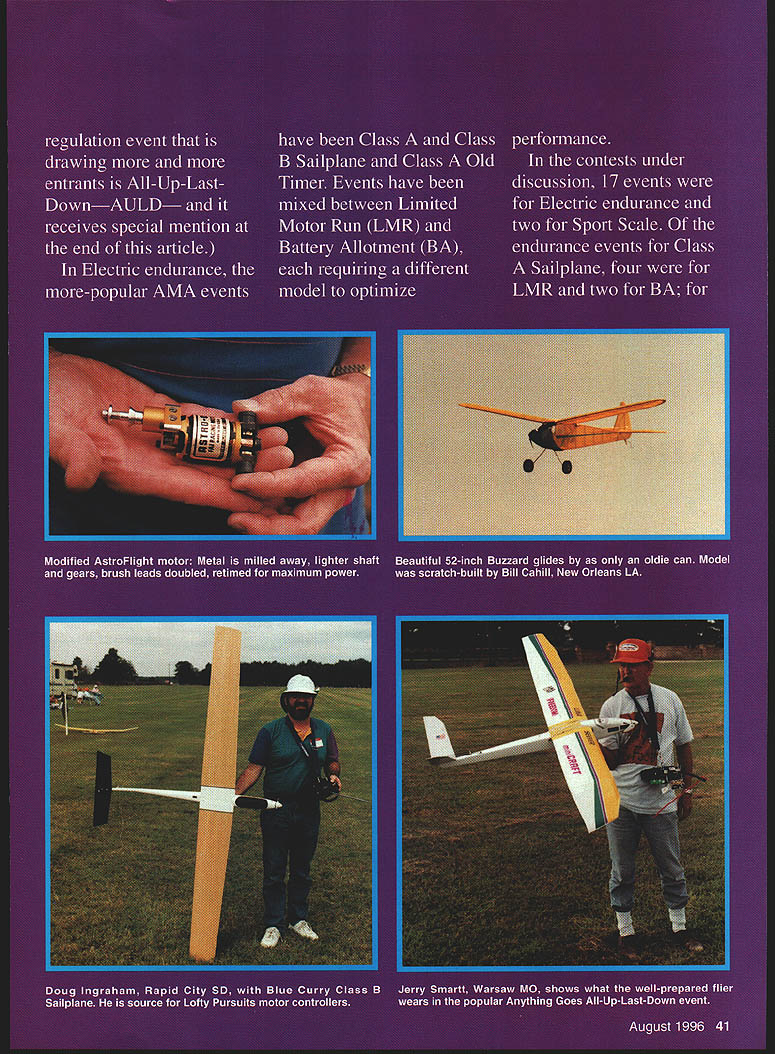
No single design dominates; there is no guaranteed winning kit. Success is a mixture of flier skill, model, motor, props, and batteries. However, several kits are consistently competitive:
- Electra
- Challenger
- Lanzo Bomber
- Playboy (cabin Playboy noted for contest success)
- Viking
Examples:
- An Electra finished third in a 19-plane Class A event, then with two additional 1700 mAh cells won a 16-plane Class B event (geared AstroFlight FAI .05, 12x7 prop).
- Old Timer winners include NATS champs flying cabin Playboys, Lanzo Bombers, and Vikings.
ARF (Almost-Ready-to-Fly) models continue to appear and be competitive. Scratch-built models are entered occasionally — for example, a 72-inch Cumulus Old Timer has been flown successfully — but the bulk of winners remain well-tried kits that are easy to build and trim.
Modifications and Repairs
Many fliers modify kits for desired characteristics or out of necessity after damage. Typical modifications seen:
- Replacement or re-sheeting of wing panels (e.g., thin balsa sheeting over top surfaces)
- Different airfoils or polyhedral wing changes
- V-tails or flattened center sections
- Relocating servos aft with servo tops protruding above the fuselage
- Upgrading motors and gearing
Modifying motors, gearheads, and frames for weight reduction and cooling is common among serious competitors.
Notable Contest Winners and Designs
Two original designs placed first and second in a major contest:
- First: George Parks (Austin, TX) — 39 oz, 80 in span, #4 model, five-turn non-geared AstroFlight FAI .05 turning a 7x6 prop.
- Second: Gary Warner (Richardson, TX) — Ohm-Mega; 82 in hybrid wing (vacuum-bagged obechi over foam to the high point, balsa aft), about 650 sq in, 35 oz, non-geared AstroFlight FAI .05 modified by New Creations R/C turning an 8x6 prop.
Motors and Motor Technology
Motor choices are increasing — including rare-earth magnet motors — but AstroFlight samarium-cobalt (often called "cobalt") motors remain very popular with serious endurance fliers. Key trends and practices:
- New Creations R/C offers full-service modification of AstroFlight motors (milling weight from frames/gearheads, lighter gears/shafts).
- Modifications commonly include five-turn armatures, parallel braids to brushes, and timing for maximum power.
- In LMR events, modified .05 cobalt motors are common; currents moved from 35–50 A up to 60 A and beyond, with some drawing 70+ A. Higher currents require increased motor cooling and removal of metal for airflow.
- Ferrite "can" motors (unmodified ferrite direct-drive, no gears) still perform well in certain sanctioned events and can outnumber cobalt motors in specific classes.
- Gearheads and combinations (e.g., Leisure drive units, Graupner, Master Airscrew drives) are popular with ferrite and geared systems.
Controllers and Switching
Electronic motor controllers are becoming necessary rather than optional in endurance contests:
- Slightly more than half of models used electronic motor control; the remainder used mechanical switches (microswitches or microrelays).
- Electronic controllers are especially important for long contest trails and precise motor-run management.
- In events where rare-earth and ferrite motors have the same LMR, few will choose ferrite motors; in unlimited-run BA and AULD events, ferrite options regain appeal.
Props
Prop choice is critical and often tested on the workbench. Common prop brands and usage:
- Sonic-Tronics: ~30% of props observed
- Master Airscrew: ~15%
- Others: Freudenthaler/Aeronaut, Graupner, Zinger, Rev-Up, and more
Bench testing with a voltmeter, current meter, simple test rig, and thrust scale yields useful optimization data.
Batteries
Cell choices vary; there is no single standard:
- Most commonly used: 1,000 mAh cells (small majority)
- Other common sizes: 900 mAh and 1,500 mAh, roughly evenly divided
- Larger cells (e.g., 1,700 mAh) are often used in AULD and multi-pack switching schemes
Battery strategy depends on event rules (BA vs. LMR) and model/system optimization.
AULD (All-Up-Last-Down)
AULD is an efficiency contest with looser rules and broad entry. Key points:
- It rewards ingenuity, gearing, props, motor choices, and switching more than specific airframes or battery count.
- A mass launch is typical and entertaining; the event is often flown last and can demand endurance from flier, spotter, and model.
- Strategy, smooth flying, and efficient use of total amperage available determine winners.
Example: Sophisticated Pack Switching
One major contest winner, John McCullough (Raleigh, NC), used an elaborate internal switching system:
- Leisure .05 Texaco ball-bearing motor with 1:3.8 gearhead
- Model carried twelve 1,700 mAh cells
- Internal switching allowed climbing on two six-cell packs in parallel (3,400 mAh) and cruising on four three-cell packs in parallel (6,800 mAh)
- Achieved flights of up to two hours in dead air
This demonstrates how switching, pack arrangement, and system design can yield long duration flights.
Practical Recommendations (Summary)
For neophyte contest fliers and entry-level competitive setups:
- Sport/BA recommendation:
- Goldberg Electra airframe
- Master Airscrew power system with ~1:3 gear ratio
- Six-cell, 1,500 mAh battery pack
- Servo microswitch (sufficient for sport and some BA contests)
- This combination provides many hours of relaxed-but-serious sport flying and can be competitive in BA.
- LMR/competition recommendation:
- Electra or Challenger airframe
- Geared AstroFlight FAI .05 (common with five- or six-turn armatures) with ~1:3 gear ratio
- Folding prop around 7.5 in (example: 1:3 x 7.5 folding prop)
- Seven 1-amp (1,000 mAh) cells
- Electronic motor controller preferred for contest reliability
- This represents a competitive entry-level LMR combination; many variations are possible and seen in top contests.
Final note: trends continue to evolve — motor modification, cooling, prop testing, switching schemes, and battery choices all matter. Competitors who keep up with technology and practice astute flying and strategy will be most successful.
Transcribed from original scans by AI. Minor OCR errors may remain.

