

Electric Flying High and Wet
On vacation our author found himself thinking about how great it would be to fly a model from the placid lake into the brilliant blue sky. Back home he put the hardware together, and his next vacation saw the fantasy come to life. — Stephen M. Brahm
Background
Three years ago Mitch Poling's article on electric floatplanes sparked an idea that came to fruition during our subsequent vacation at Big Bear Lake, California. The following passages were written at that time.
At the moment I'm looking out from our room at an azure-blue lake, fringed with green pines and topped by a brilliant-blue sky, all at 6,700 ft.
Could an electric floatplane perform at over a mile above sea level? Success or failure? Before I tell you that, let me lay the groundwork. During our first vacation one year ago, I recognized that the beach of the small peninsula where we stay would be perfect for floatplane activities. The gentle sloping shoreline for easy launch and recovery was clear of obstacles to the left and right, ahead, and 30 yards inland.
In my mind's eye I could envision every detail: an RC floatplane gathering speed in the early-morning calm, spray from the floats sparkling in the first rays of sun, the model breaking free and climbing into that cobalt-blue sky. My heart yearned to bring the fantasy to life; but how? Piston power had to be ruled out due to noise, and until I read the floatplane articles the dream was fed only by the pictures in my mind. Then, Eureka... it could be done!
After reading everything I could find on the subject, I decided that a wing loading of 12 oz per sq. ft. would be necessary to fly.
Design and Modifications
I modified a Goldberg Eaglet 50 for the job and made the following changes and choices:
- Replaced the plywood fuselage nose and cabin area with 1/8-in sheet balsa.
- Used 1/8-in balsa square-stock framing aft to the trailing edge.
- Retained the basic wing plan but replaced the single 1/8-in square spar with forward and aft spars of 3/8 x 1/8-in spruce.
- Increased wingspan to 66 in: a flat 24-in center section and two 21-in outboard sections with 90° dihedral.
- Strengthened the forward-and-aft center-section spars with stress webs.
- Holed the first nine outboard forward-spar ribs with 1/16-in copper tubing in four holes along the trailing edge for weight savings.
- Used transparent blue MonoKote over the holes and formed balsa leading-edge stock instead of the 1/8-in round dowel called for in the plans.
Altogether this netted a weight savings of 2 oz. Despite the rather large 67-in span and 640-sq-in area, the finished wing weighed a surprisingly light 9 oz and was strong.
Power and radio gear:
- Geared Cobalt Astro 15 motor.
- Two six-cell 800 mAh packs.
- 11 x 8 Top Flite prop.
- Channel controls: motor on/off switch, elevator, and rudder.
- Two mini servos for elevator and rudder; a standard-size receiver powered by a 250 mAh pack.
Float gear:
- Two 26-in floats patterned after Mitch Poling's design using two 1/8-in unbraced piano-wire struts.
- Floats covered with MonoKote; seams sealed with hot paraffin wax.
- Total weight of floats: 6 oz.
- Total model weight: 53 oz.
I also changed the incidence: the wing stabilizer was angled 2° down relative to the wing. I had no idea how it would trim out.
Maiden Flights at Big Bear Lake
Finally, paperwork and excuses ran out and it was time to fly the lake. As a newcomer to electric flight, I felt though I had forgotten something as I headed out to the water's edge with the plane and transmitter in hand. I began the checklist: radio check nominal, flight controls nominal, power on/off control nominal. The last thing left to check was whether it would fly.
The lakeshore breeze played on my face and the early sun warmed my back as the aircraft sat silently under the shadow of its wings, gently dipping from the slight swell. Filled with excitement and apprehension, feelings echoed those of a pilot before a maiden voyage. Whether a full-size or model plane, the tremor of uncertainty seizes the flier as he sends his craft skyward. "Will it perform?" he asks himself. In my imagination I saw a brief flurry of spray followed by... a sardonic, "Well, back to the drawing board!"
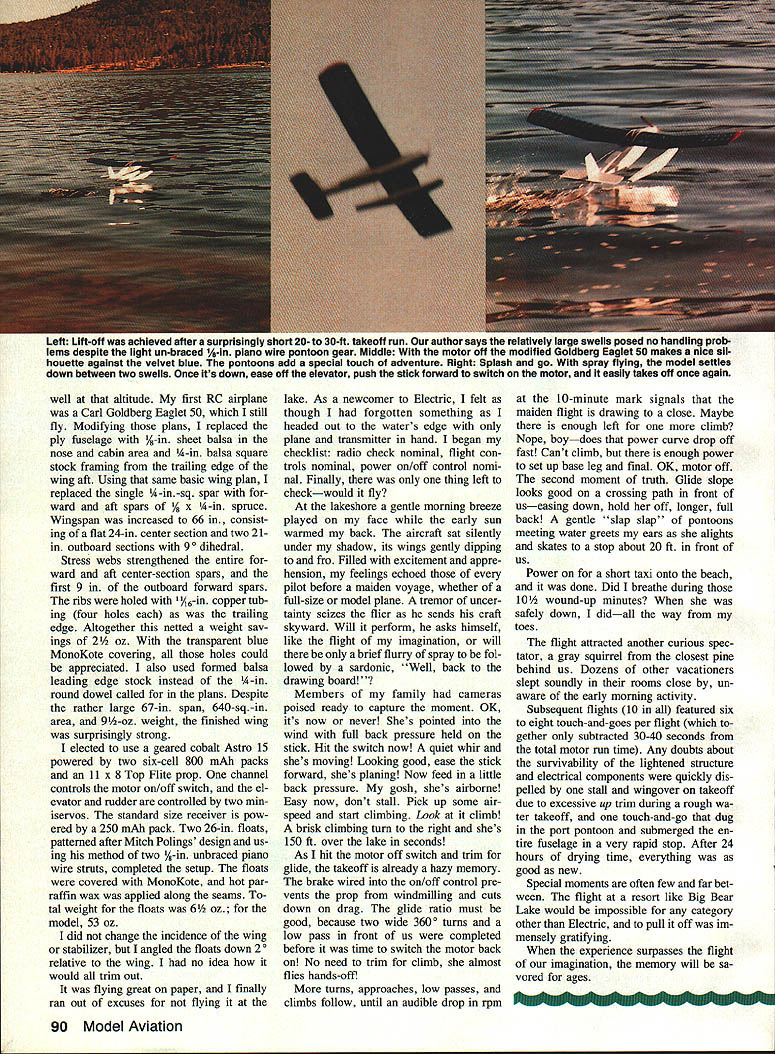
Members of my family had cameras poised ready to capture the moment. OK, it's now or never. She's pointed into the wind with full back pressure on the stick. Hit the switch now! A quiet whir and she's moving! Looking good—ease the stick forward, she's planing! Now feed in a little back pressure. My gosh, she's airborne! Easy now, don't stall. Pick up some airspeed and start climbing. Look at it climb! A brisk climbing turn to the right and she's 50 ft over the lake in seconds.
As I hit the motor-off switch and trim for the glide, the takeoff was already a hazy memory. The brake wire into the on/off control prevents the prop from windmilling and cuts down on drag. The glide ratio must be good, because two wide 360° turns and a low pass in front of us were completed before it was time to switch the motor back on. No need to trim for climb—she almost flies hands-off!
More turns, approaches, low passes, and climbs followed, until an audible drop in rpm at the 10-minute mark signaled that the maiden flight was drawing to a close. Maybe there is enough left for one more climb? Nope—boy, does that power curve drop off fast! Can't climb, but there is enough power to set up a base leg and final. OK, motor off.
The second moment of truth. Glide slope looked good on a crossing path in front of us—easing down, hold her off, longer, full back! A gentle "slap-slap" of pontoons meeting the water greeted my ears as she alighted and skated to a stop about 20 ft in front of us. Power on for a short taxi onto the beach, and it was done. Did I breathe during those 10½ wound-up minutes? When she was safely down, I did—all the way from my toes.
The flight attracted another curious spectator, a gray squirrel in the closest pine behind us. Dozens of other vacationers slept soundly in their rooms close by, unaware of the early-morning activity.
Subsequent Flights and Durability
I made 10 flights in all. Subsequent flights featured six to eight touch-and-goes per flight, which subtracted only 30–40 seconds from the total motor run time per flight. Any doubts about the survivability of the lightened structure and electrical components were quickly dispelled by two incidents:
- One stall and wingover on takeoff due to excessive up trim during a rough-water takeoff.
- One touch-and-go that dug the port pontoon in and submerged the entire fuselage in a very rapid stop.
After 24 hours of drying time, everything was as good as new.
Conclusion
Special moments are often few and far between. The flight at a resort like Big Bear Lake would be impossible for any category other than electric, and to pull it off was immensely gratifying. When the experience surpasses the flight of our imagination, the memory will be savored for ages.
Transcribed from original scans by AI. Minor OCR errors may remain.

