
Electric Mods For Junior Clipper +35%
Pancho Morris
Although I am primarily an RC sailplane flier, I dabble in other forms of modeling for both fun and the experience of learning more. I have always loved the appearance of Old‑Timer designs and have enjoyed experimenting with electric power.
Several years ago I threw together a sort of stand‑way‑back‑and‑squint Old‑Timer for electric which met with only marginal success. It was blockish and bulky — not a clean design — and was mainly useful for testing motors, reducers, and batteries. About then Model Aviation published Doc Mathews' Comet Jr. Clipper +35%, and I thought this would make a much better electric conversion.
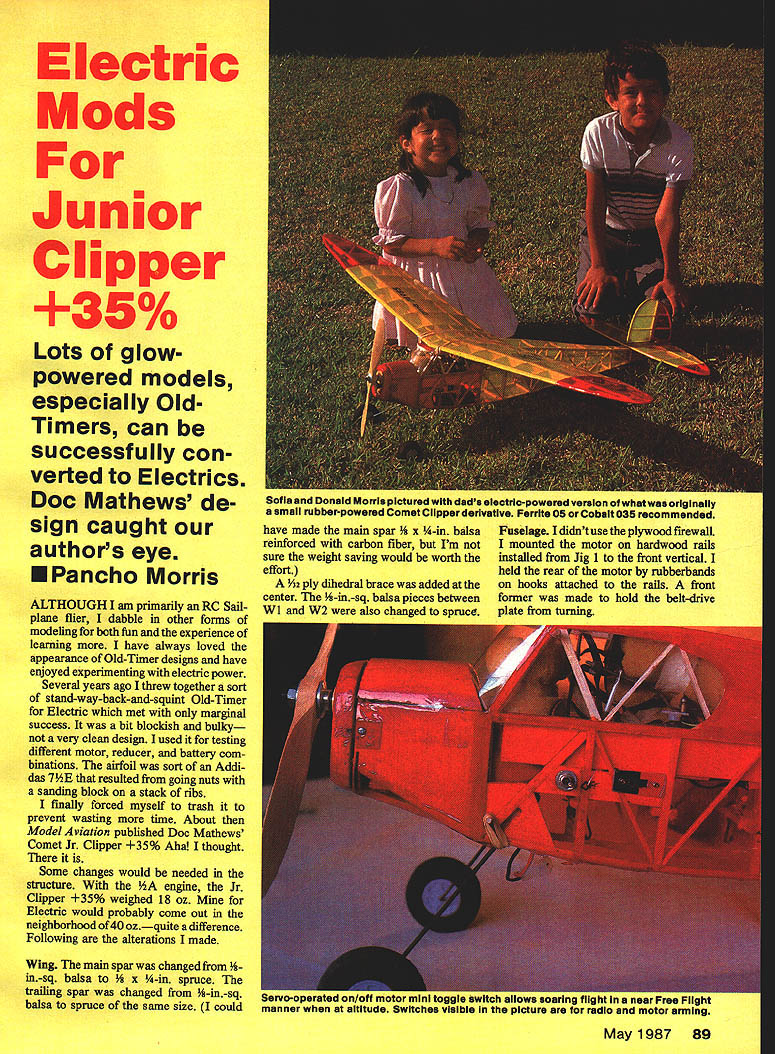
Some changes were necessary. The stock Jr. Clipper +35% with the 1/4A engine weighed about 18 oz. My electric version would likely come out around 40 oz. — quite a difference. Following are the alterations I made and notes on performance.
Wing
- Main spar changed from 1/8‑in.‑sq. balsa to 3/8 x 1/4‑in. spruce.
- Trailing spar changed from 3/16‑in.‑sq. balsa to spruce of the same size.
- The 1/4‑in.‑sq. balsa pieces between W1 and W2 were also changed to spruce.
- A 1/2‑ply dihedral brace was added at the center.
(I could have made the main spar 1/4‑in. balsa reinforced with carbon fiber, but I wasn't sure the weight saving would be worth the effort.)
Fuselage and motor installation
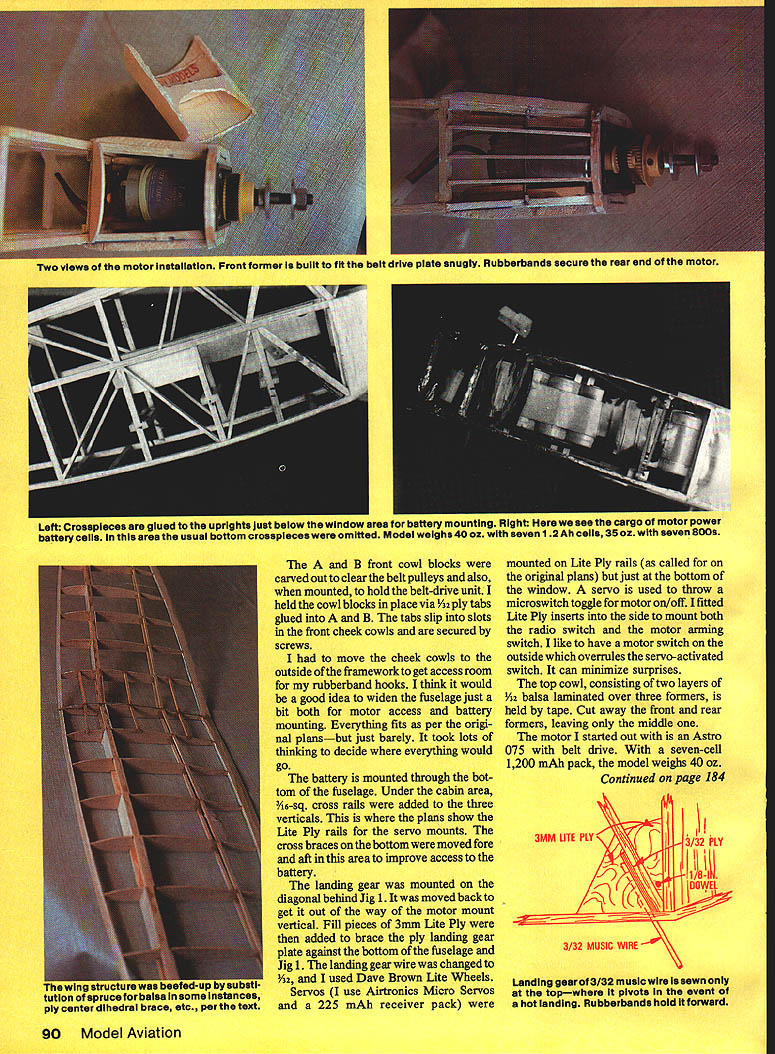
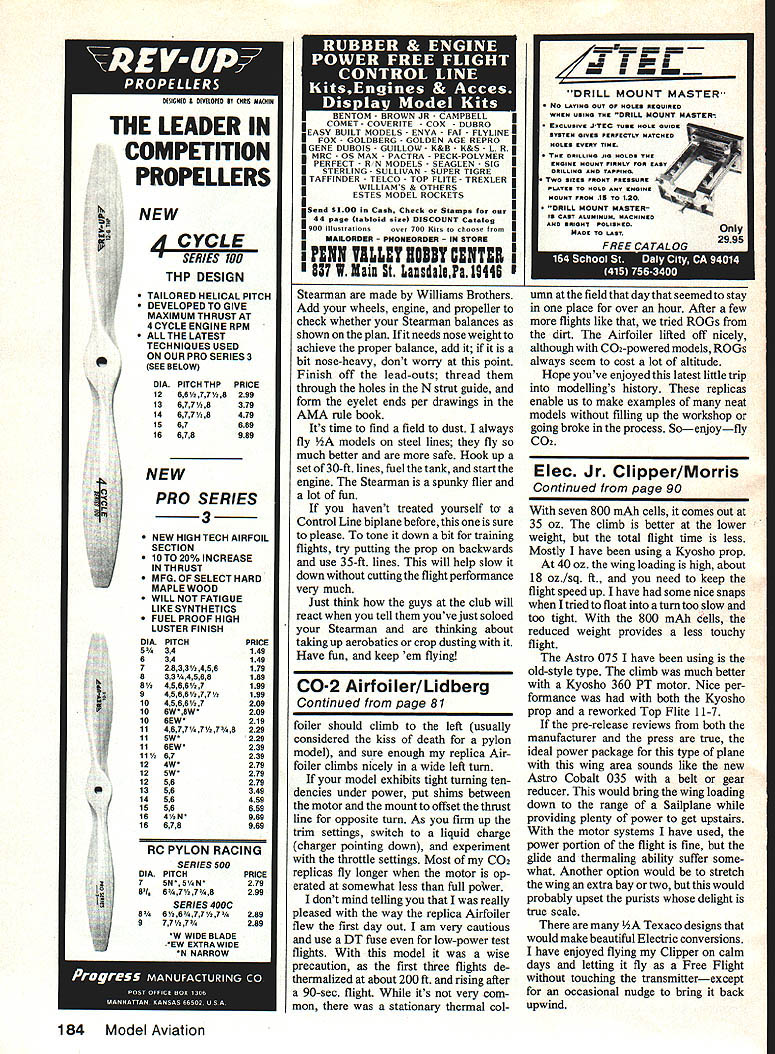
- I did not use the plywood firewall. Instead, the motor is mounted on hardwood rails installed from Jig 1 to the front vertical former.
- The rear of the motor is held by rubber bands on hooks attached to the rails; a front former was made to hold the belt‑drive plate and prevent it from turning.
- Everything fits per the original plans, but just barely — it took a lot of thought to decide placement of each component.
- The battery is mounted through the bottom of the fuselage for access.
- Under the cabin area I added 3/16‑in.‑sq. cross rails and three verticals where the original plans show lite‑ply rails, servo mounts, and cross braces. The bottom cross braces were moved fore and aft to improve battery access.
- I moved the cheek cowls to the outside of the framework to provide room for the rubber‑band hooks; widening the fuselage slightly would be a good idea for motor access and battery mounting.
Cowl and motor mounting details
- The top cowl consists of two layers of 1/8‑in. balsa laminated over three formers and held with tape. Cut away the front and rear formers, leaving the middle former for motor clearance.
- The A and B front cowl blocks were carved to clear the belt pulleys and to hold the belt‑drive unit. Cowl blocks are held in place via 1/32‑in. ply tabs glued into A and B; the tabs slip into slots in the front cheek cowls and are secured by screws.
Landing gear
- The landing gear was mounted on a diagonal behind Jig 1 and moved back to clear the motor mount vertical.
- Vertical fill pieces of 3 mm lite‑ply were added to brace the ply landing‑gear plate against the bottom fuselage and Jig 1.
- Landing‑gear wire was changed to 3/32 in. and I used Dave Brown Lite Wheels.
Servos and electronics
- Use Airtronics micro servos.
- The receiver pack (I used a 225 mAh pack in some installations) is mounted on lite‑ply rails as shown on the original plans, just below the bottom window.
- A servo throws a microswitch to toggle the motor on/off.
- I fitted lite‑ply inserts to side‑mount both the radio switch and the motor‑arming switch. I prefer a motor switch on the outside that overrules the servo‑activated switch to minimize surprises.
Power system and performance
- I started out with an Astro belt drive and a seven‑cell 1,200 mAh pack. With that setup the model weighs about 40 oz.
- With seven 800 mAh cells the weight comes down to about 35 oz. Climb is better at the lower weight, but total flight time is reduced. At 40 oz the wing loading is fairly high (about 18 oz./sq. ft.), so you must keep speed up; slow turns can induce a stall and a snap.
- Motors tried:
- Astro 075 (old‑style): reasonable performance.
- Kyosho 360 PT: much better climb.
- Props: Kyosho props and a reworked Top Flite 11‑7 both produced nice performance.
- The new Astro Cobalt 035 with a belt reducer looks promising as an ideal power package: it would bring RPM down to a sailplane range while still providing plenty of power to climb.
- With the motor systems I have used the powered portion of flight is fine, but glide and thermalling ability suffer somewhat. Stretching the wing an extra bay or two could help glide but would change the scale appearance.
Notes and closing
There are many 1/4 Texaco and Old‑Timer designs that would make beautiful electric conversions. I have enjoyed flying my Clipper on calm days and letting it free‑fly without touching the transmitter except for occasional nudges to bring it back upwind.
Transcribed from original scans by AI. Minor OCR errors may remain.

