
Electric Old-Timers
A medley of Old-Timer designs that can be easily converted to electric power and still have performance characteristics close to or equalling those of their original glow-powered counterparts.
Dr. Colin McKinley
Introduction
When electric power first appeared, an Electric Old-Timer seemed an ideal project. Because of the pressures of my career it wasn't until 1985 that I found time to build my first electric model — a Leisure Playboy with a geared .05 motor. The experience convinced me that many classic Old-Timer designs adapt very well to electric power with careful construction and appropriate power packages.
Leisure Playboy
- Span: 67 in.
- Weight: 44 oz.
- Area: 576 sq. in.
- Power: Leisure LT50, 2.5:1 gear
- Battery: six 1,200-mAh cells
- Best propeller: 11 x 5
Modelers accustomed to sheet-balsa and foam construction will no doubt find this a challenging project, but building the Playboy was like a trip down memory lane for me. With reasonable care, the Playboy is a reliable performer. Its very light airframe makes it difficult to build overweight — I know one example that weighs about 60 oz. and still flies well. (One of my earlier models was destroyed by battery failure, but the others described here are still flying.)
Lehmberg Feather Merchant
- Span: 72 in.
- Weight: 64 oz.
- Area: 660 sq. in.
- Power: Keller 25/12
- Battery: 12 × 800-mAh cells
- Best propeller: 11 x 6 or 10 x 7
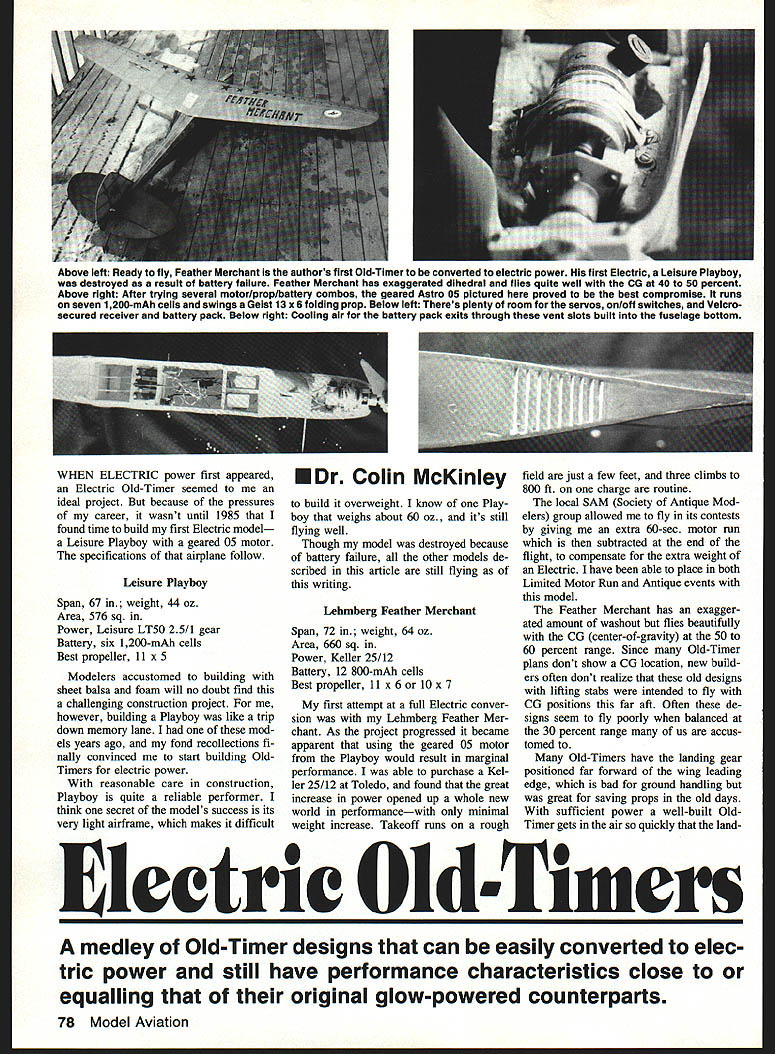
My first full electric conversion was the Feather Merchant. A geared .05 motor proved marginal for this airframe; switching to the Keller 25/12 supplied a large increase in power with only minimal weight penalty. Takeoff runs from rough fields are just a few feet, and three climbs to 800 ft on one charge became routine.
The local SAM (Society of Antique Modelers) group allowed me to fly it in contests by granting an extra 60-second motor run (subtracted at the end of the flight to compensate for the electric weight). The Feather Merchant has pronounced washout and flies beautifully. The center of gravity (CG) is far aft — in the 50–60% chord range — which surprises some builders used to modern designs that prefer ~30%.
Many Old-Timers have landing gear positioned well forward of the wing leading edge. That preserved props in the days of marginal power but hurts ground handling. With sufficient power a well-built Old-Timer lifts off quickly, so the forward gear position is less problematic. A low-powered conversion might consider moving the gear rearward (wheels below the leading edge), though this compromises authenticity.
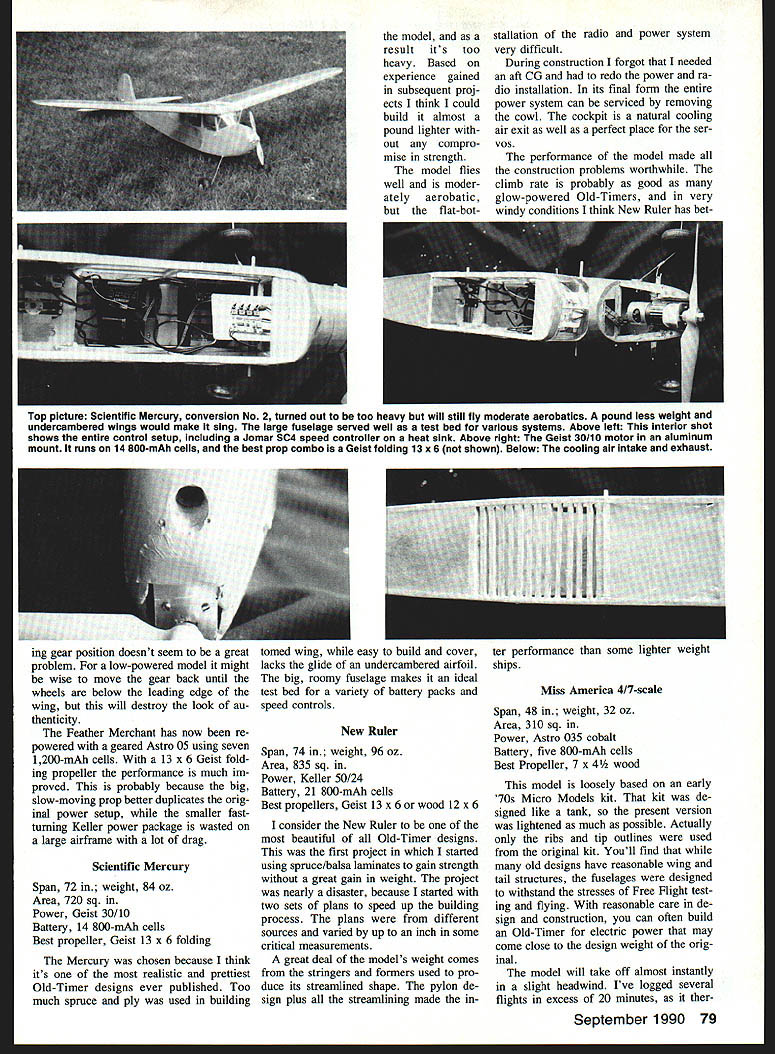
The Feather Merchant has also been repowered with a geared Astro .05 using seven 1,200-mAh cells and a 13 x 6 Geist folding prop. The larger, slower-turning prop better duplicates original power characteristics and improved performance on this draggy airframe.
Scientific Mercury
- Span: 72 in.
- Weight: 84 oz.
- Area: 720 sq. in.
- Power: Geist 30/10
- Battery: 14 × 800-mAh cells
- Best propeller: Geist 13 x 6 folding
I chose the Mercury because it is one of the most realistic and attractive Old-Timer designs published. I used too much spruce and plywood in my build, so the model is heavier than necessary — I believe I could shave almost a pound from it without compromising strength.
The Mercury flies well and is moderately aerobatic, but its flat-bottom wing (easy to build and cover) lacks the glide of an undercambered airfoil. The roomy fuselage makes it an ideal test bed for different batteries and speed controls.
New Ruler
- Span: 74 in.
- Weight: 96 oz.
- Area: 835 sq. in.
- Power: Keller 50/24
- Battery: 21 × 800-mAh cells
- Best propellers: Geist 13 x 6 or wood 12 x 6
I consider the New Ruler one of the most beautiful Old-Timer designs. This was my first extensive use of spruce/balsa laminates to gain strength without excessive weight. The project nearly became a disaster because I started with two sets of plans from different sources; some critical measurements differed by up to an inch.
Much of the weight comes from the stringers and formers required to produce the streamlined fuselage. The nylon skin plus streamlining made installing radio and power systems difficult. I initially forgot the need for an aft CG and had to redo the power and radio installation. In the final layout the entire power system is serviceable by removing the cowl. The cockpit provides a natural cooling-air exit and is a convenient location for servos.
The model’s performance made the construction difficulties worthwhile. Climb rate rivals many glow-powered Old-Timers, and in very windy conditions New Ruler may outperform some lighter ships.
Miss America (4/7-scale)
- Span: 48 in.
- Weight: 32 oz.
- Area: 310 sq. in.
- Power: Astro .035 cobalt
- Battery: five 800-mAh cells
- Best propeller: 7 x 4½ wood
This model is loosely based on an early-’70s Micro Models kit. That kit was built like a tank, so I lightened the fuselage wherever possible, keeping the original ribs and tip outlines. Many old designs have adequate wing and tail structures but overly robust fuselages intended for Free Flight stresses. With careful redesign you can often build an Old-Timer to near the original design weight for electric power.
The Miss America takes off almost instantly in a slight headwind. I’ve logged several flights in excess of 20 minutes on good days.
Powerhouse
- Span: 84 in.
- Weight: 100 oz.
- Area: 1,126 sq. in.
- Power: Astro 60 cobalt
- Battery: 24 × 800-mAh cells or 28 × 400-mAh cells
- Best propeller: 14 x 6 THP or 14 x 6–10 progressive pitch
The Powerhouse was an attempt to produce electric performance equal to that of glow-powered ships. I used spruce, balsa, and carbon-fiber laminates extensively. A large fuselage proved useful as a test bed for various systems and simplified battery and radio installations.
Construction lessons included the need to allow for an aft CG during layout; I had to redo the power/radio installation mid-build. In the final form the entire power system is accessible by removing the cowl. The cockpit serves as a natural cooling-air exit and a good place for servos.
The climb rate is comparable to many glow-powered Old-Timers, and overall performance justified the extra construction effort.
Goldberg Valkyrie
- Span: 120 in.
- Weight: 9½ lb.
- Area: 13 sq. ft.
- Power: Astro 60 cobalt
- Battery: 24 × 800-mAh cells
- Best propeller: 14 x 6
I purchased this 120-inch Goldberg Valkyrie to experiment with electric power on very large models. With an Astro 60 cobalt motor running on 24 × 800-mAh cells and swinging a 14 x 6 prop, the Valkyrie will take off in about 10 ft and climb at roughly 500 ft/min. It flies at a brisk cruise — a “fast trot” — and is a crowd-pleaser. The motor is in a standard mount and the battery pack is simply wrapped in foam and dropped into the fuselage.
Building hints
- Keep structure light. A light airframe is essential for good performance and handling.
- Strengthen wings with shear webs where appropriate.
- Save weight on tip outlines by laminating several layers of 1/16-in. balsa, soaked and shaped on a form.
- Wing spars can be balsa with carbon-fiber inlays or laminates of balsa, carbon fiber, and spruce. Using these techniques, the uncovered wing on the Powerhouse weighed only about 10 oz.
- For covering I prefer 3/32-oz. Micafilm — it resembles doped silkspan and is lightweight.
- Lighten fuselages by using smaller wood sizes where possible. Lining cabin areas with 1/16-in. ply produces a strong structure with little weight penalty.
- Motor mounts can be simple: strap the motor to the nose block with rubber bands, or make a metal mount when needed.
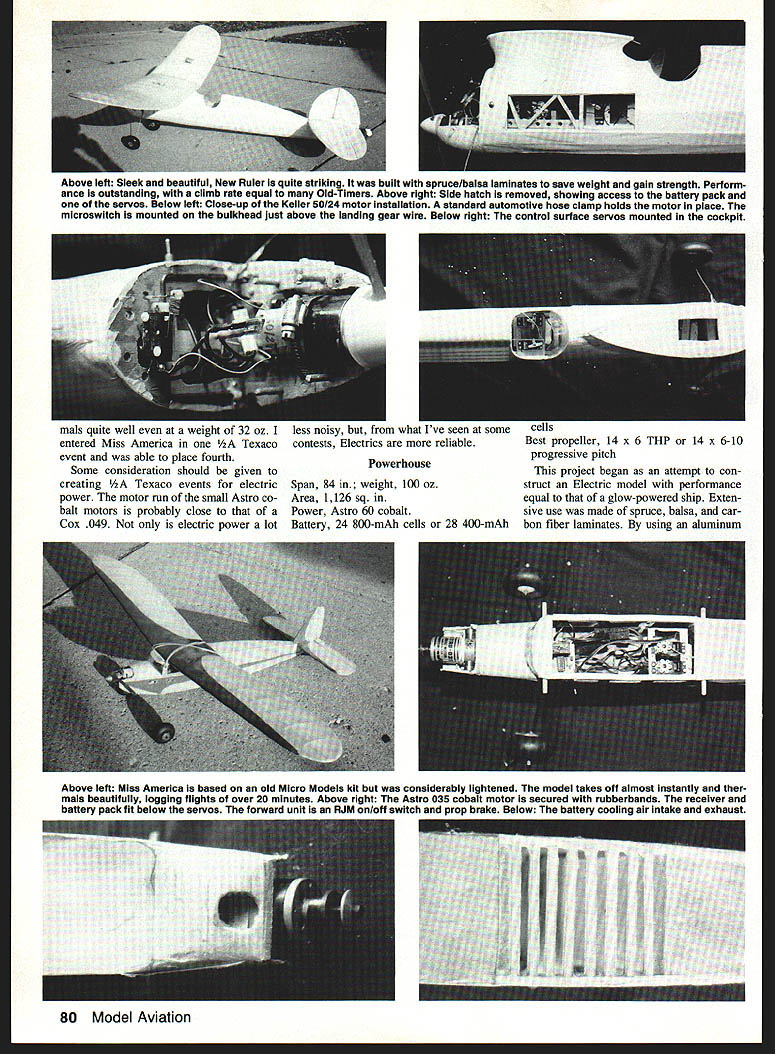
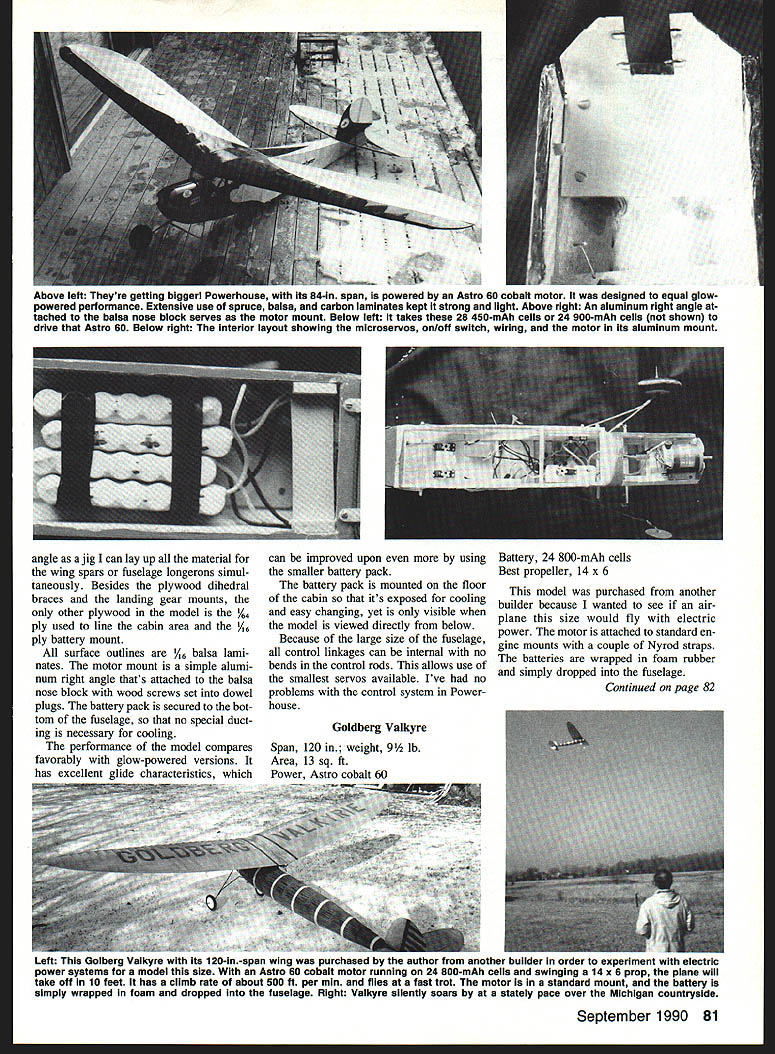
- If the battery is mounted internally, provide cooling-air entry and exit. A bottom-cavity battery installation (as used on the Powerhouse) gives good cooling and easy service without ducts.
- First-time conversions are easier with cabin designs and boxy fuselages; pylon designs and streamlined fuselages complicate battery and radio installation.
- Make battery mounting adjustable so you can shift the pack to find the best CG — often in the 50–60% chord range for Old-Timers.
- With careful selection of wood and covering, you can build an electric Old-Timer that weighs little more than the original design. Depending on the power package you choose, you can achieve flight patterns close to the original or attain near-vertical performance seen at SAM contests.
- Even when built heavier than specified, Old-Timer designs tend to have beautiful, floating glides. It’s easy to see how they used to go out of sight on 15- and 20-second engine runs.
I have found Electric Old-Timers fun to build and fly. Flight characteristics vary widely with power choice, and I hope more modelers will consider developing Electric/SA Texaco events using the new .02 and .035 motors. I prefer events that allow one well-planned flight per entrant and that reward careful craftsmanship and faithful flying.
Transcribed from original scans by AI. Minor OCR errors may remain.

