
Electric World Championships
by Steve Manganelli
"LIMBO" was the one-word utterance of all 14 national teams' contestants, who competed in the 2000 Federation Aeronautique Internationale (FAI) class F5B World Championships (WC) for electric-powered gliders in San Diego, CA.
"Ready—turn!" was the phrase the callers used to indicate when the pilot reached the turn plane. Or was it "legovin—swing," "prepare—vira," "einleiten—rummm," or "prepare menta no"? Voiced with extreme emotional fervor, these translations gave an exciting international flavor to my position as Base A plane judge.
Event overview
The F5B event is coming into its own in the U.S., but is highly competitive in Europe. The models are highly evolved, all-composite construction, made in aluminum molds carved with numerically controlled machinery. Other than the Russian Sukhoi factory-built Avionic series models designed by Anachin-Sobakin-Fufkov, most models are built by associations of local contestants.
Most contestants used brushless motors and controllers by Aveox, Schultze, and Kontronik. Twenty-seven-cell battery packs were matched and tuned for maximum performance. All used gearboxes and large propellers for peak climbing efficiency.
What three horsepower can do for a thin-winged four-pound model is scary: it goes straight up at 90 mph, has a distance lift-to-drag ratio at 100 mph, and finishes in a straight-down dive at nearly 200 mph. And some of our glow brethren think electrics are "too slow"?
Competition format
- An official F5B flight begins with a three-minute distance task: the pilot flies as many laps as possible between parallel planes that are 150 meters apart.
- Pilots may make as many as 10 climbs for altitude, but not while between the parallel planes.
- Following the distance task, pilots have one minute to descend to three meters ("limbo"), then climb for a five-minute precision duration and spot-landing task.
Organization and logistics
The August 3–13 extravaganza was the result of months of planning by the Silent Electric Flyers of San Diego and several other radio control (RC) clubs in the San Diego area. Now that the event is in the bag, I marvel at the tremendous effort put forth by so many unselfish individuals.
Tasks and items managed for the WC included:
- Banquet and receptions (San Diego Aerospace Museum, AMA-hosted).
- Opening and closing ceremonies, national anthems, and flag operations.
- Equipment rentals and logistics: trucks, tents, chairs, Porta Potties, tables, and podiums.
- Government permits and preparation of two new runways.
- Course surveying; erection of contestant and vendor tents.
- Sponsorships, money collection and accounting.
- Model measurements, certification, and documentation.
- Production of decals, hats, patches, lapel pins, and medals.
Institutions do not do this; individuals do. Many people used precious vacation time and spent time away from their families: Chuck Grim, Don Madison, Wayne Walker, Tim Attaway, Mike Neale, and Ron Scharck were just a few of the helpers. Thanks to the many others, too numerous to mention.
International Electric Flight Festival (IEFF)
An International Electric Flight Festival (IEFF) preceded the WC and was open to all entrants. The IEFF gave visitors, non-WC competitors, officials, and locals a chance to participate in unofficial events and warm up for the WC.
IEFF categories included:
- Sunrise to Sunset
- Fun Scale
- Speed 400 Pylon Racing
- AMA Class A Sailplane and Class B Sailplane
- FAI F5A Pattern
- Class A Old-Timer
- FAI F5B (premiere event, served as a warm-up for the WC)
Three simpler F5B classes were also offered:
- 10-cell: Rudy Freudenthaler (Austria)
- 7-cell: Stefan De Haudere (Belgium)
- Open (nominally 27-cell): Markus Moeckli (Germany)
You can view a complete list of IEFF scores, events, and participants at www.sefsd.org.
Practice and contest schedule
The IEFF was followed by a full day of official practice; each team was given a block of time on its respective (F5B and F5D) official course. This was the last time to dial in equipment before scoring began.
Each contest day began with F5D Pylon. Typical daily schedule:
- F5D Pylon: 8:00–11:00 a.m.
- Two rounds of F5B Glider: 11:00 a.m. onward (flight order arranged and rolled down five pilots per round)
The flight order was crafted by expert timeologist Guntram Reub; his computerized timing system had many built-in rules that proved invaluable.
F5D Pylon Racing
Picture a triangular course longer than those in Quickie 500 or Formula 40, flown with 1/2A-size models. German Harald Konrath set a world record at 1:11.5—just a few percent slower than the fastest gas-powered times.
Individual and team highlights:
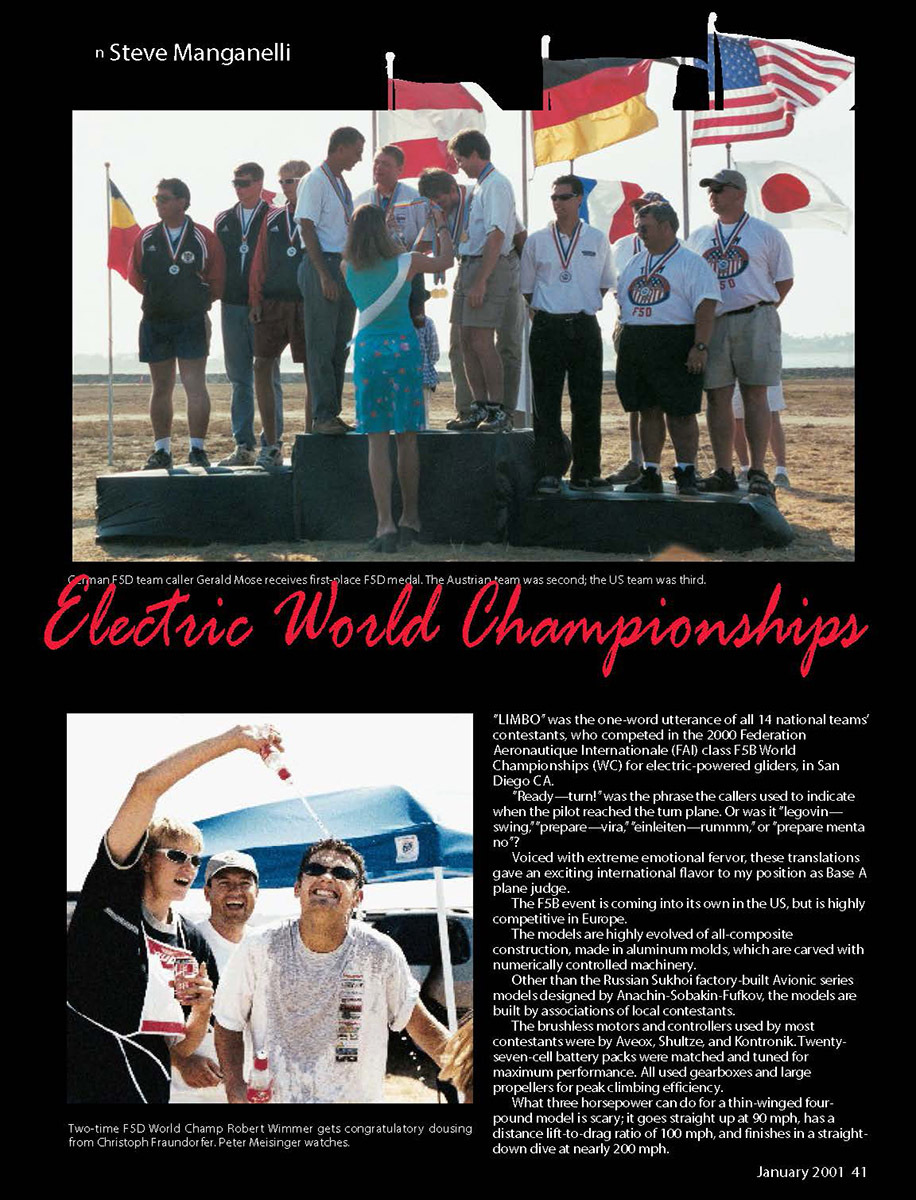
- Defending World Champion Robert Wimmer (Germany) repeated his victory.
- Team results: 1st Germany, 2nd Austria, 3rd USA.
- U.S. team: Troy Peterson, Kevin Matney, Archie Adamisin Jr.
- Troy (Los Angeles) crashed on a launch early in the contest but recovered to finish as the top American in 5th overall.
- Kevin Matney (Michigan) finished 8th.
- Archie Adamisin Jr. (Michigan) finished 9th.
- Team Austria (Peter Meisinger, Christoph and Stephan Fraundorfer) finished 2% faster than the Americans and took second place.
- Team France (Benoit LeClerc and Guy Brouquieres) finished 4th; David Hobby (Australia) was 5th.
Rules changes in the pipeline aim for lower wing loading and easier launches to encourage broader participation.
Event director Archie Adamisin Sr. faced challenges including a lack of experienced helpers. The IEFF served as a training ground for many drafted workers. It was the first WC Pylon Racing event flown with off-course judges. Archie Sr. performed admirably with help from Sabine Konrath and Keith Finkenbeiner, despite personal setbacks (backache, car theft, and flat tires).
A few protests and threatened protests arose during the event but were handled by organizers.
F5B Glider competition
Key competitors and equipment:
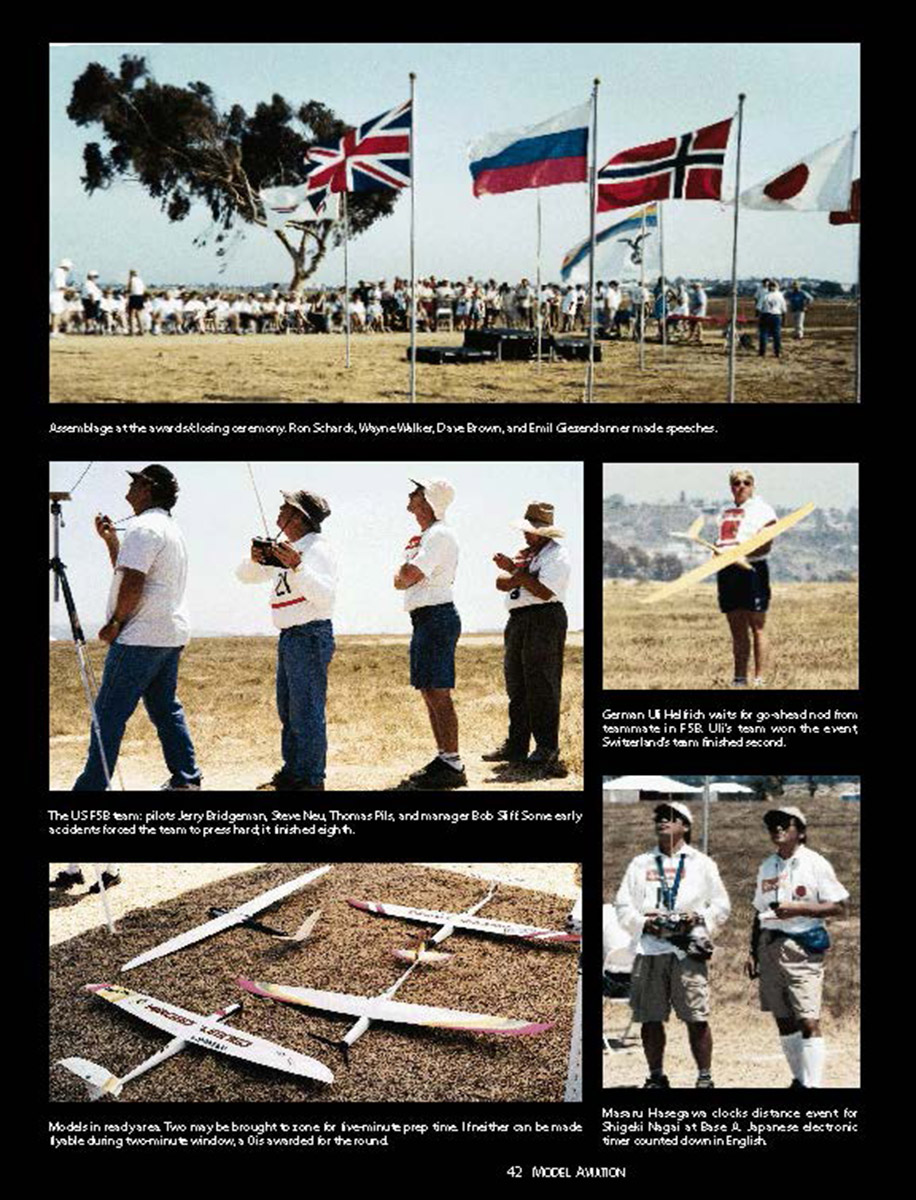
- Top contenders: defending World Champion Thomas Pils (U.S.), Urs Leodolter (Switzerland), Florian Lang (Germany), Rudy Freudenthaler (Austria).
- The big guns fared well in the first rounds; Thomas Pils led early as the sole competitor with 36 laps in Round One.
Timing and rules enforcement:
- Guntram Reub's timing system required contestants to supply a spare receiver channel wired to the motor channel output. When the transmitter indicated motor on, the Base signaling devices showed the aircraft as off-course so laps would not count (motor use on course is prohibited).
- Fouls triggered a "boop" sound; a valid lap triggered a "beep." Turning short of a base plane produced no beep and required the pilot to go around.
Contests of fate and equipment failures:
- Going around and re-flights began a stretch of bad luck that affected the U.S. team.
- Thomas Pils had a cut called after a blistering performance of approximately 33 laps and settled for 34 laps in Round Five.
- Jerry Bridgeman elected a reflight after a minor official error; during the reflight his motor mount cracked, causing a crash and a zero in that round.
- Steve Neu's Verminator 2000 (a Thomas Pils design) suffered aileron flutter; the aileron separated, producing a throw-out round.
- Jerry Bridgeman broke his second and last registered Verminator in Round Seven, leaving him without a model for Round Eight.
Weather and thermal effects:
- With F5D running until 11 a.m., the best thermals and lively air were often gone by the time F5B rounds began. The first five F5B pilots of the day had the best air and the highest chance of posting 38+ laps.
- Sea breezes stiffened by 12:30 p.m., though top contestants still managed 35–36 laps.
- A calm period at the end of the second round produced another opportunity for very high lap counts; Thomas Pils pushed hard and nearly reached the elusive 39 laps before his cut. No one else managed 39 laps. Experts noted that sea-level atmospheric conditions made 39 laps very difficult.
Team battle and final results:
- Team Germany, led by young hotshot Martin Weberschoch with seasoned Florian Lang and Norbert Huebner, moved to defend its 1998 team title.
- Team Switzerland, with strong performances from Urs Leodolter and Markus Moeckli, challenged Germany.
- Ultimately, Norbert Huebner bested Switzerland’s Hans-Jakob Baerlocher by 3%, allowing Team Germany to squeeze ahead of Team Switzerland despite Urs Leodolter’s narrow .08% individual advantage over Martin Weberschoch.
Final team standings:
- Germany
- Switzerland
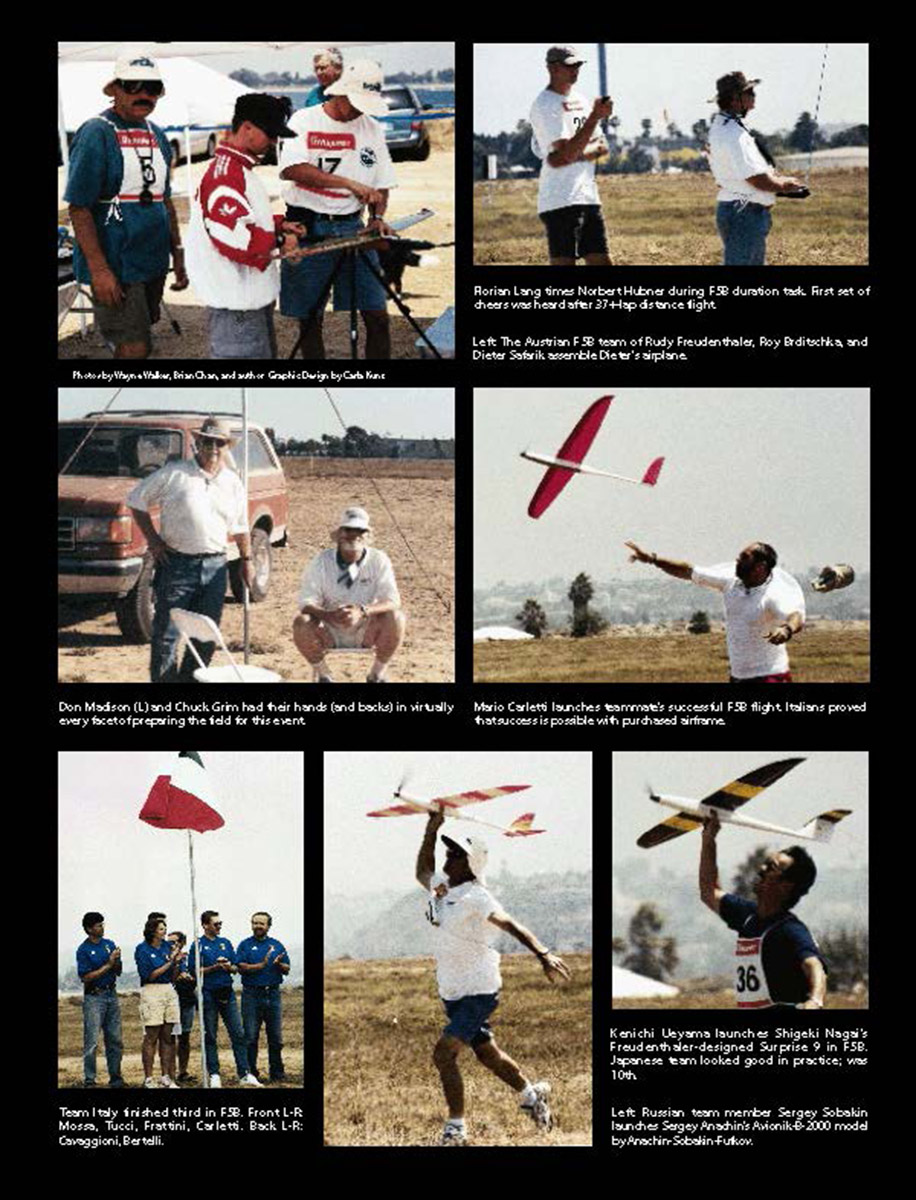
- Italy (Remo Frattini, Alessandro Mossa, Mario Carletti)
- Austria (Rudy Freudenthaler)
- Belgium
- United Kingdom
- France
- United States
Individual results:
- World Champion (individual): Urs Leodolter (Switzerland)
Congratulations to the first F5B World Champions of the millennium — individual Urs Leodolter and Team Germany.
Steve Manganelli 119 W. Walnut Ave., Apt. 9 San Diego, CA 92103
Transcribed from original scans by AI. Minor OCR errors may remain.

