
ELECTROFLIGHT INTERNATIONAL CHALLENGE
A first-hand report on one of the first U.S. contests run under the FAI F3E (RC Electroflight) rules, which combine Distance, Precision Duration, and Spot Landing tasks in a single flight. Fliers from several European countries attended. By Dale Willoughby.
Background
Upon completion of the U.S. Team Selection Contest for the 1983 RC Soaring World Championships (FAI F3B) near Chicago, Mike Charles contacted AMA Executive Director John Worth to ask about U.S. team trials for the Electroflight (F3E) World Championships. The FAI-approved rules became officially effective January 1, 1983. At that time no F3E World Championships had been scheduled; CIAM indicated that successful international contests would be required before authorizing Worlds. Interest in holding contests strictly under FAI rules grew after the December 1982 meeting of the FAI Committee for International Aeromodelling (CIAM) in Paris. Joe Beshar, U.S. representative to CIAM’s Electroflight Subcommittee, voiced the same recommendation (see his report in the April 1983 Model Aviation).
Mike Charles decided to invite European competitors to help U.S. fliers learn from current designs and techniques.
Organization and competitors
- Mike Charles contacted Peter Blommaert (chairman, CIAM Electroflight Subcommittee) to invite European competitors.
- Roland Boucher of Leisure Electronics helped arrange prize support.
- AMA Class AA contest sanction was requested.
- Hosts: Harbor Soaring Society and Chapter 1 of the Society of Electric Aircraft Modelers (SEAM) agreed to provide manpower.
European visitors included:
- Peter Blommaert (Belgium) — Benelux Electro Team manager, editor of The Ampere Flyer
- Daniel Bosshart
- Hein Van’t Laar
- Danny DeSaeger
- Michael Blommaert
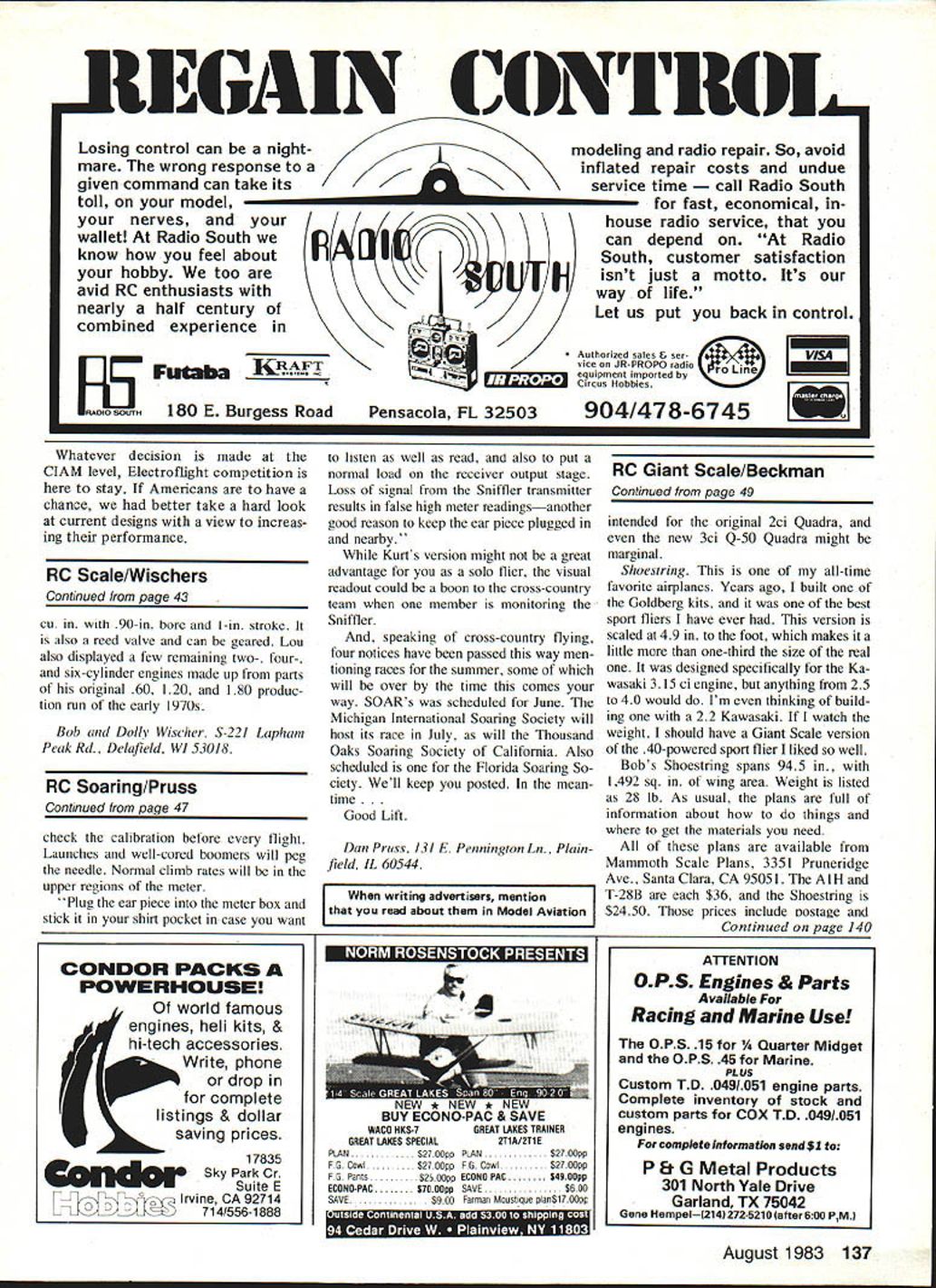
- Ralf Liebler
- Heinz Keller
Note: F3E allows each competitor one helper; several others attended as helpers and supporters.
Weather and flying
- Day 1 (fun-fly electric events): Sunny Southern California weather.
- Day 2 (F3E): Wind in the 25 mph range; the last three flights in the final round were completed as dark rain clouds approached.
Observations:
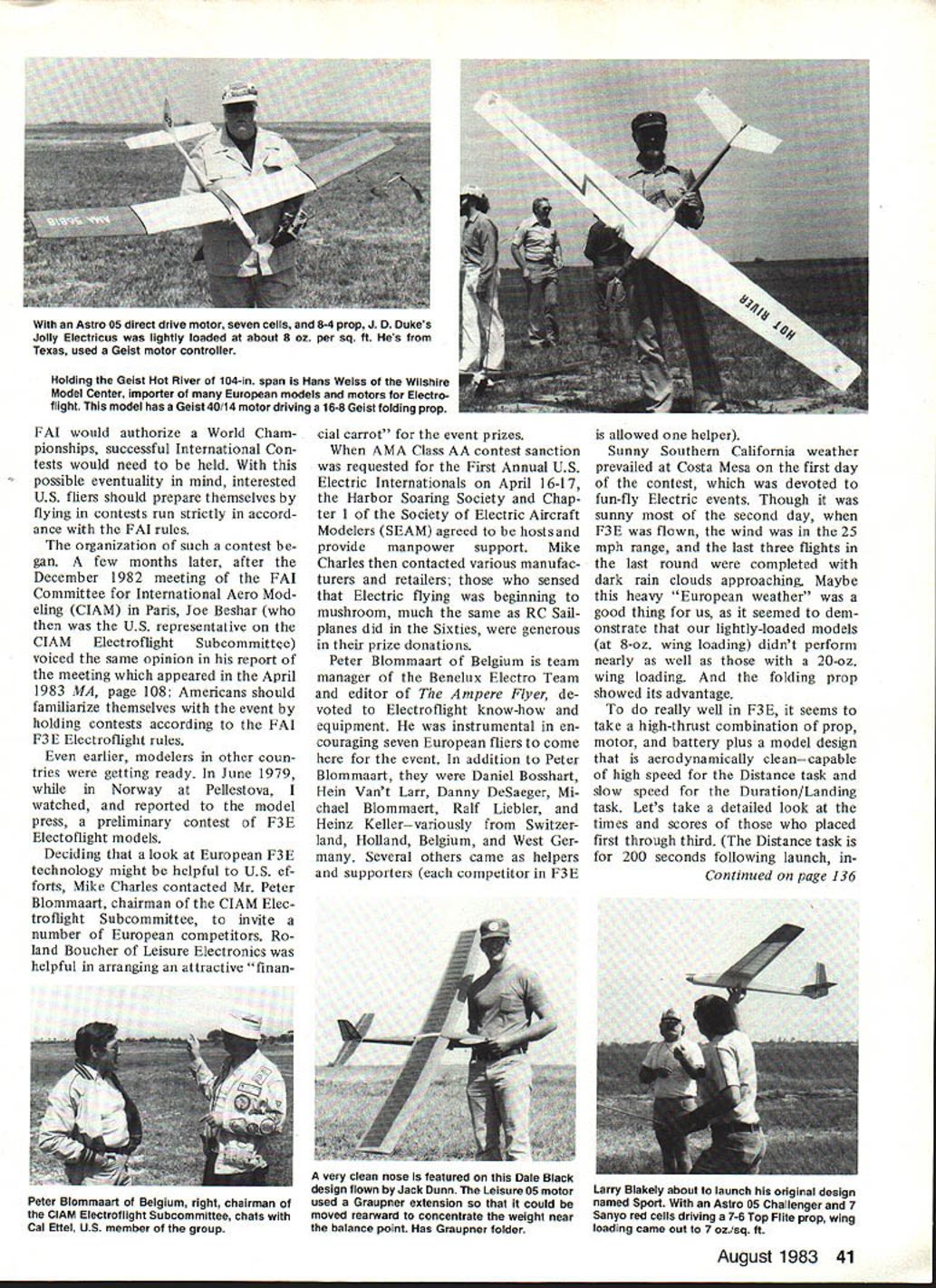
- Lightly loaded U.S. models (about 8 oz/sq ft wing loading) did not perform as well as heavier models (about 20 oz/sq ft).
- Folding props showed a clear advantage.
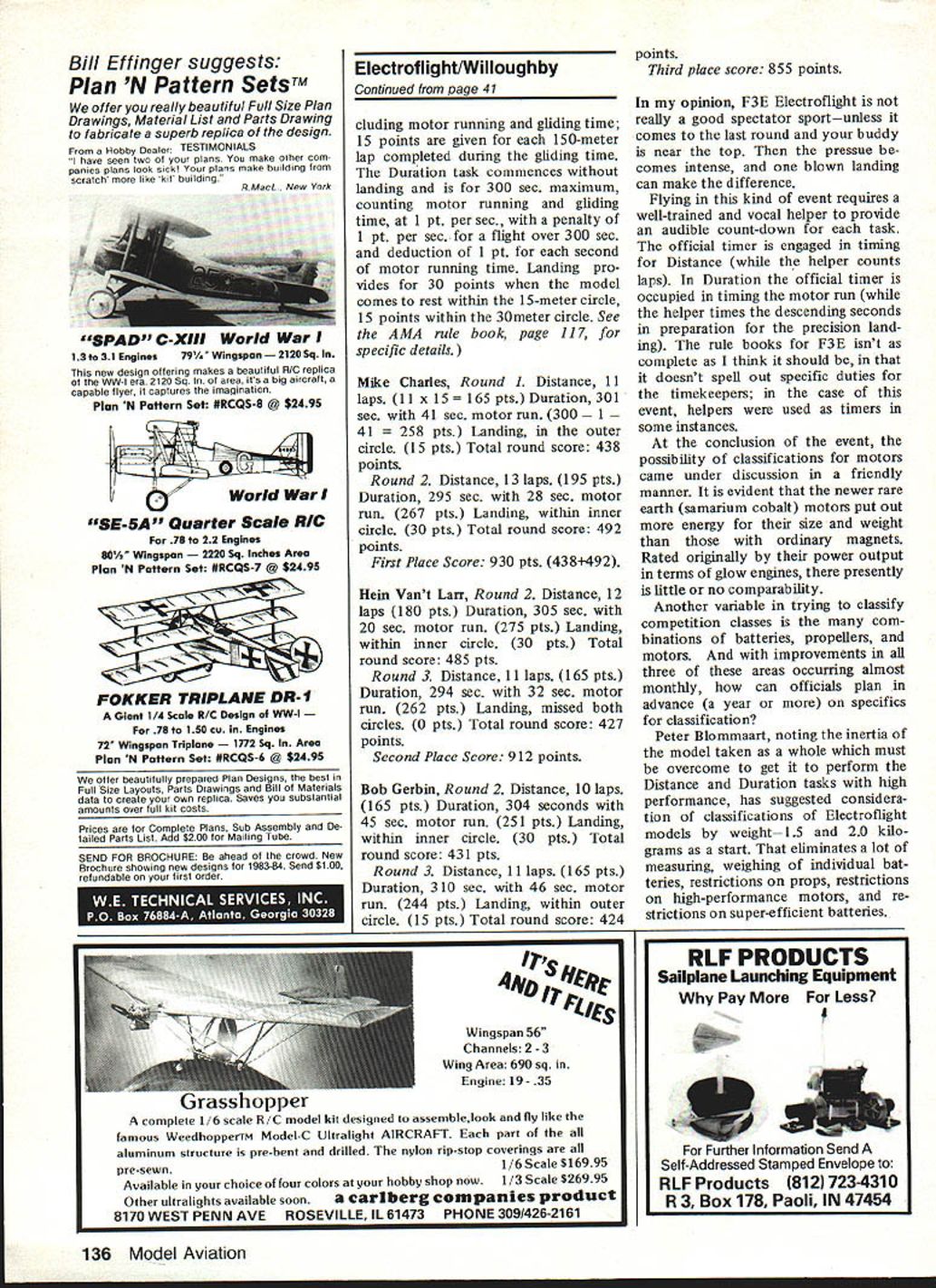
- Successful F3E entries tended to combine a high-thrust prop/motor/battery setup with aerodynamically clean airframes capable of both high speed (Distance) and slow-speed control (Duration/Landing).
F3E tasks and scoring (summary)
- Distance: 200 seconds following launch (includes motor running and gliding time). 15 points awarded for each completed 150-meter lap during gliding time.
- Duration: Commences without landing; maximum 300 seconds counting motor running and gliding time. Scoring: 1 point per second of flight; penalty of 1 point per second for flights over 300 seconds; deduction of 1 point for each second of motor running time.
- Landing: 30 points if the model comes to rest within the 15-meter circle; 15 points if within the 30-meter circle.
- See the AMA rule book (page 117) for full details.
Results
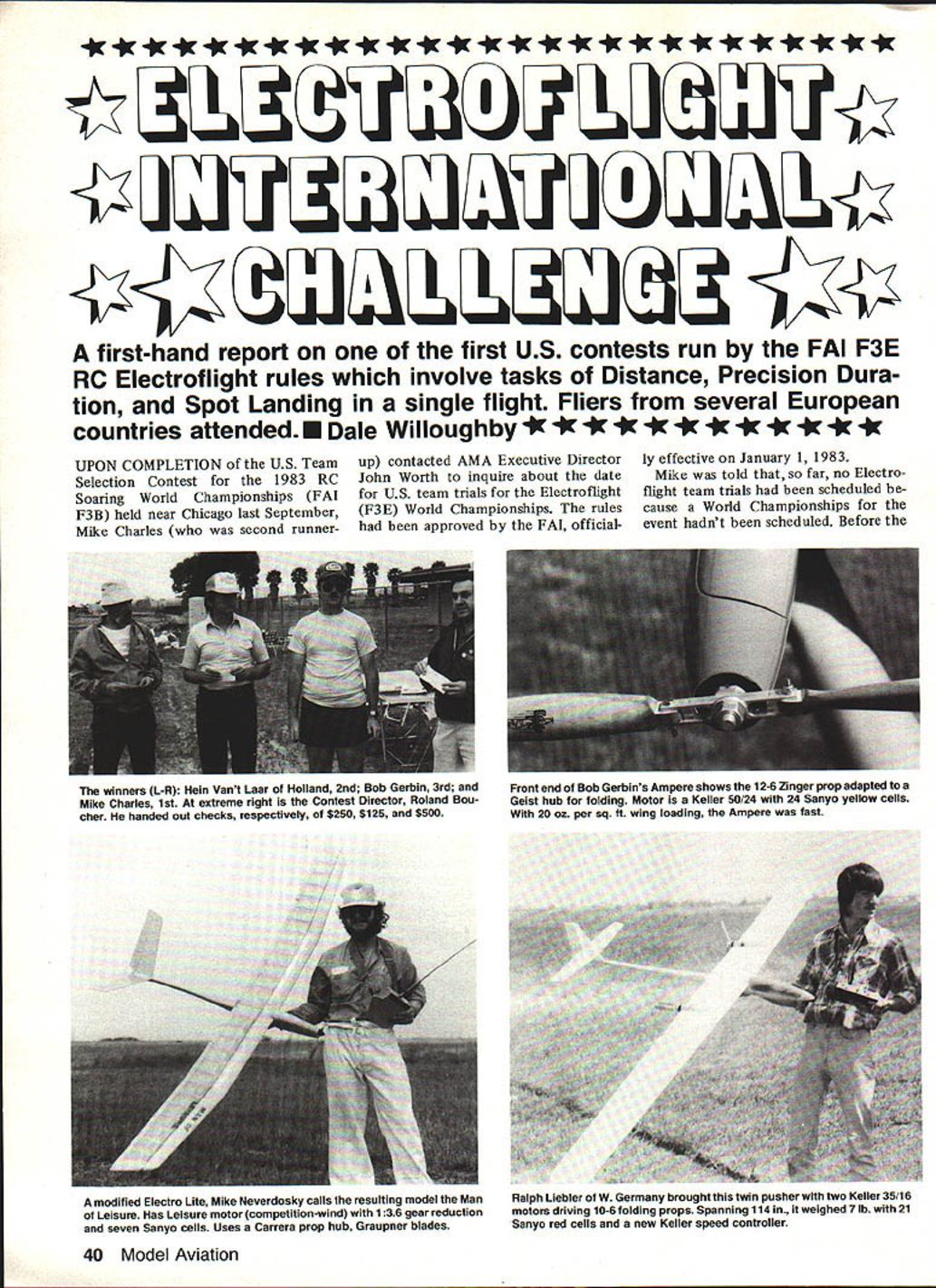
- First place — Mike Charles: Total 930 points
- Round 1
- Distance: 11 laps (11 × 15 = 165 pts)
- Duration: 301 sec with 41 sec motor run → 300 − 1 − 41 = 258 pts
- Landing: outer circle = 15 pts
- Round total: 438 pts
- Round 2
- Distance: 13 laps (13 × 15 = 195 pts)
- Duration: 295 sec with 28 sec motor run → 295 − 28 = 267 pts
- Landing: inner circle = 30 pts
- Round total: 492 pts
- Second place — Hein Van’t Laar: Total 912 points
- Round 2
- Distance: 12 laps (180 pts)
- Duration: 305 sec with 20 sec motor run → 300 − 5 − 20 = 275 pts
- Landing: inner circle = 30 pts
- Round total: 485 pts
- Round 3
- Distance: 11 laps (165 pts)
- Duration: 294 sec with 32 sec motor run → 294 − 32 = 262 pts
- Landing: missed both circles = 0 pts
- Round total: 427 pts
- Third place — Bob Gerbin: Total 855 points
- Round 2
- Distance: 10 laps (150 pts)
- Duration: 304 sec with 45 sec motor run → 300 − 4 − 45 = 251 pts
- Landing: inner circle = 30 pts
- Round total: 431 pts
- Round 3
- Distance: 11 laps (165 pts)
- Duration: 310 sec with 46 sec motor run → 300 − 10 − 46 = 244 pts
- Landing: outer circle = 15 pts
- Round total: 424 pts
Observations, timing, and classification issues
- F3E events are not highly spectator-friendly except in close finals; a single blown landing can decide placings.
- Flight crews need a well-trained, vocal helper to provide audible countdowns. Official timers are busy with Distance timing and motor-run timing; helpers frequently served as timers in this event.
- The rule book does not specify detailed duties for timekeepers; this led to using helpers as timers in some cases.
Classification issues:
- Newer rare-earth (samarium–cobalt) motors offer more energy for their size/weight than ordinary magnet motors, making direct comparison difficult.
- The wide variety of battery, propeller, and motor combinations — and rapid improvements in all three — complicates planning stable competition classes.
- Peter Blommaert suggested classifying Electroflight designs by total weight (e.g., 1.5 kg and 2.0 kg classes) to avoid excessive measuring and restrictions on individual components.
Whatever CIAM decides, Electroflight competition is here to stay. If Americans want to be competitive, they should study current high-performance designs and adapt to increase model performance.
Transcribed from original scans by AI. Minor OCR errors may remain.

