
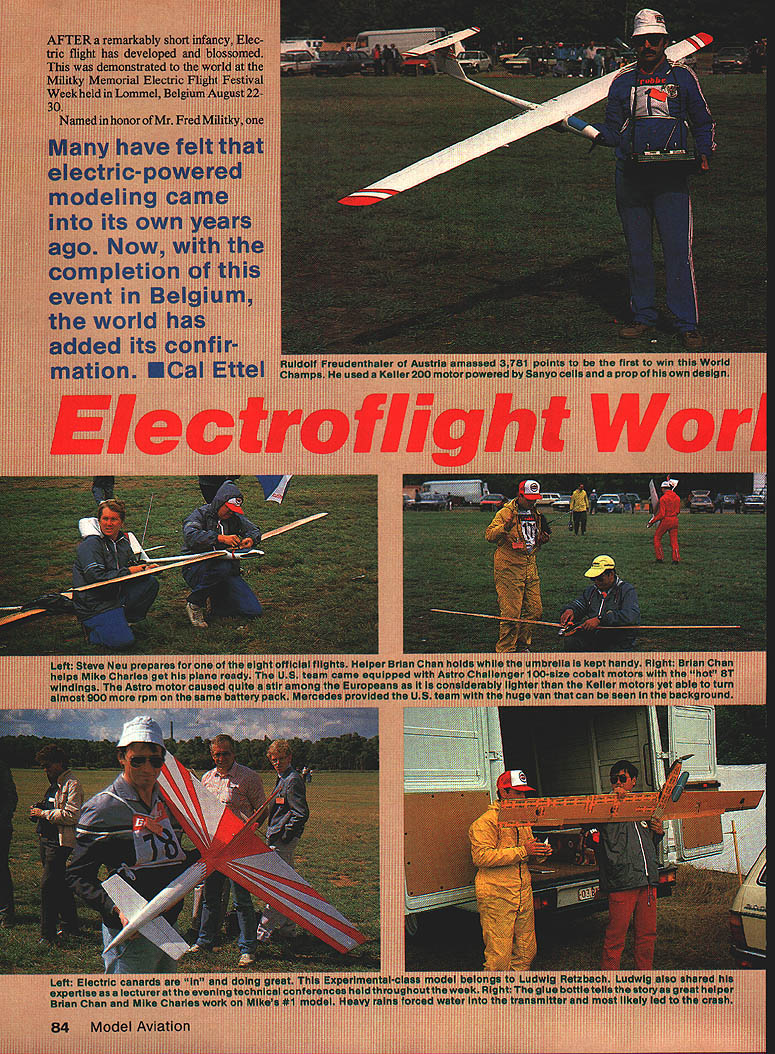


Electroflight World Championships
After a remarkably short infancy, electric flight has developed and blossomed. This was demonstrated to the world at the Militky Memorial Electric Flight Festival Week held in Lommel, Belgium, August 22–30. The festival was named in honor of Mr. Fred Militky.
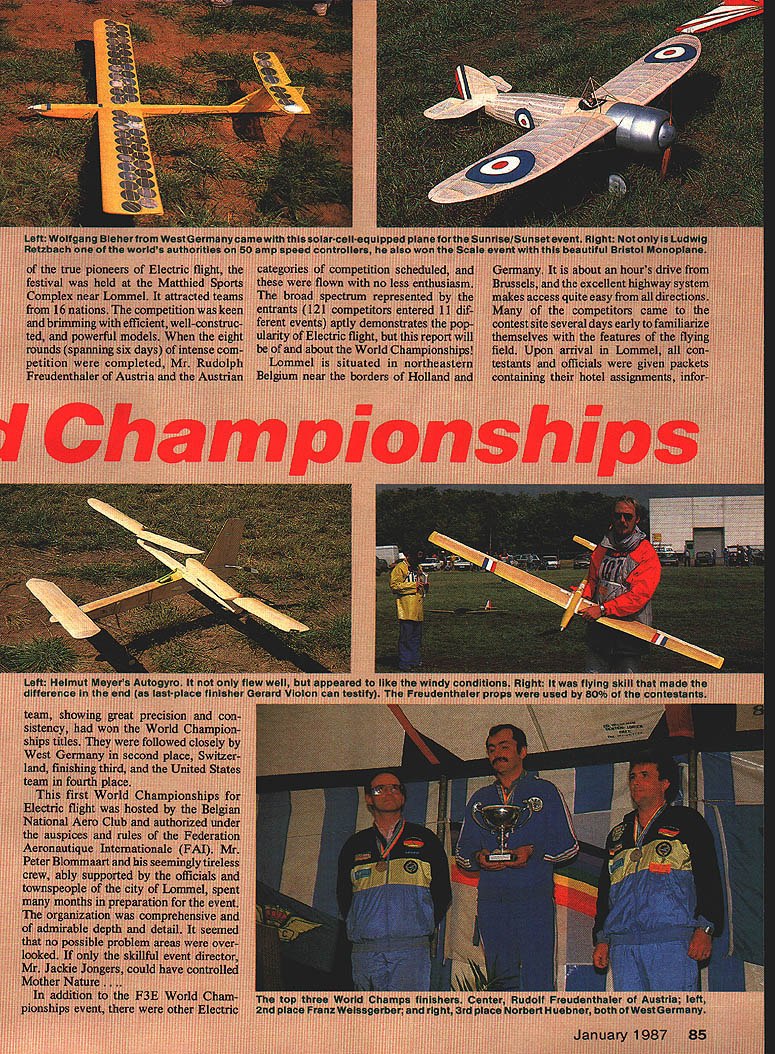
Cal Ettel, one of the true pioneers of electric flight, reported that the event was held at the Matthied Sports Complex near Lommel and attracted teams from 16 nations. The competition was keen and brimming with efficient, well-constructed, and powerful models. When the eight rounds (spanning six days) of intense competition were completed, Mr. Rudolph Freudenthaler of Austria and the Austrian team, showing great precision and consistency, had won the World Championship titles. They were followed closely by West Germany in second place, Switzerland in third, and the United States team in fourth.
This first World Championships for electric flight was hosted by the Belgian National Aero Club and authorized under the auspices and rules of the Fédération Aéronautique Internationale (FAI). Mr. Peter Blommaert and his seemingly tireless crew, ably supported by the officials and townspeople of Lommel, spent many months in preparation for the event. The organization was comprehensive and of admirable depth and detail; it seemed that no possible problem areas were overlooked. If only the skillful event director, Mr. Jackie Jongers, could have controlled Mother Nature.
In addition to the F3E World Championships event, there were other electric categories of competition flown with no less enthusiasm. The broad spectrum represented by the entrants (121 competitors entered 11 different events) aptly demonstrates the popularity of electric flight, but this report focuses on the World Championships.
Lommel is situated in northeastern Belgium near the borders of the Netherlands and Germany, about an hour's drive from Brussels. Many competitors arrived several days early to familiarize themselves with the flying field. Upon arrival, contestants and officials received packets containing hotel assignments and event information.
Friday, August 22 was the official arrival date. The first meeting of team managers, jury, and event officials took place that evening. Saturday was devoted to F3E team practice flying and official model processing. Tension and excitement were noticeable as the beginning of official competition drew near.
Weather forecasts for the week of competition were grim: Hurricane Charlie, which had brushed the New England coast a week earlier, stalled over the North Sea and produced an entire week of unfavorable weather for the contest.
The F3E Event (format and model typicals)
The F3E event is flown in rounds; each flight includes two consecutive tasks before landing.
- Distance task
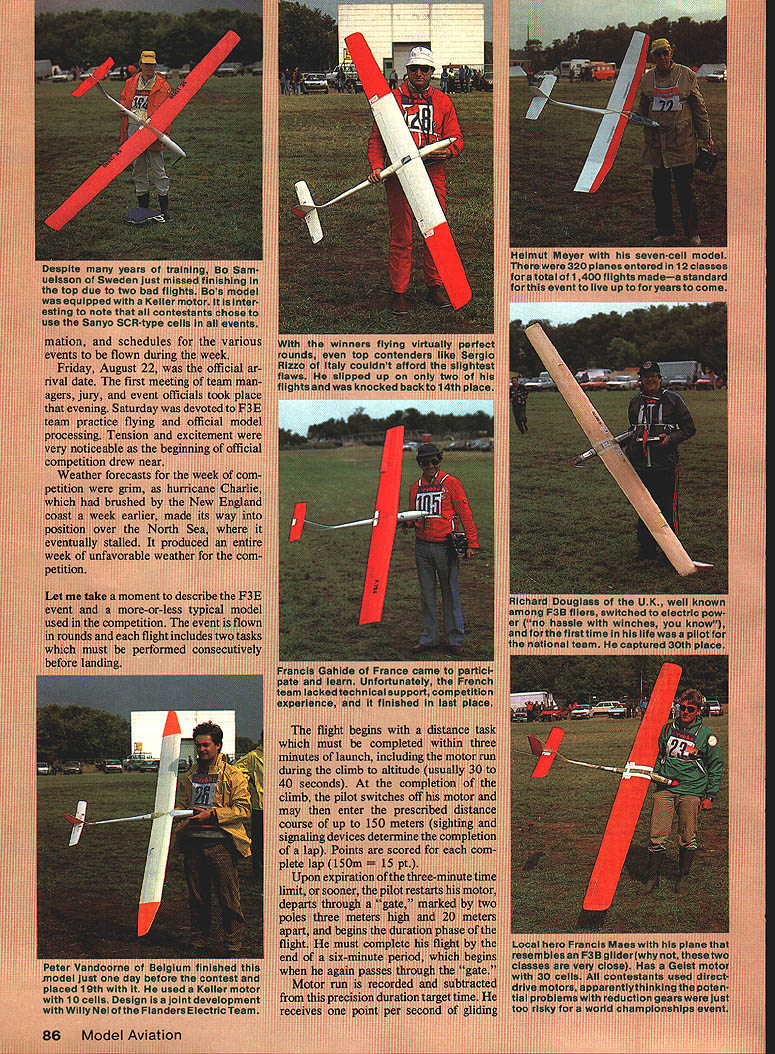
- The flight begins with a distance task that must be completed within three minutes of launch, including the motor run during the climb to altitude (usually 30–40 seconds).
- After the climb, the pilot switches off the motor and may enter the prescribed distance course of up to 150 meters per lap. Points are scored for each complete lap (150 m = 15 points).
- Duration task and landing
- Upon expiration of the three-minute time limit, or sooner, the pilot restarts the motor, departs through a "gate" marked by two poles three meters high and 20 meters apart, and begins the duration phase.
- The precision duration begins when the model passes through the gate; the pilot must complete the flight by the end of a six-minute period that begins at that moment. Motor run during this phase is recorded and subtracted from the precision target time. Pilots receive one point per second of gliding from the precision duration target time.
- The flight is followed by a precision landing. Two concentric circles mark the landing spot: the larger circle (30 m diameter) nets 15 points; the smaller circle (15 m diameter) nets 30 points.
- The combined points for distance, duration (adjusted for motor run), and landing produce the contestant's score for the round.
Typical F3E model characteristics observed at the championships:
- Wingspan: 2.5 to 3.5 meters.
- Weight: very close to the 5,000-gram maximum.
- Surface area: maximum 150 square decimeters; average just under 70 square decimeters.
- Surface loading: between roughly 12 and 75 grams per square decimeter; championship average just under 70 g/dm².
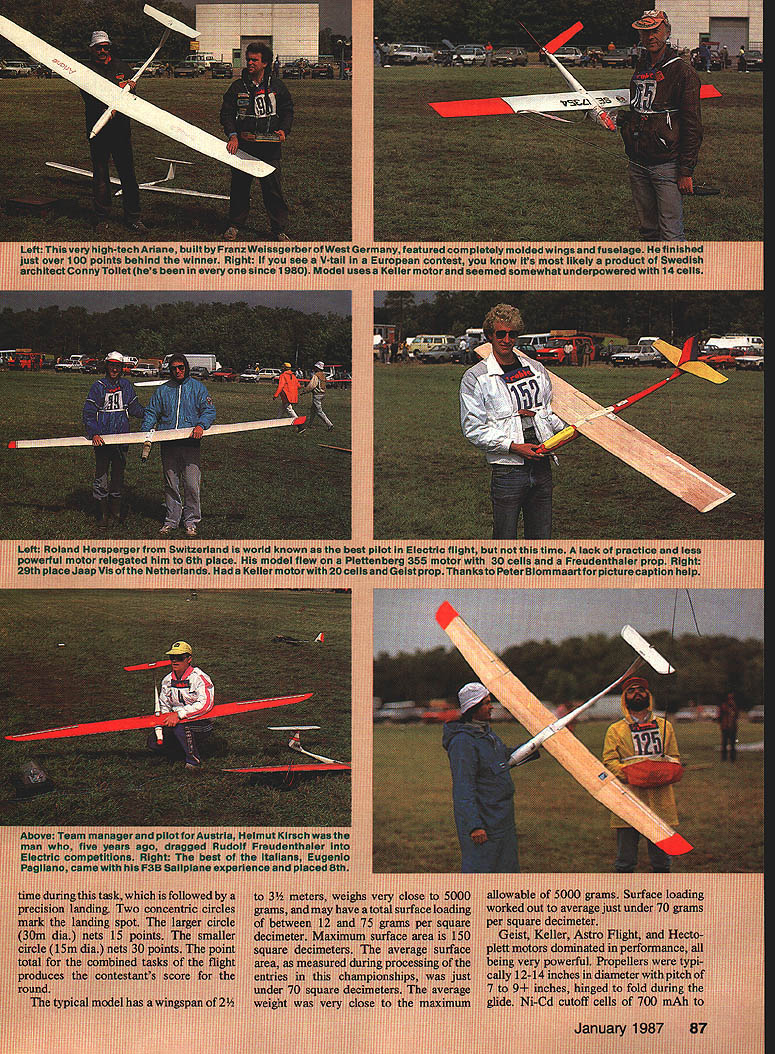
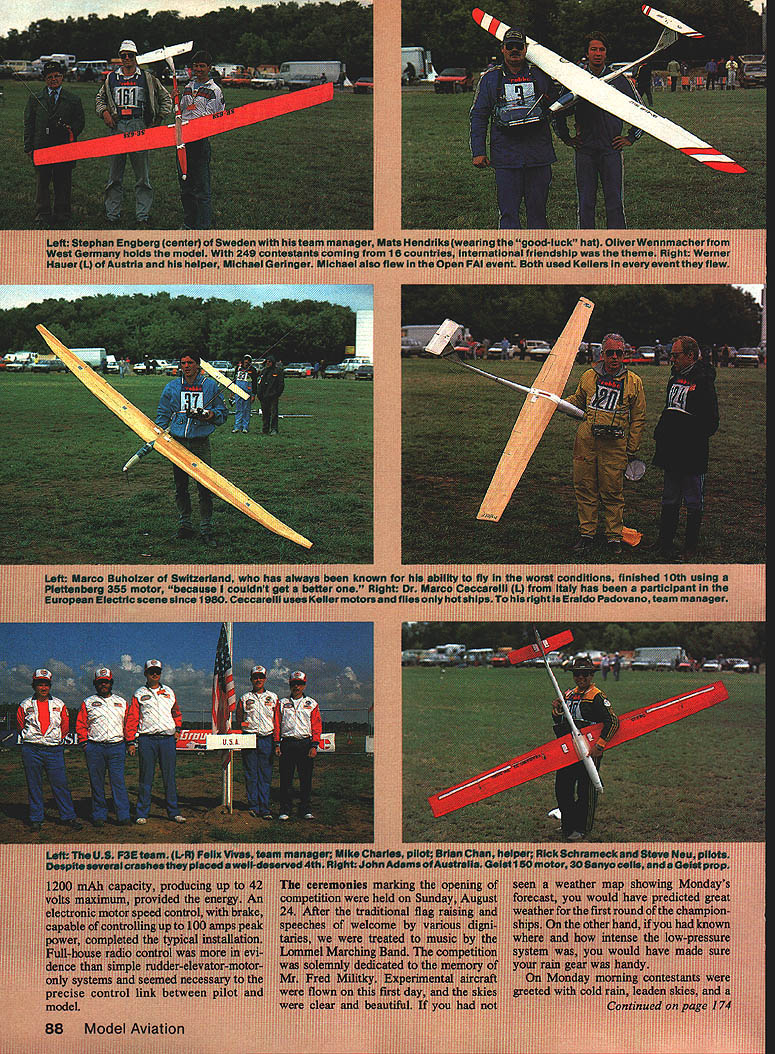
- Motors: Geist, Keller, Astro Flight, and Hectopel dominated performance.
- Propellers: typically 12–14 inches in diameter with 7–9 inch pitch, hinged to fold during the glide.
- Batteries: Ni-Cd cutoff cells of 700–1,000 mAh were common; some packs up to 1,200 mAh produced up to 42 volts.
- Electronics: electronic motor speed controls with brake capable of up to 100-amp peak power were common.
- Radio: full-house radio control (more than rudder-elevator-motor-only) was prevalent and facilitated precise control.
Opening and early rounds
The opening ceremonies were held Sunday, August 24, with flag raising, welcomes, and music by the Lommel Marching Band. The competition was solemnly dedicated to the memory of Mr. Fred Militky. Experimental aircraft flew that day and the skies were clear—unfortunately a poor indicator of the weather to come.
Monday morning greeted contestants with cold rain, leaden skies, and a freshening wind. The weather would test teams' mettle, challenge preparedness and resolve. There were no faint‑hearted pilots—teams came to fly, and fly they did. The caliber of flying exhibited by the teams proved that their national aero clubs had chosen well.
Rudolph Freudenthaler was first to fly in Round One and immediately set a challenging pace: 21 laps, 296 seconds of glide time (out of 300 seconds allowed for the gliding task), and a perfect 30-point landing. His total for the round was 641 points. Seven other contestants scored well over 600 that round, indicating the high level of competition.
Round Two, flown Tuesday, proceeded in worsening weather. Rain persisted and wind increased to just under the event maximum of 12 meters per second, with higher gusts. U.S. hopes suffered when Mike Charles developed a radio problem—possibly water inside his transmitter—shortly after the launch of his #1 model, resulting in severe damage. With his launch time still valid, Mike quickly launched his backup model, only to lose it to a strong gust as he completed his 17th distance lap.
At one point the U.S. team appeared down to two contenders, Steve Neu and Rick Schrameck, and a high team placing seemed unlikely. Through determination—and a lot of epoxy and tape—they later succeeded in making one flyable plane from bits and pieces of the two damaged models. Mike was able to continue in the event and help his team to a creditable finish—Phoenix would have been an appropriate name for the rebuilt model.
Round Four produced an astonishing display of model efficiency and pilot skill. Franz Weissgerber of West Germany, flying his high-tech all‑fiberglass model, the Ariane, achieved a perfect 300-second duration with a 30-point landing—and no motor run during the duration! By using the energy from his departure through the gate (motor off), Weissgerber reached an apparent altitude of 40–50 meters and, with careful tactical planning, found ridge lift from a band of trees and a nearby factory building that allowed him to obtain the perfect duration. He received a standing ovation.
To determine individual and team standings, eight rounds were flown and each competitor’s lowest round score was dropped.
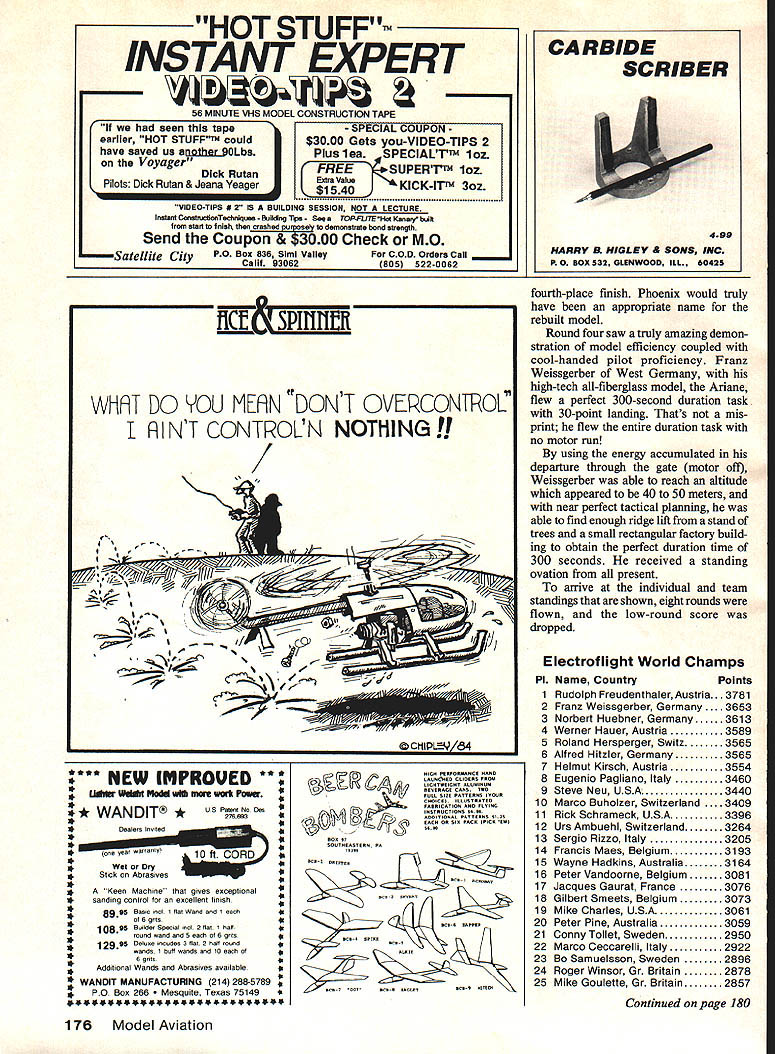
Results — Individual standings
- Rudolph Freudenthaler, Austria . . . 3781
- Franz Weissgerber, Germany . . . 3653
- Norbert Huebner, Germany . . . 3613
- Werner Hauer, Austria . . . 3589
- Roland Hersperger, Switzerland . . . 3565
- Alfred Hitzler, Germany . . . 3564
- Helmut Kirsch, Austria . . . 3554
- Eugenio Pagliano, Italy . . . 3540
- Steve Neu, U.S.A. . . . 3440
- Marco Buholzer, Switzerland . . . 3409
- Rick Schrameck, U.S.A. . . . 3296
- Urs Ambuehl, Switzerland . . . 3264
- Sergio Rizzo, Italy . . . 3205
- Francis Maes, Belgium . . . 3193
- Wayne Hudkins, Australia . . . 3164
- Peter Vandoorne, Belgium . . . 3081
- Jacques Gaurat, France . . . 3076
- Gilbert Smeets, Belgium . . . 3073
- Mike Charles, U.S.A. . . . 3061
- Peter Ronde, Australia . . . 3059
- Conny Tollet, Sweden . . . 2950
- Marco Ceccarelli, Italy . . . 2922
- Bo Samuelsson, Sweden . . . 2896
- Roger Winsor, Great Britain . . . 2878
- Mike Goulette, Great Britain . . . 2857
Results — Team standings
- Austria . . . 12711
- Germany . . . 12681
- Switzerland . . . 11983
- U.S.A. . . . 11628
- Italy . . . 11268
- Belgium . . . 10958
- Australia . . . 10677
- Sweden . . . 10049
- Great Britain . . . 9857
- Netherlands . . . 9634
- France . . . 8972
A freshening wind tested the teams’ mettle and challenged their preparedness and resolve. Round One proved there were no faint‑hearted pilots: the teams came to fly, and the caliber of flying exhibited matched the high expectations readers have come to associate with Model Aviation.
Transcribed from original scans by AI. Minor OCR errors may remain.

