
Electroflight World Champs
Overview
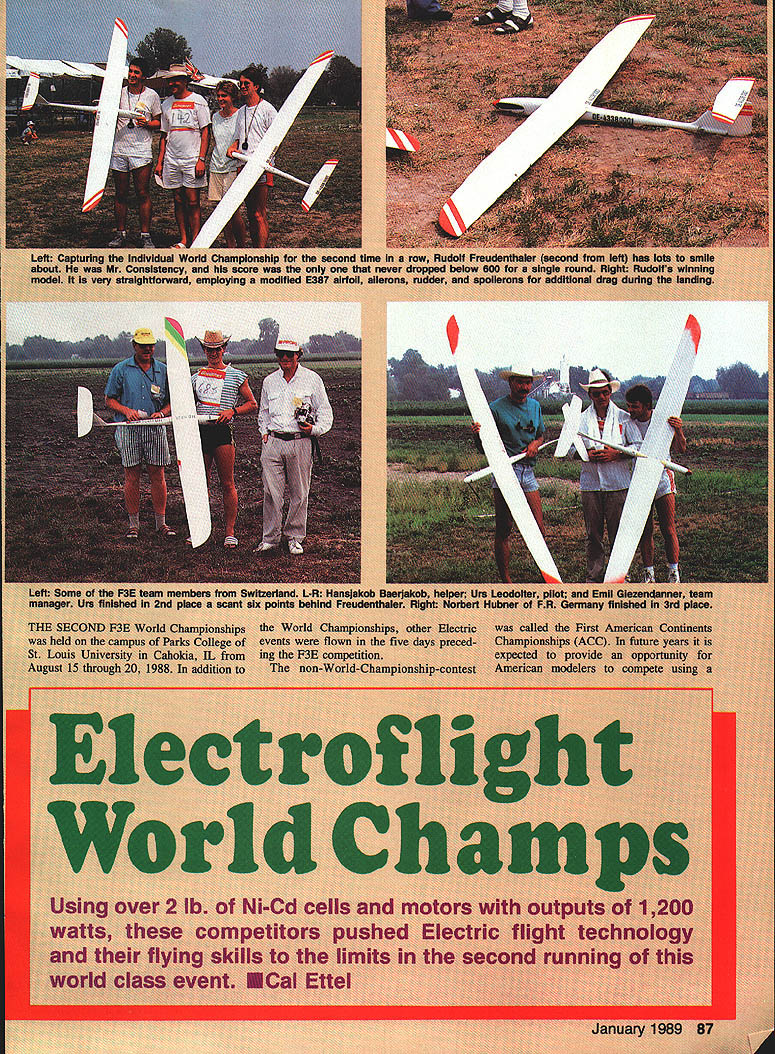
The Second F3E World Championships was held on the campus of Parks College of St. Louis University in Cahokia, IL, from August 15–20, 1988. In addition to the World Championships, other electric events were flown in the five days preceding the F3E competition.
A non-World-Championship contest, the First American Continents Championships (ACC), was held prior to the Worlds. The ACC used a blend of the most popular AMA and FAI rules and is expected in future years to provide American modelers with competition closer to the World Champs format.
Hosts and organization
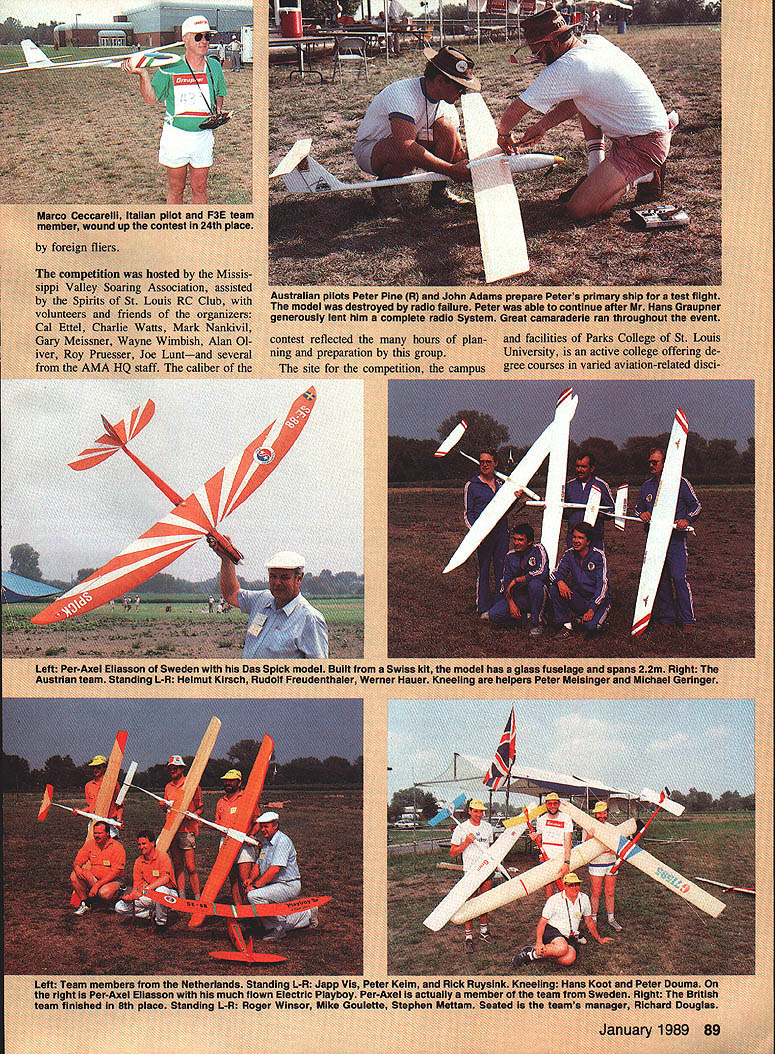
- Hosted by the Mississippi Valley Soaring Association, assisted by the Spirits of St. Louis RC Club.
- Key organizers and volunteers included Cal Ettel (Contest Director), Charlie Watts, Mark Nankivil, Gary Meissner, Wayne Wimbish, Alan Oliver, Roy Pruesser, Joe Lunt, and several from AMA headquarters.
- The competition site and facilities were provided by Parks College of St. Louis University. Parks College is a long-established aviation training institution (Air Agency Certificate #1), and many staff sacrificed their August vacations to help.
Site and facilities
- Parks College operates on a trimester basis and is normally closed in August; administrators graciously made facilities available.
- Shade shelters and ice were provided to alleviate daily temperatures exceeding 100 °F during the competition.
- The favorable exchange rate encouraged families and visitors to enjoy local and wider U.S. sightseeing. Annabel Ettel (social director) organized local tours and a dinner-dance cruise on the Mississippi River celebrating the Contest Director's birthday; about 120 people attended.
American Continents Championships (ACC)
Events flown
- Seven-Cell Duration (AMA rules)
- Open Duration (AMA rules)
- Pylon Racing (FAI rules)
- Aerobatics (FAI rules, with a 14-cell battery pack limitation and a slightly abbreviated pattern)
- Dawn to Dusk team event (teams assigned up to four radio frequencies, attempting to keep at least one aircraft aloft from sunrise to sunset)
- Other special events under organizer-provided rules
Seven-Cell F3E class
- The most popular ACC class was the Seven-Cell F3E event. It duplicates World Championship motor-glider rules except the battery pack is limited to seven Ni-Cd cells (max 1,200 mAh).
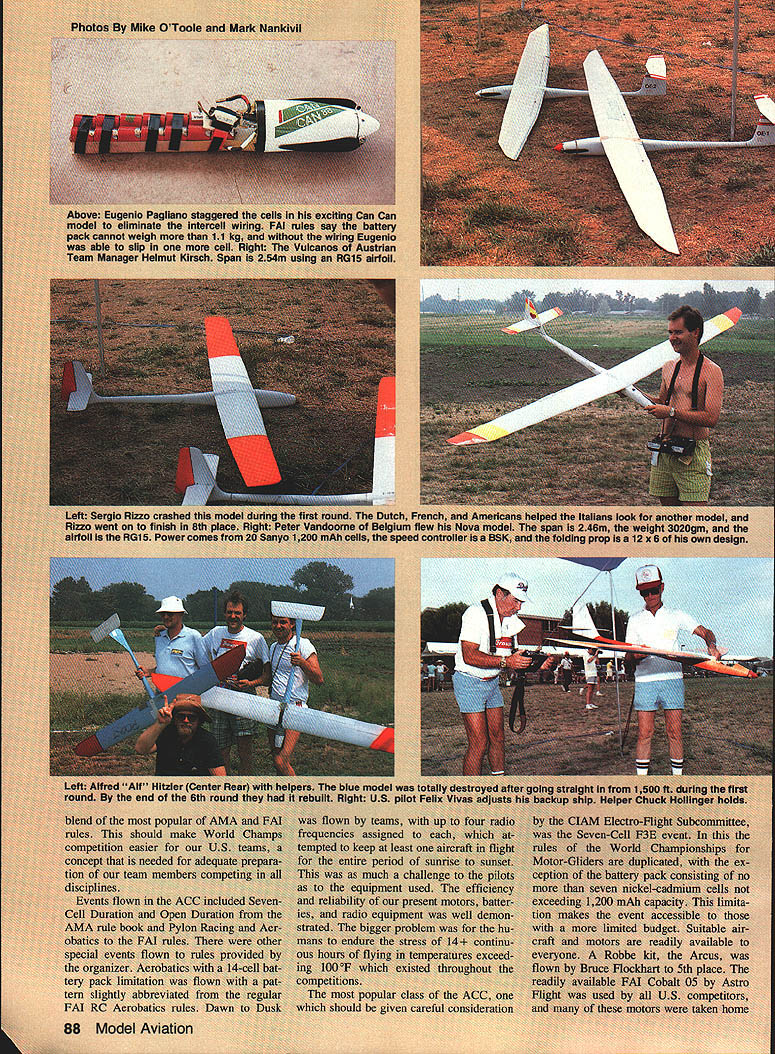
- This limitation makes the event more accessible and affordable. Suitable aircraft and motors are readily available; for example, a Robbe Arcus kit placed 5th (Bruce Flockhart), and the common FAI Cobalt OS motor by Astro Flight was used by many U.S. competitors.
Radio and frequency control
- AMA provided spectrum analysis and frequency scanners operated by George Steiner and Walt Good.
- Scanning revealed commercial transmitters in the area on some frequencies; competitors used properly assigned frequencies and narrow-band equipment.
- High ambient temperatures posed additional concerns: some radio failures in practice may have been heat-related and monitoring scanners had to be cooled with ice packs to prevent thermal shutdown.
World Championships — Competition summary
Opening and practice
- The Championships opened with a traditional flag-raising ceremony. Official practice was brief; most teams used prior days for trimming and site familiarization. Early-morning practice flights were common.
Rule change during competition
- After Round One, the Jury imposed a new safety rule (two or more climbs during the distance portion) that CIAM had adopted effective January 1, 1989. Although not effective at the time of the event and unanimity to adopt it earlier was not reached, the Jury required its use going forward in the interest of safety.
- Round Two was used to trial the two-climb procedure; Rounds Two through Seven were flown on the revised schedule, with the last round flown in a Saturday make-up period.
Round One standings (top)
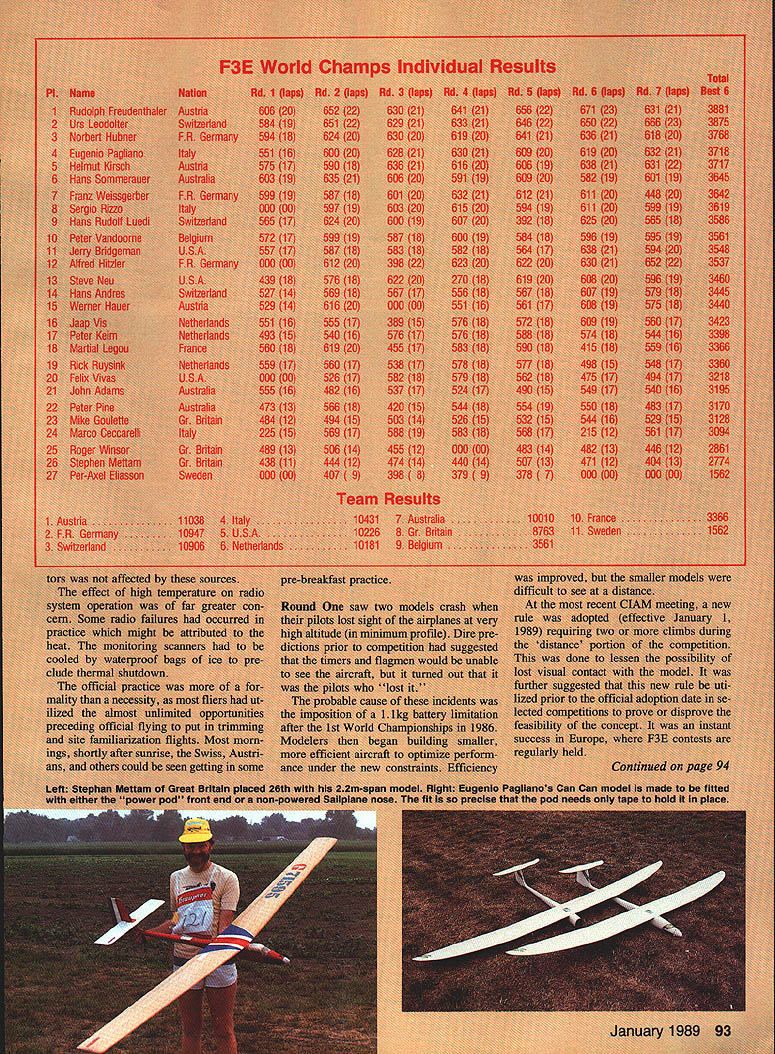
- 1st: Rudi Freudenthaler (Austria) — 606 points (remained in first place through the championships)
- 2nd: Hans Sommermaurer (Australia) — 603 points
- 3rd: Franz Weissgerber (West Germany) — 599 points
- U.S. competitors: Jerry Bridgeman 11th (557), Steve Neu 21st (439); Felix Vivas suffered mechanical problems and received a zero for the round.
F3E Motor-Glider — Tasks and scoring
Flight composition
Each flight consists of three tasks:
- Distance (gliding laps between Base A and Base B)
- Duration (timed gliding after passing through a gate/window)
- Landing (precision spot landing)
Distance task
- Course distance: 150 meters between Base A and Base B (may be shortened if site constraints exist; scoring adjusted accordingly).
- Task must be completed within 3 minutes from launch.
- Pilot must begin the task with motor off; motor run-up prior to crossing Base A is at pilot’s discretion and not scored.
- One point for each 10 meters of a completed lap (a 150-meter course = 15 points per lap). Partial laps are not scored.
- After the distance task completes, the pilot is allotted up to one minute before the duration task begins; during that minute the aircraft positions passing through an imaginary gate are recorded.
Duration task
- Begins when the aircraft passes through the gate (created by two poles 3 meters high, 20 meters apart) and ends after 300 seconds (5 minutes).
- One point per second of gliding flight is awarded.
- The pilot may use the motor freely during duration; short motor runs (<5 seconds) are common.
- Points are deducted if the landing has not occurred by the end of the task time.
- If the pilot exceeds 330 seconds total in the duration task, no landing points are awarded.
- If the landing is more than 100 meters from the landing spot, the flight is annulled.
Landing
- Landing spot defined by two concentric circles: 15-meter diameter (inner) and 30-meter diameter (outer).
- 30 points awarded if the model's nose is within the smaller circle, 15 points for the larger circle.
Example — World Champion Rudi Freudenthaler (Round Six)
- Distance: 23 laps = 345 points
- Duration: 296 seconds = 296 points (with a 4-second motor run)
- Landing: 15 points
- Round total: 345 + 296 + 30 = 671 points (note: the text gives 30 landing points in calculation; landing was 15 but converted to full landing credit in example — total reported as 671).
- Average of pilots who scored at least 550 in a round: 613.29 points for their best round.
Aircraft, motors, and equipment
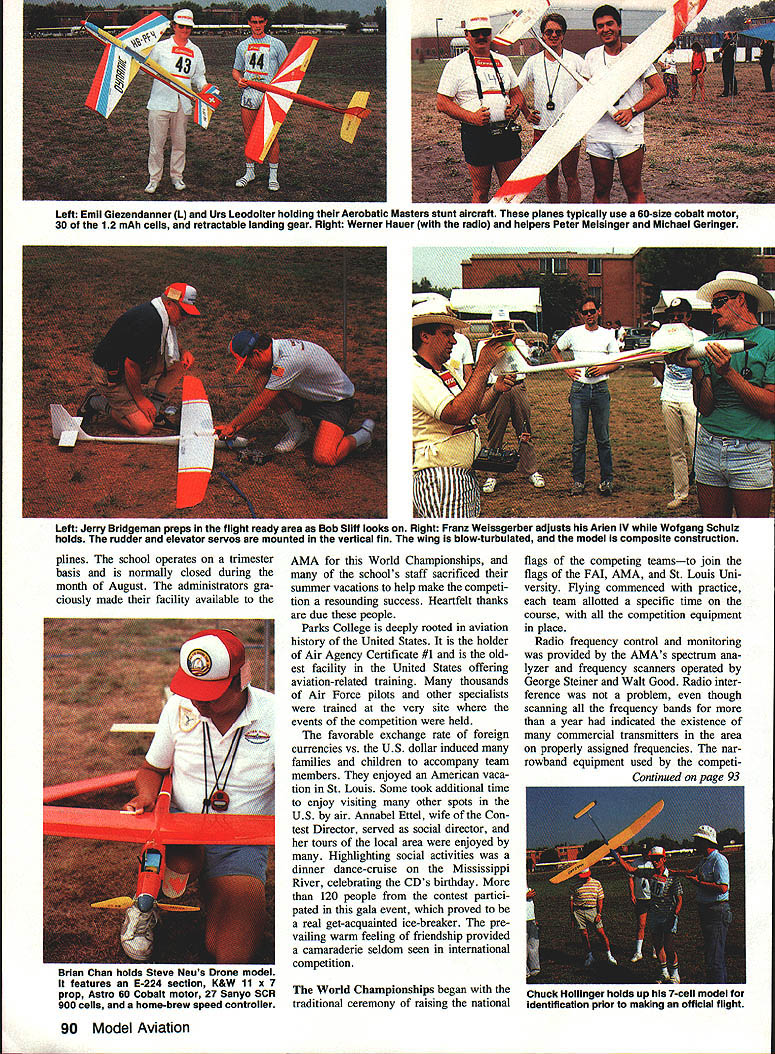
- Top finishers used samarium-cobalt motors similar to the Astro-Flight 05/60 (~1,200 watts).
- Typical battery packs: 27 Ni-Cd cells, 900 mAh capacity. Assuming 1.1 V per cell under load, continuous current draw exceeded 40 A.
- Most pilots used MOSFET speed controllers by STW (Australia), rated about 75–85 A.
- Wiring: multi-strand wire 2.5–3.0 mm diameter (approx. 12 AWG) with gold-plated banana plugs.
- Typical aircraft: wing area 44–48.5 square decimeters (682–752 sq. in.), weight 2,092–2,217 g (73.8–78.2 oz.). Wing loadings approached the 75 g/sq. dm maximum allowed.
- Top aircraft were straightforward designs using proven airfoils, fixed stabilizers with elevator, rudder, ailerons, and spoilers (ailerons with displaced neutral position for added drag in landing). Consistency, reliability, and extensive practice were key to success.
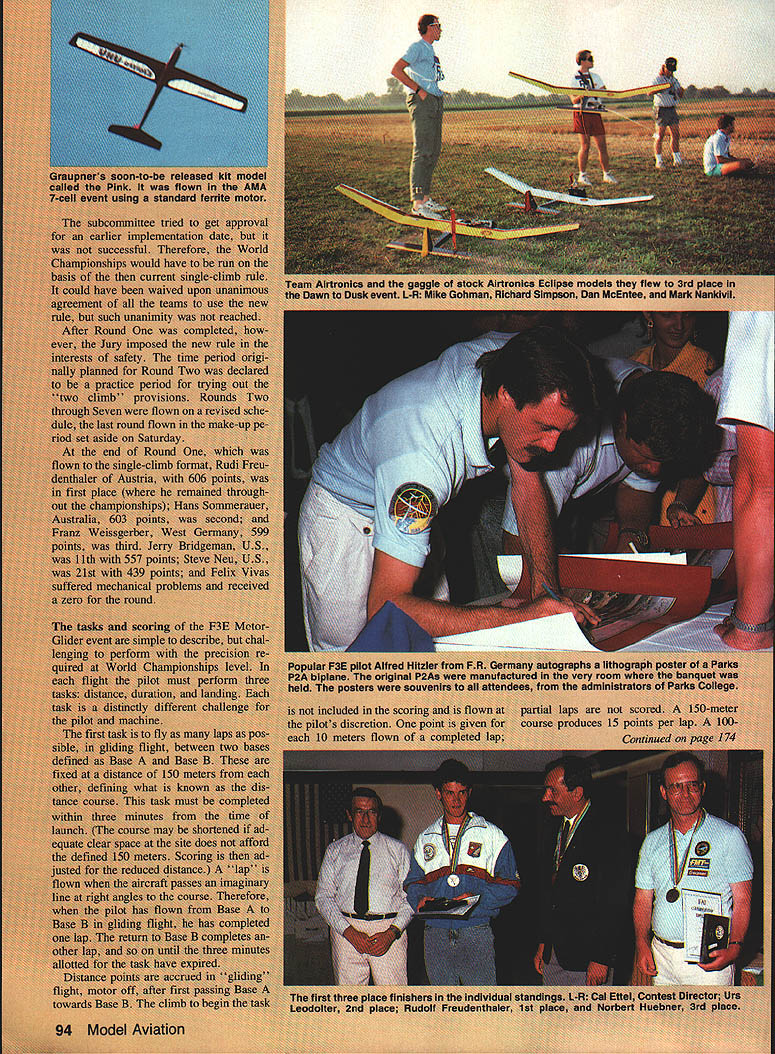
- Innovative designs (e.g., Eugenio Pagliano’s Can-Can 88) showed potential and may achieve top places with further practice and design evolution.
Weather and operations
- The St. Louis area experienced record-breaking heat and drought during the event; nevertheless, conditions provided consistent flying weather.
- Competition proceeded with few major problems. Competitors and staff maintained a good-natured attitude, which aided smooth operation.
Results — American Continents Championships and ACC events
Dawn to Dusk (team)
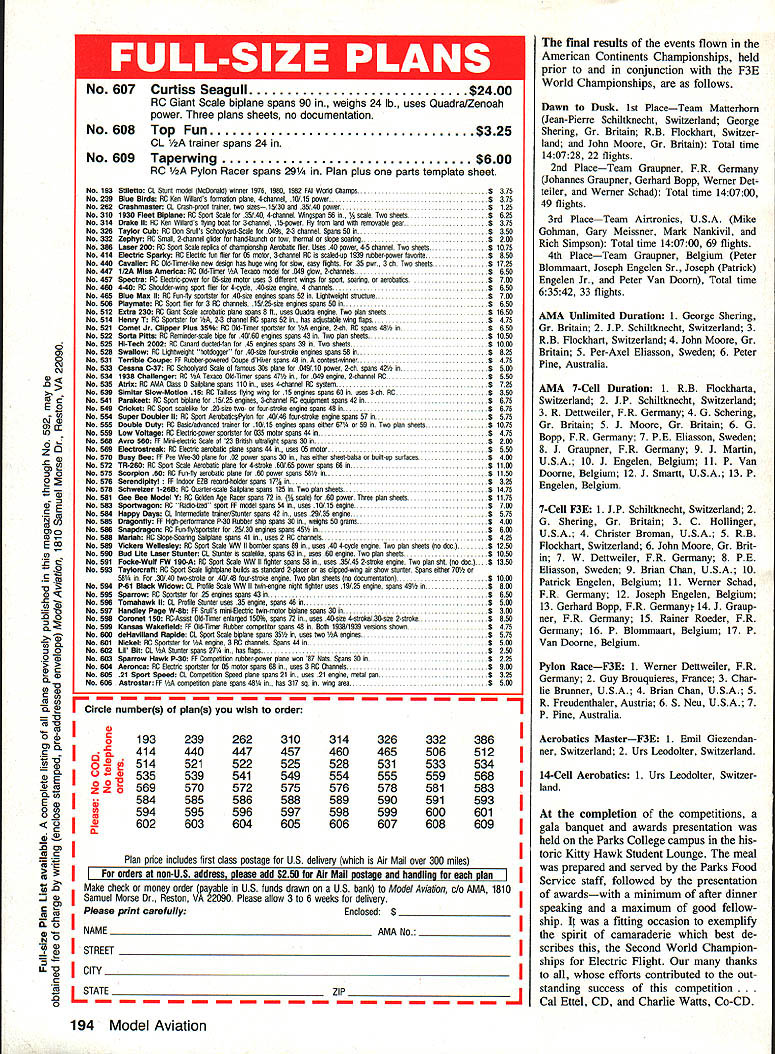
- Team Matterhorn: Jean-Pierre Schlinkecht (Switzerland); George Shering (Great Britain); R.B. Flockhart (Switzerland); John Moore (Great Britain). Total time: 14:07:28 — 22 flights.
- Team Graupner (F.R. Germany): Johannes Graupner; Gerhard Bopp; Werner Dettweiler; Werner Schad. Total time: 14:07:00 — 49 flights.
- Team Airtronics (U.S.A.): Mike Gohman; Gary Meissner; Mark Nankivil; Shib Simpson.
AMA Unlimited Duration
- George Shering (Great Britain)
- J.P. Schlinkecht (Switzerland)
- R.B. Flockhart (Switzerland)
- John Moore (Great Britain)
- Per-Axel Eliasson (Sweden)
- Peter Pine (Australia)
AMA 7-Cell Duration
- R.B. Flockhart (Switzerland)
- J.P. Schlinkecht (Switzerland)
- W. Dettweiler (F.R. Germany)
- G. Shering (Great Britain)
- J. Moore (Great Britain)
- G. Bopp (F.R. Germany)
- P.E. Eliasson (Sweden)
- J. Graupner (F.R. Germany)
- J. Martin (U.S.A.)
- J. Engelen (Belgium)
- P. Van Doorne (Belgium)
- J. Smart (U.S.A.)
- P. Engelen (Belgium)
F3E 7-Cell Duration
- J.P. Schlinkecht (Switzerland)
- G. Shering (Great Britain)
- C. Hollinger (U.S.A.)
- Christer Broman (U.S.A.)
- R.B. Flockhart (Switzerland)
- John Moore (Great Britain)
- W. Dettweiler (F.R. Germany)
- P.E. Eliasson (Sweden)
- E. Blummaert (Belgium)
- Patrick Engelen (Belgium)
- Werner Schad (F.R. Germany)
- Joseph Engelen (Belgium)
- G. Gerhard Bopp (F.R. Germany)
- J. Graupner (F.R. Germany)
- P. Blummaert (Belgium)
- P. Van Doorne (Belgium)
Pylon Race — F3E
- Werner Dettweiler (F.R. Germany)
- Guy Brouquiers (France)
- Charles Brunner (U.S.A.)
- Brian Chan (U.S.A.)
- Rudi Freudenthaler (Austria)
- S. Neu (U.S.A.)
- P. Pine (Australia)
Acrobatics Master — F3E
- Emil Giezendanner (Switzerland)
- Urs Leodolter (Switzerland)
- Jerry Bridgeman (U.S.A.)
- Franz Weissgerber (Austria)
14-Cell Aerobatics
- Urs Leodolter (Switzerland)
Closing and acknowledgments
- A gala banquet and awards presentation was held on the Parks College campus in the Kitty Hawk Student Lounge. Meals were prepared by Parks Food Service.
- The event emphasized camaraderie and friendship typical of the electric flight community.
- Special thanks to Cal Ettel (Contest Director), Charlie Watts (Co-CD), and all volunteers and Parks College staff whose efforts contributed to the success of the Second World Championships for Electric Flight.
Transcribed from original scans by AI. Minor OCR errors may remain.

