
Electronic Pylon Race Controller
By Hal deBolt and the West Jersey RC Club
If you have been involved in pylon racing, you know the need for positive control of "what is happening." When such control is present, races run smoothly, problems are eliminated and the time required to run each heat drops drastically.
This article describes a first effort to successfully operate a pylon race with a rudimentary form of computer. While some large auto races are completely controlled by computers, this electronic system is a step in that direction and can be expanded. Although the details are aimed at RC pylon racing, other forms of racing (boats, cars) can examine the system for ideas adaptable to their needs.
Normally, race control is provided by officials whose work supplies the needed information about each heat. This human operation works well, but it requires the necessary number of people at the correct times and officials who understand their roles and perform flawlessly. In areas with little racing experience, developing such officials can take time. An electronic approach can reduce dependence on experienced personnel.
The West Jersey RC Club, new to RC pylon racing and enthusiastic about the Sport Pylon version, developed a substitute electronic starting and lap-counting pilot's information console to supplement manual methods. The intent is to reduce errors and relieve some tedious tasks from officials. Construction involves some cost and effort, but the system proves valuable over many races as a hidden asset and attraction that encourages racing under controlled conditions.
System Overview
The system includes:
- A master control console manned by officials.
- Telephone communications linking the control center with the starter and other course officials.
- A pilots' information (fliers') display console.
- A bell to signal events at the start of heats.
- Stooge anchors that hold models and release them automatically on the starter's command.
- Stopwatches and lamp indicators for lap recording.
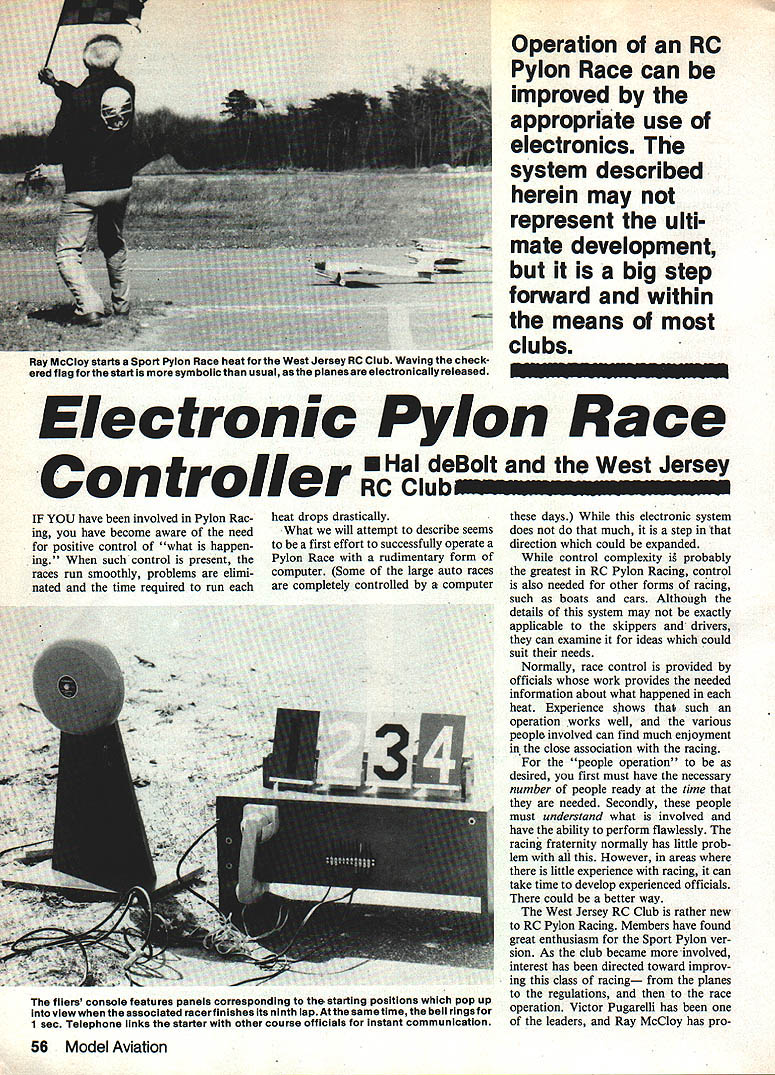
The master console is a table divided into five panels: one central starter/officials' panel and four outer model panels (one per aircraft). Each model panel is manned by an official.
Master Console and Model Panels
The center starter's panel includes:
- Two pushbuttons used together to start a heat.
- Four LED lights to indicate the start and other conditions.
A race heat is started by pressing the two starter buttons simultaneously. This activates the stooge releases and starts the associated stopwatches automatically. The start is recorded on separate LED lights.
Each of the four model panels includes:
- A pushbutton control.
- A sequence of ten LED lights showing lap progress.
As a model flies laps, the model panel button is pushed to advance the lamps in sequence. At the completion of the 10th lap the tenth lamp remains lit and the stopwatch stops automatically, positively recording the heat time. If a plane drops out, the currently lit lamp indicates the last lap completed.
Stooge Anchors
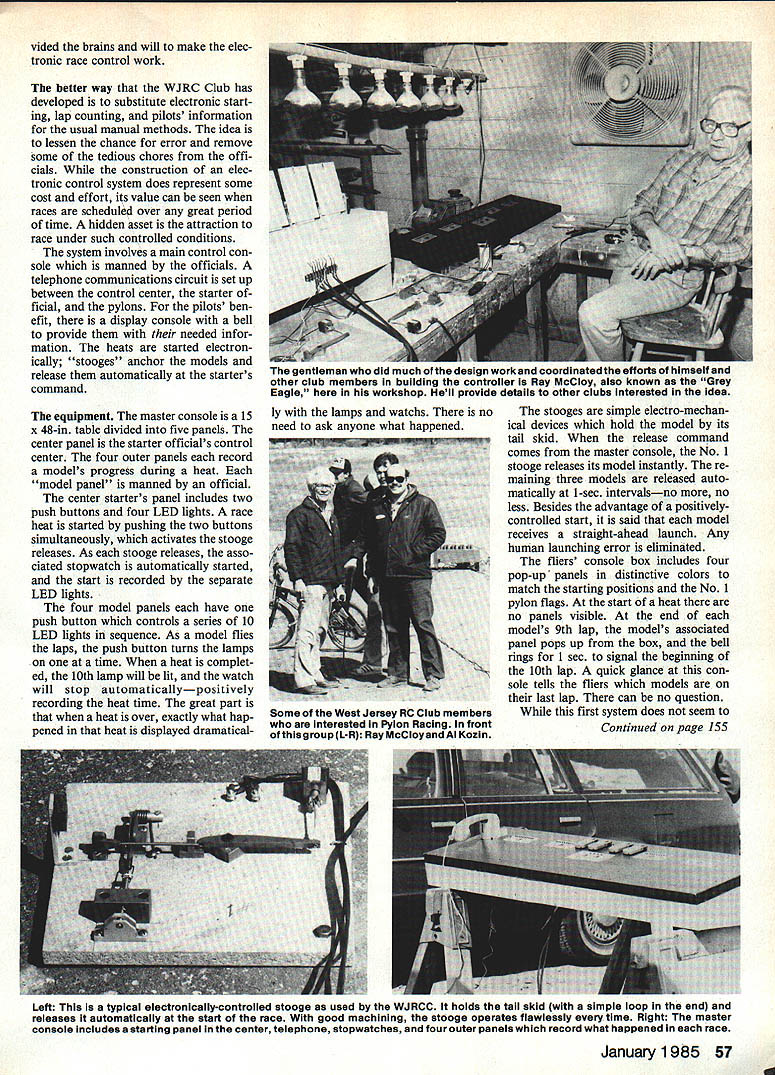
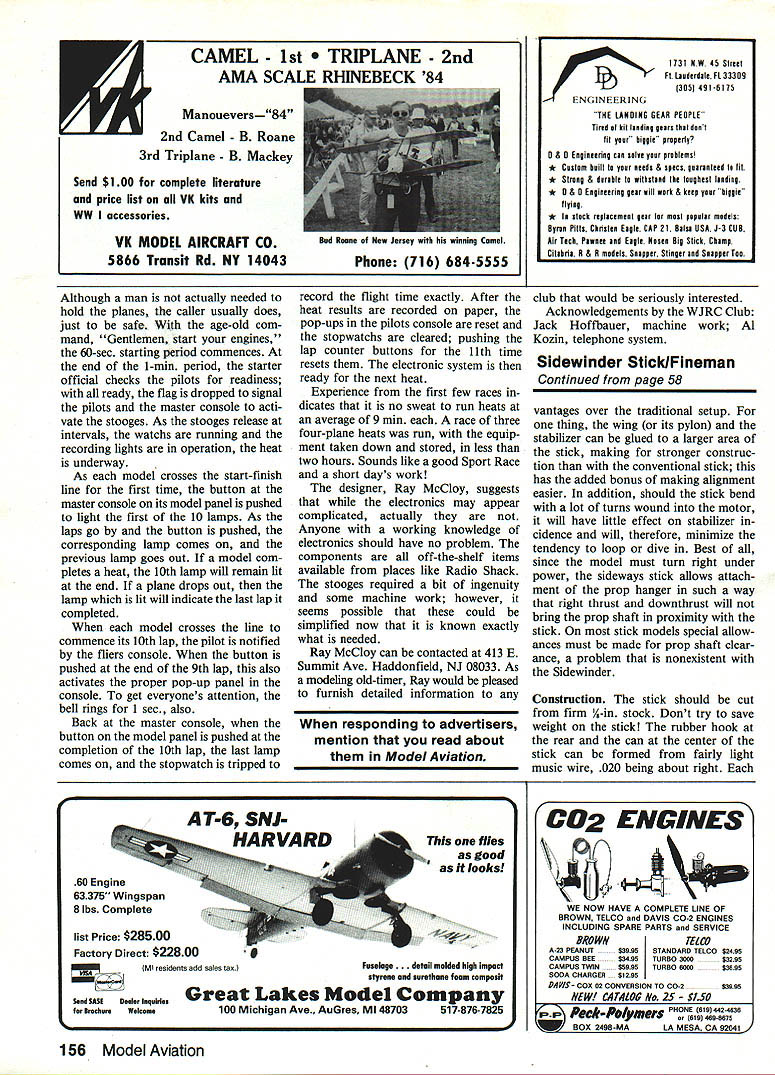
Stooge anchors are simple electro-mechanical devices that hold the model by its tail skid and release on command from the master console.
- No. 1 stooge releases immediately.
- The remaining three stooges release automatically at 1-second intervals.
- This ensures consistent, straight-ahead launches and eliminates human launching error.
Pilots' (Fliers') Console
The fliers' console box includes four pop-up panels in distinctive colors matching the starting positions. At the start of a heat there are no panels visible. At the end of each model's 9th lap (when the associated model panel button is pushed), the corresponding pop-up panel pops up and the bell rings for 1 second to signal the beginning of the 10th lap. A quick glance tells the pilots which models are on their last lap — there can be no question.
A useful additional feature not included in this first system would be an indicator for pylon cuts, so pilots would immediately know who has received a one-lap penalty.
Race Layout and Communications
For racing, the master console is set even with the start-finish line and well off the race course. This reduces confusion at the pilots' area, improves safety, and makes it easier to keep track of the models. The stooges are spaced and anchored across the runway at the start line. The fliers' console is placed at the edge of the runway and positioned to be visible to all pilots during the race. The only officials on the course are the starter and the pylon judges; these people are connected by telephone to the master console.
Conducting an Electronic-Controlled Heat
Ray McCloy describes a typical heat sequence:
- Via telephone the starter identifies each model to all officials and pilots in the usual manner.
- Planes are told to prepare for engine starting and their tail skids are engaged in the stooges. Although a person is not needed to hold the planes, someone usually stands by for safety.
- The command "Gentlemen, start your engines" begins a 60-second starting period.
- At the end of the minute the starter checks pilots for readiness. When all are ready, the flag is dropped to signal pilots and the master console to activate the stooges.
- As stooges release at 1-second intervals, the stopwatches start and the model panel lights begin operating — the heat is underway.
- Each time a model crosses the start-finish line, the model's pushbutton at the master console is pushed to light the next lamp in the 10-lamp sequence. The previous lamp goes out as the next comes on.
- When a model crosses to begin its 10th lap, the pilots' console pop-up and bell signal the pilots.
- When the 10th-lap pushbutton is pressed, the last lamp comes on and the stopwatch trips to record the exact flight time.
- After the heat results are recorded on paper, the pilots' console pop-ups are reset and the stopwatches are cleared. Pushing the lap counter button for an 11th time also resets the counters.
- The system is then ready for the next heat.
Performance and Practical Results
Experience from the first races shows it is easy to run heats averaging about 9 minutes each. A race of three four-plane heats, with the equipment taken down and stored, was completed in less than two hours — a good sport race and a short day's work.
Construction and Availability
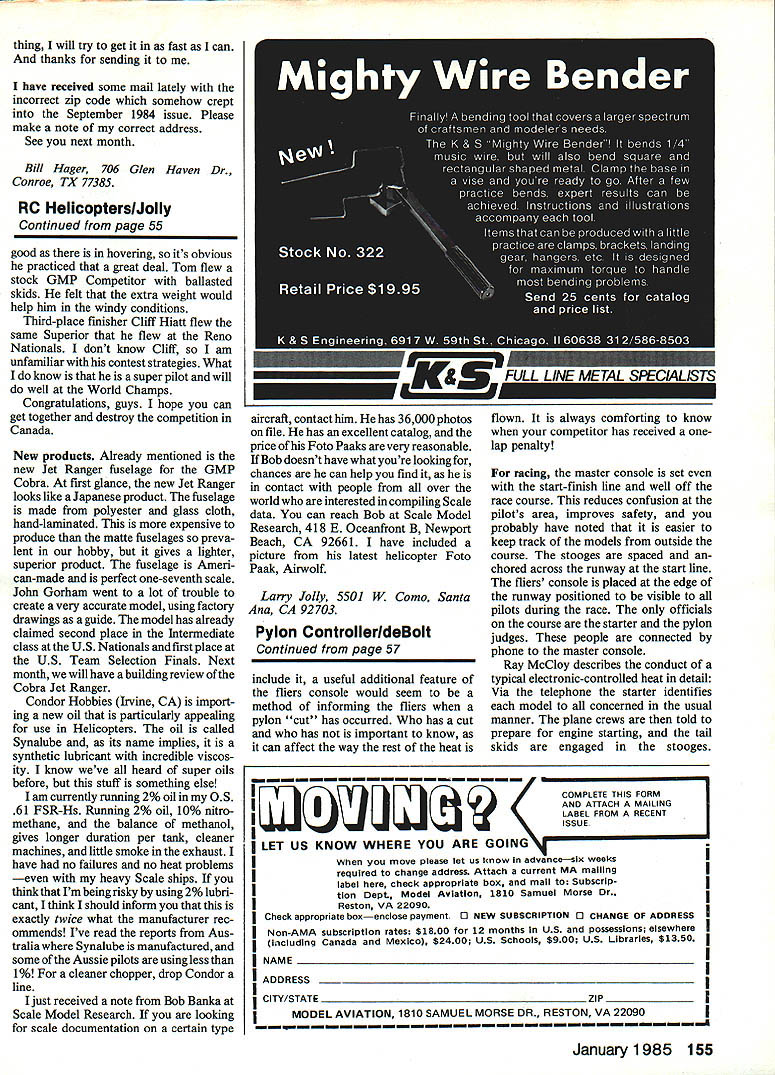
Although the electronics may appear complicated, they are not. Anyone with working knowledge of electronics should have no problems. Components are standard, off-the-shelf items available from suppliers such as Radio Shack. The stooges required some ingenuity and machine work; however, now that requirements are known, the stooges could be simplified.
Ray McCloy can be contacted for detailed information:
- Address: 413 E. Summit Ave., Haddonfield, NJ 08033
Acknowledgements
The West Jersey RC Club thanks:
- Jack Hoffbauer — machine work
- Al Kozin — telephone system
Transcribed from original scans by AI. Minor OCR errors may remain.

