

Eloy Marez
Electronics
Think about the improvements you would like to see in radio control (RC) equipment.
We have come a long way since the days when we depended on a rubber band to furnish the muscle to move the rudder. Now it often seems as if equipment has been developed as far as it can be. However, that is not the case, and every new series of radios brings some new features.
Airtronics RD-6000
The latest is the Airtronics RD-6000. You can say that it is a refinement of older designs such as the Radiant, and there is some truth to that, but the RD-6000 has some previously unheard-of qualities. It is a computer radio—not TOC (Tournament of Champions)-caliber, but with many functions that scare off the uninitiated.
The RD-6000 has two programs. In the Basic program, in addition to the normally used stick functions, only servo reverse, end-point adjustments (servo travel), and dual rates are operative. All of the other stuff might as well not be there.
When you and your airplane are ready, switch to the Advanced program, which brings in all of the popular mixing and coupling functions, exponential, etc. Except for programmed flight—such as roll and snap buttons—almost all useful features are included.
There’s another new feature for those of you who don’t use Dual Rates because you forget you are in Low until you try to flare for landing: when in Low Rate, the transmitter reminds you every 15 seconds or so with a beep, beep, beep!
What you can do
It is still possible to come up with useful new features, and you have a say in what they might be. Well, maybe you don't, but your credit card does, which amounts to the same thing.
You need to do two things:
- Let the manufacturers know what you expect from them, but within reason. Don’t bother asking them to cut prices by 50%. Considering the quality and reliability we now enjoy, RC equipment is reasonable.
- Stop insisting on and being impressed by small size; take a more practical approach in deciding what to ask for.
Would a few ounces make much difference in a model's performance? Consider what could be gained in RC electronics by a few ounces or a few cubic inches—primarily redundancy. Everything mechanical on an airplane has redundancy in its systems, except RC.
Redundancy and backup in receivers
In the history of the industry, one loose transistor or resistor has cost a $5K airplane. The industry could develop receivers with backup circuitry that would cut in automatically in case of failure.
Using the Airtronics RD-6000 receiver as an example, the additional size and weight required for backup circuitry would be negligible compared to the insurance gained. Couldn't you live with a two-cubic-inch, two-ounce tradeoff to never have to worry about receiver failure? Especially on large airplanes, flying two complete airborne systems greatly reduces the chance of total failure.
Battery backups and switching circuitry that select a backup when the main battery becomes depleted or fails have existed for years. Such circuitry could be included in receivers and would accept the added size of a few grams' weight.
Some multi-servo airplanes are being equipped with separate batteries for receiver and servos. The hookup is relatively simple, yet it requires fabrication of special harnesses. Such hookups could easily be included in receivers, simplifying installation and eliminating some messy wiring inside the airplane.
One case-type installation concern is the ability of receiver printed-circuit-board lands to carry the current load caused by a large number of high-current, high-power servos. These lands (metal traces that make internal connections within the receiver) make the necessary battery connections. As conductors, wires are sized by their physical dimensions to determine how much amperage they can handle; if overloaded they will overheat and eventually open. A larger receiver would allow heavier lands and avoid possible damage caused by heavy servo loads.
Servos and motors
Now servos are the ingenious part of the RC system. A great deal of effort has gone into developing the heart of the motor, which converts electricity into the muscle needed to move things. As with other mechanical objects, price is often inversely proportional to size: coreless motors in small servos can cost much, while the motor in a standard larger servo may be only four or five bucks.
The camera industry can be thanked for the small, powerful servos; those small motors were developed for cameras, not the RC industry. Slightly larger servos could be made that are as powerful (or more so), at greatly reduced prices, and there would also be gains in reliability; larger components with greater voltage and current ratings could be used in the electronics.
In more than 100 ounce-inch high-power servos, failure often occurs when the transistors carrying the motor current burn up. The same rule of thumb applies to transistors as to all other conductors: power-handling ability is determined somewhat by size. A larger servo would allow more room for larger transistors, thereby eliminating—or at least greatly reducing—this type of failure.
As in the case of receivers, given the space in which to work—and we are not talking about letter-sized receivers, only slightly larger ones—RC engineers could provide completely redundantly equipped servos that could determine if a failure developed and automatically switch in backup circuits.
There are those who will say weight and size increases are unacceptable. For small models, those arguments have merit. But for larger models, where servos are already substantial in size and where reliability is a major concern, a small increase in receiver and servo size would be a small price to pay. That last airliner you flew in had a copilot—isn't that a comforting thought?
Combined receiver-and-servo units
What about combined receiver-and-servo units? Not new. Kraft and Cannon had them in the '70s. The idea died with the onset of Japanese-made equipment, and possibly because size-wise the "bricks," as they were called, seemed large.
Actually, the combined cube was not as big as the total of the individual components, and installation within the airplane was easier and neater. Reliability also improved because plug-in connectors were eliminated; any time you replace a plug with a soldered connection, dependability increases.
Often ahead of us, Europeans have bricks available again from Multiplex Company. However, they are not for all installations, and none of my crystal-ball dreams are either. Maybe you can improve on my thoughts, but your ideas are of value only if you communicate them to Airtronics, Futaba, Hitec, JR, etc., letting them know what you would like to see in Y2K's RC systems and that you are willing to lay down that credit card for it.
Another challenge to you
I am going to build a competition-scale airplane. I have the subject picked out and I have the documentation; however, I have not built it, because while I have faith in my ability to design and build a machine that will fly, I am less than confident about my ability to detail and finish it so that it will be competitive.
I have never attempted to do this, and seeing it done all the time has not been enough to convince me to try. Does that sound familiar? How many projects do you keep putting off for one reason or another? Wouldn't you like to show up at the field with something other than that Ugly Stik? If so, I have something that might make you "get off your (our) duff."
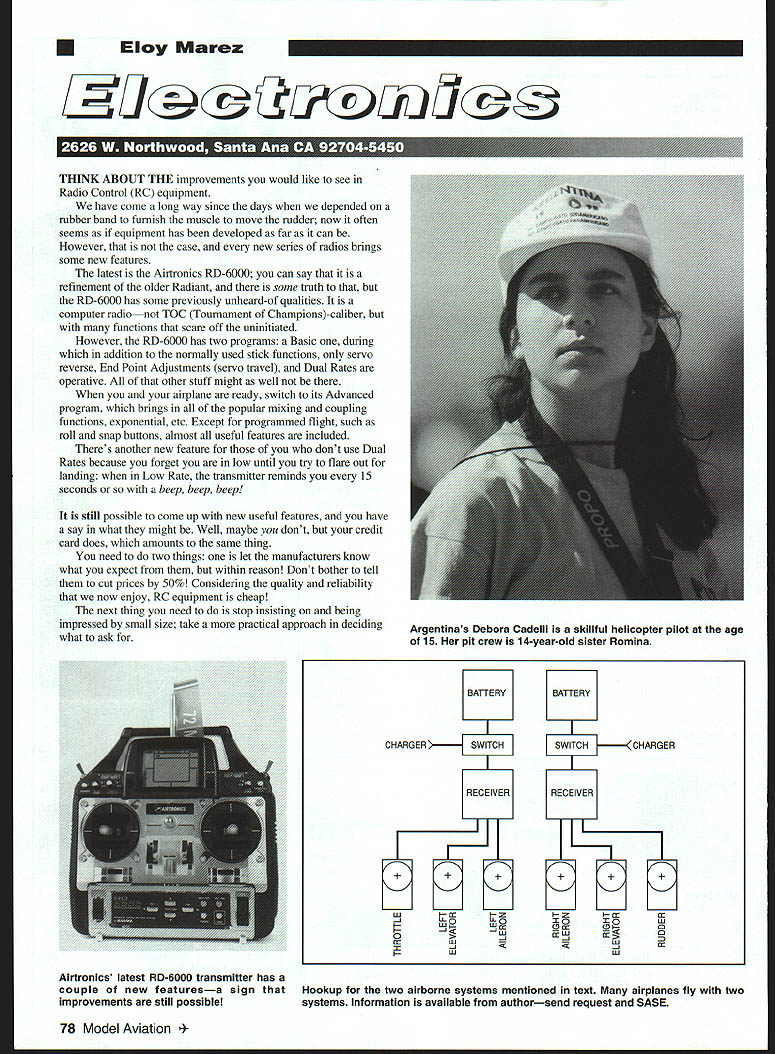
Although I am not a helicopter flier, I appreciate the complexity of the machines, the critical need for proper adjustments, and the skill needed to fly them. On a recent trip to Chile, to South America's Panamericana annual international meet, I met a most impressive helicopter flier.
With a sibling for crew, this pilot walks out, starts, trims, and proceeds to fly smoothly and under full control, performing all standard helicopter maneuvers—including the inverted ones done without the "invert" switch on the transmitter—and those tricky autorotation landings.
So what? Well, this particularly able helicopter pilot's name is Debora, and she is 15 years old. She assembled and maintains her X-Cell helicopter in addition to flying it with great skill. Debora started with sailplanes about three years ago, then moved to powered fixed-wing, ultimately deciding that she prefers helicopters. Her pit person, sister Romina, is 14.
Are we going to be outdone by a 15-year-old? The gauntlet has been thrown down; what are you going to do about it? Are you going to continue to say, "I don't know how," or "I can't"? I'm going to start selecting wood; I am going to build that scale airplane.
Transcribed from original scans by AI. Minor OCR errors may remain.

