
Electronics
Eloy Marez 2626 W. Northwood, Santa Ana CA 92704
Single-stick transmitters
The May 2002 column, in which I discussed what we may see—or should ask our suppliers for—in the next generation of Radio Control (RC) equipment, brought interesting input. David Kasdan of Cleveland, Ohio has strong thoughts about single-stick radios. He writes:
"I read your May 2002 Model Aviation column and yes, I have a suggestion for manufacturers and the RC community: Bring back single-stick, three-axis transmitters. None has been on the market for ten years or so, and I think we are all missing something.
"The more common systems of having ailerons lateral on one stick and rudder on the other makes flight coordination difficult to learn and to execute. It turns this aspect of flying into the equivalent of piano or drum playing—one is forced to learn to disconnect limb functions. My own understanding of this as a modeler began when I took up full-scale flying later and had to learn pedal usage.
"Single-stick systems couple rudder and aileron in a much more natural way. They permit the flier's dominant hand to coordinate all flight controls. They are probably the best way to do this other than a rudder pedal system, which won't go over well with most modelers (too bad)! It would make switching between models and full-scale easier.
"Single sticks provide a manually and visually obvious way of providing both coordinated turns and slipping maneuvers: Twist and move laterally the same direction for coordinated turns; the opposite direction for uncoordinated slips. This is much easier than learning to move thumbs together or apart at different rates for the various maneuvers.
"I will guess that the three-axis joystick is more expensive to manufacture than two double-axis ones and that they are not available as a commodity OEM [Original Equipment Manufacturer] part for the transmitter manufacturers. That may be what did them in commercially.
"Let me know what you think."
In my opinion, the prognosis is negative. More important than my opinion are those of the manufacturers, which—at least some of the time—are governed by those of the consumers. Even in the pioneer days of proportional RC, when every manufacturer offered a single-stick system, sales were minimal. They were offered mostly as a courtesy because the companies were owned and operated by active modelers: the Bob Dunhams of Orbit Electronics, the Phil Krafts of Kraft Systems, etc. Those were my Orbit days; during a good single-stick year, our sales accounted for 1 or 2%. That is not enough to interest the big-business RC-makers of today—companies operated by executives far removed from and with no personal experience in RC flying and looking only at the bottom (profit) line.
Except for the fact that the machines resemble each other, I see little similarity between RC and full-scale flight. The differences are so great that I don't see a need to go into them here. However, I appreciate David's reference to "full-scale" instead of the oft-used phrase "real airplanes." I don't own or fly any of those multi-thousand-dollar airplanes, but I roll my own; I have handled and am familiar with every piece that goes into them, and they may not carry people when they are done, but they are "real"!
Another historical fact about single-stick transmitters is that even when they were readily available, in serious competition the rich and famous almost all used two-stick radios. I can only think of one person—Joe Bridi—who made any sort of name for himself in competition with a single-stick transmitter. I think Chip Hyde flew the mode in his early days, but he has not done badly since switching to a two-sticker!
I do agree with David about the difference between uncoordinated and coordinated turns, but uncoordinated turns are common for RC flight, during which most of the turns are made with ailerons only. It is only when one flies a larger high-winger that he can see how the airplane skids through the air and learn about the need for rudder input—which he probably couples into the aileron stick anyway.
It all has to do with many—probably most—fliers' inability to use their left hand. Since I am being disagreeable, I'll do so with the analogy about piano and drum playing. I am not really qualified to discuss such things as "limb functions," but I do know that most people who want to learn to play piano, drums, guitar, to "keyboard" (as they now call typing in computer classes), and most tasks for which two hands are required, are capable of learning.
It being softball season, I am seeing a lot of left-handed action now. As a bit of community service, I do photography for a local high-school girls' softball team. No matter how much the coach jumps up and down and yells "two hands," they all catch with one—in most cases, the left one. Don't tell me a teenage girl can learn to do something difficult left-handed and an adult male cannot.
Last, I doubt if the cost of the three-axis gimbals has any bearing on the lack of such transmitters. They are available as OEM components for other than RC uses, but in most cases they are intended for commercial applications and cost more than we pay for an entire sport-class RC system.
Our manufacturers use proprietary stick assemblies to which only the top knob would need to be added, though an entirely different case would have to be developed and expensive molds made.
Mode One fliers such as Hanno Prettner, Quique Somenzini, Dave Shadel, and myself won't even agree that Mode Two is a sensible way to fly, much less single-stick. We believe that if you actually pilot an RC airplane, instead of just pointing one, Mode One allows you to input pitch without upsetting a given amount of roll (or vice versa); with Mode Two, there has to be some interaction of the two.
Single-stick systems compound that effect. If one could discern it, there has to be some interaction with pitch and roll when the rudder is input. The saving factor is that with the common-size airplane, our eyes simply don't see the effect.
As I wrote (quoted by Mr. Kasdan), you need to let suppliers know what you are willing to spend your money on, and maybe someday we'll see the rebirth of the salad-mixer type of transmitter.
Nickel-Cadmium batteries and "cyclers"
Nickel-Cadmium batteries and their proper care are a concern of all serious RC fliers. However little experience and/or interest in electronics we may have, we learn early that without proper electronic power, no matter the brand or the quality, our control systems will not work.
Much has been written about the subject—some true and valuable, and much better suited to science-fiction novels. I am a firm believer that one of the most valuable tests we can make to prove or disprove the quality of these important pieces of our RC systems is to measure and compare their capacity to their makers' ratings. For this purpose we use devices incorrectly referred to as "cyclers."
Why incorrectly? The real experts on the subject of rechargeable batteries are at Sanyo, Panasonic, and other battery manufacturers. They refer to a "cycle" as one charge and discharge period, even if the discharge is partial. The "cycler" referred to in RC circles is intended to discharge a previously charged battery and to determine the usable capacity in milliampere-hours. It does not recondition the battery.
Here's a short course in Battery 101 terminology. We are dealing with the terms milliamperes (mA) and milliampere-hours (mAh). It is probably easier to understand if we discuss mAh first. It is the capacity of a battery, like the capacity in ounces of your fuel tank.
The most common receiver battery is marked as having a 600 mAh capacity. This is normally taken to be a battery that is capable of producing 600 mA for one hour, but that is not strictly correct. Most major battery makers rate their products at a two-hour rate; said battery will produce 300 mA for two hours, for a total of 600 mAh. If consumed at a higher rate, that figure is less, and a lower consumption will provide more apparent total time.
Milliamperes is the rate of usage. Referring to that fuel-tank analogy again, mA is the amount that your engine would burn per period of time. Say you have a 10-ounce tank and an engine that consumes one ounce per minute. You would have a 10-minute tank, right? Just think capacity and rate.
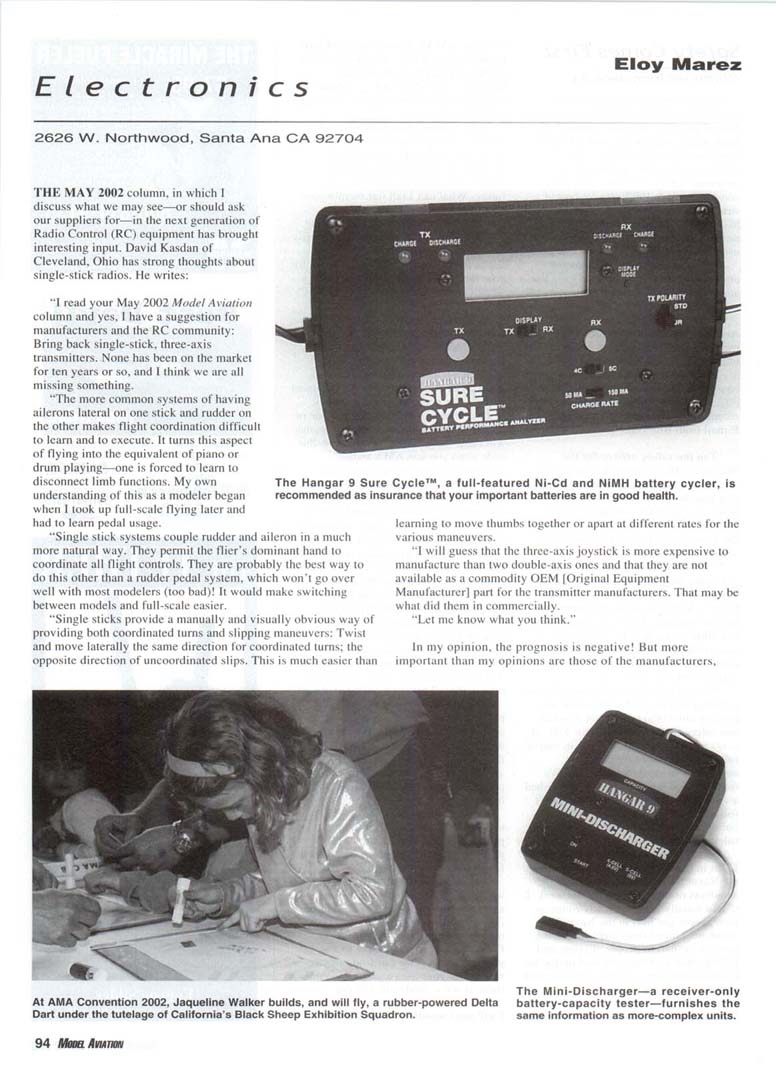
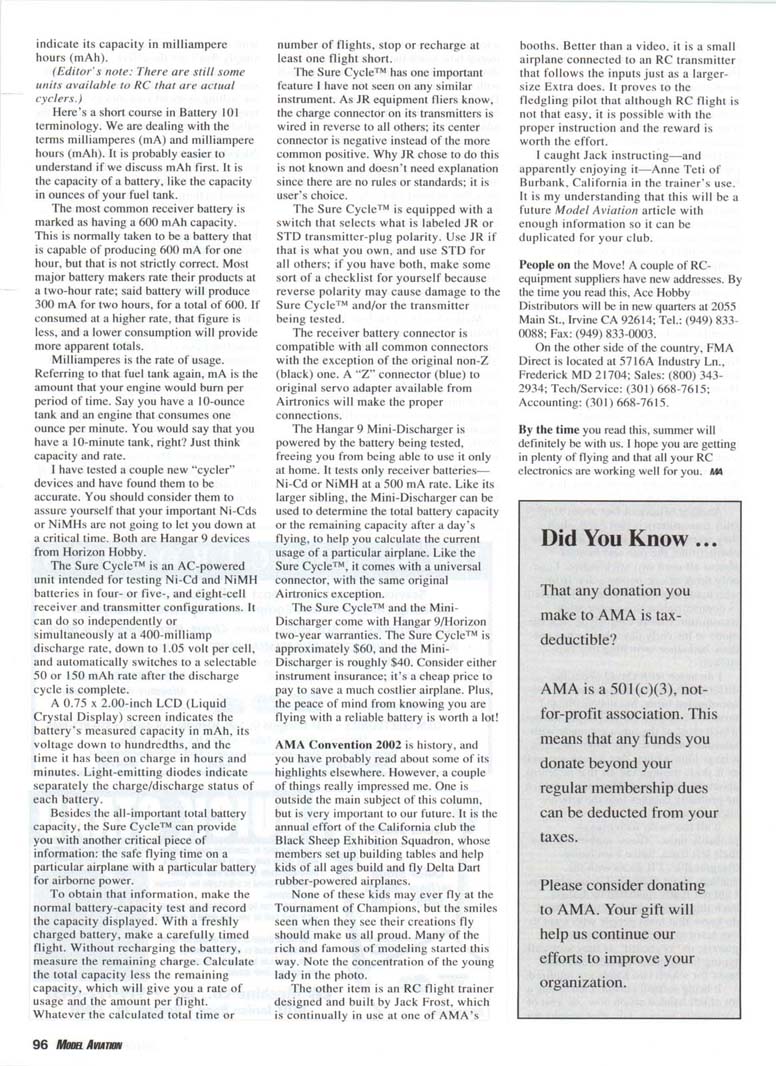
I have tested a couple of new "cycler" devices and have found them to be accurate. You should consider them to assure yourself that your important Ni-Cds or NiMHs are not going to let you down at a critical time. Both are Hangar 9 devices from Horizon Hobby.
Hangar 9 test instruments
Sure Cycle
- The Sure Cycle™ is an AC-powered unit intended for testing Ni-Cd and NiMH batteries in four-/five-cell and eight-cell receiver and transmitter configurations.
- It can test independently or simultaneously at a 400 mA discharge rate, down to 1.05 volt per cell, and automatically switches to a selectable 50 or 150 mAh trickle rate after the discharge cycle is complete.
- A 0.75 x 2.00-inch LCD screen indicates the battery's measured capacity in mAh, its voltage down to hundredths, and the time it has been on charge in hours and minutes.
- Light-emitting diodes indicate separately the charge/discharge condition of each battery.
- Besides total battery capacity, the Sure Cycle™ can help determine safe flying time for a particular airplane with a particular battery.
To obtain safe-flight information:
- Make the normal battery-capacity test and record the displayed capacity.
- With a freshly charged battery, make a carefully timed flight.
- Without recharging the battery, measure the remaining charge.
- Calculate the used capacity (initial capacity minus remaining capacity) to determine the rate of usage and the amount per flight.
- Whatever the calculated total time or number of flights, stop or recharge at least one flight short.
The Sure Cycle™ has one important feature I have not seen on any similar instrument. As JR-equipment fliers know, the charge connector on JR transmitters is wired opposite to most others: its center connector is negative instead of positive. The Sure Cycle™ is equipped with a switch labeled JR or STD transmitter-plug polarity. Use JR if that is what you own, and use STD for all others. If you have both, make a checklist for yourself because reverse polarity may cause damage to the Sure Cycle™ and/or the transmitter being tested.
The receiver battery connector is compatible with all common connectors with the exception of the original non-Z (black) one. A "Z" connector (blue) to original servo adapter available from Airtronics will make the proper connections.
Mini-Discharger
- The Hangar 9 Mini-Discharger is powered by the battery being tested, freeing you from being limited to using it only at home.
- It tests only receiver batteries—Ni-Cd or NiMH—at a 500 mA rate.
- Like the Sure Cycle™, the Mini-Discharger can determine total battery capacity or remaining capacity after a day's flying to help calculate current usage for a particular airplane.
- It comes with a universal connector, with the same Airtronics exception noted above.
The Sure Cycle™ and the Mini-Discharger come with Hangar 9/Horizon two-year warranties. The Sure Cycle™ is approximately $60, and the Mini-Discharger is roughly $40. Consider either instrument insurance; it's a cheap price to pay to save a much costlier airplane. Plus, the peace of mind from knowing you are flying with a reliable battery is worth a lot.
AMA Convention 2002
AMA Convention 2002 is history, and you have probably read about some of its highlights elsewhere. However, a couple of things really impressed me.
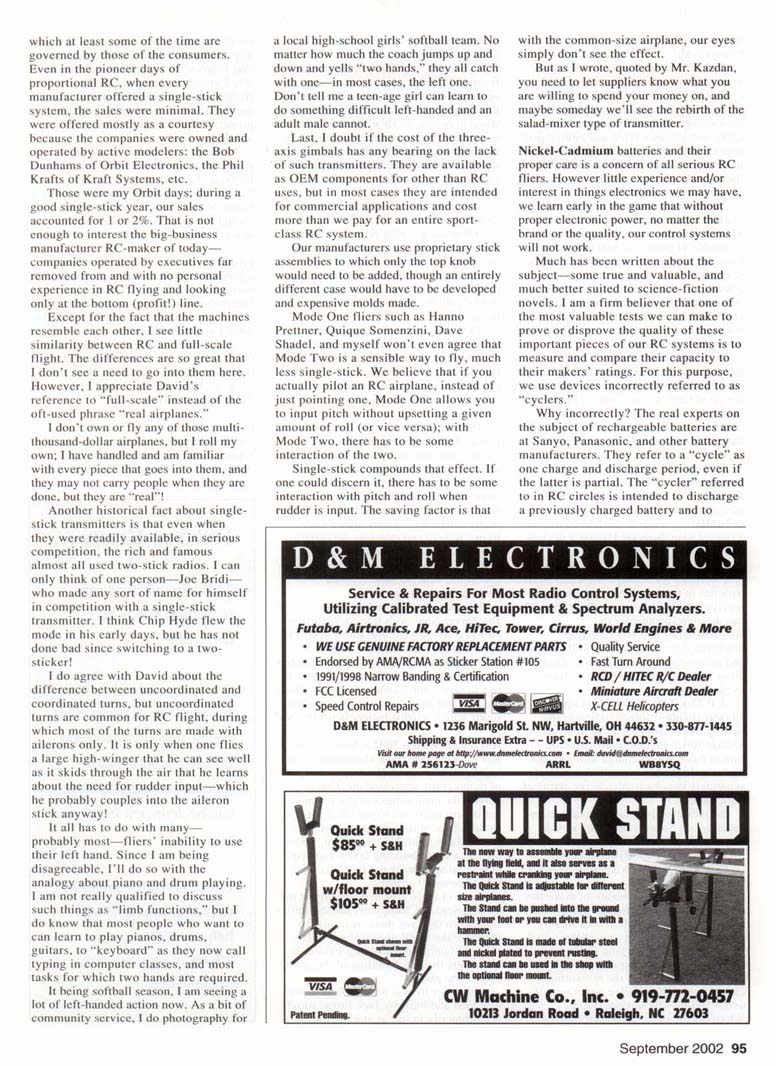
One is outside the subject of this column, but is very important to our future: the Black Sheep Exhibition Squadron, whose members set up building tables and help kids of all ages build and fly Delta Dart rubber-powered airplanes. None of these kids may ever fly at the Tournament of Champions, but the smiles when they see their creations fly should make us all proud. Many of the rich and famous of modeling started this way.
The other item is an RC flight trainer designed and built by Jack Frost, which is continually in use at one of AMA's booths. Better than a video, it is a small airplane connected to an RC transmitter that follows the inputs just as a larger-size Extra does. It proves to the fledgling pilot that although RC flight is not easy, it is possible with the proper instruction and the reward is worth the effort.
I caught Jack instructing—and apparently enjoying it—Anne Teti of Burbank, California in the trainer's use. It is my understanding that this will be a future Model Aviation article with enough information so it can be duplicated for your club.
People on the Move!
A couple of RC-equipment suppliers have new addresses:
- Ace Hobby Distributors
2055 Main St., Irvine CA 92614 Tel: (949) 833-0088 Fax: (949) 833-0003
- FMA Direct
5716A Industry Ln., Frederick MD 21704 Sales: (800) 343-2934 Tech/Service: (301) 668-7615 Accounting: (301) 668-7615
By the time you read this, summer will definitely be with us. I hope you are getting in plenty of flying and that all your RC electronics are working well for you.
AA
Transcribed from original scans by AI. Minor OCR errors may remain.

