
Elmira Aero-Tow '97
Elmira Aero-Tow '97 consolidated three days of aero-towing scale sailplanes, vendor displays, and an excellent banquet. About 60 registered pilots from Canada, Germany, and ten U.S. states displayed and flew 120 scale sailplanes. The event featured both vintage and modern models, full-scale sailplane operations, and several cutting-edge technologies.
Highlights
- Approximately 60 pilots and 120 scale sailplanes.
- International participation: Canada and Germany.
- Three days of excellent weather and long flights.
- Venue: Harris Hill gliderport, Elmira, NY.
Flightline, Launches, and Weather
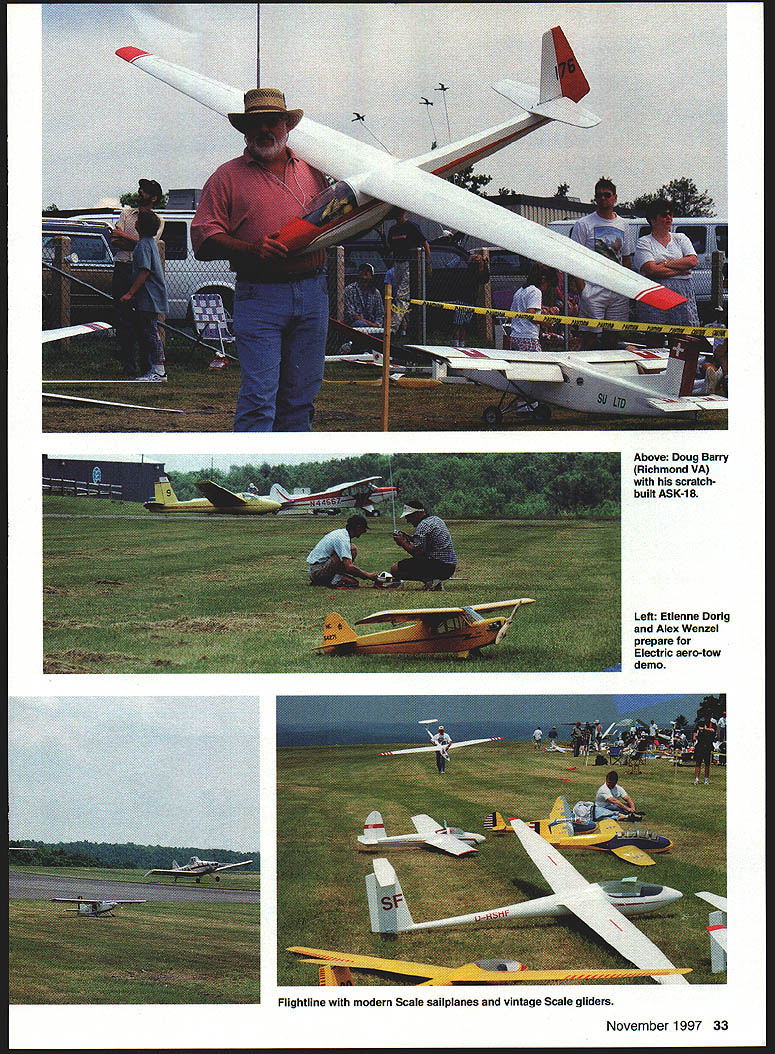
A well-organized flightline and as many as four tow pilots available made for plenty of opportunity to fly large and beautiful scale sailplanes. Three days of perfect weather allowed many long flights. The elevated venue provided wide vistas, including a view of the jetport in the valley below and hang gliders working a distant ridge.
Aerobatics and Electric Flight
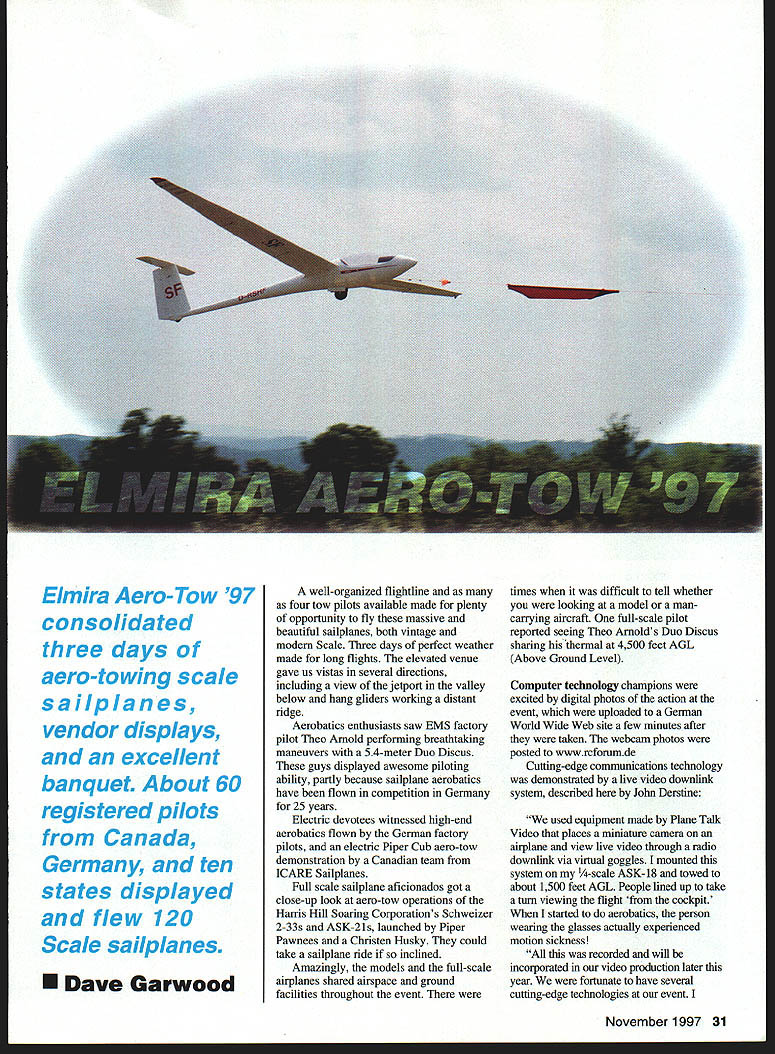
Aerobatics enthusiasts saw EMS factory pilot Theo Arnold performing breathtaking maneuvers with a 5.4-meter Duo Discus. These displays demonstrated exceptional piloting skill—sailplane aerobatics have been a competition discipline in Germany for 25 years.
Electric-flight devotees witnessed high-end aerobatics flown by German factory pilots, and an electric Piper Cub aero-tow demonstration by the Canadian team ICARE Sailplanes.
Full-Scale Operations
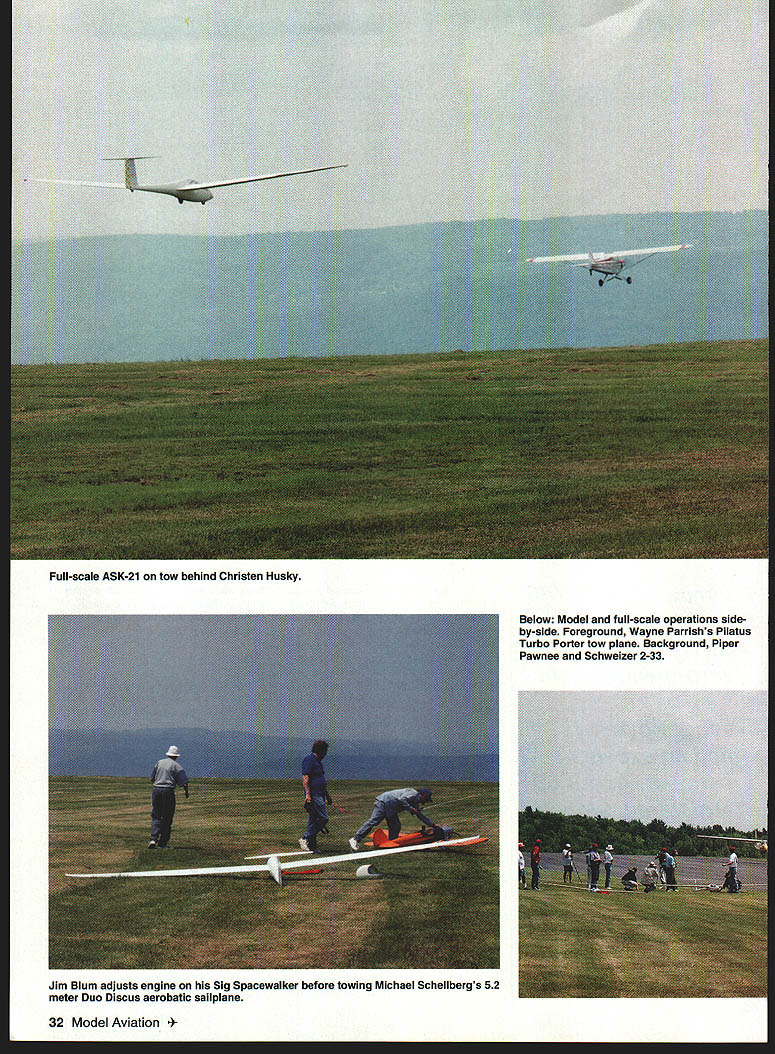
Full-scale sailplane aficionados got a close-up look at aero-tow operations conducted by Harris Hill Soaring Corporation using Schweizer 2-33s and ASK-21s, launched behind Piper Pawnees and a Christen Husky. Visitors could take a sailplane ride if they wished.
Amazingly, the models and the full-scale airplanes shared airspace and ground facilities throughout the event. At times it was difficult to tell whether you were looking at a model or a man-carrying aircraft. One full-scale pilot reported seeing Theo Arnold's Duo Discus sharing his thermal at 4,500 feet AGL (above ground level).
Technology and Media
Computer-technology enthusiasts were excited by digital photos of the action that were uploaded to a German World Wide Web site a few minutes after being taken; webcam photos were posted to www.rcforum.de.
Cutting-edge communications technology was demonstrated by a live video downlink system, described by John Derstine:
"We used equipment made by Plane Talk Video that places a miniature camera on an airplane and lets you view live video through a radio downlink via virtual goggles. I mounted this system on my 1/4-scale ASK-18 and towed to about 1,500 feet AGL. People lined up to take a turn viewing the flight 'from the cockpit.' When I started to do aerobatics, the person wearing the goggles actually experienced motion sickness!
"All this was recorded and will be incorporated in our video production later this year. We were fortunate to have several cutting-edge technologies at our event."
Venue and History
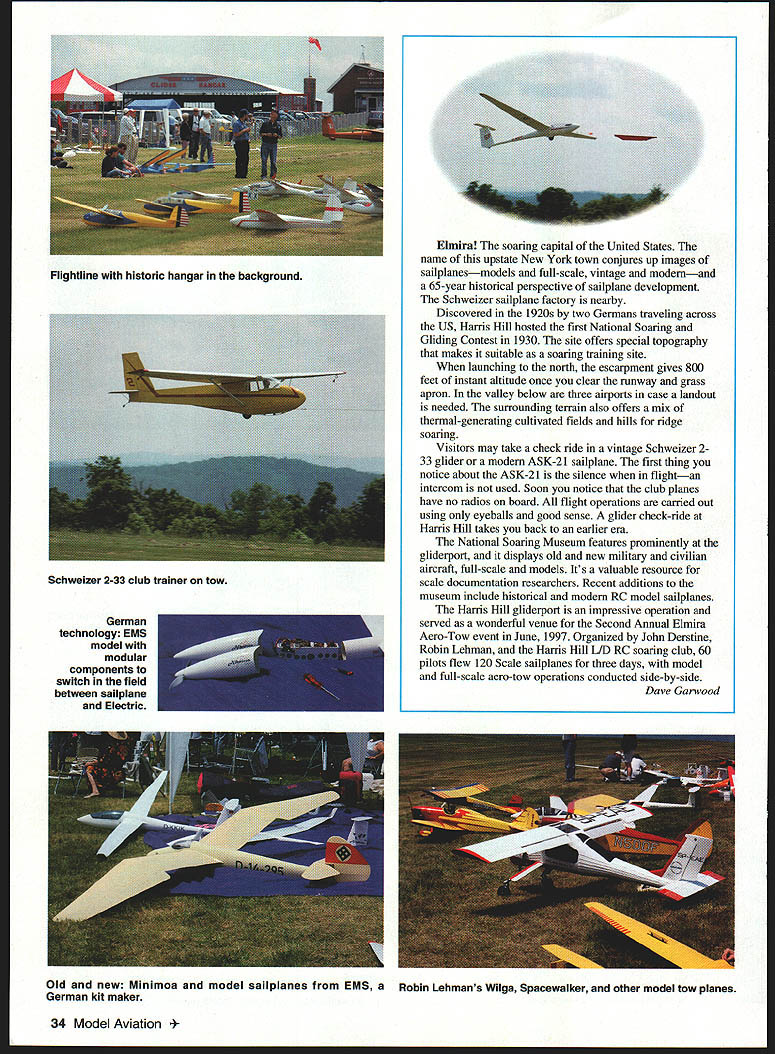
Elmira — the "soaring capital of the United States" — conjures up images of sailplanes, both model and full-scale, vintage and modern, and a 65-year historical perspective of sailplane development. The Schweizer sailplane factory is nearby.
Harris Hill was discovered in the 1920s by two Germans traveling across the U.S. and hosted the first National Soaring (gliding) Contest in 1930. The site's topography makes it a suitable soaring training area: launching the north escarpment gives about 800 feet of instant altitude. Once clear, the runway is a grass apron; the valley below contains three airports in case a landout is needed. Surrounding terrain offers a mix of thermal-generating cultivated fields, hills, and ridges for ridge soaring.
The National Soaring Museum at the gliderport displays historical and modern full-scale aircraft and model sailplanes, making it a valuable resource for scale documentation and researchers. Recent additions include historical and modern RC model sailplanes.
Visitors may take a check ride in a vintage Schweizer 2-33 glider or a modern ASK-21 sailplane. The first thing you notice about the ASK-21 is the silence of flight—an intercom is not used. Club planes often have no radios aboard; flight operations are carried out using eyeballs and good sense. A glider check ride at Harris Hill evokes an earlier era.
Personal Experiences: Flying Large Scale Sailplanes
I was apprehensive about flying these gleaming long-winged models; not anymore. Until Aero-Tow '97 my experience was limited to building and flying a single 2.2-meter scale sailplane and to being warned about the skill needed to fly the big models. I learned to aero-tow at Elmira in 1996, flying an Airtronics Peregrine.
Doug Barry (Richmond, VA), a member of the Tidewater Model Soaring Society, asked if I’d like to fly his four-meter, 11.5-pound ASK-18, scratch-built from Cliff Charlesworth plans. I asked Doug to handle the launch and landing; he refused, urging me to fly the entire flight.
With Robin Lehman flying the Sig Spacewalker towplane, launch and release at about 1,000 feet were uneventful. Flying smoothly so as not to unnerve Doug, I found the ASK-18 delightful in the air. Stall behavior was benign: the forward stall was uneventful and recovered with no control input, including damping porpoising. An intentional tip stall recovered in about one-eighth revolution by simply releasing the sticks. During the ten-minute flight the ASK-18 never came close to a stall at normal speed; it was stable yet maneuverable, behaving much like an Olympic II.
The next day, Jim Armstrong (Topsham, ME), president of the DownEast Soaring Club, was about an hour into what became a two-hour flight with his 4.2-meter span, 4,000-gram R/C-model ASK-21 when he asked for relief so he could rest his eyes. Flying that model, I found it handled much like an Open-class competition sailplane—faster than Doug's ASK-18, solid and well-balanced. An intentional forward stall was predictable and controllable; tip-stall recovery was easy by releasing the controls and letting it dive 20–30 feet to regain speed, then pulling out gently. After about 15 minutes I worked up to inside loops, inverted flight, and Cuban 8s. The lift was stellar; Jim later took the sticks for another half-hour and landed the model.
I agree with Jim Thomas' assessment: "If you can fly an aileron sailplane and use common sense, you can fly Scale."
Organization and Thanks
The Second Annual Elmira Aero-Tow event (June 1997) was organized by:
- John Derstine
- Robin Lehman
- The Harris Hill L/D RC Soaring Club
Special thanks to:
- The tow pilots and flightline volunteers (including Dave Garwood’s flightline organization)
- The generous makers and dealers who donated raffle items
- The National Soaring Museum for hosting many event components
Elmira Aero-Tow '97 was a marvelous seeing, doing, sharing, and learning experience, held at one of the best possible sites for soaring.
— Dave Garwood
5 Birch Lane Scotia, NY 12302 DaveGarwood@Compuserve.com
Transcribed from original scans by AI. Minor OCR errors may remain.

