
Joe Wagner
The Engine Shop
135 Waugh Avenue, New Wilmington, PA 16142
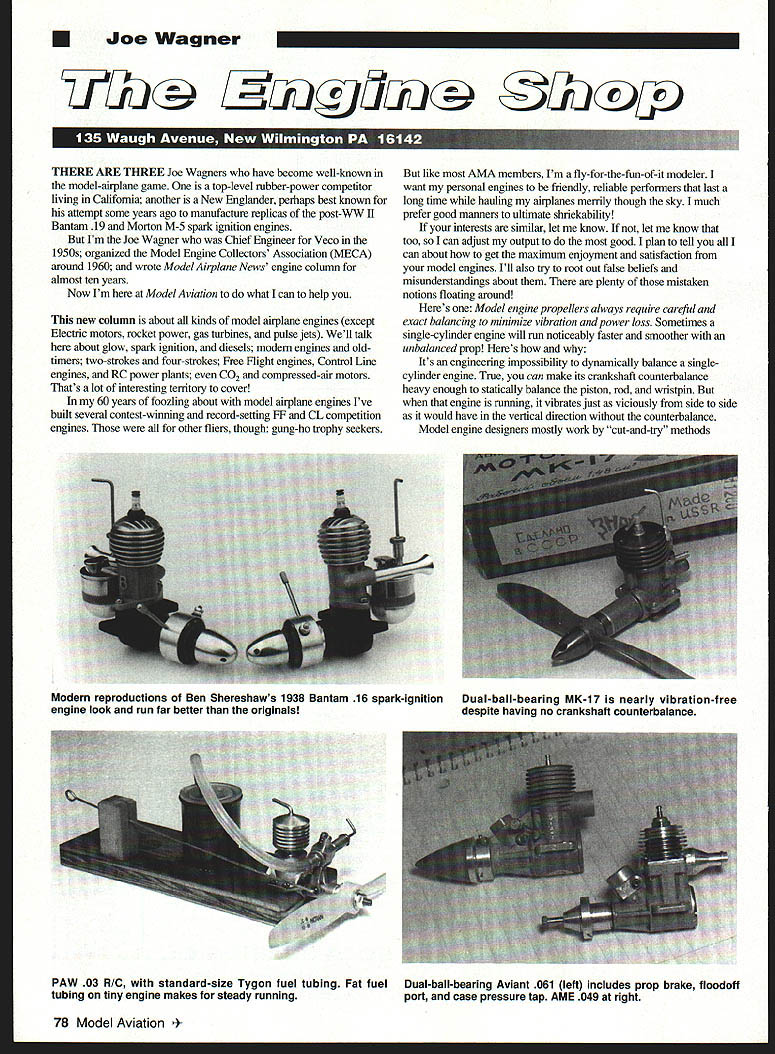
I am one of three Joe Wagners who have become well-known in the model-airplane game. One is a top-level rubber-power competitor living in California; another is a New Englander, perhaps best known for his attempt some years ago to manufacture replicas of the post‑WWII Bantam .19 and Morton M‑5 spark‑ignition engines.
But I'm the Joe Wagner who was Chief Engineer for Veco in the 1950s; organized the Model Engine Collectors' Association (MECA) around 1960; and wrote Model Airplane News' engine column for almost ten years. Now I'm here at Model Aviation to do what I can to help you.
Scope of this column
- All kinds of model airplane engines except electric motors, rocket power, gas turbines, and pulse jets.
- Glow, spark ignition, and diesels.
- Modern engines and old-timers.
- Two‑strokes and four‑strokes.
- Free Flight, Control Line, and RC power plants.
- Even CO2 and compressed‑air motors.
That's a lot of interesting territory to cover!
In my 60 years of fooling about with model engines I've built several contest‑winning and record‑setting FF and CL competition engines. Those were all for other fliers—gung‑ho trophy seekers. But like most AMA members, I'm a fly‑for‑the‑fun‑of‑it modeler. I want my personal engines to be friendly, reliable performers that last a long time while hauling my airplanes merrily through the sky. I much prefer good manners to ultimate shriekability!
If your interests are similar, let me know. If not, tell me that too so I can adjust my output to do the most good. I plan to tell you all I can about how to get the maximum enjoyment and satisfaction from your model engines. I'll also try to root out false beliefs and misunderstandings about them. There are plenty of those mistaken notions floating around!
Propeller balancing: a common misconception
Here's one mistaken notion: model engine propellers always require careful and exact balancing to minimize vibration and power loss. Sometimes a single‑cylinder engine will run noticeably faster and smoother with an unbalanced prop! Here's how and why.
It's an engineering impossibility to dynamically balance a single‑cylinder engine. True, you can make its crankshaft counterbalance heavy enough to statically balance the piston, rod, and wristpin. But when that engine is running, it still vibrates from side to side just as it would have in the vertical direction without the counterbalance.
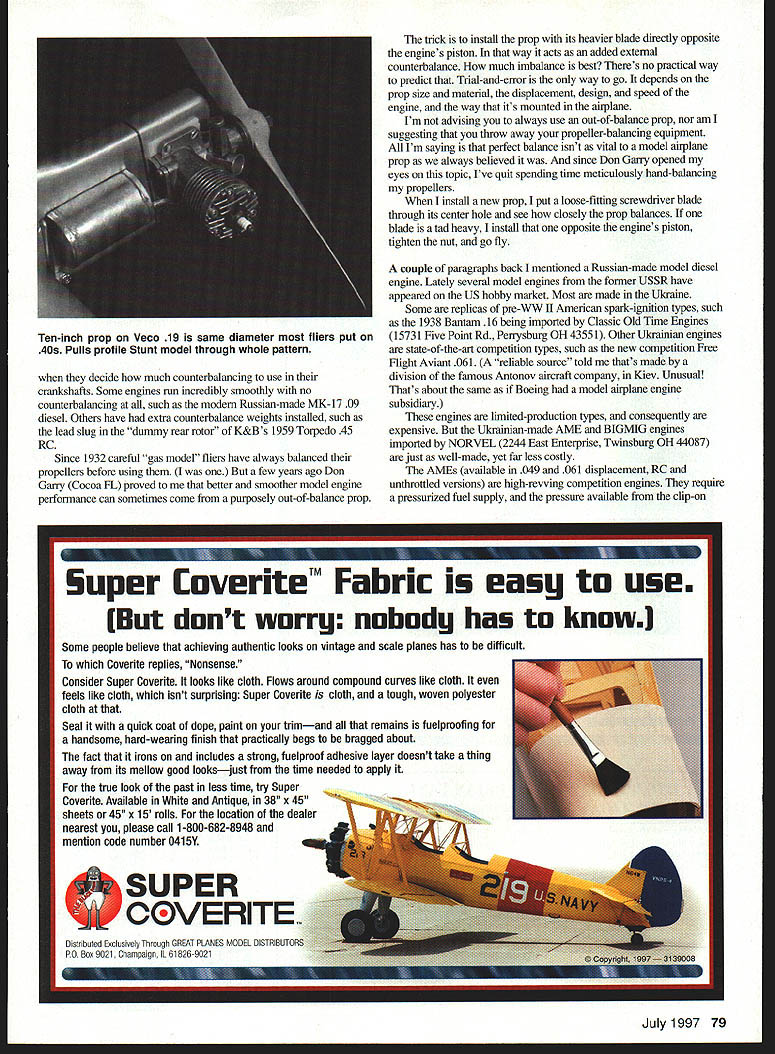
Model engine designers mostly work by "cut‑and‑try" methods. Some engines run incredibly smoothly with no crankshaft counterbalance (for example, some modern Russian‑made MK‑17 .09 diesels). Others have extra counterbalance weights installed, such as lead slugs or dummy rear rotors (for example, K&B's 1959 Torpedo .45 RC).
Since 1932 careful gas model fliers have always balanced propellers before using them. A few years ago Don Garry of Cocoa, FL proved that better, smoother model engine performance can sometimes come from a purposely out‑of‑balance prop. The trick is to install the prop with its heavier blade directly opposite the engine's piston. In that way it acts as an added external counterbalance to the engine's internal imbalance.
How much imbalance is best? There's no practical way to predict. Trial‑and‑error is the way to go. It depends on prop size and material, engine displacement and design speed, and the way the engine is mounted in the airplane. I'm not advising you to always use an out‑of‑balance prop, nor am I suggesting you throw away your propeller‑balancing equipment. I'm saying perfect balance isn't vital to model airplane propellers.
Since Don Garry opened our eyes to the topic, I've quit spending time meticulously hand‑balancing props. My practical method: install a new prop, put a loose‑fitting screwdriver blade through its center hole to see whether the prop balances. If the blade shows one side a tad heavy, I install that blade opposite the engine's piston, tighten the nut, and go fly.
Engines from the former USSR (mostly Ukraine)
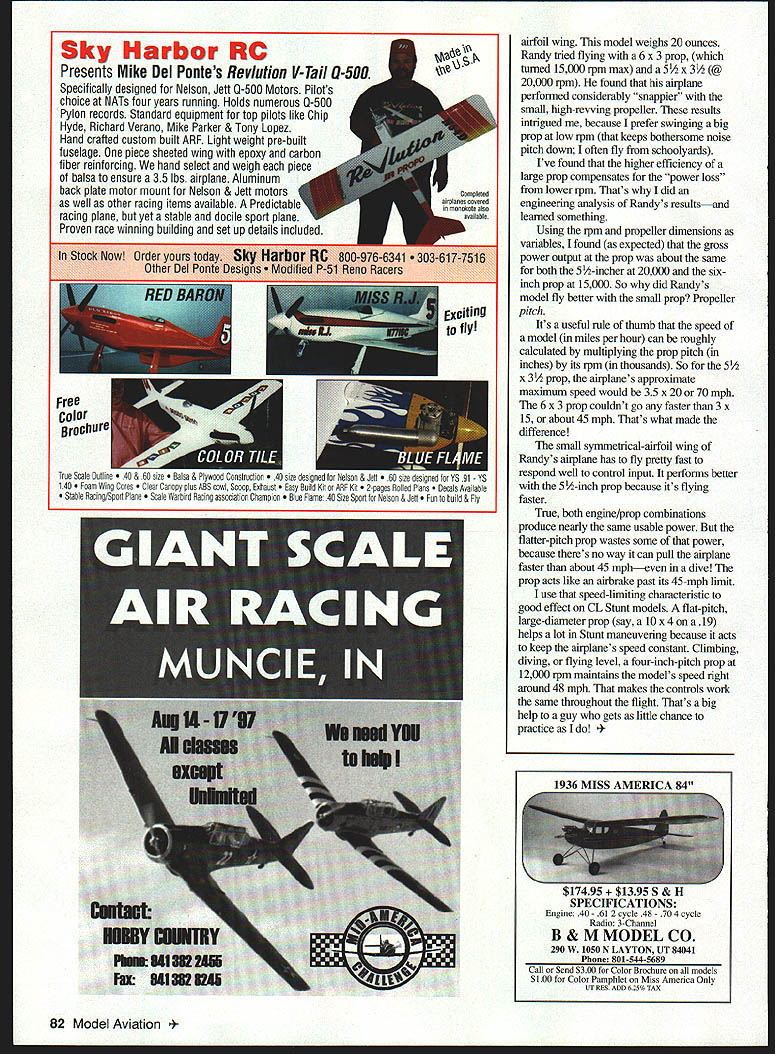
Lately several model engines from the former USSR have appeared on the U.S. hobby market. Most were made in the Ukraine. Some are replicas of pre‑WWII American spark‑ignition types, such as Ben Shereshaw's 1938 Bantam .16 being imported by Classic Old Time Engines (15731 Five Point Rd., Perrysburg, OH 43551). Other Ukrainian engines are state‑of‑the‑art competition types, such as the new Free Flight Aviant .061. A "reliable source" told me the Aviant is made by a division of the famous Antonov aircraft company in Kiev—unusual, about the same as if Boeing had a model‑airplane‑engine subsidiary.
These engines tend to be limited‑production and consequently expensive. But the Ukrainian‑made AME and BIGIMG engines imported by Norvel (2244 East Enterprise, Twinsburg, OH 44087) are well made and far less costly.
The AMEs (available in .049 and .061 displacement, RC and unthrottled versions) are high‑reving competition engines. They require a pressurized fuel supply, and the pressure available from the clip‑on muffler that comes with these engines isn't nearly enough for reliable fuel delivery—especially for starting. However, the importer offers pressurized fuel supply systems for the AME and the BIGIMG; I haven't seen one yet.
The "sport‑type" BIGIMG, though it looks very much like its older brother (the AME), is a friendlier engine by far. I own an AME but haven't flown anything with it yet because I seldom use competition engines in my model flying. My old friend Randy Randolph prefers the same style of RC flight that I do, and he's been having fun galore with a BIGIMG .061 RC.
Randy reports the BIGIMG requires a break‑in period, just like any lapped‑cast‑iron‑piston model engine. He says the throttle works smoothly from 5,000 to 20,000 rpm, and although the fuel‑tank location is "a little fussy," he didn't have much trouble with fuel feed. Randy thinks muffler pressure would help, but I rather doubt it. The clip‑on muffler is a bit tricky to install, has no gasket, and the spring doesn't seem to hold the muffler tightly against the exhaust‑port boss. That's why I feel the pressure available from a BIGIMG muffler tap (which you'd have to install yourself) wouldn't amount to much.
Fuel tubing for 1/4A engines (and a general tip)
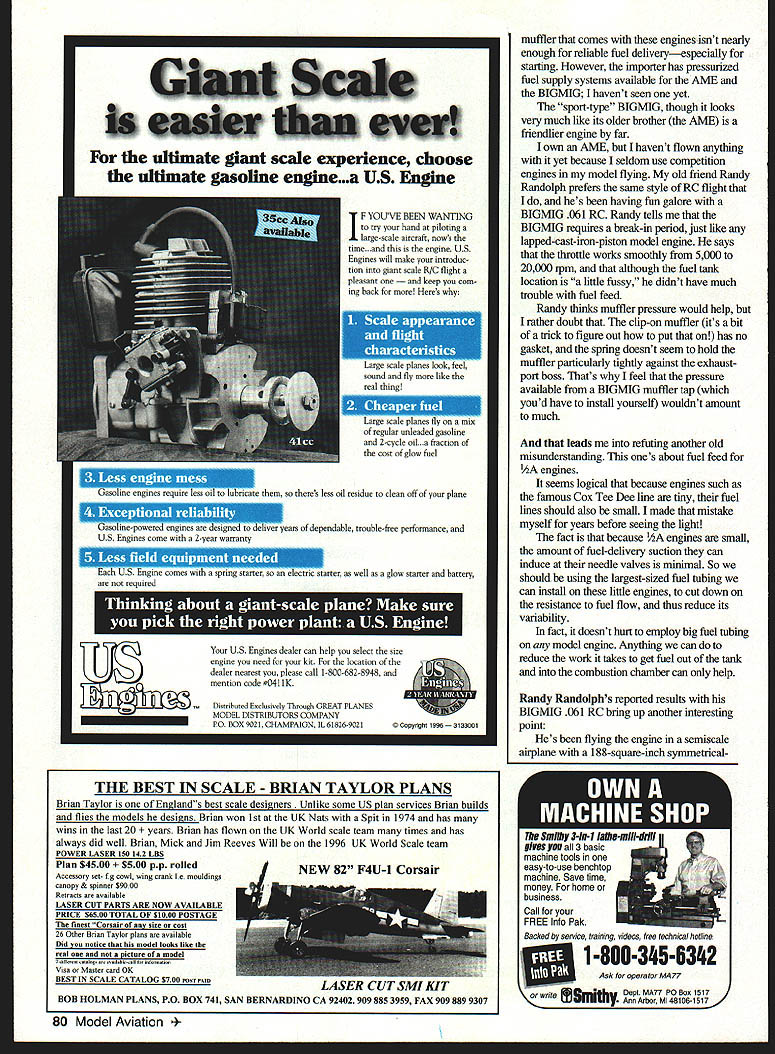
Another common misunderstanding concerns fuel feed for 1/4A engines. It seems logical that because engines such as the famous Cox Tee Dee line are tiny, their fuel‑pressure lines should be small. I made that mistake myself for years before seeing the light.
Because 1/4A engines are small, the amount of fuel‑delivery suction they can induce at their needle valve is minimal. So you should use the largest‑sized fuel tubing that will install on these little engines to cut down on resistance to fuel flow and thus reduce variability.
In fact, it doesn't hurt to employ big fuel tubing on any model engine. Anything we can do to reduce the work required to get fuel out of the tank and into the combustion chamber can only help.
Prop choice, pitch, and model performance — Randy Randolph's example
Randy has been flying his BIGIMG .061 RC in a semiscale airplane with a 188‑square‑inch symmetrical‑airfoil wing. The model weighs 20 ounces. He tried a 6 x 3 prop (which turned 15,000 rpm max) and a 5½ x 3½ (at 20,000 rpm). He found the airplane performed considerably "snappier" with the small, high‑revving propeller.
I analyzed Randy's results. Using rpm and prop dimensions as variables, I found the gross power output at the prop was about the same for both combinations: the 5½‑inch at 20,000 rpm and the 6‑inch at 15,000 rpm. So why did the model fly better with the smaller prop? Propeller pitch.
Rule of thumb: model speed (mph) ≈ prop pitch (inches) × rpm (thousands). For Randy's props:
- 5½ x 3½ at 20,000 rpm → approx. 3.5 × 20 = 70 mph
- 6 x 3 at 15,000 rpm → approx. 3 × 15 = 45 mph
Randy's small symmetrical wing has to fly pretty fast to respond well to control input. It performs better with the 5½‑inch prop because it's flying faster. Both engine/prop combos produce nearly the same usable power, but a flatter‑pitch prop wastes some power because the prop can't pull the airplane faster than its speed limit (about 45 mph in this example). The prop effectively acts like an airbrake past that limit.
I use that speed‑limiting characteristic to good effect on CL Stunt models. A flat‑pitch, large‑diameter prop (for example, a 10 x 4 on a .19) helps a lot in Stunt because it tends to keep the airplane's speed constant. Climbing, diving, or flying level, a four‑inch‑pitch prop at 12,000 rpm maintains the model's speed around 48 mph. That makes the controls work the same throughout the flight—a big help for someone who gets little chance to practice.
Closing
I'll continue to pass along practical tips, correct misconceptions, and share what I've learned about getting the most enjoyment from model engines. Tell me what you want to read about, and I'll try to cover it.
Transcribed from original scans by AI. Minor OCR errors may remain.

