
The Engine Shop
Joe Wagner 927 Pine Ave., Ozark, AL 36360 E-Mail: engineshop1@juno.com
Two “impossible” reader questions
In a previous column I discussed three categories of reader questions that I regularly receive. There are two more kinds of queries I didn't mention then; these are by far the most difficult for me to answer.
- "Please send me all available information on _____."
I get about one request of that sort per column. It doesn't matter much what subject is being inquired about — CO2 motors, ABC engines, diesel fuel, some specific make of old-time engine — it would usually take a good-sized book to supply "all available information." I can appreciate the motivation behind this sort of query. A reader finds out about something that strikes his interest strongly; something he knew nothing of previously. He then enthusiastically sends a letter or an e-mail message, wanting to find out all about this intriguing new topic.
Few reference books devoted to model airplane engines are available nowadays. Hardly any of those few can be found on the shelves at the local public library. So I never ignore readers' requests for information, even if it's difficult to provide. Many of the "tell me all" inquirers probably do not realize just how extensive the information may be that they're asking for.
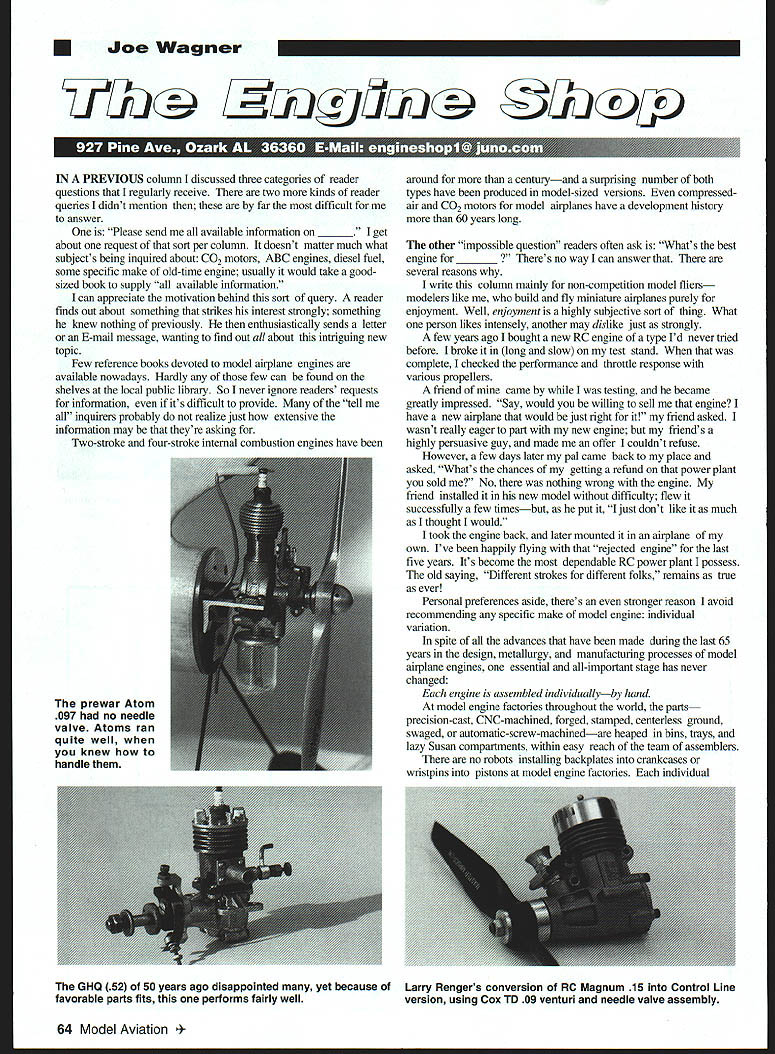
Two-stroke and four-stroke internal-combustion engines have around a century of history — and a surprising number of both types have been produced in model-sized versions. Even compressed-air and CO2 motors for model airplanes have a development history more than 60 years long.
- "What's the best engine for _____?"
There's no way I can answer that. I write this column mainly for non-competition model fliers — modelers like me, who build and fly miniature airplanes purely for enjoyment. Enjoyment is a highly subjective thing. What one person likes intensely, another may dislike just as strongly.
A few years ago I bought a new RC engine of a type I'd never tried before. I broke it in (long and slow) on my test stand. When that was complete, I checked the performance and throttle response with various propellers. A friend came by while I was testing, became greatly impressed, and asked if he could buy the engine for a new airplane he had. I wasn't eager to part with it, but my friend made an offer I couldn't refuse.
A few days later he returned the engine, asking, "What's the chances of my getting a refund on that power plant you sold me?" There was nothing wrong with the engine. He installed it without difficulty and flew it successfully a few times — but, as he put it, "I just don't like it as much as I thought I would." I took the engine back and later mounted it in an airplane of my own. I've been happily flying with that "rejected engine" for the last five years. It's become the most dependable RC power plant I possess. Different strokes for different folks.
The human element in assembly
Personal preferences aside, there's a stronger reason I avoid recommending any specific make of model engine: individual variation.
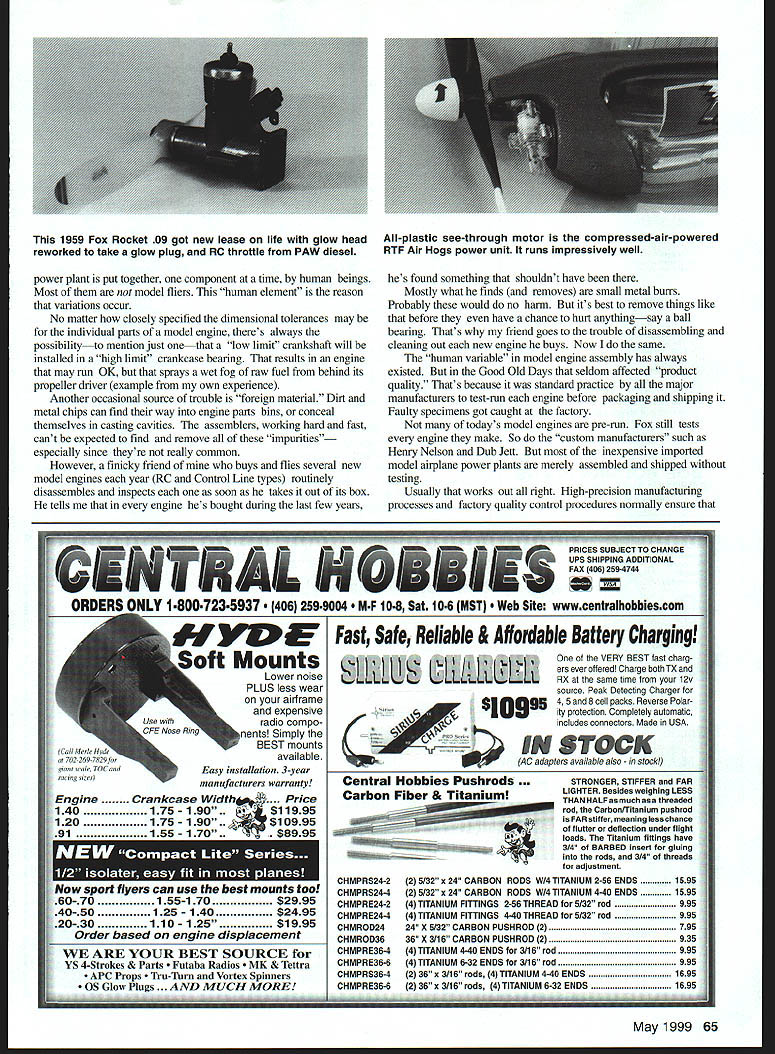
In spite of all the advances in design, metallurgy, and manufacturing processes over the last 65 years, one essential and all-important stage has never changed: each engine is assembled individually — by hand. At model engine factories throughout the world, parts — precision-cast, CNC-machined, forged, stamped, centerless-ground, swaged, or automatic-screw-machined — are heaped in bins, trays, and lazy Susans within easy reach of the assemblers. There are no robots installing backplates into crankcases or wristpins into pistons; each individual engine is assembled by hand.
Most model fliers understand the human element is the reason variations occur. No matter how closely specified the dimensional tolerances may be for individual parts of a model engine, there's always the possibility — to mention just one — that a low-limit crankshaft will be installed in a high-limit crankcase bearing. The result may be that the engine runs OK, or it may spray a wet fog of raw fuel behind its propeller.
Another occasional source of trouble is foreign material. Dirt or metal chips can find their way into parts bins, conceal themselves in casting cavities, or be transferred by assemblers' hands. Assemblers work hard and fast; they can't be expected to find and remove impurities, especially since such contaminants are fairly common.
The finicky friend who buys and flies several new model engines a year — RC and control-line types — routinely disassembles and inspects them soon after taking them out of the box. In the engines he's bought during the last few years he has found things that shouldn't have been there. Mostly what he finds (and removes) are small metal burrs. Probably these would do no harm, but it's best to remove them before they have a chance to cause problems, such as damaging a ball bearing. That's why my friend goes to the trouble of disassembling and cleaning out each new engine he buys. Now I do the same.
The "human variable" in assembly has always existed. In the Good Old Days it seldom affected product quality because major manufacturers tested each engine before packaging and shipping it; faulty specimens were caught at the factory. Not many of today's model engines are pre-run. Fox still tests every engine they make, and so do custom manufacturers such as Henry Nelson and Dub Jett. But most inexpensive imported model airplane power plants are merely assembled and shipped without testing.
Usually that works out all right. High-precision manufacturing and factory quality control normally ensure each newly assembled engine is functional. But there are exceptions. I once recommended a certain highly regarded make of .40–.32 RC engine to a friend who bought one by mail order. When he put a prop on it for the first time, he discovered the engine had practically no compression — it had been assembled without its piston ring!
Model engine customization
One problem often occurs when converting an older glow head to use a standard glow plug. It's easy enough to punch out the old center electrode and element from, say, a Cox Sportsman .15, Gilbert Thunderbird .11, or Fox Rocket .09 glow head; then drill and tap 1/4–32 for a standard plug. But many modelers who make that change don't like the results. They find engine performance suffers, and trying various plug types and heat ranges doesn't improve things much.
The problem comes from the fact that most glow heads are rather thick. If you merely drill out and tap one of these for a standard plug, the plug's element ends up much higher within the combustion chamber than the original glow head element, and the compression ratio is reduced. The solution is to counterbore the head before tapping — deeply enough so the glow plug's element will have the same position within the combustion chamber as the original. I've reworked more than a dozen engines this way, and they all performed better than they did with the factory-designed glow head.
Something else in the way of customizing is possible for those of us who've collected a goodly pile of old engines and components. I've learned to never throw away a broken or worn-out engine; its parts can be very handy in a later customization project.
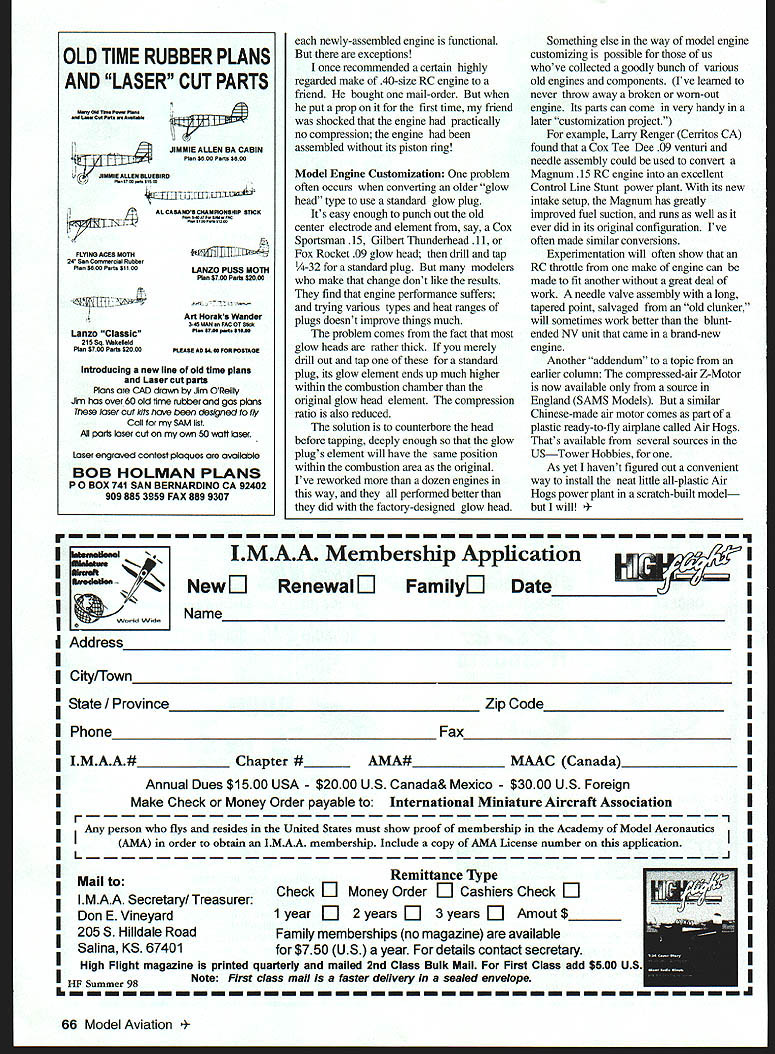
For example, Larry Renger (Cerritos, CA) found that a Cox Tee Dee .09 venturi and needle assembly could be used to convert a Magnum .15 RC engine into an excellent control-line Tee Dee stunt power plant. With its new intake setup, the Magnum has greatly improved fuel suction and runs as well as — or even better than — it did in its original configuration. I've often made similar conversions.
Experimentation will often show that an RC throttle from one make of engine can be made to fit another without a great deal of work. A needle-valve assembly with a long, tapered point, salvaged from an old "clinker," will sometimes work better than the blunt-ended needle that came in a brand-new engine.
Addendum: compressed-air motors
An addendum to a topic from an earlier column: the compressed-air Z-Motor is now available only from a source in England (SAMS Models). But a similar Chinese-made air motor comes as part of a plastic ready-to-fly airplane called Air Hogs. That's available from several sources in the U.S. — Tower Hobbies, for one.
As yet I haven't figured out a convenient way to install the neat little all-plastic Air Hogs power plant in a scratch-built model — but I will!
Transcribed from original scans by AI. Minor OCR errors may remain.

