
Joe Wagner
The Engine Shop
Contact
- 927 Pine Ave., Ozark, AL 36360
- E-mail: engineshop1@juno.com
Fuel myths and "miracle" ingredients
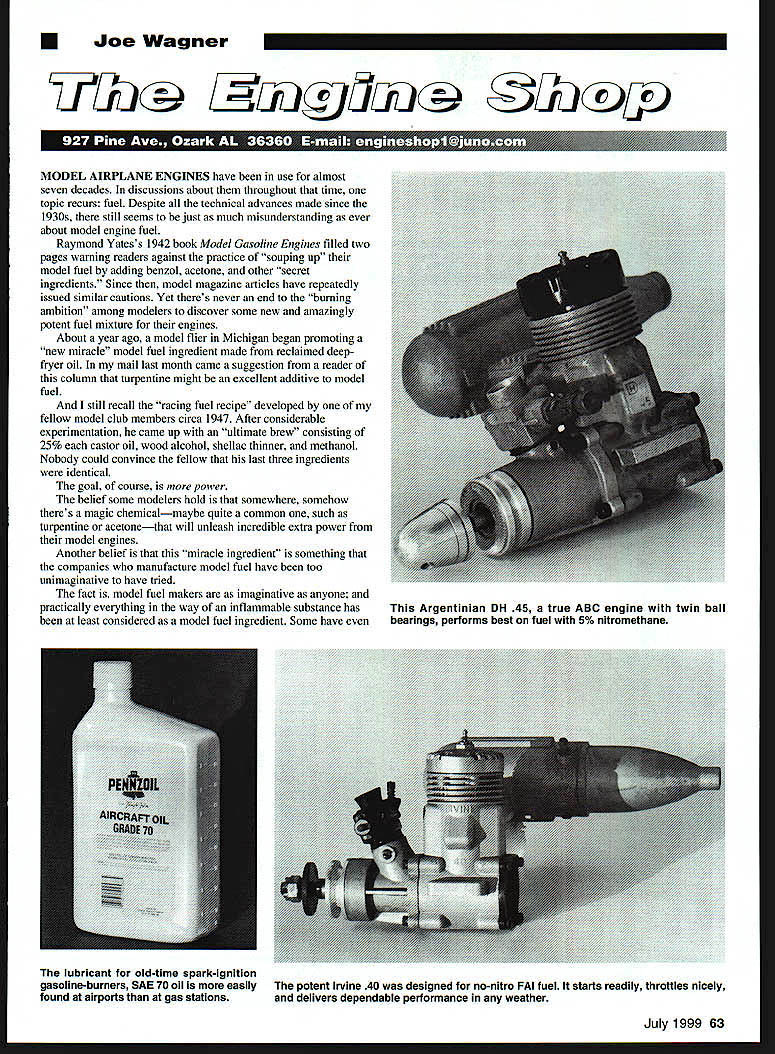
Model airplane engines have been in use for almost seven decades. In discussions about them throughout that time, one topic recurs: fuel. Despite technical advances since the 1930s, there still seems to be just as much misunderstanding as ever about model engine fuel.
Raymond Yates' 1942 book Model Gasoline Engines filled two pages warning readers against the practice of "souping up" their model fuel by adding benzol, acetone, and other "secret ingredients." Since then, model magazine articles have repeatedly issued similar cautions. Yet there's never an end to the "burning ambition" among modelers to discover some new and amazingly potent fuel mixture for their engines.
About a year ago a model flier in Michigan began promoting a "new miracle" model fuel ingredient made from reclaimed deep-fryer oil. In my mail last month came a suggestion from a reader of this column that turpentine might be an excellent additive to model fuel.
I still recall the "racing fuel recipe" developed by one of my fellow model club members circa 1947. After considerable experimentation he came up with an "ultimate brew" consisting of 25% each castor oil, wood alcohol, shellac thinner, and methanol. Nobody could convince the fellow that his last three ingredients were identical.
The goal, of course, is more power. Some modelers believe that somewhere there's a magic chemical—maybe something common, such as turpentine or acetone—that will unleash incredible extra power from their engines. Another belief is that fuel manufacturers have been too unimaginative to have tried that ingredient. The fact is, model fuel makers are as imaginative as anyone; practically every inflammable substance has at least been considered as a model fuel ingredient, and some have even been used before their detrimental effects were fully appreciated.
What manufacturers have tried (and why some attempts failed)
- Liquid Dynamite racing fuel of the mid-1940s contained picric acid (an explosive used in British artillery shells in World War I). According to Duke Fox, who tested Liquid Dynamite in a couple of his early engines, the power gain didn't amount to much and didn't compensate for the serious corrosion picric acid caused inside the engines.
- Some of the first glow fuels contained nitrobenzene. Years later medical research showed that solvent to be a potent carcinogen.
- During the nitromethane shortage of the early 1950s (when it was widely used as a rocket fuel), di-tert-butyl peroxide (DTBP) was briefly used as a glow-fuel accelerant. It worked well, but DTBP is shock-sensitive; the manufacturer who included it decided the handling risks were far too high to continue.
Combustion fundamentals and power
The fundamental facts about model engine fuel are simple and paradoxical. No fuel ingredient contains appreciably more potential combustion energy than ordinary 94-octane lead-free automotive gasoline; this is demonstrated by the paradoxical fact that for maximum power output, alcohol-fueled model engines require much larger air intakes than gasoline- or kerosene-burners.
It's still imperfectly understood exactly what goes on in the combustion chambers of model engines, but a few basic points are well established. One is that it does no good to release energy in the combustion chamber faster than the piston movement can accept it. Doing so can cause damage such as blown head gaskets, burst glow plug seals, and broken pistons.
That's why high-nitro fuel provides little benefit in engines that run at modest rpm. The advantage of nitromethane as an engine fuel is its exceedingly rapid combustion rate. That's vital above roughly 20,000 rpm, when the maximum available combustion period is less than a millisecond. But for sport-type model flying, and for RC engines that spend most of their running time at part throttle, dependable performance calls for relatively mild, "slow-burning" fuel.
Oil as a coolant
One much-misunderstood aspect of model engine fuel is its oil content. A Canadian reader, Ian McQueen, objected: "All the heat produced during combustion goes out the exhaust when each power stroke is complete. Then how can the oil in the fuel possibly 'carry away excess heat' in its supposed role as a coolant?" Ian has a good point. However, the "cooling effect" of oil in model fuel takes place at the instant of combustion, not at the exhaust port. It acts like water injection or the inert kieselguhr content in dynamite; the noninflammable material moderates the heat energy release by absorbing some of it at the instant of generation. That prevents detonation and its well-known bad effects. The greater the oil content in two-stroke model fuel, the lower the combustion-chamber temperature.
George Aldrich (San Antonio, TX), internationally known for his high-performance competition engines, found distinct advantages in using 33% oil content in gasoline-fueled spark-ignition engines. The "standard blend" of 3:1 gas and SAE 70 oil has been used since 1932, but George discovered that a 2:1 mix noticeably reduced the operating temperature of hot-running old-time sparkers and improved their performance.
Reducing the oil content of model fuel does have benefits in some competition events. Control Line Team Racing is one; so are the various Texaco endurance categories. In these events fuel economy provides a competitive edge, and minimizing the "unburnable ingredients" in Team Racing and Texaco fuel is common practice among the experts who fly those events.
For sport fliers, however, the advantages of long engine life and dependable performance in less-than-optimum conditions make a good case for a high oil percentage in model fuel—especially for diesels.
Diesel fuel recommendations
Some readers questioned the need in modern model diesels for the old-fashioned diesel fuel formula of one-third each ether, kerosene, and castor oil. (To amateur model-fuel beakers, the "one-third" figure has seldom meant precisely 33.33%; to most it represents a working value somewhere between one-quarter and one-third.)
Who would know better how much castor oil model diesel fuel should contain than the manufacturers of the engines? Here's what they recommend:
- A.E.: 30% castor during "break-in and sport flying"; 25% for "contest use."
- Aurora: the "one-third each" mix.
- Russian makers of the Marz and MK-17: one-third each.
- Chinese Silver Swallow: one-third each.
- Czech MP Jet: 40% castor for break-in; 35% for sport flying.
- British Progress Aero Works (PAW): 30% for break-in; 24% for plain-bearing engines; 20% for ball-bearing engines.
Not one of these model-diesel manufacturers calls for any lubricant other than castor oil.
In the above listing I deliberately avoided including "old-time replica" diesel engines. The manufacturers mentioned produce modern-design, short-stroke, high-performance diesels. My conclusion from this international consensus—from Britain, India, Russia, China, and the Czech Republic—is that they'd surely be among the first to know if there were any benefit from using low oil percentages in model diesel fuel or from exotic lubricants such as jet turbine oil or reclaimed deep-fry cooking fat. That's why I use—and recommend—the tried-and-true diesel fuel blend of approximately one-third each castor, ether, and kerosene, with 2% to 3% "cetane booster" added to the total quantity.
Handy hint
For hand-starting model engines (which many of us prefer to using an electric starter), I can retain all of the "feel" of finger-flipping my propellers while protecting my right hand by wearing a glove on that hand. I found some tough yet quite flexible cowhide work gloves at a discount store a few years ago and now use the right one for all of my engine starting, except for the very smallest .15s. My flipping finger has been "bitten" a few times when wearing the glove, but it never got hurt or even broke a fingernail.
Transcribed from original scans by AI. Minor OCR errors may remain.

