
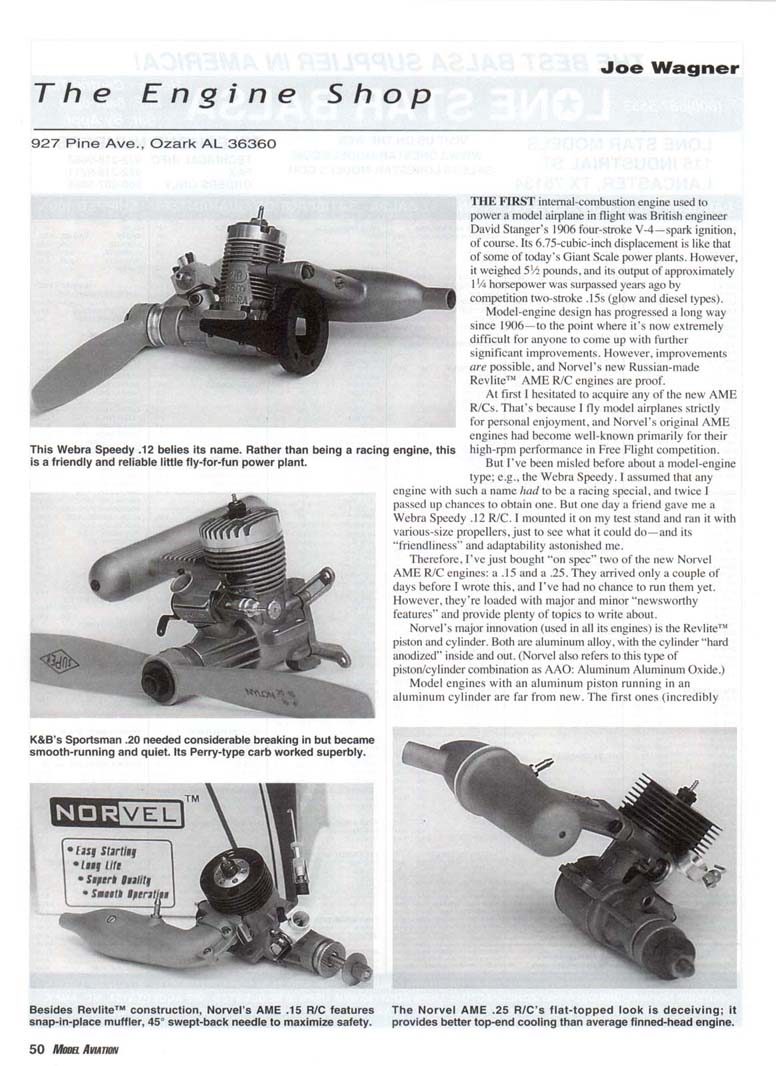
The Engine Shop
Joe Wagner
927 Pine Ave., Ozark AL 36360
A brief history
The first internal-combustion engine used to power a model airplane in flight was British engineer David Stanger's 1906 four-stroke V-4—spark ignition, of course. Its 6.75-cubic-inch displacement is like that of some of today's Giant Scale power plants. However, it weighed 5 1/2 pounds, and its output of approximately 1 1/4 horsepower was surpassed years ago by competitive two-stroke .15s (glow and diesel types).
Model-engine design has progressed a long way since 1906—to the point where it's now extremely difficult for anyone to come up with further significant improvements. However, improvements are possible, and Norvel's new Russian-made Revlite™ AME R/C engines are proof.
First impressions of the Norvel AME R/C
At first I hesitated to acquire any of the new AME R/Cs. I fly model airplanes strictly for personal enjoyment, and Norvel's original AME engines had become well-known primarily for their high-rpm performance in Free Flight competition.
I've been misled before about a model-engine type—for example, the Webra Speedy. I assumed that any engine with such a name had to be a racing special, and twice I passed up chances to obtain one. But one day a friend gave me a Webra Speedy .12 R/C. I mounted it on my test stand and ran it with various-size propellers just to see what it could do—and its friendliness and adaptability astonished me.
Therefore, I bought, on spec, two of the new Norvel AME R/C engines: a .15 and a .25. They arrived only a couple of days before I wrote this, and I've had no chance to run them yet. However, they are loaded with major and minor newsworthy features and provide plenty of topics to write about.
Revlite piston and cylinder (AAO)
Norvel's major innovation (used in all its engines) is the Revlite™ piston and cylinder. Both are aluminum alloy, with the cylinder hard-anodized inside and out. Norvel also refers to this piston/cylinder combination as AAO: Aluminum Aluminum Oxide.
Model engines with an aluminum piston running in an aluminum cylinder are far from new. The first ones—cheap designs mass-produced in 1946 called Thor, Genie, and Ram—ran, but just barely. Some 45 years later, K&B came out with its Sportsman series of glow engines, which featured pistons and cylinders made from high-silicon aluminum alloy. These ran quite well once properly broken in. I used a Sportsman .45 to power a 900-square-inch radio-control trainer for teaching teenagers how to fly RC: the more that engine ran, the better it performed. However, K&B's Sportsman series (.20, .45, and .60) never became popular. "It feels funny," one owner told me—and he sold me his almost-new Sportsman .20 for $10.
The new AME R/C engines are different. Norvel calls the hard-anodized Revlite™ cylinder surface a "ceramic." That's not quite accurate; true ceramics (such as porcelain) are kiln-fired materials. Hard anodizing is a conversion coating. Like case-hardening steel, hard-anodized aluminum's outer surface is an integral part of the metal, specially treated to convert it into a hard and durable skin. It's not an added-on coating like plating. Chrome plate can sometimes peel off; hard anodizing's sapphire-hard surface cannot. (Sapphires, rubies, and hard-anodized aluminum are chemically identical: they're aluminum oxide.)
Besides providing extreme resistance to wear, the AME's Revlite™ cylinders optimize heat transfer. The outer fins and the inner bore are a single piece of metal, providing an uninterrupted conductivity path for disposing of surplus combustion-chamber heat.
Head design and compression adjustment
AME R/C engines use standard glow plugs installed in an unusual two-piece removable head. You need a special Norvel spanner tool to remove and replace the head retainer ring; it costs roughly $7 and fits both the .15 and the .25. I can see an advantage to this removable-head design that Norvel doesn't specifically mention: the ability to change the compression ratio to suit various-size propellers. The lower part (Norvel calls this a "Glow Plug Adapter") seals to the cylinder with a thin metal ring gasket like Cox uses for sealing its glow heads. Adding extra gaskets reduces the compression and permits flying with larger propellers without suffering preignition and overheating problems.
Mechanical features and mufflers
The new AME R/C engines feature double ball bearings, a positive-keyed propeller drive, and a gasketless rear cover. The .25 has a bolt-on, adjustable-outlet muffler; the .15 uses an ingenious spring-clip muffler attachment with an inner O-ring that provides a seal. Imperfect sealing at the muffler-to-engine joint has no adverse effect on anything except cleanliness of the engine area.
Carburetor design and handling
AME's carburetor design impresses me. It is a double-needle, cam-action type with a central annular-orifice fuel-delivery nozzle. The main needle is swept back at a 45° angle, positioning the needle-adjustment end more than two inches aft of the propeller.
When I received these two AME R/C engines, both carburetors were installed with their main needles swept back considerably more than 45°. Evidently, this was done to minimize the overall width of the assembled engines in their packages and to lessen the risk of anything getting bent in handling.
Resetting the AME carburetor angle for straight fore-and-aft action of the throttle arm required cautious work with a precision open-end wrench. The clamp nut is small, thin-walled, and made from brass. Don't use long-nose pliers on this nut—or on any nut or bolt.
Weight and a thought about aluminum crankshafts
One further advantage of Norvel's Revlite™ engine line is light weight. The AME .25 R/C is more than an ounce lighter than the K&B Sportsman .20, even though that's also an all-aluminum design—and 20% smaller in displacement.
Now I'm wondering who will be first to use an aluminum crankshaft in a model-airplane engine. Some aluminum alloys are as strong as steel—and with hard anodizing to provide an almost invulnerable surface, why wouldn't an aluminum shaft work?
Sudden-stop troubles: a slipping propeller
Dale Dutt (Norco, LA) wrote about "sudden stop" troubles with his Saito 65 four-stroke:
"No problems for years, just a pleasure to run... Saturday at the field it would start, no problem—idle perfectly—transition up to 3/4 throttle, then stop abruptly as if someone grabbed the crank."
That sounds serious, and for a while it seemed so to Dale. He and his friends tried everything they could think of, but nothing helped. Eventually someone suggested changing the propeller, and the source of the trouble stood revealed: an insufficiently tightened propeller slipping on its shaft.
This isn't a new problem. I've experienced it myself from time to time, first with a spark-ignition Forster .29 (in a control-line Fireball) back in the good old days. My Forster started easily; when I tried speeding it up (by advancing the spark timer), it suddenly quit. It did the same thing repeatedly. One of the older flyers came over and told me, "Your prop nut isn't tight enough." That was the problem. The Forster had smooth-faced prop washers, and only friction drove the propeller. It was probably sufficiently tight when I first installed it, but after a while the wood at the prop hub compressed just enough to allow it to slip.
This same thing has happened with engines that lack a positive connection between shaft and propeller. They use a tapered shoulder on the shaft and a mating conical hole in the back of the propeller drive washer. Friction does the whole job of connecting the engine shaft to the propeller—and model-airplane engine shafts are normally oily.
Here is why a slipping propeller causes trouble. Model-airplane engines use the propeller as a flywheel. On power strokes, the crankshaft turns the propeller; on the "up strokes," the propeller's rotating mass is the only thing that drives the shaft and keeps the engine running. If the propeller-driver interface slips, the flywheel action suffers. At higher rpm, the problem worsens—and the engine quits.
This is even more of a problem with four-stroke engines. On two-strokes the crank drives the propeller on every downstroke, and the propeller drives the shaft on every upstroke. But on a four-stroker, the propeller momentum has to rotate the shaft through its three other strokes (two up and one down) for each of the power strokes from which the propeller acquires its energy.
It's a good idea—though nobody I know actually does this—to loosen the prop nut after every flying or engine-operating session. Retighten the nut firmly the next time you need to run the engine. That way, the propeller hub material (wood or plastic) doesn't have to withstand a constant crushing pressure all the time it's not in use.
Any slippage whatever between a propeller and its driver will hurt performance. A minute amount of slippage may not stop the engine, but it will reduce the power output. If this persists, the resultant burnishing action on the propeller's rear face will soon make things worse.
—MA
Transcribed from original scans by AI. Minor OCR errors may remain.

