
The Engine Shop
Joe Wagner
For more than 60 years, one particular size of model engine has been almost an orphan, at least in competition classifications: the .10 displacement engine.
Engine classifications and early history
When the Academy of Model Aeronautics (AMA) established "classes" of model-engine sizes in the 1930s, it set the upper limit of Class A at .199 cubic inches. That was an arbitrary decision—a best guess as to a dividing line between the "little engines" and midsize Class B engines (.200 through .299).
At the time, the distinction probably seemed unimportant. Most gas model flying then—entirely Free Flight (FF)—used Class C engines (.300 and upward). Few engines on the market were much less than .36 displacement.
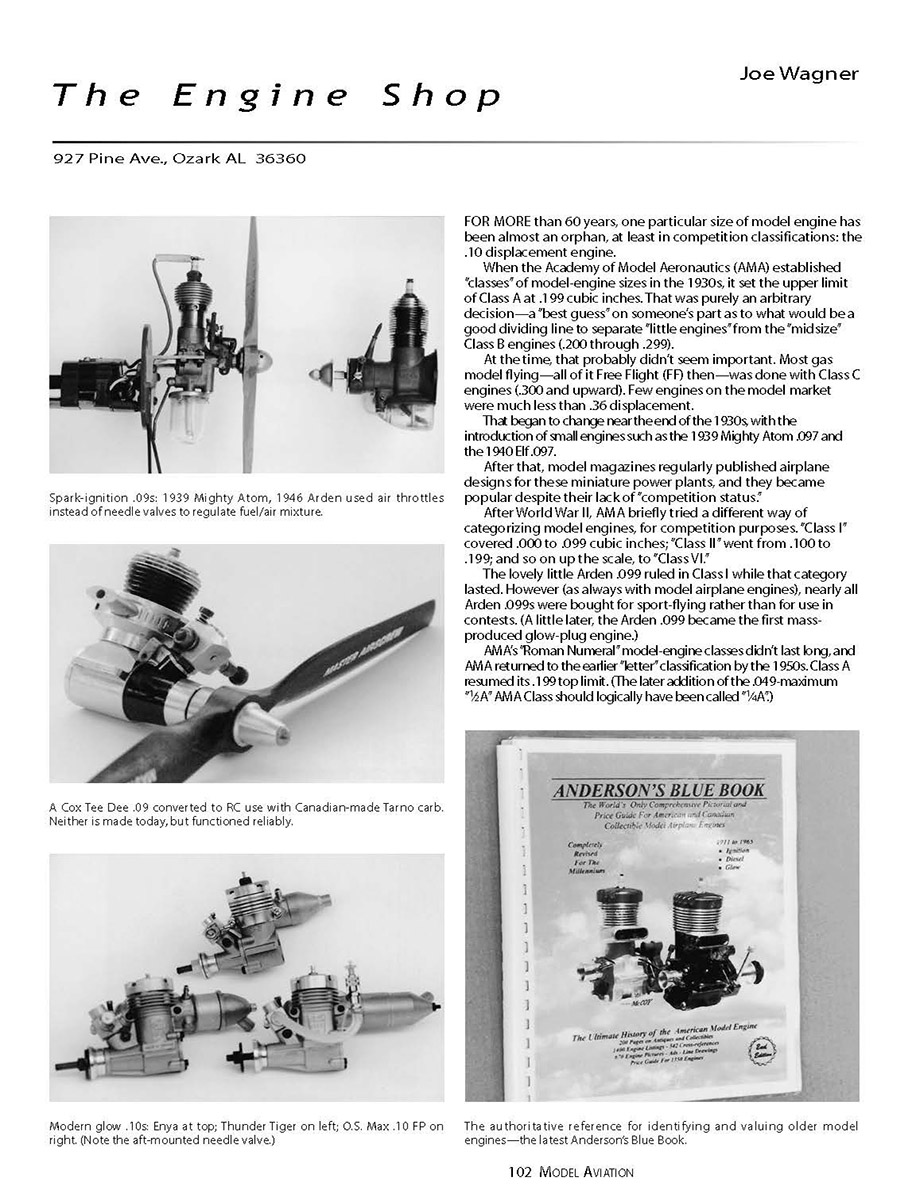
That began to change near the end of the 1930s with the introduction of small engines such as the 1939 Mighty Atom .097 and the 1940 Elf .097. After that, model magazines regularly published airplane designs for these miniature power plants, and they became popular despite their lack of "competition status."
After World War II, AMA briefly tried a different competition categorization. "Class I" covered .000 to .099 cubic inches; "Class II" went from .100 to .199; and so on up to "Class VI." The little Arden .099 ruled Class I while that category lasted. However, nearly all Arden .099s were bought for sport flying rather than contests. (A little later, the Arden .099 became the first mass-produced glow-plug engine.)
AMA's Roman Numeral classes didn't last long, and by the 1950s AMA reverted to the earlier letter classification. Class A resumed its .199 top limit. (The later addition of the .049-maximum "1/2A" AMA class should logically have been called "1/4A".)
Yet the .099 engines survived because they provide almost ideal power for sport flying—FF, Control Line (CL), and Radio Control (RC). Bigger and more powerful than 1/2As, the "Tens" are less finicky and more rugged, while models remain compact, inexpensive, easy to build and transport, and generally light enough to minimize damage from unplanned landings.
Modern .10 engines and applications
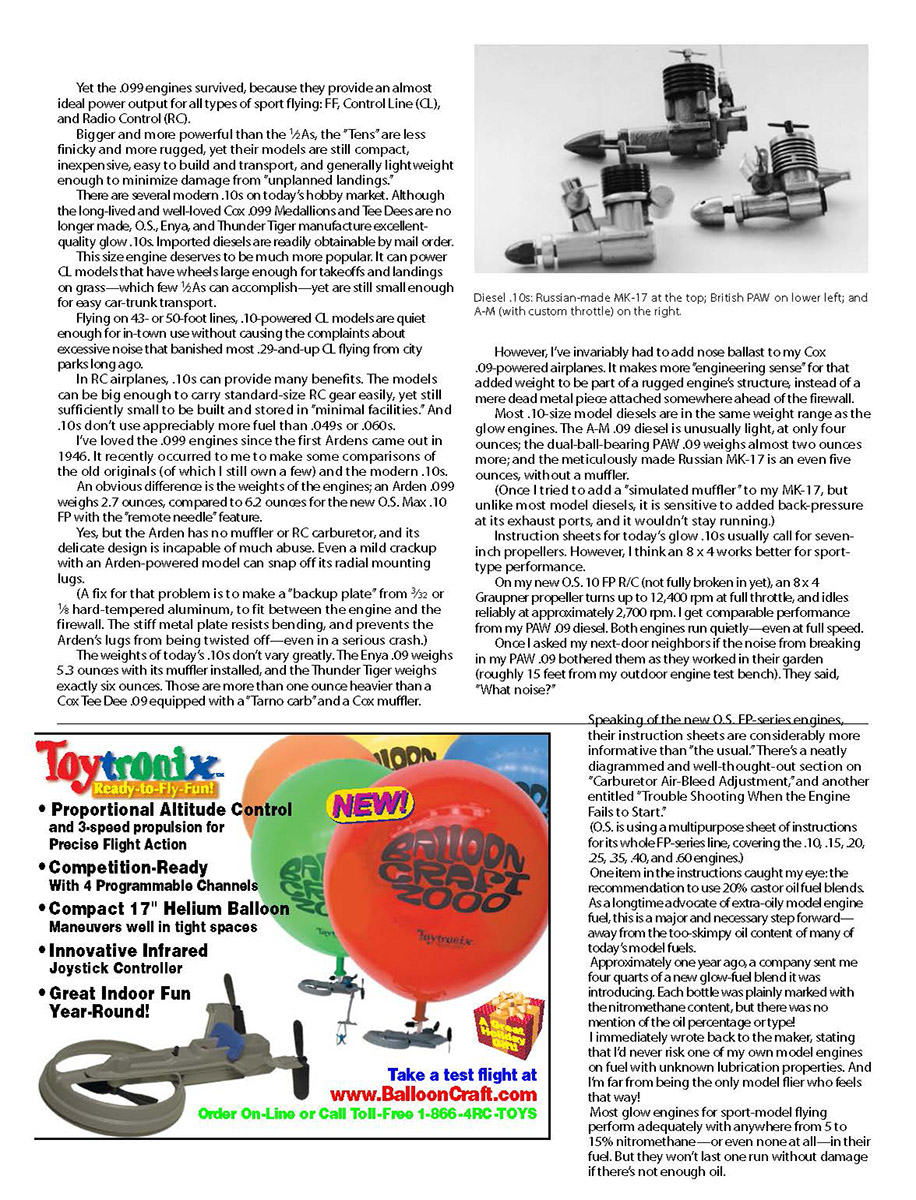
Several modern .10 engines are on today's hobby market. Although the long-lived Cox .099 Medallions and Tee Dees are no longer made, O.S., Enya, and Thunder Tiger manufacture excellent glow .10s. Imported diesels are readily obtainable by mail order. This size deserves to be more popular: it can power CL models with wheels large enough for grass takeoffs and landings (which few 1/2As can manage), yet still be small enough for easy car-trunk transport. Flying on 43- or 50-foot lines, .10-powered CL models are quiet enough for in-town use without causing the noise complaints that banished most .29-and-up CL flying from city parks long ago.
In RC airplanes, .10s offer benefits as well. Models can be large enough to carry standard-size RC gear easily, yet still small enough to be built and stored in minimal facilities. And .10s don't use appreciably more fuel than .049s or .060s.
I've loved the .099 engines since the first Ardens appeared in 1946. It recently occurred to me to compare some of those originals (of which I still own a few) to modern .10s. An obvious difference is weight: an Arden .099 weighs 2.7 ounces, compared to 6.2 ounces for the new O.S. Max .10 FP with the remote-needle feature.
Yes, but the Arden has no muffler or R/C carburetor, and its delicate design is incapable of much abuse. Even a mild crash with an Arden-powered model can snap off its radial mounting lugs.
A simple fix is to make a backup plate from 3/32" or 1/8" hard-tempered aluminum to fit between the engine and the firewall. The stiff metal plate resists bending and prevents the Arden's lugs from being twisted off—even in a serious crash.
Engine weights (examples)
- Arden .099: 2.7 ounces
- O.S. Max .10 FP (with remote needle): 6.2 ounces
- Enya .09 (with muffler): 5.3 ounces
- Thunder Tiger .10: 6.0 ounces
- These are more than one ounce heavier than a Cox Tee Dee .09 equipped with a Tarno carb and a Cox muffler.
Most .10-size model diesels are in the same weight range as the glow engines. Examples:
- A.M. .09 diesel: unusually light at 4 ounces
- Dual-ball-bearing PAW .09: almost two ounces heavier (about 6 ounces)
- Russian MK-17: 5 ounces (without muffler)
(Once I tried to add a simulated muffler to my MK-17, but unlike most model diesels it is sensitive to added back-pressure at its exhaust ports and wouldn't stay running.)
Props and performance
Instruction sheets for today's .10s usually call for seven-inch propellers; however, I think an 8 x 4 works better for sport-type performance.
On my new O.S. 10 FP R/C (not fully broken in yet), an 8 x 4 Graupner propeller turns up to 12,400 rpm at full throttle and idles reliably at approximately 2,700 rpm. I get comparable performance from my PAW .09 diesel. Both engines run quietly—even at full speed. Once I asked my next-door neighbors if the noise from breaking in my PAW .09 bothered them as they worked in their garden roughly 15 feet from my outdoor engine test bench. They said, "What noise?"
O.S. FP-series instructions and fuel recommendations
O.S.'s instruction sheets are considerably more informative than the usual. There's a neatly diagrammed and well-thought-out section on "Carburetor Air-Bleed Adjustment" and another entitled "Trouble Shooting When the Engine Fails to Start."
O.S. is using a multipurpose instruction sheet for its whole FP-series line, covering:
- .10
- .15
- .20
- .25
- .35
- .40
- .60
One item in the instructions caught my eye: the recommendation to use 20% castor-oil fuel blends. As a longtime advocate of extra-oily model engine fuel, this is a major and necessary step forward—away from the too-skimpy oil content of many of today's model fuels.
Approximately one year ago a company sent me four quarts of a new glow-fuel blend it was introducing. Each bottle was plainly marked with the nitromethane content, but there was no mention of oil percentage or type. I immediately wrote back, stating that I'd never risk one of my engines on fuel with unknown lubrication properties. I'm far from being the only model flier who feels that way.
Most glow engines for sport-model flying perform adequately with anywhere from 5 to 15% nitromethane—or even none at all—in their fuel. But they won't last one run without damage if there's not enough oil. The company that sent me the sample fuel reluctantly admitted to a 16% lubrication percentage but firmly refused to state how much of that was castor. "That's proprietary information," it insisted. I refused to take a chance on using the fuel.
Lubrication: quantities and calculations
Consider a typical example to see how sparse lubrication really is. A .29 CL Stunt engine runs at approximately 11,000 rpm and burns roughly 0.55 fluid ounces of fuel per minute (for example, a 3-ounce tank lasting about 5½ minutes). Since glow fuel has a specific gravity near 0.8, that means only about 0.0004 avoirdupois ounces of fuel passes through the engine per revolution.
Converting ounces to grams, only 1.13 milligrams of fuel are used in each rotation of the .29's crankshaft, and a mere one-fifth of that (for fuel with 20% lubricant content) is oil. Looking at it that way, it becomes evident how sparse the lubrication of a two-stroke model engine really is.
Yes, the outside of a .29-powered CL airplane can get mighty oily during a flight. However, each time its piston goes up and down, a measly 1/4 milligram of fresh oil keeps the moving parts from seizing solid. (And that's with 22% oil—my standard for "minimum oil content.")
Identifying and appraising old engines
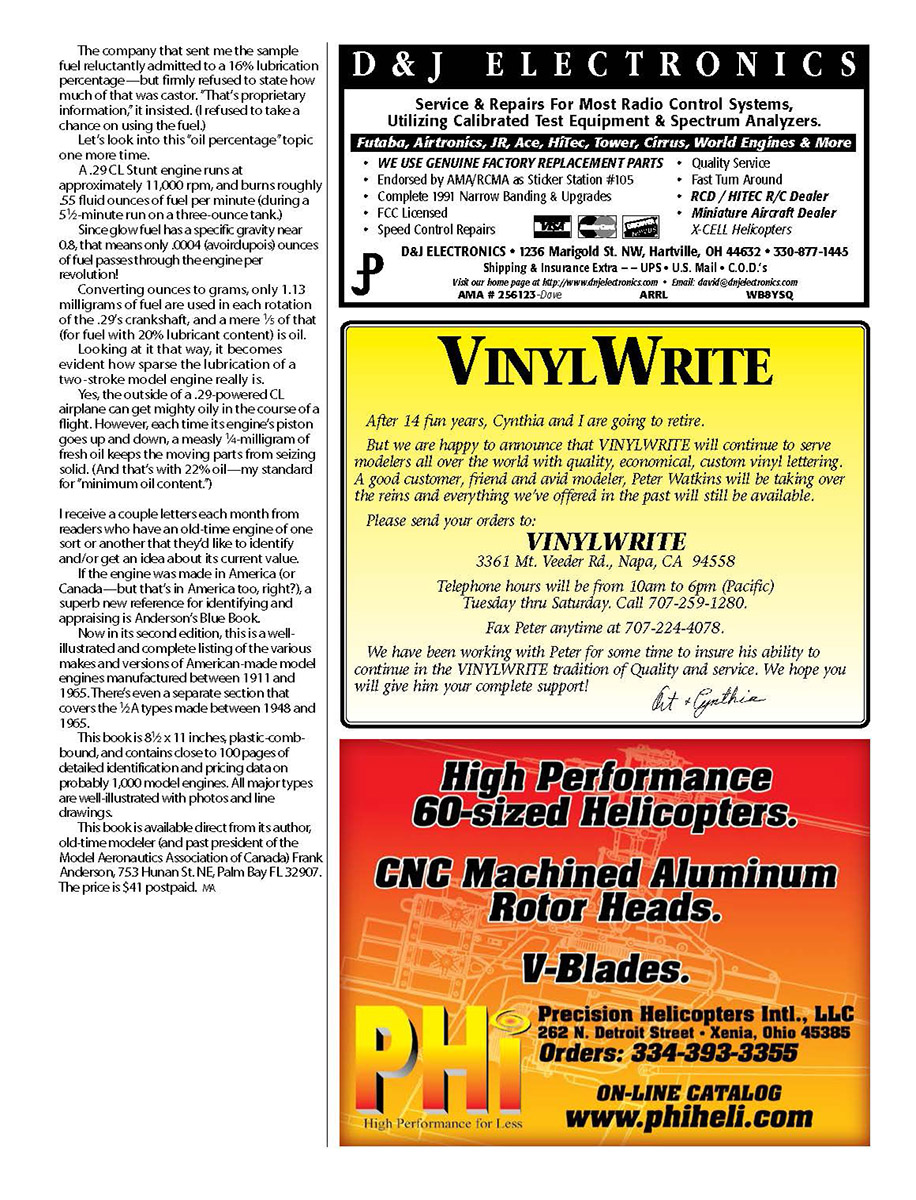
I receive a couple of letters each month from readers who have an old engine they'd like to identify or get appraised. If the engine was made in America (or Canada), a superb new reference is Anderson's Blue Book.
Now in its second edition, this is a well-illustrated and complete listing of American-made model engines manufactured between 1911 and 1965. There's even a separate section that covers 1/2A types made between 1948 and 1965. The book is 8½ x 11 inches, plastic-comb-bound, and contains close to 100 pages of detailed identification and pricing data on probably 1,000 model engines. All major types are well-illustrated with photos and line drawings.
The book is available direct from the author, modeler and past president of the Model Aeronautics Association of Canada, Frank Anderson:
Frank Anderson 753 Hunan St. NE Palm Bay, FL 32907
Price: $41 postpaid.
Transcribed from original scans by AI. Minor OCR errors may remain.

